
The bedroom is finally dark, but the house is not quiet. The old air conditioner kicks on, the cabinet rattles, the fan surges, and the whole room gets that familiar mechanical roar right when you are trying to fall asleep.
That scene is common across Tampa Bay, Sarasota, Port Charlotte, Cape Coral, and Fort Myers. In Florida, air conditioning does not get a light workload. It runs hard, runs long, and when a system is older or poorly installed, you hear every bit of it.
Homeowners usually start by asking for a noiseless air conditioner. What they really want is simple. They want cool air that does not dominate the room. They want a bedroom that feels comfortable at night without the bang, buzz, or hum of an aging system.
That goal is realistic. Modern quiet systems are far better than what many Florida homes had even a few years ago. But quiet comfort is not just about buying a premium unit. It depends on the equipment, the sizing, the installation, and the maintenance afterward. If the system is wrong for the space, or if it is neglected in our heat and humidity, the quiet does not last.
The Sound of Silence on a Hot Florida Night
A homeowner in Tampa once described it the same way many people do. The house got cool enough, but sleep was a fight. Every cooling cycle started with a jolt. The outdoor unit hummed through the wall, the indoor airflow sounded harsh, and the bedroom never felt restful even though the thermostat said the temperature was fine.
That is the part many people miss. Comfort is not only temperature. Sound matters too.
In Florida, people often put up with a noisy AC because they are focused on whether it still blows cold air. If it cools, they assume the noise is normal. Sometimes it is not. Sometimes the noise is the first clue that the system is aging, vibrating, moving too much air, or working harder than it should. If your system is loud and also struggling to cool, this guide on why your AC is not blowing cold air is a useful place to start.
What homeowners usually notice first
The complaints are usually specific:
- The startup is too abrupt: The system sounds calm, then suddenly kicks hard.
- The bedroom wall seems to vibrate: This often points to installation or mounting issues.
- The air itself sounds loud: Sometimes the equipment is not the main problem. The duct or grille noise is.
- The unit got louder over time: That often means wear, dirt buildup, loose panels, or other service issues.
A newer quiet system changes the feel of the house. You still know the AC is running, but it stops being the loudest thing in the room. That matters when the weather is heavy, the humidity hangs on into the evening, and the system has to keep working long after sunset.
A quiet home at night is not a luxury item in Florida. For many homeowners, it is part of what makes cooling feel comfortable in the first place.
The good news is that “noiseless” is not just ad copy with no substance behind it. The term gets stretched in marketing, but the best modern systems can operate at sound levels that feel dramatically different from older equipment. The key is knowing what “quiet” means before you shop.
What a 'Noiseless' Air Conditioner Really Sounds Like
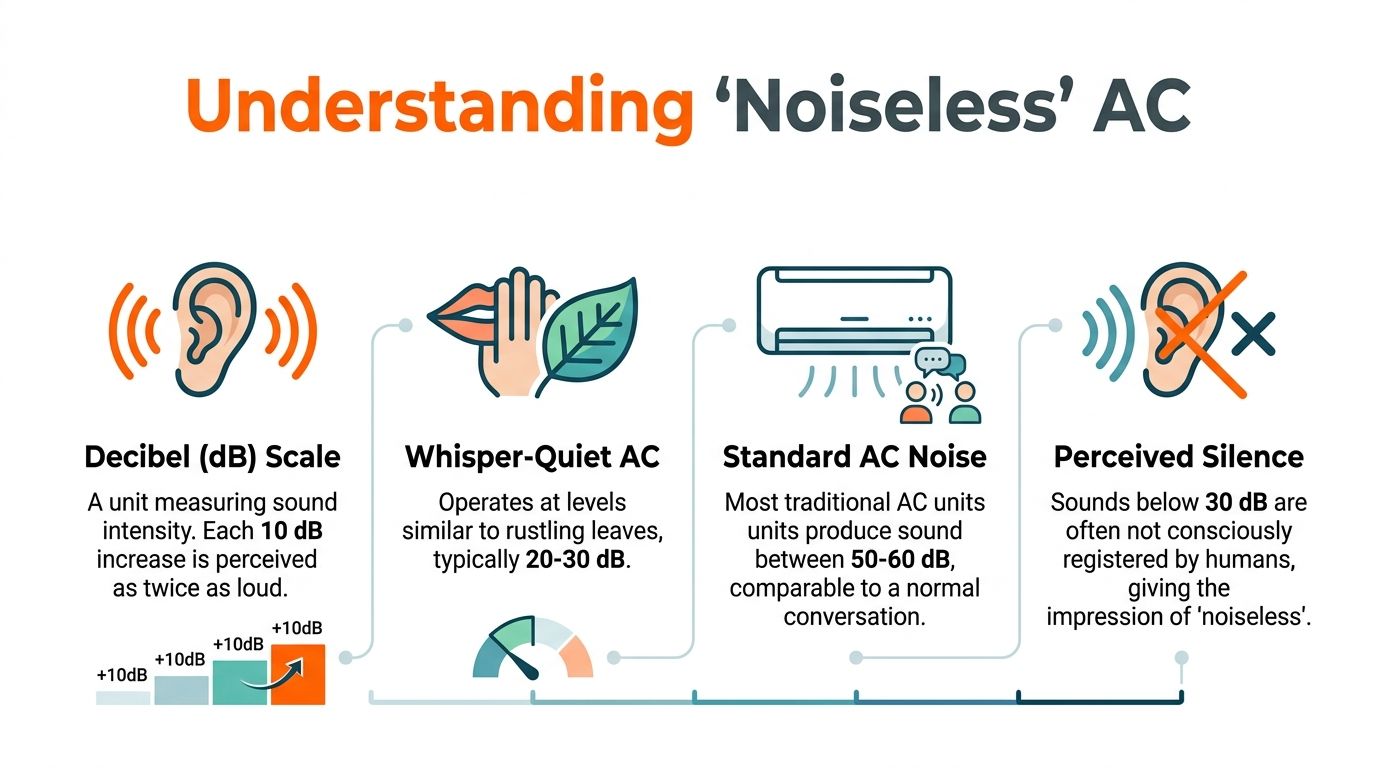
“Noiseless” is a marketing term. In real HVAC terms, it means whisper-quiet, not silent.
Modern low-noise air conditioners can reach very low decibel levels, comparable to breathing or a soft whisper, and many low-noise models operate in the 20 to 50 dB range. A quiet library is about 40 dB (reference). That is why some homeowners describe a modern noiseless air conditioner as “barely there” rather than silent.
A simple way to read decibels
When homeowners compare models, they usually focus on size, efficiency, or brand. For quiet performance, the decibel rating, or dB, deserves just as much attention.
Use these reference points:
| Sound Source | Decibel Level (Approx.) |
|---|---|
| Breathing or soft whisper | 19-20 dB |
| Light rainfall | 20-30 dB |
| Quiet library | About 40 dB |
| Most low-noise AC models | 20-50 dB |
That chart helps reset expectations. A noiseless air conditioner is not producing zero sound. It is producing sound low enough that many people stop noticing it, especially at night.
Why the label can confuse buyers
Manufacturers and retailers know that “silent” sells. The problem is that homeowners may expect impossible performance.
Here is the practical standard I use when talking to customers:
- If you can sleep without focusing on the unit, that is quiet performance.
- If the sound is steady instead of abrupt, it usually feels less intrusive.
- If the room noise comes more from airflow than machinery, the system is probably doing well acoustically.
- If the unit dominates the room, it does not matter what the brochure says. It is not quiet enough for that application.
A bedroom, nursery, office, or condo living room all need a lower noise threshold than a garage or utility area. That is why one homeowner may call a system quiet while another says it is still too loud.
The number is useful, but context matters more
A published dB rating is a starting point, not the whole story. Ask where that number applies. Indoor and outdoor sound are different. Low-fan and high-fan operation are different. A unit may be very quiet on its lowest setting but more noticeable when it has to work harder.
The most useful quiet rating is the one that reflects how the system will run at night, not the one that looks best on a spec sheet.
This is also why homeowners should be careful with broad claims. The phrase “noiseless air conditioner” can describe an excellent system, but it can also hide trade-offs or omit the conditions required to reach that quiet performance.
Quiet begins with engineering. The way a compressor starts, the way a fan ramps up, and the way the system isolates vibration all make a difference.
The Engineering Behind Whisper-Quiet AC Systems
Quiet AC systems do not happen by accident. Manufacturers reduce sound by changing how the system runs, where the loud parts sit, and how vibration is controlled inside the equipment.
The biggest shift has been compressor technology.
Inverter operation instead of hard on and off cycling
Traditional fixed-speed systems run a bit like stop-and-go traffic. They switch on, run hard, hit the target, shut off, then start again later. That start-stop pattern creates the sound many homeowners dislike most.
Inverter-driven compressors behave more like cruise control. They run continuously and adjust speed to match demand, instead of slamming into full output every cycle. That softer operating pattern cuts the sharp acoustic shock of startup. It also allows indoor units in ductless mini-split systems to produce 19 to 30 dB on low settings (reference).

What else lowers the sound
A quiet system usually combines several design choices, not just one.
- Variable-speed fan motors: These let the fan slow down when the space does not need full airflow.
- Sound insulation inside the cabinet: Better internal insulation absorbs noise before it leaves the equipment.
- Smoother compressor design: Premium systems often use designs that reduce vibration and moving-part noise.
- Tuned fan blades and airflow paths: Better blade geometry can cut turbulence and reduce the “whoosh” homeowners hear indoors.
If you want a broader look at current equipment design, recent HVAC technology advances show how modern systems are moving toward smoother, more controlled performance.
Why mini-splits are often so quiet
Ductless mini-splits have a natural advantage. The compressor sits outside, away from the occupied room. Indoors, you mainly hear the fan and the movement of air.
That physical separation matters because compressors are the noisiest part of the system. Moving that sound source outdoors gives the indoor unit a head start on quiet performance before insulation, fan tuning, or sleep modes even enter the picture.
Noise control is also about vibration
Homeowners often think sound travels only through the air. In HVAC, it also moves through the structure.
When a system is mounted poorly, refrigerant lines touch framing, or brackets transfer vibration into the wall, the house itself can become part of the speaker. Even a premium noiseless air conditioner can sound disappointing if the vibration path is ignored.
That is why installation details matter as much as equipment design:
| Quiet Design Feature | What It Helps Control |
|---|---|
| Inverter compressor | Reduces abrupt startup noise |
| Variable-speed fan | Lowers fan and airflow noise during lighter loads |
| Cabinet insulation | Absorbs internal sound |
| Physical separation in split systems | Keeps compressor noise outside |
| Vibration isolation hardware | Prevents noise from transferring into walls or framing |
Features worth asking about
If you are comparing systems for a bedroom or another noise-sensitive area, focus on questions that reveal how the system behaves in real life.
Ask the contractor:
- Does the unit use inverter compressor technology?
- What is the indoor sound rating on the lowest fan setting?
- How is vibration isolated at the mounting point?
- How will airflow be tuned so the room does not get noisy air rush?
- Will placement of the outdoor section create reflected sound near windows or walls?
Those answers tell you more than the word “quiet” on a brochure.
The quietest system on paper can become a noisy one in the field if the installer ignores mounting, line routing, airflow, or fan setup.
The hardware matters. The setup matters just as much. And for Florida homes, the right choice is not always the quietest possible unit. It is the quietest unit that can still handle the heat, humidity, and layout of the house.
Choosing the Best Quiet AC for Your Florida Home
Florida changes the conversation. In a mild climate, a homeowner might chase the lowest sound rating and stop there. In Tampa Bay and Southwest Florida, the system also has to deal with long cooling seasons, heavy humidity, and rooms that can heat up fast in the afternoon.

A quiet system that cannot keep up is not a comfort upgrade. It is just a quieter frustration.
Ductless mini-splits
For many bedrooms, additions, offices, and rooms with uneven cooling, mini-splits are the first thing I would consider.
They are strong candidates when you want:
- Low indoor noise: The loudest component stays outside.
- Targeted comfort: Good for a room that needs separate control.
- No duct dependence: Helpful in homes where duct layout creates noise or imbalance.
Mini-splits make a lot of sense when one room keeps people awake because it is hot and loud. They are less ideal when the homeowner wants one single solution for the whole house and prefers not to add visible indoor wall units.
High-efficiency central systems
A modern central system can still be a quiet choice, especially if the homeowner wants whole-home cooling with one integrated setup.
This works well when:
- The duct system is in good shape.
- Airflow is balanced correctly.
- The indoor equipment is matched and installed properly.
- The home benefits from a central return and even distribution.
The weak point is that central systems can introduce other noise sources. Supply grilles can hiss. Returns can roar. Ducts can rattle if they are loose or undersized. So the equipment may be quiet while the system as a whole is not.
For homeowners weighing full-system options, this guide on how to choose the right HVAC system for your home is a useful comparison point.
Modern window units
Window units have improved. Some newer designs are much more livable than the old boxy units people remember.
They can be practical for:
- A single room that needs fast relief
- Renters or owners who do not want a major install
- Spaces where central upgrades are not realistic right now
But they still come with limits. Window units put mechanical equipment right at the envelope of the room. Even when they are better designed, they usually do not disappear acoustically the way a good split system can.
The quiet versus cold decision
The quiet versus cold decision. Marketing can be slippery here. Some models are promoted as both the “coldest and quietest,” but homeowners in high-heat climates need to think carefully because achieving top-tier quietness and maximum cooling capacity can involve engineering compromises (reference).
That does not mean you must choose one or the other. It means you should ask better questions.
A practical way to choose
Instead of chasing the quietest advertised unit, match the system to how you use the room.
- Bedroom priority: Favor low indoor sound and smooth overnight operation.
- Large open living area: Balance sound with enough cooling strength for afternoon load.
- Sun-exposed room: Make sure the system is not too small, or it may run harder and louder than expected.
- Condos and tighter lots: Think about where the outdoor unit sits relative to windows, neighbors, and shared walls.
A good recommendation should sound specific. It should account for the room, the home layout, and the climate exposure. If someone only talks about brand labels and never asks how the room behaves at night, that is not enough.
Common AC Noises and How to Troubleshoot Them
A quiet system should sound steady and controlled. When the sound changes, homeowners usually notice fast. The type of noise often points to the type of problem.
Rattling and vibration
Rattling often starts simple. A loose access panel, unsecured fastener, or debris in the outdoor section can create a noise that sounds worse than the actual repair.
Check these first:
- Loose panels: Turn the system off and look for a panel that is not seated correctly.
- Outdoor debris: Leaves, twigs, or loose material around the condenser can cause vibration noise.
- Window unit fit: A poor fit in the frame can create shake and chatter.
If the rattle seems to come from inside a wall, ceiling, or duct run, stop there and call a technician. Structure-borne vibration tends to get worse, not better.
Buzzing or electrical hum
Buzzing can point to several issues. Some are minor. Some are not.
Possible causes include:
| Noise | Possible Cause | What to Do |
|---|---|---|
| Buzzing outdoors | Debris, loose panel, failing component | Clear visible debris, then schedule service if it continues |
| Constant indoor hum | Motor or airflow issue | Replace filter, check vents, call if noise remains |
| Sharp electrical buzz | Electrical fault | Shut system down and call for service |
If you are hearing a strong electrical sound, do not keep resetting the system. That is not a homeowner experiment.
Hissing and whooshing
Not every air movement sound is a problem. Some systems move air more audibly than others.
But a persistent hiss can mean:
- Air leaking where it should not
- A duct issue
- A refrigerant-related problem
- A loose connection affecting airflow
For home systems, a recurring hiss deserves a proper diagnosis. For RV owners dealing with a rooftop unit, this guide on troubleshooting RV air conditioner issues is a useful companion resource because many noise symptoms start with the same basic logic: isolate the sound, check the mounting, and rule out loose components first.
Clanking, grinding, or banging
These are the sounds to treat seriously.
- Grinding: Often points to motor or bearing trouble.
- Banging: Can signal a loose internal part or fan issue.
- Clanking: Usually means something mechanical is striking where it should not.
Those noises are not maintenance reminders. They are service calls.
If your system is making repeat noise and you want a broader checklist of likely causes, these common AC problems and solutions can help you narrow down what is normal, what is fixable, and what should not wait.
If the sound is new, sharper than usual, or getting worse by the day, have it checked before a minor vibration issue turns into a damaged component.
Preserving Peace and Quiet with Proper Maintenance
A quiet AC does not stay quiet by default. Florida is rough on equipment.
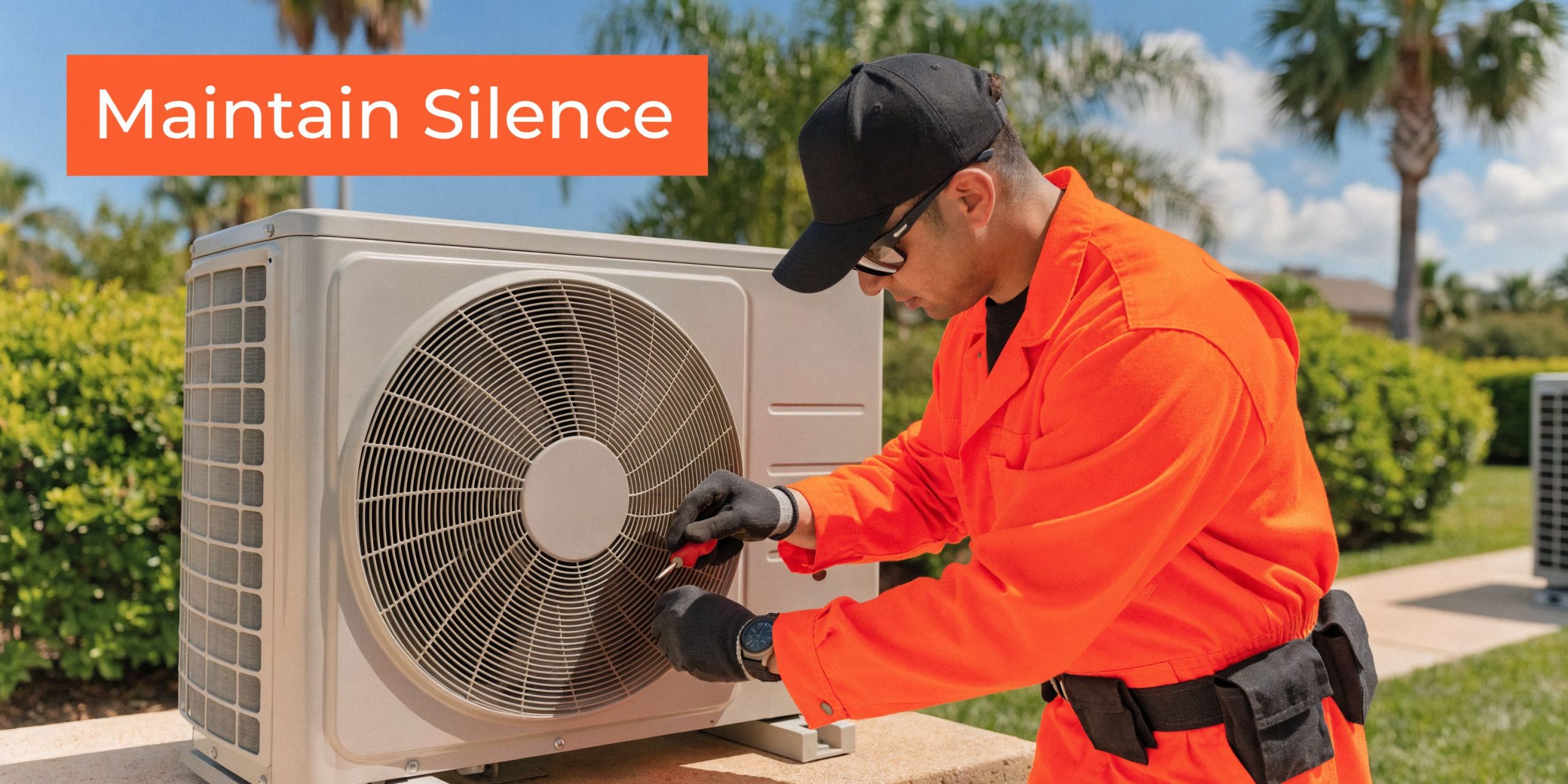
Humidity, salt air near the coast, long cooling seasons, wind-driven debris, and constant runtime all chip away at acoustic performance. Search results often overlook how high-humidity environments like Southwest Florida, around 80 to 90 percent humidity, can affect compressor noise levels and insulation, and without proper maintenance, quiet components can degrade and noise can increase over time (reference).
Why quiet performance fades
This usually happens gradually.
Fan blades collect dirt. Outdoor coils trap debris. Mounting points loosen. Insulation ages. A system that sounded soft and smooth when it was new can become harsher over time even before it completely fails.
Homeowners often adapt to the change little by little. Then one day they realize the bedroom sounds louder than it used to, or the outdoor unit has developed a stronger hum that carries into the house.
The homeowner checklist
A few basic habits help preserve quiet operation.
- Replace or clean filters regularly: Restricted airflow can make the system work harder and sound rougher indoors.
- Keep the outdoor area clear: Leaves, grass, and buildup around the condenser can interfere with airflow and increase noise.
- Watch for loose screws or panels: Small vibration points often start small and grow.
- Notice sound changes early: A new buzz is easier to fix than a long-ignored one.
These are simple tasks, but they matter because airflow and vibration are tied directly to sound.
What professional maintenance adds
A tune-up is where the hidden noise problems get caught.
A technician can inspect mounting points, fan condition, insulation, fasteners, cabinet fit, and operating sound under load. That is where the long-term value is. Not just keeping the unit running, but keeping it running the way you wanted when you bought a quiet system in the first place.
For homeowners who want a starting point between visits, these top AC maintenance tips cover the basics that help protect both performance and noise levels.
Maintenance is part of the original investment
Many homeowners stumble here. They spend more for a premium quiet unit, then treat maintenance like an optional add-on.
It is not optional if quiet was one of the main reasons for the purchase.
A noiseless air conditioner depends on clean airflow, stable mounting, healthy motors, and intact sound control materials. If those slip, the quiet slips with them.
In Florida, maintenance is not just about efficiency or breakdown prevention. It is what keeps a quiet system from turning into a noisy one after a few hard seasons.
When homeowners want ongoing service for that reason, companies such as Heatwave Air Conditioning, Plumbing, & Electric can handle seasonal inspections and maintenance for residential systems across Tampa Bay and Southwest Florida.
Achieving True Quiet The Heatwave Installation Advantage
A quiet AC system is part product and part workmanship. Homeowners sometimes buy excellent equipment and still end up disappointed because the installation undermines the design.
That happens more often than people think.
Where installation changes the sound
A few examples come up again and again:
- Poor mounting: The equipment transfers vibration into the wall, platform, or framing.
- Bad placement: The outdoor section sits where sound reflects toward a bedroom window.
- Line contact with structure: Refrigerant lines or supports create buzz inside the home.
- Airflow setup mistakes: Fan settings or duct design make the room sound louder than the equipment itself.
With ductless mini-splits, the quiet advantage is real because the compressor stays outside, and indoor sound can fall in the 19 to 35 dB range. But that benefit depends on expert installation with vibration isolation hardware and proper physical separation so structure-borne noise does not carry into the home (reference).
What good installation sounds like
Most homeowners do not describe great installation in technical terms. They describe the result.
The room cools down without a harsh rush of air. The wall does not tremble. The outdoor unit is present but not intrusive. At night, the AC fades into the background.
That outcome takes planning. Equipment has to fit the load. Placement has to fit the room. Mounting has to control vibration. The installer has to care about what the system sounds like after startup, not just whether it runs.
The practical takeaway for Florida homeowners
If you live in Tampa Bay, Sarasota, Port Charlotte, Cape Coral, or Fort Myers, ask your contractor about sound the same way you ask about cooling. Ask where the outdoor unit will go. Ask how vibration will be isolated. Ask what indoor sound to expect in a bedroom.
Those questions separate a basic equipment swap from a quiet comfort upgrade.
A noiseless air conditioner is possible in real-world Florida conditions. But the advertised quiet only becomes real when the unit is chosen well, installed carefully, and maintained consistently.
If you want help choosing or installing a quieter cooling system for your Florida home, contact Heatwave Air Conditioning, Plumbing, & Electric. A good conversation should cover more than brand names. It should address room layout, noise sensitivity, equipment type, installation details, and how to keep that system quiet over time.