
You walk inside after being out in a Florida afternoon, and the house is cool but still feels sticky. The thermostat says the temperature is fine. Your AC is running. But the air feels heavy, your floors feel a little tacky, and the whole place has that cold-clammy feel that makes you want to turn the thermostat down again.
That’s the moment a lot of homeowners start asking, how do whole house dehumidifiers work, and why does the house still feel damp if the air conditioner seems to be doing its job?
The short answer is that cooling the air and drying the air are related, but they aren’t the same thing. In Florida, that difference matters every day. A whole-house dehumidifier is built to remove the moisture your AC often leaves behind, especially during muggy weather, rainy stretches, and mild days when the system doesn’t run long enough to wring out that humidity on its own.
Why Your Florida Home Feels Damp Even When the AC Is On
A Florida home can feel uncomfortable even when the temperature looks perfect on the thermostat. That’s because your body doesn’t only react to temperature. It reacts to moisture in the air too.
When indoor humidity stays high, the air feels muggy. Bedding feels slightly damp. Towels don’t dry well. Closets get musty. You may even notice that the house feels better late at night, then clammy again by late morning.
Your AC cools first and dehumidifies second
Air conditioners do remove some moisture. But their main job is to lower temperature.
In many Florida homes, especially newer or more efficient ones, the AC may cool the house quickly and shut off before it removes enough moisture. That leaves you with air that’s technically cool, but still uncomfortable.
A common version of this problem shows up in homes dealing with air conditioner short cycling. When the system starts and stops too often, it doesn’t stay on long enough to handle humidity well.
Cool air can still feel wet. That’s why a house can feel uncomfortable even when the thermostat says everything is normal.
Why this happens so often in Florida
Florida doesn’t give your home much of a break. Outdoor air carries a lot of moisture, and that moisture keeps finding ways in. It comes through normal door openings, small leaks in the building envelope, attic pathways, garage connections, and daily living habits like cooking, showering, and doing laundry.
That’s why homeowners often describe the same pattern:
- The house feels sticky by afternoon: Even though the AC ran earlier.
- Certain rooms stay worse than others: Back bedrooms, closets, and rooms with less airflow usually show the problem first.
- Lowering the thermostat doesn’t fully solve it: The home gets colder, but not necessarily drier.
A whole-house dehumidifier addresses that exact gap. It doesn’t replace your air conditioner. It handles the moisture load your AC may not be able to manage consistently in Florida conditions.
How a Whole-House Dehumidifier Works Its Magic
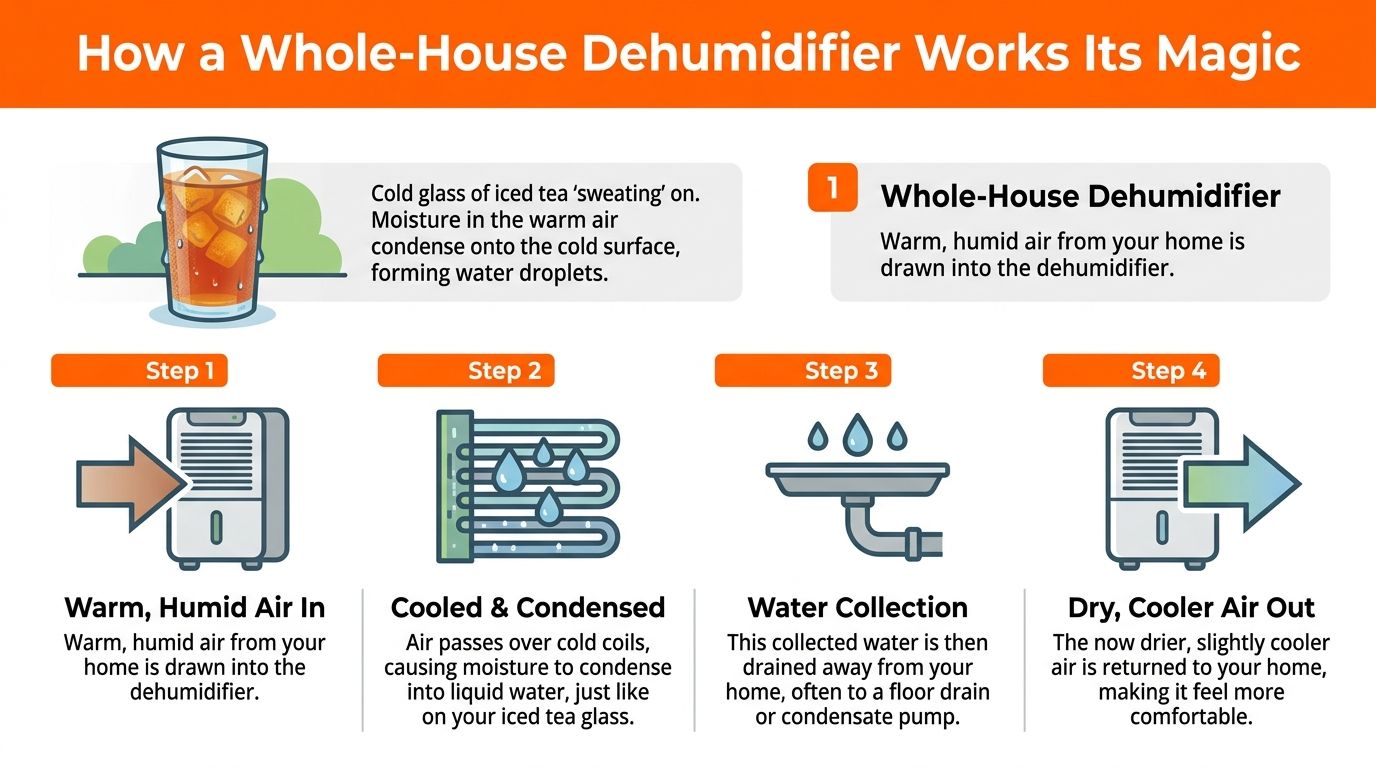
The easiest way to understand this system is to think about a glass of iced tea on a hot Florida day. Water forms on the outside of the glass because warm, moist air hits a cold surface and the moisture condenses into liquid.
A whole-house dehumidifier uses that same basic principle inside a controlled mechanical process.
Step 1 Warm humid air gets pulled in
The unit draws warm, humid air from your home, usually through the return side of the HVAC system. This is one reason whole-house systems feel so different from portable units. Instead of treating one room at a time, they work with your home’s airflow system.
Many homeowners first look into this after comparing options for humidifiers and dehumidifiers and realizing that humidity control is really about managing the whole air stream, not just one damp corner of the house.
Step 2 The air passes over cold evaporator coils
Inside the unit, the air moves across evaporator coils that contain refrigerant. Those coils cool the air to its dew point, which is the temperature where water vapor changes into liquid.
That’s the moment the moisture gets squeezed out of the air.
The process is the same basic refrigeration cycle used in air conditioning, but the focus is different. A whole-house dehumidifier is designed primarily to remove moisture, not to drop room temperature.
Step 3 Water condenses and drains away
As the moisture condenses, it forms water droplets on the coils. The unit collects that water and sends it out through a drain line.
This is the part homeowners don’t always picture. The machine isn’t “absorbing” humidity like a sponge. It’s turning airborne moisture into liquid water and removing it from the house.
According to this explanation of how whole-house dehumidifiers work, high-capacity units like the Aprilaire 1850 Dehumidifier can remove up to 11.9 gallons of water per day.
That’s a useful mental picture. Humidity doesn’t disappear. The system physically pulls it out and drains it away.
Step 4 The air gets reheated slightly and sent back
After moisture is removed, the air is slightly reheated and then circulated back into the home through the HVAC system. That surprises some people.
They expect the air to come out icy cold, but that’s not the goal. The goal is drier air, because drier air feels more comfortable on your skin and helps the house feel less clammy.
Practical rule: If your home feels cold but still muggy, you usually don’t need more cooling. You need better moisture removal.
What confuses people most
Homeowners often mix up the job of an AC and the job of a dehumidifier. Here’s the plain-language difference:
| System | Main job | What you notice |
|---|---|---|
| Air conditioner | Lowers temperature | Rooms get cooler |
| Whole-house dehumidifier | Lowers moisture | Air feels lighter, cleaner, less sticky |
Both systems can work at the same time, and a whole-house dehumidifier can also operate between AC cycles to remove moisture the air conditioner missed.
Why the “whole-house” part matters
Portable dehumidifiers can help in a single room. But Florida humidity doesn’t stay politely in one room.
It moves through hallways, under doors, through returns, into closets, and into the air your HVAC system recirculates. A whole-house setup treats the air stream for the house as a system, which is why it can create steadier comfort from room to room.
If you’ve been wondering how do whole house dehumidifiers work in real life, the answer is simple. They pull humid air in, chill it enough to condense the water, drain that water away, and send the drier air back through the home. That’s the magic, and it’s really just controlled condensation.
Choosing Your Technology Refrigerant vs Desiccant Systems
Most Florida homeowners will hear about two types of dehumidifier technology. One is refrigerant, also called compressor-based. The other is desiccant, which uses a moisture-absorbing material.
They do the same job in different ways, but they aren’t equally common in our climate.
Why refrigerant systems are the standard here
In hot, humid places like Tampa, Sarasota, Fort Myers, Cape Coral, and Port Charlotte, refrigerant systems are the usual choice. They fit the climate well because they remove moisture by cooling air to the point where water condenses.
That works especially well when outdoor conditions are warm and muggy, which describes a lot of the year in Florida.
Newer models also come with smarter controls. As noted in this overview of HVAC innovations for Florida residents, homeowners are seeing more systems with app controls, smarter sensors, and automation that makes humidity control less of a guessing game.
Where desiccant systems fit
A desiccant system works differently. Instead of condensing water on a cold coil, it uses a material that attracts and holds moisture.
That can be helpful in cooler conditions where compressor-based equipment may not be the best fit. In Florida, that usually makes desiccant equipment more of a niche option than the first recommendation for a typical residence.
According to the video source on emerging dehumidifier technology, smart features like GPP control and auto-defrost can cut energy use by 30% annually compared to RH-only units, while desiccant hybrids can handle colder air better and can cost twice as much upfront.
Refrigerant vs Desiccant Dehumidifiers at a Glance
| Feature | Refrigerant (Compressor) System | Desiccant System |
|---|---|---|
| Best fit for Florida homes | Strong fit | More specialized |
| Moisture removal method | Condensation on cold coils | Moisture absorbed by desiccant material |
| Typical use case | Hot, humid weather | Cooler air conditions |
| Smart feature availability | Common in newer models | Varies |
| Upfront cost | Standard residential range | Can cost twice as much upfront |
What most homeowners should take from this
You don’t need to become a dehumidifier engineer to make a good decision. For most homes in this region, a refrigerant whole-house dehumidifier makes the most practical sense because it matches our weather and integrates well with standard HVAC equipment.
Desiccant systems aren’t wrong. They’re just more specialized.
If a Florida home has a standard central HVAC system and a year-round humidity problem, refrigerant equipment is usually the more straightforward answer.
How Your Dehumidifier Connects to Your HVAC Ductwork
A whole-house dehumidifier works best when it’s treated like part of the home’s air system, not like an appliance sitting off to the side. The installation layout affects airflow, comfort, and how evenly the house dries out.
That’s why the duct connection matters as much as the equipment itself.
Fully ducted installation
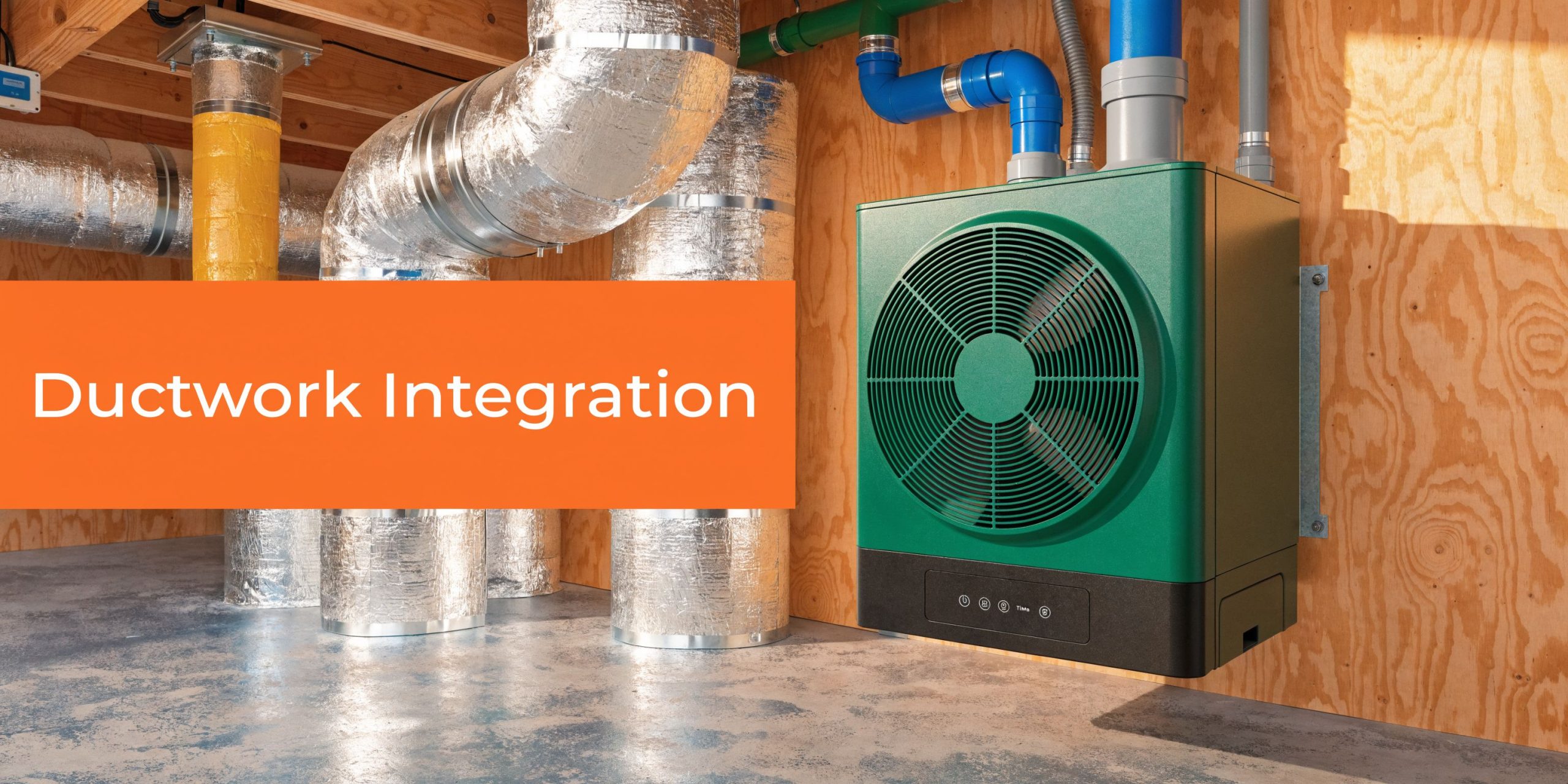
In a fully ducted setup, the dehumidifier is tied directly into the main return side of the HVAC system. Air moving back to the air handler passes through the dehumidifier first.
This approach treats the home more uniformly because the equipment sees the air stream from the full system. It’s a strong option when the goal is broad, even moisture control throughout the house.
The tradeoff is airflow design. As noted in the installation guidance from PV Heating, Cooling & Plumbing on whole-house dehumidifier setups, configuration affects effectiveness and energy efficiency, and modern units can reduce energy consumption by up to 30% annually through smart controls and features.
Dedicated return to supply plenum
A dedicated return configuration gives the dehumidifier its own air pickup. It dries that air and sends it into the supply side of the HVAC system.
This can be a smart solution when a home has a problem area, uneven humidity patterns, or a layout where the contractor wants more control over where air is being drawn from and where dry air is being delivered.
It can also help avoid repeatedly processing air that’s already been dried.
Standalone installation
A standalone setup usually goes in a basement, utility space, or another area that needs independent moisture control. This layout doesn’t rely on the main duct system in the same way.
For Florida homeowners, standalone arrangements make sense in some specific situations, but they usually aren’t the first pick for full-home comfort when central HVAC integration is possible.
Airflow is where installers earn their keep
This is the part homeowners rarely see, but it’s where a lot of performance problems begin or get prevented.
A dehumidifier has to be connected in a way that works with the blower, duct size, air velocity, and pressure conditions already in the house. If the airflow path is poorly planned, the unit may still run, but comfort won’t be as even as it should be.
If you’re already thinking about the condition of the air pathways themselves, it’s worth understanding how duct cleaning fits into overall system performance. Clean ducts don’t fix bad design, but airflow quality and duct condition still matter when you’re asking the HVAC system to circulate and distribute dry air well.
Here’s a short visual on how these installations come together in the field:
The three layouts in plain English
- Fully ducted: Best when you want broad, whole-home humidity control tied closely to the central HVAC return.
- Dedicated return: Useful when the installer wants more targeted control over where moist air is captured.
- Standalone: Good for isolated problem areas or homes where a duct-integrated approach isn’t the right fit.
The best installation isn’t the one with the most ductwork. It’s the one that moves the right air through the right path without fighting the rest of the HVAC system.
Getting the Right Size Dehumidifier for Your Florida Home
Sizing matters more than most homeowners expect. If the unit is wrong for the house, you won’t get the comfort you’re paying for.
A whole-house dehumidifier shouldn’t be chosen by square footage alone. Florida homes may have the same floor area and completely different humidity loads.

What affects sizing besides floor plan
A technician should look at how your house behaves.
That includes things like:
- Home construction: Older homes may let in more outdoor moisture. Tighter new homes may hold indoor moisture longer once it gets in.
- Ceiling height and layout: Tall ceilings and open layouts change the air volume the equipment has to handle.
- Occupancy and daily habits: Showers, laundry, cooking, and the number of people in the home all add moisture.
- Room-specific trouble spots: Back bedrooms, large closets, garage-adjacent spaces, and closed-off areas can change the recommendation.
If you want a broader view of how HVAC equipment should be matched to the house, this guide on choosing the right HVAC system for your home is helpful background.
What the numbers tell us
The source from Follow the Snowman notes that properly configured dehumidifiers add 0.2 to 0.5 in. w.c. of external static pressure, and typical units for Florida homes remove 45 to 95 pints per day across 2,500 to 5,000 sq ft. The same source also states that keeping humidity around 35% to 45% RH can lead to 10% to 15% in HVAC energy savings by preventing overcooling, according to their discussion of whole-house dehumidifier sizing and performance.
Those numbers are useful, but they’re not a shortcut. They give a range, not a one-size-fits-all answer.
What happens when sizing is wrong
Undersized equipment usually runs a lot and struggles to pull the house down to the target humidity level. You keep waiting for the air to feel better, and it never quite gets there.
Oversized equipment can create a different problem. It may satisfy the humidity call too quickly and cycle in a way that doesn’t deliver the steady control the home really needs.
A simple way to think about it
Sizing is about matching the machine to the moisture load, not just the building size.
| Sizing issue | What you notice in the house |
|---|---|
| Too small | Sticky rooms, long run times, poor humidity control |
| Too large | Uneven operation, less stable comfort |
| Properly sized | Steadier indoor feel, less need to overcool |
A good sizing visit should include questions about how the house feels, not just measurements from the outside.
Understanding the Energy Use and Cost Savings
A lot of homeowners hesitate at the same point. They understand the comfort benefit, but they still wonder if adding another machine means adding another utility bill problem.
That’s a fair question.
The practical answer is that a whole-house dehumidifier uses electricity, but dry air often lets you rely less on overcooling the home just to feel comfortable. That’s where the savings logic comes from.
Why drier air can feel better at the same thermostat setting
When the air is humid, your body has a harder time cooling itself. Sweat doesn’t evaporate as easily, so the room feels warmer than the thermostat reading suggests.
When the air is drier, the same room often feels more comfortable without chasing lower and lower thermostat settings. That can reduce how hard the AC has to work, especially during those long Florida stretches when the house feels muggy all day.
The savings side of the equation
This isn’t about pretending a dehumidifier is free to run. It isn’t.
It’s about using the right tool for the job. If your AC has been doing double duty by cooling more than necessary just to fight humidity, dedicated moisture removal can be a smarter and more efficient way to get comfortable.
A lot of the same logic shows up in broader HVAC energy saving tips from Comfort Experts. The general principle is consistent: when the system operates more efficiently and the house stays comfortable without forcing the thermostat lower than needed, energy waste drops.
Where homeowners usually notice the difference first
- The thermostat war settles down: People stop turning the temperature down just to make the air feel drier.
- The house feels comfortable sooner: Not just cooler.
- The AC may not need to work as hard for comfort: Especially during sticky weather or shoulder-season humidity.
If the house only feels good when you set the thermostat lower than you want, humidity is probably part of the problem.
Simple Maintenance to Keep Your System Running Smoothly
Whole-house dehumidifiers don’t need constant attention, but they do need basic upkeep. If you ignore that upkeep, small problems can turn into comfort issues pretty quickly.
The good news is that most of the routine stuff is simple.
The core maintenance checklist
A homeowner can usually stay ahead of problems by checking a few things on a regular basis.
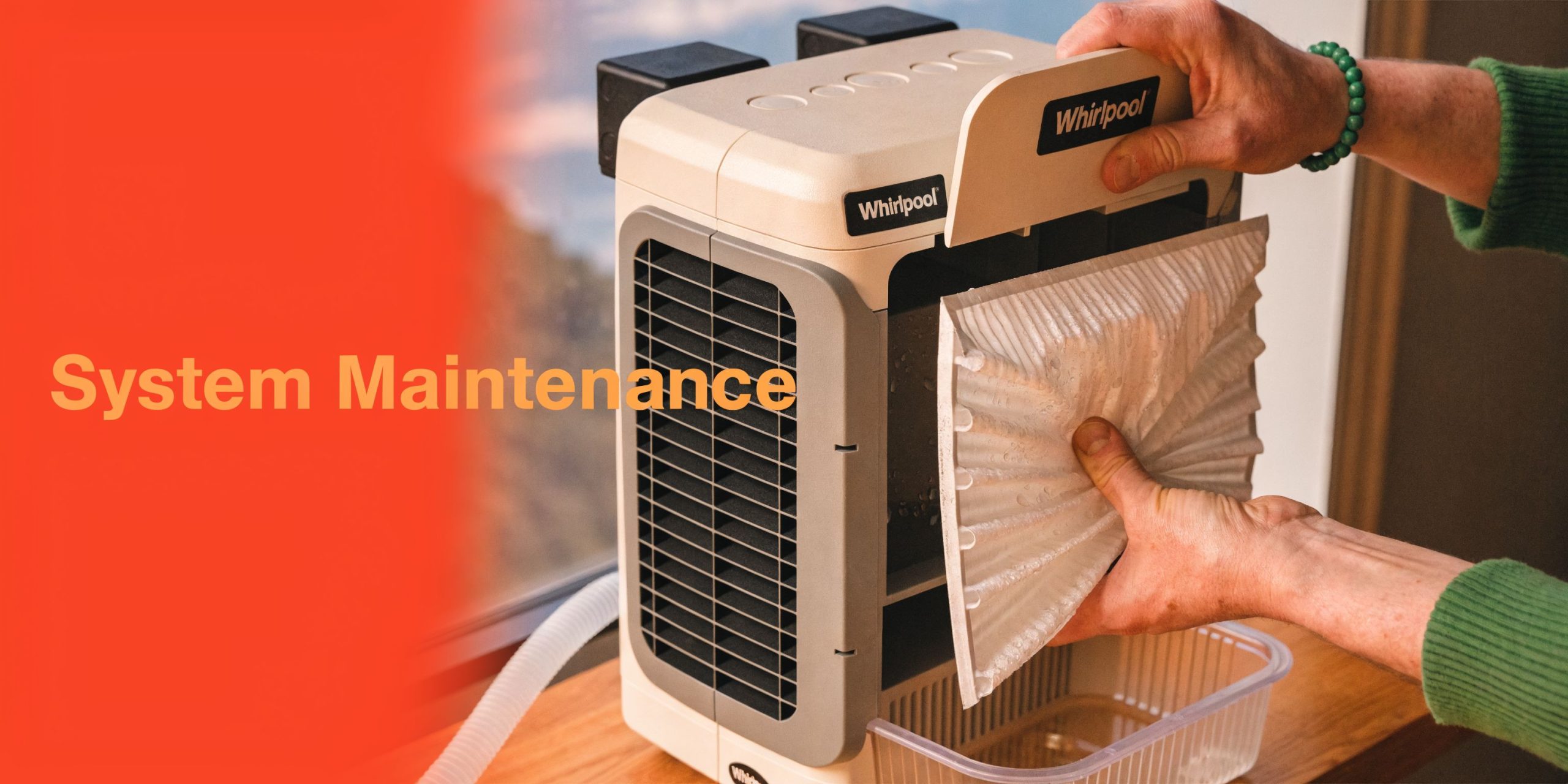
- Filter condition: If the unit has a filter, clean or replace it based on the manufacturer’s schedule. A dirty filter restricts airflow and hurts performance.
- Drain line flow: The system removes water by draining it away. If the line clogs, moisture can back up and the unit may shut down or stop working properly.
- Humidistat settings: Make sure the control settings still match how you want the house to feel. Sometimes comfort complaints are just a settings issue.
- Visible dust and debris: Keep the area around the unit clean so airflow and service access aren’t restricted.
What homeowners often mistake for a major problem
Sometimes the unit seems to be “not collecting water,” and people assume it has failed. That’s not always true.
If indoor humidity is already under control, the system may not need to pull as much water at that moment. On the other hand, if the house still feels damp and the unit isn’t draining, that’s when the drain line, filter, controls, or airflow should be checked.
Common symptoms and likely causes
| Symptom | Possible issue |
|---|---|
| House still feels sticky | Dirty filter, wrong setting, sizing issue, airflow problem |
| Little or no drainage | Clog, control issue, or conditions don’t currently require much moisture removal |
| Frost or icing concerns | Airflow restriction or a condition that needs professional diagnosis |
| Uneven comfort | Duct or installation layout issue |
Field advice: Start with the filter and drain before assuming the equipment itself has failed.
When to call a professional
DIY maintenance is good for simple inspection and upkeep. It’s not the place for guessing with refrigerant components, internal controls, or airflow redesign.
Call for service if:
- The unit runs but humidity stays high
- You see recurring drainage issues
- The coils appear to be icing
- The system cycles strangely or won’t respond to settings
- Some rooms stay damp while others feel fine
The goal of maintenance isn’t just to keep the unit running. It’s to keep it removing moisture the way it was designed to, so your house keeps feeling dry and comfortable instead of drifting back to that Florida clammy feel.
Trust Heatwave for Expert Dehumidifier Installation and Service
Florida humidity isn’t a small comfort issue. It changes how your whole house feels. It can make a properly cooled home feel damp, force your AC to work harder than it should, and leave you chasing comfort with the thermostat instead of fixing the underlying problem.
That’s why whole-house dehumidifiers matter. They remove moisture directly, work with your HVAC system, and help create the kind of indoor air that feels dry, balanced, and easier to live with.
But the equipment is only part of the result. Success relies on correct sizing, proper duct integration, smart control setup, and clean drainage. Those are the details that separate a system that turns on from one that solves the problem.
If you’ve been asking how do whole house dehumidifiers work, the practical answer is this: they work very well when they’re matched to the house and installed the right way.
If your home feels cool but still damp, visit Heatwave Air Conditioning, Plumbing, & Electric to schedule an evaluation and get expert guidance suited to your home.