
You're usually standing in a towel when this problem shows up. You turn the handle, wait for the water to warm, and nothing happens. No hot water at the kitchen sink. No hot shower. Maybe the water was fine last night and dead cold this morning.
When homeowners search hot water heater problems no hot water, they usually want one thing first. A calm answer on what to check before they assume the whole unit is done for. In Tampa Bay and Southwest Florida, that matters even more because local hard water can make a heater act “dead” long before the tank fails.
Some fixes are simple. Others need a pro right away. The trick is knowing the difference before you waste time, risk your safety, or spend money on the wrong repair.
Start with the checks that do not require opening the heater. That approach rules out simple supply problems first and keeps you out of wiring, burners, and hot pressurized plumbing until you know more.
Run the hot side at two or three fixtures, preferably in different parts of the home.
If one sink or one shower is the only place with no hot water, the heater may not be the problem. A failed shower cartridge, a stuck mixing valve, or a fixture issue can block hot water at one location while the rest of the house works normally.
If every fixture is cold, focus on the water heater and its power or fuel supply.
In Tampa Bay and Southwest Florida, I also tell homeowners to pay attention to whether hot water faded over days or disappeared all at once. Our hard water loads tanks with mineral scale fast. That buildup can shorten recovery time, overwork parts, and make a heater seem dead before the tank itself has fully failed.
Look around the heater before you touch anything.
Stop and call for help if you notice any of these:
A steady hiss is different from a gas smell, but it still deserves attention. Sediment from local hard water can trap heat at the bottom of the tank and create odd sounds. If that matches what you are hearing, this guide on fixing a hissing water heater tank explains what the sound can point to.
Go to the main electrical panel and find the breaker labeled for the water heater. Reset it by switching it fully off, then fully back on. If you want a quick refresher on the right sequence, use this guide on how to reset a breaker.
Then leave the heater alone for a bit. A tank-style electric unit does not make hot water instantly after power is restored.
If the breaker trips again, stop there. Repeated tripping usually points to a failed heating element, a thermostat problem, damaged wiring, or another electrical fault that needs testing with the power off.
Check the gas shutoff valve on the line feeding the heater. If the handle is perpendicular to the pipe, the gas is off. If it is parallel, it is on.
Do not try to relight the unit if you smell gas. Leave the area, avoid switches and open flames, and call your gas utility or a licensed pro.
If there is no gas smell and the valve is on, leave burner and pilot diagnosis for the gas troubleshooting section. The goal here is to confirm supply and rule out an immediate safety issue.
Electric tank water heaters usually fail in a small number of ways. Once power to the house is confirmed, the next suspects are the high-limit switch, a failed heating element, a thermostat issue, or heavy mineral scale inside the tank.
In Tampa Bay and Southwest Florida, scale is a bigger factor than many national guides admit. Our hard water can coat elements fast enough that the heater still has power but struggles to recover, gives you only a short run of hot water, or burns through parts sooner than it should.

Shut off power to the heater before removing an access panel. On many electric units, the upper panel hides a red high-limit reset button. It is a safety switch that cuts power if the tank temperature gets too high.
Press it firmly once, restore power, and give the heater time to recover.
If it trips again, stop resetting it. Repeated trips usually mean a thermostat is sticking, an element is failing, wiring is damaged, or the tank is overheating for another reason that needs electrical testing with the power off.
The pattern of the failure matters.
| Symptom | More likely issue |
|---|---|
| No hot water at any fixture | upper thermostat, upper element, high-limit switch |
| Hot water runs out fast | lower element, lower thermostat, scale reducing recovery |
| Breaker holds, but water heats very slowly | element buried in mineral buildup or partially failed |
| Breaker trips after reset | grounded element, wiring fault, internal short |
That third row is common in Florida homes. I see heaters that look fine from the outside, but the elements are packed with lime and mineral crust. The heater keeps trying to work, recovery gets slower, power use goes up, and the tank often fails earlier than the homeowner expected.
If you are comfortable using a multimeter and working around 240-volt equipment with the power fully off, the next step is to test continuity and confirm the thermostats are switching properly. This guide on how to test a water heater heating element walks through that process.
A failed upper element can leave you with no hot water at all. A failed lower element often gives you a little hot water, then a quick turn to lukewarm or cold. A thermostat problem can mimic either one, which is why testing matters before buying parts.
Give the tank adequate time after any successful reset. An electric tank heater does not recover right away, especially if the tank cooled off completely.
A quick visual can help if you want to see the parts being discussed:
A lot of expensive mistakes start here.
Electric heaters usually leave a trail of clues. No hot water anywhere points to the upper controls or power path. Short hot water cycles often point lower in the system. Slow reheating in our area often means hard-water buildup is already part of the problem.
Gas heaters have a different personality. When they stop making hot water, the issue is often tied to flame, ignition, or the safety parts that control gas flow.
That means you need to think in terms of pilot light, burner operation, and thermocouple condition, not breakers and elements.
If your gas water heater has no hot water, check whether the pilot is lit. Many units have a small viewing window near the bottom compartment. If there's no flame, the burner can't ignite and the tank won't heat.
Follow the manufacturer's lighting instructions exactly. If you need a refresher on the process, this guide on lighting pilot lights is a practical reference.
If the pilot lights and stays on, that's useful information. If it lights and immediately goes out, that points toward a safety or gas-control issue.
The thermocouple is a safety sensor. Its job is simple. It confirms the pilot flame is present. If it doesn't sense that flame properly, it shuts off gas flow.
That's a good safety design, but when the thermocouple ages or wears out, it can act like the flame is missing even when you're trying to relight the unit. Homeowners often describe this as, “It lights, but it won't stay lit.”
According to AAA ST Louis, traditional tank-style water heaters typically provide reliable service for 8 to 12 years, and once a heater gets close to or past 10 years, it may need professional inspection for internal wear such as thermocouple degradation in gas models.
That age matters. A newer heater with a one-time pilot issue is one thing. An older unit that won't keep a pilot lit may be telling you several parts are wearing out together.
A gas heater that won't maintain a pilot flame often has a part problem, not a relighting problem.
You can learn a lot just by looking and listening.
If you smell gas at any point, stop. Leave the area. Don't continue troubleshooting.
For gas heaters, age changes the decision. A repair can still make sense on a younger tank in otherwise solid condition. On an older tank, especially one with multiple symptoms, a single part replacement may not buy much time.
Use this quick lens:
| Condition | Usually the smarter move |
|---|---|
| pilot issue on a younger unit | inspect and repair |
| repeated ignition failures on an older unit | full professional evaluation |
| visible corrosion plus combustion issues | plan for replacement |
| gas smell of any kind | emergency professional response |
Gas heaters are not the place for guesswork. If the issue is basic and visual, you can check it. Once you're dealing with gas controls, persistent pilot failure, or signs of age-related wear, that's pro territory.
Tankless units confuse a lot of homeowners because they don't behave like storage tanks. No tank means no reserve of hot water waiting for you. The system has to detect water flow, activate, and heat on demand.
So when a tankless heater stops producing hot water, the question isn't only “is it on?” It's also “is it being triggered?”
Start with the easy things that interrupt activation.
This matters in homes where people say, “It works at one sink, but not during a shower,” or “It goes hot, cold, then hot again.”
Tankless systems don't escape mineral problems. In this region, scale can build inside heating pathways and interfere with ignition or heat transfer. When that happens, the unit may lock out, throw an error, or fail to deliver consistent hot water.
If you're trying to decide whether the problem is performance or sizing, this article on sizing your instantaneous hot water unit is a useful companion read. A unit that's undersized can feel broken when demand rises, even if the heater itself is technically operating.
For a basic refresher on system operation, this explanation of how a tankless water heater works helps connect the symptoms to the design.
Tankless heaters are compact, but the internal parts are not simple homeowner repairs. If the screen shows a code you can't identify, the burner won't ignite, or the unit repeatedly shuts itself down, stop at the observation stage and get it inspected.
That's especially true in Southwest Florida homes with hard water history. Scale doesn't always announce itself with obvious noise. Sometimes it just cuts performance until the unit won't fire correctly.
Some water heater problems are worth a careful homeowner check. Others are the kind you should stop and hand off right away.
The line is usually easy to draw. If the problem involves gas, active leaking, repeated electrical faults, visible corrosion, or a failing older heater, a professional diagnosis is the safer and cheaper path.
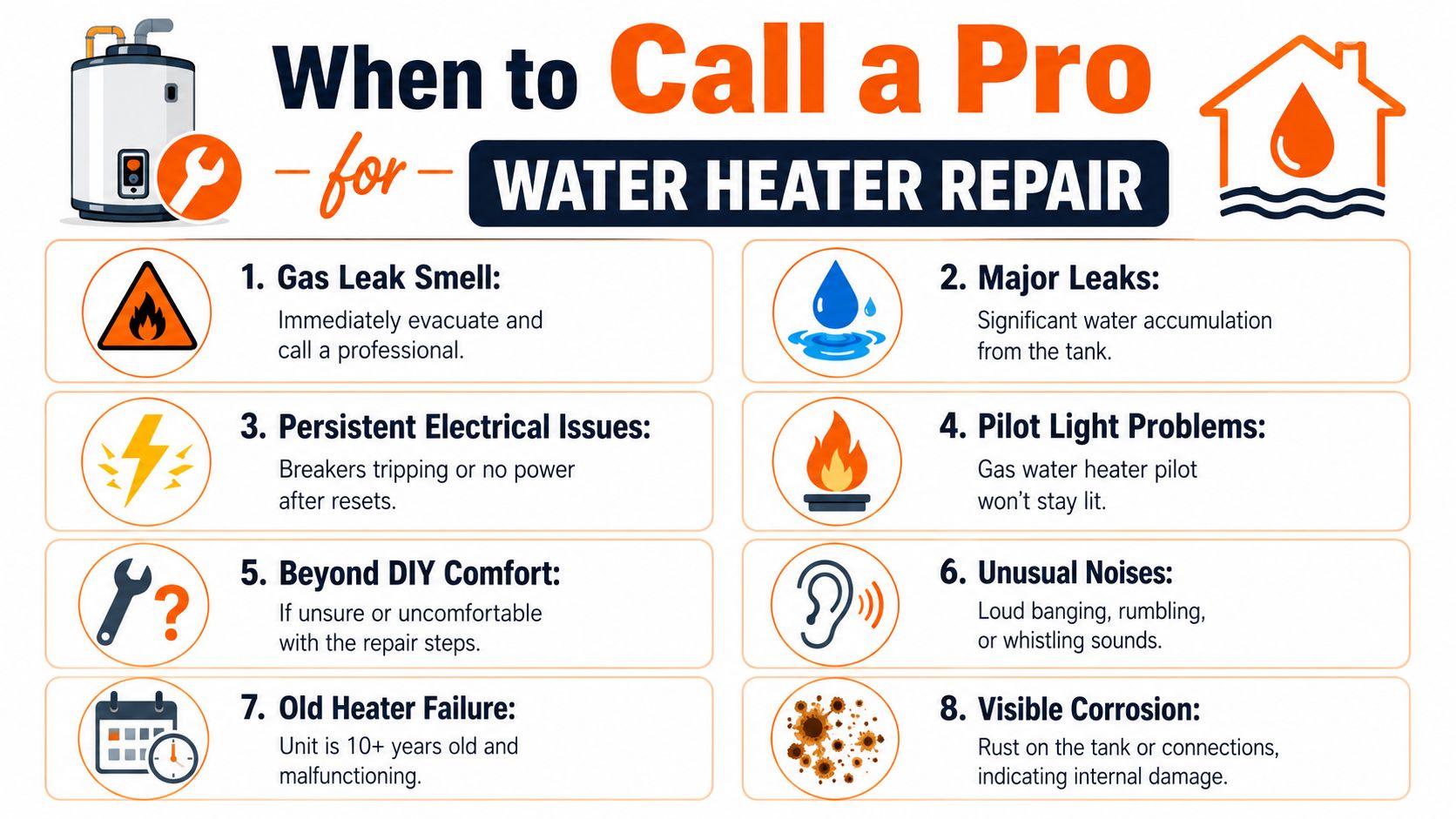
Here are the calls I'd never tell a homeowner to “just keep trying” with:
If you have to guess whether a step is safe, it's time to stop guessing.
Local conditions matter in this context. In coastal regions like Cape Coral and Fort Myers, high mineral content from groundwater sources causes rapid tank insulation, reducing heating efficiency by up to 30% and mimicking total failure, and flushing alone is often insufficient; annual anode rod inspections and proactive descaling are critical for models common in Florida, according to Snell Heating & Air.
That's the part generic advice skips. A heater can look like it has an electrical problem, a burner problem, or a capacity problem when the actual issue is severe mineral buildup inside the system.
In Tampa Bay and Southwest Florida, that changes repair decisions. A national checklist may tell you to replace one part. A local technician may find that hard water has already affected several components or the tank's overall efficiency.
Not every no-hot-water call ends with replacement. But not every repair is a good investment either.
A few signs push the decision toward replacement:
| Situation | Why replacement starts making sense |
|---|---|
| unit is older and failing in more than one way | multiple worn parts often follow close behind |
| tank body is leaking | the tank itself is not a practical repair |
| corrosion is visible | internal damage may already be advanced |
| heavy mineral history plus poor performance | restoring reliability may cost more than it's worth |
For gas-related work, homeowners in any region should rely on properly qualified people. If you want a plain-language explanation of why licensed gas work matters, this guide to boiler legal duties gives useful context, even though the terminology differs by country.
Call a pro if any of these are true:
That's not overreacting. It's good judgment.
No one wants to troubleshoot a cold shower twice. Prevention isn't glamorous, but it's the cheapest way to avoid the usual hot water heater problems no hot water calls.
In this part of Florida, maintenance isn't optional background work. Hard water makes it front-line equipment care.
The single most useful habit for tank-style water heaters is regular flushing. According to Legacy Precision HVAC, routine yearly tank flushing reduces sediment accumulation by 80-90%, significantly extending water heater lifespan. The same source notes that preventive maintenance, like annual flushing and anode rod inspections, can cost $150-300 but helps prevent premature tank replacement, which can cost $1,200-$2,000.
That's a clear trade-off. Spend modestly on maintenance, or risk paying much more when mineral buildup shortens the life of the unit.
If you want the step-by-step process, this guide on how to flush a water heater is the right place to start.
Don't overcomplicate this. A short routine catches most developing problems.
Keep a note on your phone with the last flush date, last service date, and the unit age. That simple habit makes repair decisions much easier later.
Some homeowners try one flush after years of buildup and expect the heater to act brand new. Sometimes that helps. Often it doesn't. Once scale is severe, maintenance becomes damage control rather than restoration.
What works better is consistency.
| Approach | Result |
|---|---|
| waiting until there's no hot water | emergency calls and rushed decisions |
| occasional attention with no schedule | easy to miss early warning signs |
| yearly flushing plus anode checks | better reliability and less sediment stress |
That pattern is especially important in Sarasota, Port Charlotte, Cape Coral, Fort Myers, and other Southwest Florida areas where mineral-heavy water is hard on plumbing equipment.
A water heater usually doesn't fail all at once without warning. More often, it starts giving smaller clues. Less hot water. Longer recovery. New noise. Repeated resets. Slight rusting. In a hard-water region, those clues deserve attention sooner, not later.
Preventive care gives you more control over timing. You get to schedule maintenance on your terms instead of dealing with a cold shower, a flooded garage, or a same-day replacement decision.
That's the essential value. Not just keeping the water hot, but keeping the problem from becoming urgent.
If your water heater has stopped producing hot water, or you want a local expert to inspect an aging system before it fails, Heatwave Air Conditioning, Plumbing, & Electric can help homeowners across Tampa Bay and Southwest Florida with professional plumbing, electrical, and home comfort service.