
Imagine turning on your faucet and getting hot water instantly, every single time, without ever running out. That’s the promise of a tankless water heater, and it delivers by heating water on demand, right as you need it. This clever approach eliminates the need for a big, energy-draining storage tank that keeps water hot 24/7.
The Magic of On-Demand Hot Water Explained
Traditional water heaters are like a giant thermos, constantly burning energy to keep 40-50 gallons of water hot, whether you're using it or not. It's a lot of wasted effort and money.
A tankless unit, on the other hand, is like having a personal chef for your water. It only gets to work the moment you turn on a faucet, heating just what you need, when you need it. This “on-demand” process is the secret behind both its incredible efficiency and its endless supply of hot water.
But what's actually happening inside that small box on the wall when you turn on the shower? It’s a straightforward and lightning-fast process.
On-Demand vs Traditional Hot Water Process
To really see the difference, it helps to compare the two systems side-by-side. The contrast in their operation highlights why tankless technology is so much more efficient.
| Action | Tankless Water Heater (On-Demand) | Traditional Tank Water Heater |
|---|---|---|
| You turn on the tap | A flow sensor detects water movement and activates the heater. | Hot water stored in the tank begins flowing to your faucet. |
| Water is heated | Cold water passes over a powerful heating element, heating it in seconds. | Water is already pre-heated. The tank starts reheating cold water to replace what you use. |
| Hot water arrives | A continuous, endless stream of hot water flows to the tap. | You get hot water until the tank's supply runs out, then you have to wait. |
| You turn off the tap | The unit immediately shuts off, using zero energy. | The burner or element continues to cycle on and off to keep the tank hot. |
The table makes it clear: the tankless heater only works when you need it, while the traditional tank works around the clock.
The Step-by-Step Heating Process
It all starts the instant you need hot water, whether it’s for the kitchen sink, the washing machine, or a long, relaxing shower.
- A Faucet Opens: You turn a handle, signaling the need for hot water. Simple enough.
- Flow is Detected: A highly sensitive flow sensor inside the tankless unit immediately detects water moving through the pipes. This sensor is the trigger that tells the system it’s time to get to work.
- The Heater Activates: Once the flow sensor gives the green light, it instantly ignites a powerful gas burner or energizes a heating element, depending on your model.
- Water is Heated: Cold water is directed through a maze-like component called a heat exchanger. As it snakes through these coils, the intense heat is transferred directly into the water, bringing it up to your preset temperature in just a few seconds.
- Hot Water is Delivered: That perfectly heated water exits the unit and flows through your pipes to the open faucet, providing a steady, unending supply for as long as you need it.
This simple diagram helps visualize exactly how the heater kicks into gear.
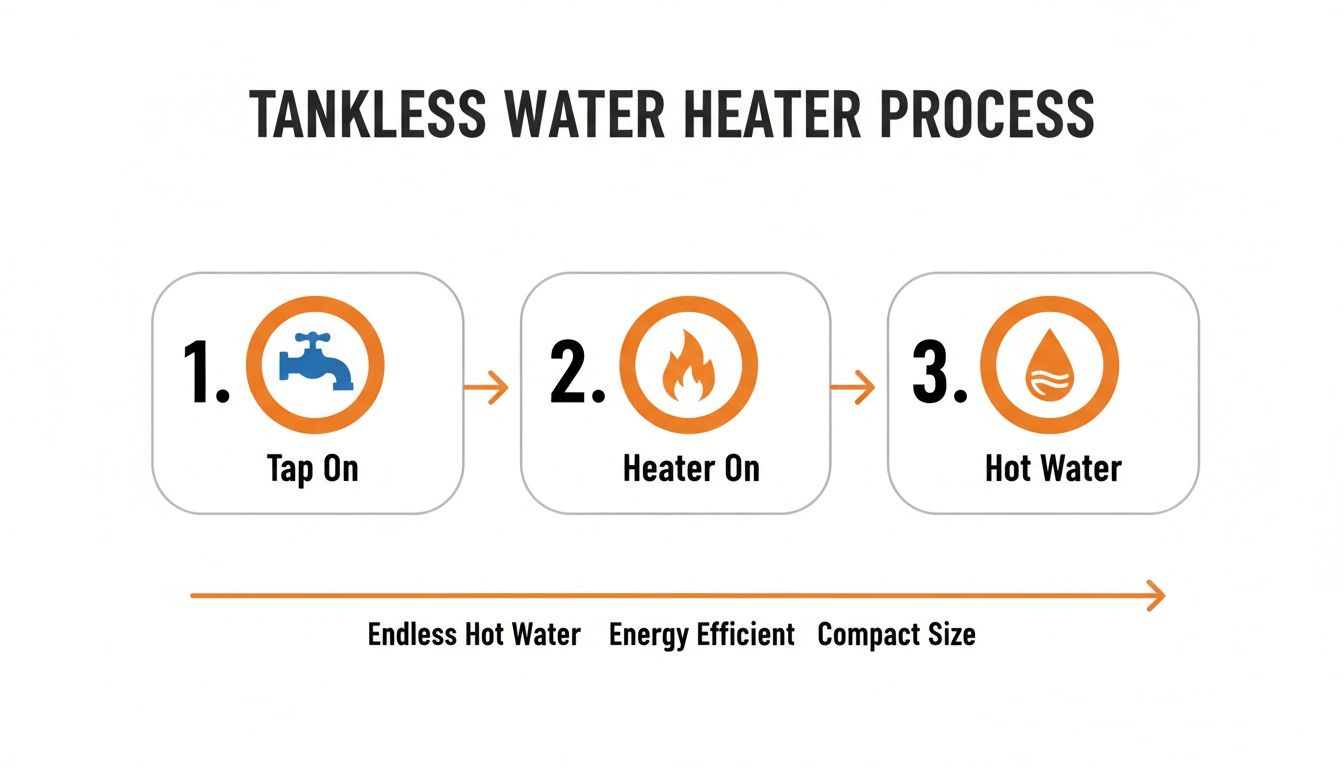
As you can see, the system only draws energy at the precise moment you ask for hot water. When the tap closes, the unit shuts down completely.
You can learn more about the different types of advanced water heaters available in the Tampa Bay area to see which technology is the best fit for your home and family.
Inside a Tankless Water Heater The Core Components

So, you know how a tankless heater gives you hot water instantly. Now, let’s pop the cover off and see what parts work together to make that happen. A tankless unit is a pretty slick piece of engineering, and every component has a critical job to do.
Think of it as a well-rehearsed team. The moment you turn on a hot water tap, these parts spring into action in perfect harmony. Once you understand what each one does, you’ll have a much better handle on how your appliance works and what it takes to keep it running smoothly.
The Trigger and The Engine
The whole on-demand process is a lightning-fast chain reaction kicked off by a couple of key players: the flow sensor and the heat exchanger. These are the components that sense your need for hot water and then do the heavy lifting.
The Flow Sensor: This is the system's "go" switch. It’s a sensitive device that detects when water starts moving through the pipes, even at a flow as low as 0.5 gallons per minute (GPM). As soon as it senses that flow, it signals the control board to fire up the heater.
The Heat Exchanger: This is the powerhouse of the unit. Imagine a car's radiator, but working in reverse—instead of getting rid of heat, its job is to transfer it into the water. Water snakes through a series of copper or stainless steel coils, which maximizes contact with the heat source for an incredibly fast and efficient temperature rise.
This instant activation and rapid heating is the secret sauce behind on-demand hot water. No storage tank needed.
Controls, Safety, and Everything In Between
Of course, it’s not just about heating the water. Other parts are essential for controlling the temperature, ensuring efficiency, and keeping your home safe. These components make sure the unit runs properly and is protected from damage.
A tankless heater's lifespan is directly tied to how well these parts are maintained. Mineral scale is the heat exchanger's worst enemy, and it will kill efficiency if it’s not removed with regular descaling.
The control panel is your command center. This digital display lets you set the water temperature with precision, usually anywhere between 100°F and 140°F. This is a huge step up from the vague, less-accurate dials on old tank heaters.
For gas models, the venting system is a non-negotiable safety feature. It’s responsible for safely routing exhaust gases like carbon monoxide outside your home. This is one of the main reasons professional installation is so important for gas units. Electric models, on the other hand, don't produce exhaust and don’t require venting, which can make them simpler to install.
If you're ever curious about the heating components in other appliances, you might find our guide on how to test a heating element useful.
Choosing Your Heater: Gas vs. Electric Models
Alright, so you're sold on the idea of getting a tankless water heater. Smart move. Now for the big question: should you go with a gas or an electric model? This isn't just about what's available; it's a decision that'll shape your installation costs, monthly bills, and how well the unit keeps up with your family's hot water needs.

Let's break down the real-world differences to help you figure out which is the right fit for your home here in the Tampa Bay area.
The Powerhouse: Gas Tankless Heaters
If you’ve got a large family or find yourself running the shower, dishwasher, and washing machine all at once, a natural gas or propane tankless heater is probably your best bet. These units are the heavyweights of the on-demand world, known for their massive heating capacity.
They work by using a powerful gas burner and a heat exchanger to get water hot, fast. This makes them perfect for homes with high, simultaneous demands. You won’t have to worry about the water turning lukewarm just because someone else started a load of laundry.
The trade-off? Installation can be more involved. Gas heaters need to be connected to your home’s gas lines and require proper venting to the outside to safely get rid of combustion fumes. If your home isn't already set up for gas, the upfront cost to run a new line can be a major budget consideration.
The Compact Contender: Electric Tankless Heaters
Electric tankless models are all about convenience and flexibility. They are typically much smaller than gas units and, because they don’t burn anything, they don't produce exhaust. This means no venting is required, opening up a ton of installation possibilities. You can tuck them away in a closet, under a sink, or in tight utility spaces where a gas model simply wouldn't be an option.
The real magic of tankless technology, whether gas or electric, is how it eliminates standby heat loss. Traditional tanks keep 40-50 gallons of water hot 24/7, wasting up to 20% of their energy just sitting there. An on-demand unit only fires up when a flow sensor detects water moving—at a rate as low as 0.5 gallons per minute (GPM). If you want to dive deeper, you can discover more about on-demand heating technology on hotwater.com.
But there's a catch with electric units: they need a lot of power. To heat water instantly, they pull a serious electrical load. Many older homes, or even newer ones without the right setup, will need an electrical panel upgrade to handle it. Before you fall in love with the idea of an electric model, it’s critical to have a licensed electrician evaluate your home's capacity. You can learn more by checking out our guide on what to expect during home electrical panel upgrades.
Ultimately, the best choice depends on what your home is already equipped for, how much hot water you use, and your local utility costs. Gas models often cost less to run month-to-month, but their installation can be more expensive. Electric units are often simpler to install, but that can be offset by the need for costly electrical work and potentially higher energy bills.
Getting the Right Size for Truly Endless Hot Water
The promise of "endless hot water" is probably what got you interested in a tankless water heater in the first place. But here’s the inside scoop from years of installing these systems: that promise only comes true if the unit is sized perfectly for your home.
Getting the size wrong is the number one reason homeowners get frustrated with a new tankless unit. A heater that’s too small will leave you with a lukewarm shower if someone starts the dishwasher. Too big, and you’ve just spent more than you needed to. The real magic happens when we match the unit to your home by looking at two key factors: flow rate and temperature rise.
Figuring Out Your Peak Flow Rate
First, let's talk about flow rate. This is measured in gallons per minute (GPM) and it’s basically the maximum amount of hot water you might need at one single moment. Think about a busy morning—is the shower running while the dishwasher is cleaning last night's plates? That’s your peak usage.
To get a handle on your home's needs, we just add up the GPM for every fixture you might use at the same time. Here are some typical numbers:
- Shower: A modern showerhead uses about 2.0 GPM.
- Dishwasher: An average dishwasher needs around 1.5 GPM to do its job.
- Washing Machine: If you use a hot water cycle, that’s another 2.0 GPM.
- Kitchen or Bathroom Faucet: These usually pull between 1.0 to 1.5 GPM.
So, let's say you're the type to run a shower (2.0 GPM) while the dishwasher is going (1.5 GPM). Your peak demand is 3.5 GPM. That means you need a tankless unit that can heat at least 3.5 gallons of water every minute without breaking a sweat.
Why Temperature Rise Matters in Tampa Bay
The second piece of this puzzle is called temperature rise. It sounds technical, but it’s simple. This is just how hard the heater has to work to get your water from its starting temperature to the nice, hot 120°F you want at the tap.
Desired Hot Water Temperature – Incoming Groundwater Temperature = Required Temperature Rise
Here in the Tampa Bay area, we have a huge advantage. Our groundwater stays at a pretty consistent 70°F all year long. So, to get to the standard 120°F setting, your heater only needs to raise the temperature by 50°F (120°F – 70°F = 50°F).
This is a critical detail. When you look at a tankless water heater's specs, you'll see its GPM output changes based on the required temperature rise. A unit that boasts 5.0 GPM might only provide 3.5 GPM when it has to work harder (a higher temperature rise). By knowing your home's GPM needs and our local 50°F temperature rise, a professional can pinpoint the exact unit that will deliver on that promise of endless hot water, every time.
Efficiency and Lifespan: The Real Payoff
Sure, the promise of endless hot water is what gets everyone’s attention. But the true power of a tankless water heater is what it does for your wallet and your peace of mind over the long run. It all comes back to a simple, brilliant idea: it only uses energy when you actually turn on the hot water tap.
This isn’t just a small tweak. It's a completely different way of thinking about water heating. Instead of constantly paying to keep 40 or 50 gallons of water hot in a tank, you only pay for the hot water you’re using in that moment. That on-demand approach leads to serious gains in efficiency and a much, much longer lifespan for the unit itself.

Maximizing Your Energy Savings
This is where you really start to see the return on your investment. Tankless units eliminate standby heat loss—that’s the energy your old tank heater wastes just sitting there, constantly reheating the water inside. Those wasted dollars really add up.
According to ENERGY STAR, for homes using 41 gallons or less of hot water each day, tankless heaters can be 24% to 34% more energy-efficient than traditional tank models. One study on natural gas units found that homeowners who switched from an old tank saw their water heating energy use drop by an average of 37%. With utility bills always seeming to climb, savings like that make a real difference every month. You can get more details on these energy efficiency findings on hotwater.com.
Built to Last for Decades, Not Years
On top of the monthly savings, the durability of a tankless unit is a huge win. A standard tank water heater will usually give you about 10-12 years before rust and sediment buildup finally win the battle. At that point, you’re shopping for a whole new unit.
A well-maintained tankless water heater, on the other hand, can easily last 20 years or more. That's potentially double the lifespan, meaning you buy one unit in the time you might have to replace a tank heater twice.
This incredible longevity really changes how you should look at the initial cost. It’s not just another appliance; it’s a long-term upgrade for your home that pays you back for decades.
Simple Maintenance for Peak Performance
So, what's the secret to getting that 20+ year lifespan? Simple, consistent maintenance. The main enemy of any water heater here in Florida is mineral scale from our hard water, which builds up inside the heat exchanger. This limescale forces the unit to work harder and less efficiently.
To keep it running like new, an annual descaling is a must. This process is pretty straightforward—it just involves flushing the system with a non-toxic solution (like basic vinegar) to dissolve those mineral deposits. It’s a small task that makes a huge difference in efficiency and longevity. We believe so strongly in routine care that we created a guide on how to extend the life of your water heater in Pinellas Park that you can check out.
Why Professional Installation Is a Must-Have
We get it. The temptation to tackle a home project yourself is strong, and a lot of homeowners in the Tampa Bay area have impressive DIY skills. But when it comes to installing a tankless water heater, this is one job that absolutely needs a licensed professional.
This isn’t about making things complicated; it's about keeping your family safe, making sure the unit performs correctly, and protecting the investment you just made in your home. A bad installation can undo all the benefits of going tankless in the first place.
With gas models, you’re dealing with natural gas or propane lines. A tiny, undetected leak is a catastrophic risk that no one should take. For electric units, the high-voltage wiring is just as serious. It requires an expert to ensure your electrical panel can safely handle the heavy power draw and to prevent a major fire hazard.
Code Compliance and Warranty Protection
Beyond the clear and present dangers, there's the issue of paperwork and protection. A professional installation ensures your new heater meets all local building codes, particularly the strict venting requirements for gas units. This isn't just red tape—it's a critical safety standard.
A professional setup isn’t just a good idea; it's almost always a requirement to keep your manufacturer's warranty intact. Most brands will void their warranty if the unit isn't installed by a certified technician, which would leave you on the hook for any future repair costs.
Hiring a pro is the only way to guarantee your new heater works at peak efficiency right from the start, delivering that endless hot water you were promised. It protects your home, your family, and the long-term value of your appliance.
To get the job done right the first time, check out our certified plumbing services in the Tampa Bay area and let an expert handle all the complexities for you.
Common Questions About Tankless Water Heaters
Even after you understand the basic concept of a tankless water heater, it's normal to have some practical questions before deciding to make the switch. We get it. Homeowners in Tampa Bay want to know how these units perform in the real world, what they really cost, and what it's like to live with one day-to-day.
Here are the straightforward answers to the questions we hear most often.
Can a Tankless Water Heater Run Out of Hot Water?
No, and for many people, this is the single best reason to go tankless. Since the unit heats water on the spot as you need it, there’s no tank to empty. It will keep producing hot water for as long as you need it.
The only time you might run into an issue is with its flow rate. If you try to run too many hot water appliances at the exact same time—say, two showers, the dishwasher, and the washing machine—you might notice the water isn't as hot as you'd like. This is why getting a professional to size your unit correctly for your family’s needs is absolutely essential for that truly "endless" hot water experience.
Are Tankless Heaters More Expensive Than Tank Heaters?
Yes, the initial investment for a tankless water heater and its installation is typically higher than a standard tank model. However, it's best to look at this as a long-term investment that pays for itself over time in two big ways:
- Lower Energy Bills: Tankless units don't waste energy keeping a huge tank of water hot 24/7. This can make them 24-34% more efficient, which adds up to real savings on your monthly utility bills.
- Longer Lifespan: A well-maintained tankless heater can last for 20+ years. That's about double the typical 10-12 year lifespan you'd expect from a traditional storage tank heater.
Is There a Delay for Hot Water?
A tankless unit heats water almost instantly, but you'll still have to wait a few moments for that hot water to travel from the heater, through your home's pipes, and out of your faucet. This is the exact same delay you already experience with a traditional tank heater.
The wait time is all about the distance the water has to travel in your plumbing, not about how fast the heater works.
Ready to experience the benefits of endless, on-demand hot water? The team at Heatwave Air Conditioning, Plumbing, & Electric has the expertise to help you select and professionally install the perfect tankless unit for your home. Get your free estimate today!