
When your AC quits in Virginia Beach, it usually doesn't pick a mild day. It happens when the air feels wet, the house starts warming up fast, and every room gets sticky within an hour. You hear the thermostat click, expect the usual hum, and get nothing.
That moment rattles people because the problem could be simple or serious. It might be a thermostat setting, a tripped breaker, a clogged filter, a backed-up drain, or an electrical part that gave up under heat load. It could also be the point where an older system finally tells you it's done.
A calm response saves time, money, and sometimes a lot of avoidable damage. Good air conditioning repair in Virginia Beach starts with three things: checking the safe basics first, knowing when a symptom points to a real fault, and understanding when repair still makes sense financially in a coastal home where humidity, salt air, and storm prep all matter.
That Unmistakable Silence When Your AC Dies
A summer AC failure has its own kind of silence. The vents stop moving air. The outdoor unit sits still. The house gets warm in layers, first upstairs, then in the rooms that already run hot in the afternoon. In Virginia Beach, that change happens fast because humidity makes even a small temperature rise feel worse.
Most homeowners I talk to are thinking the same two things right away. Is this dangerous, and how expensive is this going to be? Both are fair questions.
What usually happens next
The first mistake is panic-calling the first number you find before checking anything simple. The second mistake is the opposite. People keep resetting the thermostat, flipping breakers over and over, or trying to force a struggling system to run. Neither helps.
A better response looks like this:
- Start with safety: If you smell burning, see smoke, or notice active water around electrical components, stop using the system.
- Check the obvious controls: Thermostat setting, breaker position, and filter condition.
- Pay attention to symptoms: Noises, weak airflow, short cycling, ice, water, or warm air all point in different directions.
- Think about the system's age and history: A first-time repair is different from another repair on an older coastal system that's been fighting corrosion.
Practical rule: The less guessing you do before a technician arrives, the faster the diagnosis usually goes.
Why Virginia Beach failures feel different
This isn't the same market as an inland town with drier air. Salt air works on metal. Humidity pushes drainage systems harder. Summer peak load exposes weak electrical parts. Hurricane season also changes how I think about outdoor equipment, disconnects, pad stability, and debris exposure.
That means a repair decision here isn't only about “Can it run again today?” It's also about whether the fix makes sense for the equipment's condition in a coastal environment.
Is Your AC Crying for Help Common Warning Signs
Most systems don't fail without warning. They complain first. The trick is knowing which sounds and symptoms matter.

What you can hear and feel
A grinding or scraping sound usually means something mechanical is unhappy, much like a car engine running with parts out of alignment. A buzzing outdoor unit that won't properly start often points to an electrical issue, not just “old age.”
Weak airflow from the vents tells a different story. The system may be running, but air isn't moving the way it should. That can come from a clogged filter, blower trouble, ice on the coil, or duct-related restrictions.
If some rooms feel cool and others stay muggy, don't assume the thermostat is the only problem. Uneven cooling often means the system is struggling to move or remove heat consistently.
What you can see and smell
Water around the indoor unit matters. In local coverage, a Virginia Beach HVAC crew identified clogged drains and failed run capacitors as common summer calls, and noted that a failed capacitor can keep a unit from starting on hot days in the first place, according to WTKR's Virginia Beach report on busy HVAC repair crews.
Ice on refrigerant lines or the indoor coil is another clear warning. Homeowners sometimes think ice means the unit is “working extra hard.” Usually it means something is wrong. A frozen system often needs to be shut down and diagnosed, not pushed harder.
A musty smell can point to moisture problems. A burning smell is different. That can signal overheating wiring, a failing motor, or another electrical fault that shouldn't be ignored.
A short symptom guide
- Unit won't start on a hot day: A failed run capacitor is high on the list.
- Puddles near the air handler: Drainage needs attention, and water can damage nearby materials.
- Rapid on-off cycling: Controls, airflow, or electrical components may be under strain.
- Loud banging or metal-on-metal noise: Shut it down and have it checked before more parts get damaged.
Strange noises are early warnings. They're cheaper to investigate before they turn into a no-cooling call.
Quick DIY Checks You Can Safely Try First
Some service calls turn out to be control issues, power issues, or airflow issues that a homeowner can safely spot in a few minutes. That's worth doing before scheduling repair.
The safe checklist
Check the thermostat
Make sure it's set to cool, not heat or fan-only. Lower the setpoint enough that the system should clearly call for cooling. If the screen is blank, the problem may be power-related.
Look at the breaker
A tripped breaker can shut the system down completely. Reset it once if it's clearly tripped. If it trips again, stop there. Repeated resets can hide a deeper electrical problem.
Inspect the air filter
Pull the filter and look at it in good light. If it's packed with dust, airflow can drop enough to hurt performance and contribute to icing or poor comfort.
Check the drain area
If your indoor unit has visible standing water or signs of overflow, don't ignore it. Drain problems are common and can become a water-damage issue fast.
For a simple seasonal reminder mindset, this home systems prep visual gets at the same basic principle. Catch small home maintenance issues before they become expensive calls.

What not to do
Don't open sealed panels. Don't poke at wiring. Don't try to test capacitors yourself. Don't add refrigerant from a store-bought can and assume you solved the problem. Don't keep running a unit that's frozen, making severe noise, or giving off an electrical smell.
The line between homeowner checks and technician work
Safe DIY checks are visual and basic. Technician work starts when tools, electrical testing, component replacement, refrigerant handling, or panel access are involved.
If the system needs more than a thermostat check, filter check, breaker check, or visible drain inspection, it's usually time to stop and call for service.
That line matters because a misstep on an HVAC system can turn a repairable problem into a larger one.
Emergency Call Versus a Scheduled Visit
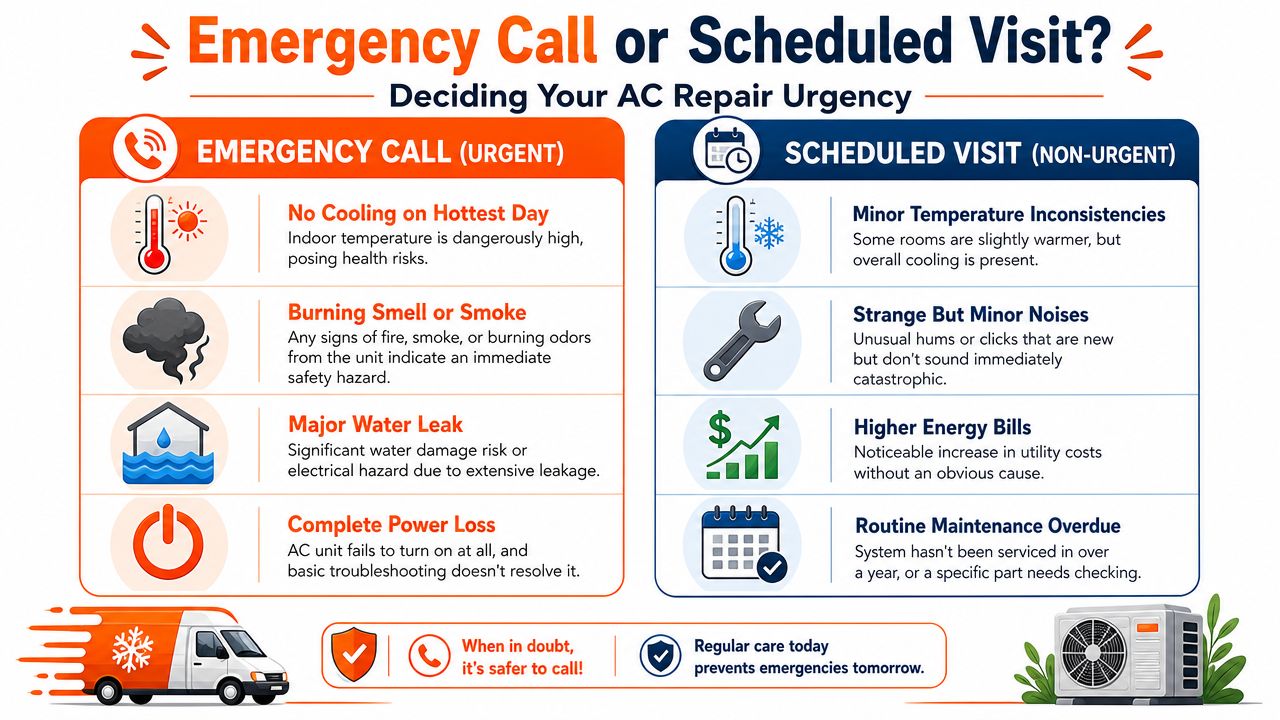
Not every AC problem is a midnight emergency. Some are urgent. Others are uncomfortable but stable enough to schedule properly.
When I'd treat it as urgent
Call right away if the system has a burning smell, visible smoke, major leaking near electrical components, or total loss of cooling during severe heat when someone in the home is medically vulnerable, very young, or elderly.
A complete no-start with no obvious thermostat or breaker issue also belongs in the urgent category, especially during a heatwave. Local reporting showed Virginia Beach HVAC companies making about 45 house calls per day during a heatwave, with advice for routine check-ups twice a year to reduce breakdown risk on 95-degree days, as noted in this Virginia Beach heatwave service report.
That surge matters because the longer you wait to call during peak heat, the harder it can be to get a fast appointment.
When a scheduled visit is usually reasonable
If the system is still cooling but doing it poorly, a normal appointment often makes sense. That includes:
- Minor noise changes: A new hum or click with no burning smell or shutdown.
- Uneven cooling: The house is uncomfortable, but the equipment is still operating.
- Water that appears limited and contained: You still need service, but it may not require after-hours dispatch if there's no electrical risk.
- Gradual decline in performance: Longer run times or weaker comfort without a full breakdown.
This seasonal heating service graphic isn't about AC specifically, but it reflects the same decision logic. Some comfort issues can wait for a normal slot. Safety hazards can't.

Quick urgency table
| Situation | Better choice |
|---|---|
| Burning odor, smoke, or electrical concern | Emergency call |
| Major water leak near powered equipment | Emergency call |
| No cooling in severe heat with vulnerable occupants | Emergency call |
| AC still cools, but unevenly or noisily | Scheduled visit |
| Maintenance overdue and performance slipping | Scheduled visit |
Understanding AC Repair Costs in Virginia Beach
The biggest money question is usually simple. Is this likely to be a repair bill or a replacement decision?

The price range that gives homeowners context
For air conditioning repair in Virginia Beach, local repair bills generally fall between $250 and $750, while a full system replacement typically runs $5,500 to $12,500, according to ConsumerAffairs' Virginia Beach HVAC cost guide.
That spread tells you why most homeowners start with repair. A repair is usually the smaller and more common decision, especially when the issue is isolated and the rest of the system is in serviceable shape.
What pushes a bill up or down
A final invoice depends less on the phrase “AC repair” and more on what failed, how accessible the equipment is, and whether the visit happens under pressure.
- Simple electrical failures: These are often faster to diagnose and resolve than deeper mechanical problems.
- Water and drainage issues: These can be straightforward if caught early, but expensive if they've already damaged surrounding materials.
- Older equipment: Parts can be harder to source, and one repaired fault may expose the next weak point.
- After-hours timing: Emergency service and peak-season dispatch usually change the logistics, even when the failed part itself is not unusual.
Here's the financial question I'd want answered before approving major work: are you fixing one contained problem, or are you putting money into a system that keeps producing new failures?
Repair versus replace in a coastal house
In Virginia Beach, generic advice often fails homeowners. Coastal air changes the equation. Salt exposure can shorten the useful life of coils, fasteners, cabinets, and electrical components. If the unit has repeated corrosion-related problems, a repair may restore operation without restoring confidence.
That's why older coastal systems need a different conversation than inland systems of the same age. This Heatwave service image is a reminder that diagnosis is part of the value. The right decision isn't just “Can it be fixed?” It's “Does this fix make financial sense for this specific system?”

How to Choose a Qualified Virginia Beach AC Technician
A lot of homeowners make this call while the house is getting warmer by the hour, the indoor humidity is climbing, and every company on the schedule sounds the same. In Virginia Beach, the right choice is not just about who can get there first. It is about who understands what salt air, heavy moisture, and storm exposure do to an AC system over time.

Start with the basics, but do not stop there. A company should be able to explain its license status, insurance coverage, diagnostic fee, and whether you will receive a written estimate before work begins. If you want background on how licensing works in Virginia, this expert guide for Virginia contractors gives useful context.
After that, ask questions that reveal judgment.
A qualified Virginia Beach AC technician should be comfortable discussing coil condition, cabinet corrosion, electrical terminals, drain performance, and the condition of outdoor components that sit in humid coastal air for years. If a technician jumps straight to “you need a new unit” without explaining what failed and what else they inspected, that is a warning sign. Good diagnosis is specific.
Here is what I would ask before booking:
- How often do you work on systems near the ocean or in salt-air areas? You want someone who has seen corrosion patterns common to Virginia Beach equipment.
- What is included in your diagnostic visit? A solid answer should mention electrical testing, airflow or temperature checks, component inspection, and visible condition of the indoor and outdoor equipment.
- Will you explain repair versus replacement in writing? Homeowners need clear options, not pressure.
- Do you note hurricane-related concerns? Loose disconnects, damaged pads, exposed wiring, and weakened cabinet panels matter in this market.
Phone questions can save you a wasted service call.
| Question | What a good answer sounds like |
|---|---|
| Have you worked on systems near the coast? | They mention corrosion, humidity, drainage, and outdoor electrical wear |
| Will I get a written estimate? | Yes, with parts, labor, and any recommended follow-up clearly listed |
| Do you repair first when it makes sense? | They explain both options and the likely life left in the system |
| What should I have ready for the visit? | Model information, symptoms, timing of the failure, and any recent storm or power issues |
Local reviews help, especially when you read the comments instead of stopping at the rating. This review snapshot from local customer feedback is a reminder to look for patterns such as clear communication, accurate arrival windows, and explanations that make sense to a homeowner.

One more point matters in coastal homes. A technician who understands Virginia Beach should be able to tell you whether a repair restores reliability or only gets the unit running again for now. Those are not the same thing.
Heatwave Air Conditioning, Plumbing, & Electric is one company operating in this market. What matters most is choosing a technician who shows a clear process, explains the trade-offs, and understands how coastal conditions affect repair decisions and long-term cost.
Virginia Beach Climate and Your ACs Health
Virginia Beach equipment lives a tougher life than many homeowners realize. The outdoor unit doesn't just sit in heat. It sits in humid air, salty coastal exposure, and storm-season conditions that steadily work on metal and electrical parts.
Salt air changes repair decisions
Salt doesn't need dramatic ocean spray to cause problems. Fine coastal exposure can still attack coil surfaces, cabinet edges, screws, terminals, and contact points. That means a system can look acceptable from a distance and still have age-related weakness where it counts.
This is why the same repair can mean different things in different locations. On an inland unit, replacing one failed electrical part may be routine. On a coastal unit with visible corrosion in multiple areas, that same repair may be only a short-term bridge.
Humidity punishes weak drainage
Virginia Beach air also asks more from the condensate side of the system. If drainage is poorly pitched, partially clogged, or slow, moisture problems show up faster. Then you get water around the indoor unit, musty smells, stained materials, or nuisance shutdowns.
That's one reason proper sizing and airflow matter so much. A house that doesn't match the equipment well can feel clammy even when the thermostat reads a reasonable number. If you want a simple homeowner-friendly primer on sizing logic, this explanation of why home BTU affects comfort is useful background.
For a broader home-comfort visual reference, this HVAC interview image reflects the bigger point. Comfort is about system condition, home load, airflow, and moisture control together.

Hurricane prep for the outdoor unit
Storm season adds another layer. Homeowners should think about:
- Debris exposure: Loose yard items and branches can damage the condenser.
- Pad and mounting condition: An unstable base makes a bad situation worse in heavy weather.
- Disconnect access: You want safe shutoff access if conditions require it.
- Post-storm inspection: Even if the system runs, look for bent fins, shifted lines, impact marks, and debris inside the cabinet area.
In coastal Virginia Beach, AC maintenance isn't just about efficiency. It's about preserving reliability in an environment that accelerates wear.
Frequently Asked AC Repair Questions
How often should I have my AC checked in Virginia Beach
Twice a year is practical guidance for this area. That schedule makes sense in a climate with heavy seasonal demand, high humidity, and hard summer runtime. Spring and fall are common checkpoints.
Is it safe to keep running an AC that's making a weird noise
Usually not if the sound is new, loud, metallic, or paired with poor cooling. A minor hum is one thing. Grinding, banging, scraping, or repeated hard-start behavior is another. Shut it down if the noise sounds mechanical or electrical rather than normal operation.
What if my AC won't start on a very hot day
Start with safe basics only. Check the thermostat, breaker, and filter. If those look normal and the outdoor unit still won't get going, an electrical component may have failed. In Virginia Beach summer conditions, weak starting parts often show themselves when heat load is highest.
Is water around the indoor unit always an emergency
Not always, but it's never something to ignore. A small drain issue can turn into damaged drywall, flooring, or insulation. If water is close to electrical components or actively spreading, treat it as urgent.
Should I repair or replace an older coastal system
That depends on condition, not just age. I'd lean toward replacement when corrosion is widespread, failures are stacking up, and a new repair doesn't restore confidence. I'd lean toward repair when the issue is isolated and the rest of the system is structurally sound.
What's a fair way to think about repair cost
Think in categories. If the repair is contained and the system has otherwise been dependable, repair is usually the first move. If the estimate starts feeling like another payment into a unit that's already had repeated problems, stop and ask for a clear repair-versus-replace breakdown.
Can salt air really shorten AC life
Yes. It affects metal and electrical parts over time, especially outdoors. That doesn't mean every coastal unit is doomed. It means inspections should pay close attention to corrosion, drainage, and component condition.
What should I tell the technician when I call
Give the clearest symptom timeline you can:
- What changed first: No cooling, noise, water, smell, or breaker trip
- When it started: Sudden failure or gradual decline
- What the thermostat is doing: Blank, calling for cooling, or acting normally
- What you already checked: Filter, breaker, and visible water
That information helps the technician arrive with a better idea of what they're walking into.
If you need a professional opinion on an AC problem, Heatwave Air Conditioning, Plumbing, & Electric is one company homeowners can contact for HVAC service. The smart move is to get a clear diagnosis, ask direct questions about repair versus replacement, and choose the option that fits your system's actual condition, especially in a coastal environment like Virginia Beach.