
Ever wondered how flipping a switch instantly floods a room with light? It's easy to take for granted, but behind that simple action is a carefully designed system that safely brings massive amounts of power into your home.
Think of your home's electrical system like its circulatory system. The main service panel is the heart, pumping electricity through circuits—the arteries—to power everything from your refrigerator to your phone charger. Understanding this flow is the first step toward a safer, more capable home.
Your Home's Electrical System Demystified
At its core, your electrical system's job is to take high-voltage power from the utility company and step it down into smaller, usable amounts for every outlet, switch, and appliance in your house. It ensures you can run what you need without overloading the system and creating a hazard.
Imagine the main power line coming into your home is like a giant fire hose. You can’t just connect your garden sprinkler to it—the force would be overwhelming. Instead, that powerful flow first enters your main electrical panel, which acts as a distribution hub. From there, it's divided into smaller, manageable streams (circuits) that feed all your individual outlets and fixtures.
The Path of Power
This journey of electricity follows a clear, logical path. This diagram shows the straightforward flow from the power grid right to your devices.
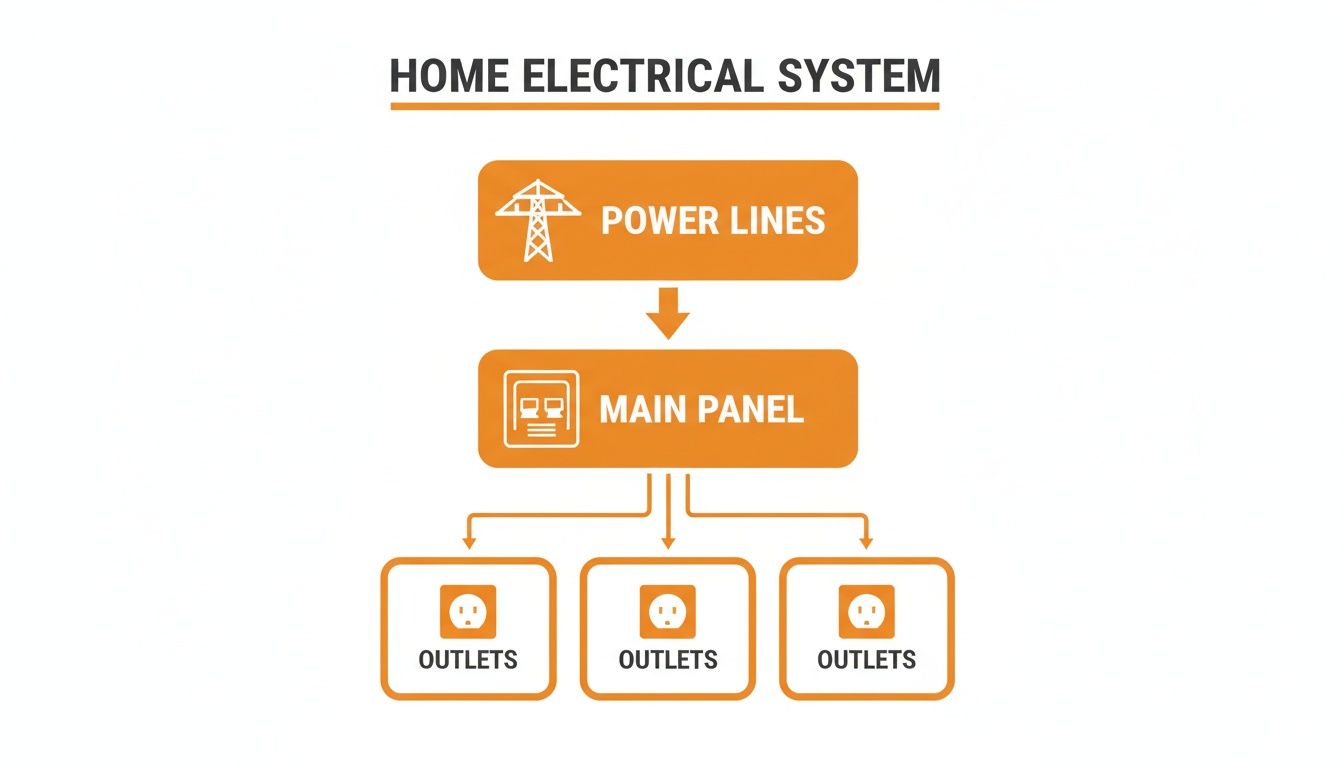
The main panel is the critical command center, standing between the utility's supply and your home's wiring. To really get a handle on how it all works, you need to know about three key concepts: volts, amps, and watts.
- Volts (V): This is the measurement of electrical pressure. Think of it as the force pushing electricity through the wires, much like water pressure in a pipe. Most standard outlets in your home provide 120V, while heavy-duty appliances like ovens or clothes dryers require a more powerful 240V circuit.
- Amps (A): This measures the electrical current, or the volume of electricity flowing. It’s like how much water is actually moving through the pipe. A circuit's amp rating tells you how much current it can safely carry.
- Watts (W): This is the total power an appliance actually uses. You find it by multiplying volts and amps (Volts x Amps = Watts). This simple formula explains why a 1,500-watt hair dryer draws so much more power than a 60-watt light bulb.
The most important thing to remember is that these three elements must always be in balance. A circuit wired and protected for 15 amps cannot safely handle a 20-amp load from your appliances. This kind of mismatch is a primary cause of overheating and electrical fires, which is why a basic understanding of your system is so crucial for your safety.
Grasping these ideas is the foundation for making sense of everything else, from circuit breakers to different types of wiring. A well-designed electrical system isn't just about convenience—it's a fundamental part of keeping your home and family secure.
Exploring Your Electrical Panel's Core Components
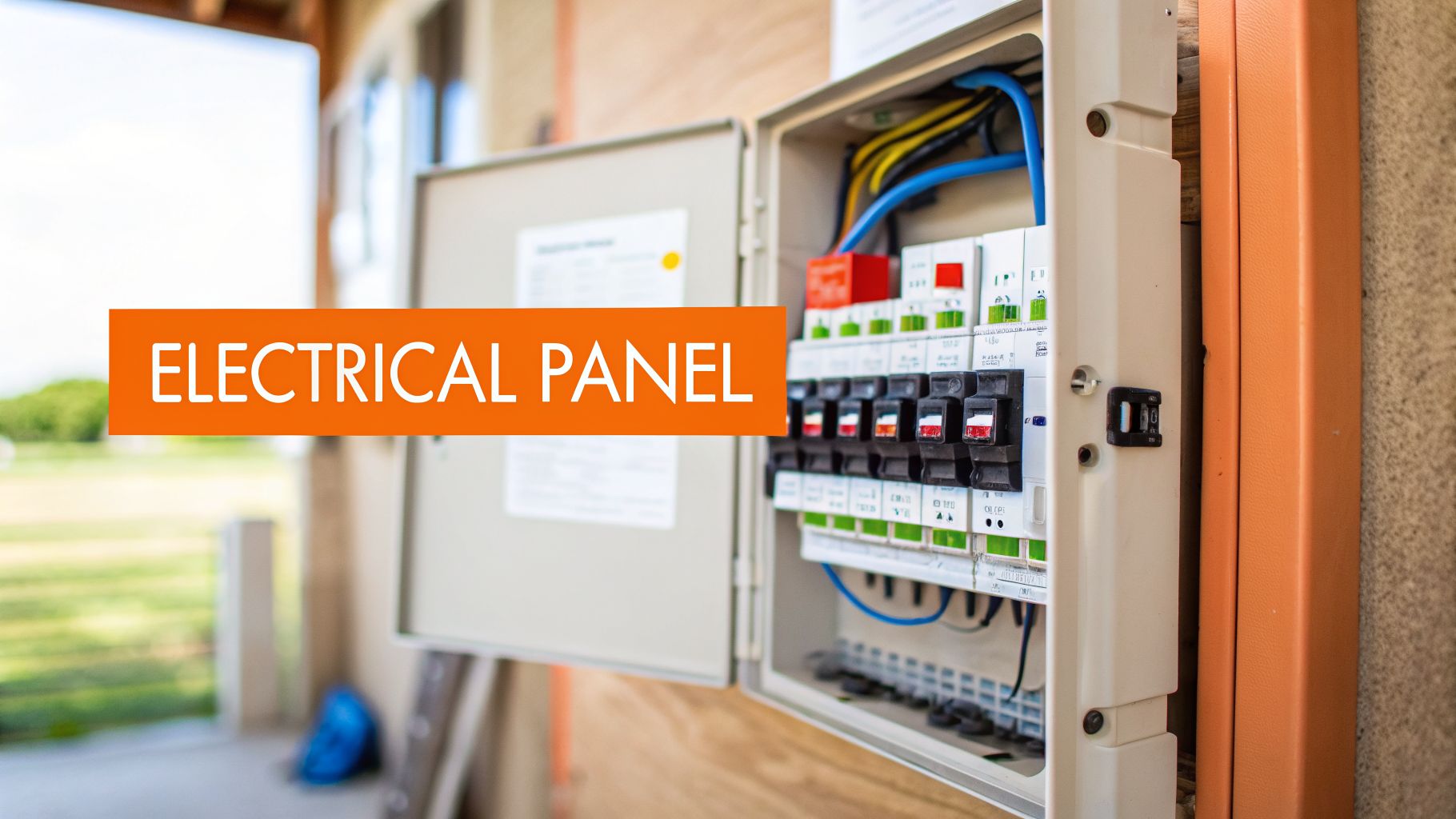
Think of your electrical panel as the command center for your home's electricity. Tucked away in a garage, basement, or utility closet, this metal box is where all the power from the grid gets organized and sent safely to every outlet, switch, and appliance. Opening that little door reveals the crucial components that keep your home powered up and protected.
Right at the top or sometimes on the side, you’ll spot the main circuit breaker. This is the big one—the master switch for your entire house. In an emergency or before any major electrical work, a single flip of this switch cuts off all power coming from the utility company. It’s your ultimate safety control.
Lined up below are rows of smaller switches. These are the individual circuit breakers, and each one acts as a dedicated bodyguard for a specific area or "circuit" in your home. You'll have separate breakers for the kitchen outlets, the bedroom lights, the air conditioner, and so on.
The Guardians of Your Home's Wiring
When a circuit breaker "trips," it might feel like an annoyance, but it's actually doing its job perfectly. That automatic shut-off is a lifesaver, stopping an excessive amount of current from flowing through the wires. Without it, those wires could overheat and create a serious fire hazard—this is a foundational concept in the basics of home electrical wiring.
Most homes today have a few different types of breakers, each designed to guard against a specific kind of electrical danger. Getting to know them is a big step toward homeowner safety.
- Standard Breakers: These are the old workhorses. Their one job is to protect against overloads (like plugging too many things into one circuit) and short circuits (when a hot wire accidentally touches a neutral one).
- Ground Fault Circuit Interrupters (GFCI): These are the ones that prevent shocks. A GFCI constantly monitors the electricity flowing in and out. If it detects even a tiny imbalance—like electricity taking a detour through a person to the ground—it shuts off power instantly. You'll find them protecting any area with water, like kitchens, bathrooms, laundry rooms, and outdoor outlets.
- Arc-Fault Circuit Interrupters (AFCI): Think of these as fire-prevention specialists. AFCIs are designed to detect dangerous electrical arcs, which are tiny, high-heat sparks that happen in damaged, frayed, or loose wiring. They cut the power before that spark can ignite nearby wood or insulation.
Modern electrical codes are continuously updated and now widely require both AFCI and GFCI protection in new homes and major renovations. This combination marks a huge leap in home safety, moving beyond just overload protection to actively preventing electrocution and fires.
The Importance of Modern Breaker Technology
The technology inside these modern breakers is a direct answer to common household electrical dangers. The data speaks for itself. Electrical malfunctions are behind roughly 49,000 home fires in the U.S. each year, causing about $1.9 billion in property damage.
Most importantly, arc-fault circuit interrupters (AFCIs), which have been required in new bedroom circuits since 2002, have been shown to reduce the risk of these specific types of fires by over 50%. For any homeowner wanting to make a real impact on their home’s safety, upgrading old breakers is one of the most effective steps you can take.
While swapping out a standard breaker for a GFCI or AFCI might seem simple, it means working inside a live electrical panel. Because of the serious risks involved, this is a job best left to a licensed professional. If you want help bringing your system up to modern safety standards, you can learn more about our comprehensive electrical panel services. Making sure your panel is up-to-date is one of the smartest investments you can make for your home and family.
Understanding Circuits and Common Wire Types
Once power leaves your electrical panel, it doesn't just wander aimlessly. It travels along dedicated pathways called circuits. A great way to think of these is like individual highways, each designed to carry a certain amount of electrical traffic to a specific part of your home.
Some of these circuits are like quiet country roads for things like general lighting, while others are multi-lane expressways built for high-demand appliances. For example, your living room lamps probably share a general-purpose circuit. But a major appliance like your electric range or central air conditioner needs its own exclusive, dedicated circuit. This is critical to prevent a single power-hungry appliance from overloading a shared path and constantly tripping the breaker.
Getting a handle on how these circuits work is a core part of understanding the basics of home electrical wiring.
Circuit Types and Their Jobs
Not all circuits are built the same. They are rated by amperage—basically, the amount of current they can safely carry. In just about any modern home, you’ll find a few common types, each with a very specific job.
- 15-Amp Circuits: These are the workhorses, powering most of your general lighting and the standard outlets in bedrooms and living areas. They handle low-power devices like lamps, TVs, and chargers.
- 20-Amp Circuits: You'll find these sturdier circuits in kitchens, laundry rooms, and bathrooms. They're designed to handle more demanding items like hair dryers, blenders, and countertop microwaves without a fuss.
- 30- to 50-Amp Circuits: These are the heavy hitters. They deliver 240 volts of power for your most demanding appliances, such as electric dryers, water heaters, stoves, and HVAC systems.
A tripped breaker is your electrical system’s way of waving a red flag. Plugging a 1,500-watt space heater into a 15-amp circuit that's already running a few other things is a classic recipe for an overload. The breaker trip isn't a failure—it's the system doing its job perfectly to keep you safe.
Making Sense of Wire Gauges and Colors
The wires hidden in your walls are the physical roads these circuits travel on. Their most important feature is their thickness, known as gauge. A wire's gauge dictates how much electricity it can carry without dangerously overheating. The rule here is a bit counterintuitive: the lower the gauge number, the thicker the wire and the more amps it can handle.
Matching the right wire gauge to the correct circuit breaker isn't just a good idea—it's a non-negotiable safety rule. Using a wire that's too thin for the circuit's amperage is a major fire hazard.
- 14-Gauge Wire: The go-to for 15-amp circuits (think general lighting).
- 12-Gauge Wire: The standard for 20-amp circuits (kitchens, bathrooms, garages).
- 10-Gauge Wire: Typically paired with 30-amp circuits (electric dryers, water heaters).
- 6- or 8-Gauge Wire: Reserved for heavy-duty 40- or 50-amp circuits (electric ranges, large AC units).
The global demand for proper wiring is massive, with the wires and cables market projected to hit USD 393.6 billion by 2034. For homeowners, this just reinforces how vital it is to use the right materials. As you can see from the wires and cables market statistics on imarcgroup.com, this isn't a place to cut corners. Investing in 12-gauge wire for a 20-amp circuit isn't just about passing an inspection; it's about preventing the types of electrical failures that cause thousands of home fires every year.
Besides their thickness, wires are also color-coded to identify their job. This is absolutely critical for anyone working on the system. While you might find some variations in older homes, the standard today is:
- Black/Red: These are "hot" wires that carry the live electrical current.
- White: This is the "neutral" wire, which completes the circuit.
- Green/Bare Copper: This is the ground wire, a crucial safety feature.
Properly installing and connecting these wires is a job that demands precision and expertise. If you're thinking about upgrading or adding circuits in your home, it's always best to bring in a pro. You can learn more about what that involves with our overview of professional wiring and rewiring services to ensure the work is done safely and up to code.
Essential Electrical Safety Practices for Every Homeowner
When it comes to your home’s electrical system, there’s zero room for guesswork or taking shortcuts. Think of electricity with a healthy dose of respect. Whether you’re just resetting a tripped breaker or planning a small project, a few core safety habits are absolutely non-negotiable.
The first, last, and most important rule is to always turn off the power before you even think about touching a wire. Find the right circuit breaker in your panel and flip it firmly to the "OFF" position. This one simple action is your most critical line of defense.
But don't ever assume the power is off just because you flipped a switch. You have to be sure.
Verify Before You Touch
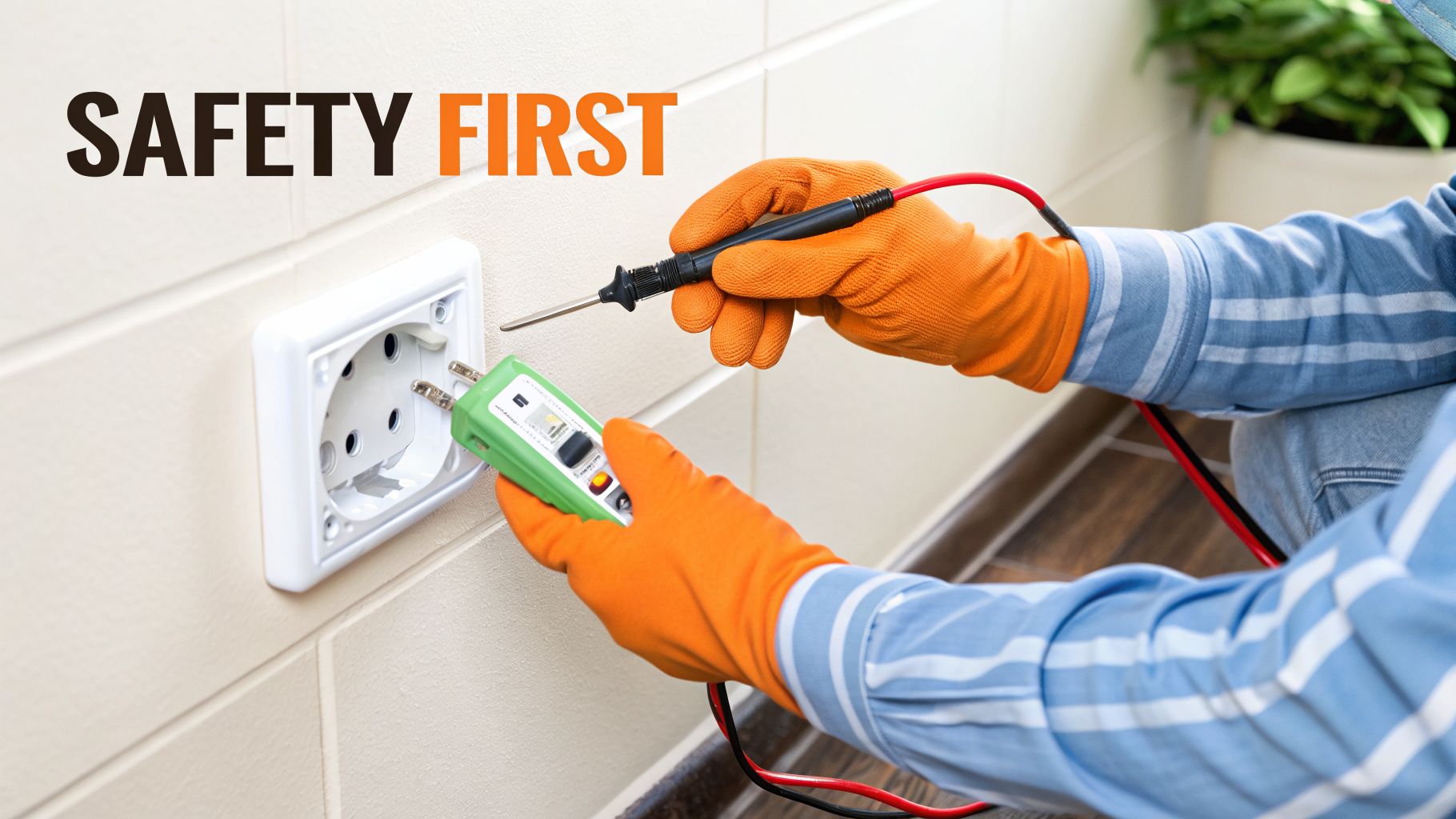
After you've shut off the breaker, your next step is to confirm the circuit is actually dead. The only reliable way to do this is with a voltage tester. This little tool costs next to nothing and is an absolute must-have if you plan to do anything more than change a lightbulb.
Carefully touch the tester’s probes to the screws or wires you're about to work on. If that tester lights up or makes a sound, stop everything. The circuit is still live, which likely means you flipped the wrong breaker.
This two-step process—shutting off the breaker and then verifying with a tester—is a life-saving habit. It eliminates the single biggest risk in any electrical work and is the foundation of working safely. If you have any doubt, don't risk it. Test it.
Beyond that golden rule, a few other practices are crucial for keeping yourself safe around your home's wiring.
- Keep Water Away: Water and electricity are a lethal mix. Never try to do electrical work in wet or even damp conditions, and make sure your hands, tools, and work area are completely dry.
- Use Insulated Tools: Good-quality screwdrivers and pliers with insulated handles are a smart investment. They're rated for electrical work and give you an important extra layer of protection from accidental shock.
- Understand Grounding: That bare copper or green-coated wire is the ground wire. It’s a safety feature designed to give electricity a safe path to the earth if there's a fault. Never, ever cut or disconnect a ground wire.
You can get more great information by checking out these essential electrical safety tips that every homeowner should know.
Recognizing Warning Signs of Bad Wiring
Your home has ways of telling you when its electrical system is struggling. Learning to spot these warning signs can help you catch a problem before it turns into a real emergency. Since electrical faults are a leading cause of house fires, paying attention is critical.
Keep an eye out for these common red flags:
- Frequently Tripping Breakers: A breaker tripping once in a while is one thing. But if the same breaker trips over and over, it’s a clear sign that the circuit is overloaded or has a more serious fault.
- Flickering or Dimming Lights: Do your lights flicker or dim when a big appliance like your air conditioner turns on? This can point to an overloaded circuit or even an issue with your main electrical service.
- Buzzing or Sizzling Sounds: Your outlets, switches, and breaker panel should always be silent. If you hear any buzzing, crackling, or sizzling, you're hearing the sound of a loose connection or a dangerous electrical arc.
- Discolored or Warm Outlets: A switch plate or outlet that feels warm to the touch is a major hazard. It means there's a bad connection inside causing it to dangerously overheat.
- A Burning Smell: If you smell something burning—often like hot plastic—coming from an outlet or switch, don't hesitate. Turn off the power to that circuit immediately and call an electrician.
Ignoring these symptoms is a gamble you never want to take. If you notice any of these signs, it's time to stop using that circuit and get a professional involved.
Knowing When to DIY and When to Call a Professional
There’s a real satisfaction in tackling a home project yourself. But when it comes to electrical work, the line between a rewarding DIY task and a dangerous gamble is razor-thin. One of the most critical skills a homeowner can learn is knowing where that line is.
A mistake with electricity isn't like hanging a picture crookedly; the consequences can be devastating for your home and family. Knowing which jobs you can handle and which ones absolutely demand a licensed electrician is key to keeping everyone safe.
DIY vs Professional Electrical Jobs
Deciding what you can safely tackle yourself can be confusing. This table breaks down common electrical tasks to help you make a smart, safe choice.
| Task | Recommended for DIY? | Why It's Pro-Level |
|---|---|---|
| Replacing an Outlet or Switch | Yes, with caution | If the circuit wiring needs to be changed, it's a pro job. |
| Installing a New Light Fixture | Yes, if replacing an existing one | Running a new wire or creating a new fixture box requires an electrician. |
| Adding a New Circuit | No, never | This involves working in the main panel and calculating electrical loads. |
| Upgrading Your Electrical Panel | No, absolutely not | This is one of the most dangerous electrical jobs and is strictly for pros. |
| Rewiring a Room or Home | No | Requires deep knowledge of codes, permits, and safe wiring practices. |
| Installing a 240-Volt Outlet | No, never | These high-voltage circuits for dryers or ovens are extremely dangerous. |
Ultimately, if you have even the slightest doubt, it’s always the right move to call in a professional. A service call is a small price to pay for your safety and peace of mind.
Simple Projects You Might Tackle
With the right precautions, a confident DIYer can safely handle a few small jobs. These are almost always "like-for-like" replacements, meaning you're swapping out an old component for a new one of the exact same type.
The golden rule is non-negotiable: always shut off the power at the circuit breaker and then use a voltage tester to confirm the circuit is dead before you touch a single wire.
Acceptable DIY tasks often include:
- Replacing an existing light fixture: Swapping out an old chandelier for a new one.
- Replacing a standard light switch: Upgrading a basic toggle to a simple dimmer switch.
- Replacing a standard electrical outlet: Changing a cracked or worn-out receptacle.
When deciding whether to undertake electrical tasks yourself or hire a professional, it's vital to ensure any contractor you consider has appropriate coverage. Learning about options like general liability insurance for electrical contractors can offer peace of mind by protecting you from liability in case of accidents.
Jobs That Always Require a Professional
Some electrical work is just plain dangerous and complex. These jobs are firmly in "pro-only" territory because they involve working inside the service panel, pulling new wire through walls, or calculating electrical loads—all of which require years of training and experience.
Here are the jobs you should always leave to a licensed electrician:
- Adding a new circuit: Whether for a home office or a hot tub, this is a complex job that starts at the panel.
- Upgrading your electrical panel: Replacing an old or undersized panel is extremely hazardous and must be done by a pro.
- Rewiring any part of your home: Replacing old knob-and-tube or aluminum wiring is a massive job subject to strict codes.
- Installing 240-volt circuits: These circuits for appliances like ovens and dryers carry double the voltage and double the danger.
The risks here are no joke. We're talking about house fires from bad connections, life-threatening shocks, and failing a home inspection, which can kill a future sale. Even worse, your homeowner's insurance could deny a claim if a fire is traced back to unpermitted, non-professional work.
This is exactly why getting an expert eye on your system is so valuable. A comprehensive electrical safety inspection can spot these hidden dangers before they become disasters.
Navigating Electrical Codes and Permits
At first, electrical codes and permits can feel like a mountain of red tape meant to slow your project down. But their real job is much more straightforward and incredibly important: keeping you, your family, and your home safe from electrical disasters. They’re the official rulebook for any and all electrical work.
Think of these codes as a shared safety agreement. They make sure every new wire, outlet, and fixture gets installed correctly, dramatically cutting the risk of fires and shocks. Following the code isn't just about getting a green sticker from an inspector; it’s about genuine peace of mind.
Understanding the Rulebook: The NEC and Local Codes
Across the United States, the gold standard for electrical safety is the National Electrical Code (NEC). This massive document, published by the National Fire Protection Association (NFPA), lays out the detailed guidelines that every professional electrician lives by. It’s the master plan for the basics of home electrical wiring.
But the NEC is just the starting point. Your local city or county will often take the NEC and add its own rules based on things like regional climate or common construction styles. This is why an installation that’s perfectly fine in one town might not pass inspection just one county over.
An electrician's deep knowledge of both national and local codes is a huge part of their value. They know the specific rules for your area, ensuring any work is not only safe but also 100% legal and compliant.
When Do You Need an Electrical Permit?
The big question for many homeowners is, "Do I really need a permit for this?" While the specific answer depends on your local building department, you almost always need a permit for any work that involves adding or changing your home's permanent wiring.
You'll definitely need to pull a permit for bigger jobs, such as:
- Installing a new circuit for a home office, hot tub, or major appliance.
- Upgrading your main electrical panel to handle more power.
- Rewiring an entire room or replacing old knob-and-tube or aluminum wiring.
- Running power to a separate structure like a new shed or detached garage.
- Adding a dedicated circuit for an electric vehicle (EV) charger.
On the other hand, small jobs like swapping out a light fixture or replacing a single outlet typically don't require a permit. But when in doubt, the safest move is to make a quick call to your local building department and ask.
The Inspection Process Explained
Pulling a permit is the first step, but passing the final inspection is what closes the loop. The inspector is a neutral expert whose only job is to confirm that the work was done safely and meets all current code requirements. It's a critical safety check for your home.
Inspections usually happen in two phases:
- Rough-In Inspection: This happens after the new wires are run through the walls but before any drywall goes up. The inspector will check the type of wire used, how it's secured, where boxes are placed, and if the grounding is correct.
- Final Inspection: After all the outlets, switches, and fixtures are fully installed and the power is on, the inspector comes back. They'll test everything to make sure it all works properly and safely.
Passing that final inspection is non-negotiable. It's the official record that your electrical project is safe and up to code, something that’s vital for your homeowner’s insurance and for the future resale value of your property. If you want to get ahead, you can learn more about what is included in a home electrical wiring inspection to know what they'll be looking for.
Frequently Asked Questions About Home Wiring
Getting familiar with your home's electrical system is a smart move. Naturally, the more you learn, the more questions you'll have. We get it. Understanding what’s happening behind your walls helps you catch problems early and keep your family safe. Here are some of the most common questions we hear from homeowners just like you, with clear, straightforward answers.
Why Do My Circuit Breakers Keep Tripping?
A breaker that trips every now and then is no reason to panic—it’s just doing its job. But when it becomes a regular occurrence for the same breaker, that's your system telling you something’s wrong. It usually boils down to one of three things.
Most often, the culprit is a simple overloaded circuit. This happens when you plug in too many power-hungry appliances on the same circuit, like running a space heater and a vacuum cleaner at the same time. The demand for electricity is more than the circuit can safely provide, so the breaker trips to prevent overheating.
More serious issues include a short circuit, where a hot wire accidentally touches a neutral wire. This creates a massive, uncontrolled flow of electricity that the breaker shuts down instantly to prevent a fire. A ground fault is similar; it happens when a hot wire touches a ground wire or a grounded metal box, creating a dangerous shock hazard that a GFCI outlet or breaker will immediately cut off.
What Are the Signs My House Needs Rewiring?
Age is a huge factor here. If your home was built before the 1970s and has its original wiring, especially old knob-and-tube or aluminum wiring, it’s definitely time for a professional assessment. Those systems simply weren't built to handle the demands of our modern, plugged-in lives.
Keep an eye out for these clear warning signs:
- A persistent burning smell from any outlets or switches.
- Buzzing or sizzling sounds coming from receptacles or your electrical panel.
- Discolored outlets or faceplates that feel warm to the touch.
- Flickering or dimming lights that happen often, especially when a big appliance kicks on.
- Two-prong outlets, which mean your home lacks a proper grounding system.
If you spot any of these red flags, don’t wait. It’s crucial to call a licensed electrician to inspect your wiring right away.
Can I Use Two-Prong Outlets With Adapters?
Those little three-to-two-prong "cheater plugs" are everywhere, but they are not a safe long-term fix. Using one creates a major safety gap by completely bypassing the ground connection, which is your electrical system’s most important defense against shock.
Using an adapter lets you plug in a three-prong cord, but it does not provide the essential safety of a ground connection. If an electrical fault occurs, the dangerous current has no safe path to the ground and could electrify the metal casing of an appliance, creating a severe shock hazard.
The only truly safe solution is to have the outlet rewired with a proper ground wire. Another option is to replace it with a GFCI outlet, which can provide shock protection even on an ungrounded circuit.
How Often Should I Have My Electrical System Inspected?
Think of a professional electrical inspection as a check-up for your home’s central nervous system. For a new home, an inspection is typically part of the buying process. After that, a good rule of thumb is to have your system inspected every 5 to 10 years.
You should definitely schedule one sooner if you’re planning a major renovation, adding a large appliance like a hot tub or EV charger, or if you notice any of the warning signs we mentioned earlier. It’s a small investment for some serious peace of mind.
Understanding your electrical system is the first step toward a safer home. For nearly 20 years, Heatwave Air Conditioning, Plumbing, & Electric has provided trusted electrical services to homeowners across Florida. If you have questions or need a professional inspection, our certified technicians are ready to help. Visit us online to schedule your service at https://www.heatwavehvac.com.