
A lot of Florida homeowners start thinking about the electrical panel only when it says no.
It happens when the new AC goes in and the lights dip on startup. Or when an EV charger gets added to the garage and suddenly there's no clean way to feed another breaker. Or when a kitchen remodel brings in an induction range, a wall oven, and more countertop circuits, and the old panel looks packed tight before the job even starts.
That's usually when the core question comes up. Not “What's the best brand?” but what's the best electrical panel for home use in my situation? In Tampa Bay and along the Gulf Coast, that answer has to account for load demand, available circuit space, moisture, corrosion, and storm exposure. A good panel choice is one that fits the house you have now and the one you're building toward over the next several years.
Is Your Home's Electrical Panel Ready for Modern Life?
A common local scenario goes like this. A homeowner buys an electric vehicle, replaces an aging HVAC system with a heat pump, and starts planning a kitchen update. On paper, each project makes sense. In the panel, it can turn into a problem fast.
The breaker box that handled an older Florida house just fine for years may not have enough capacity, enough spaces, or enough flexibility for modern loads. That doesn't always mean the panel is dangerous. It does mean the panel may no longer match the way the house is being used.
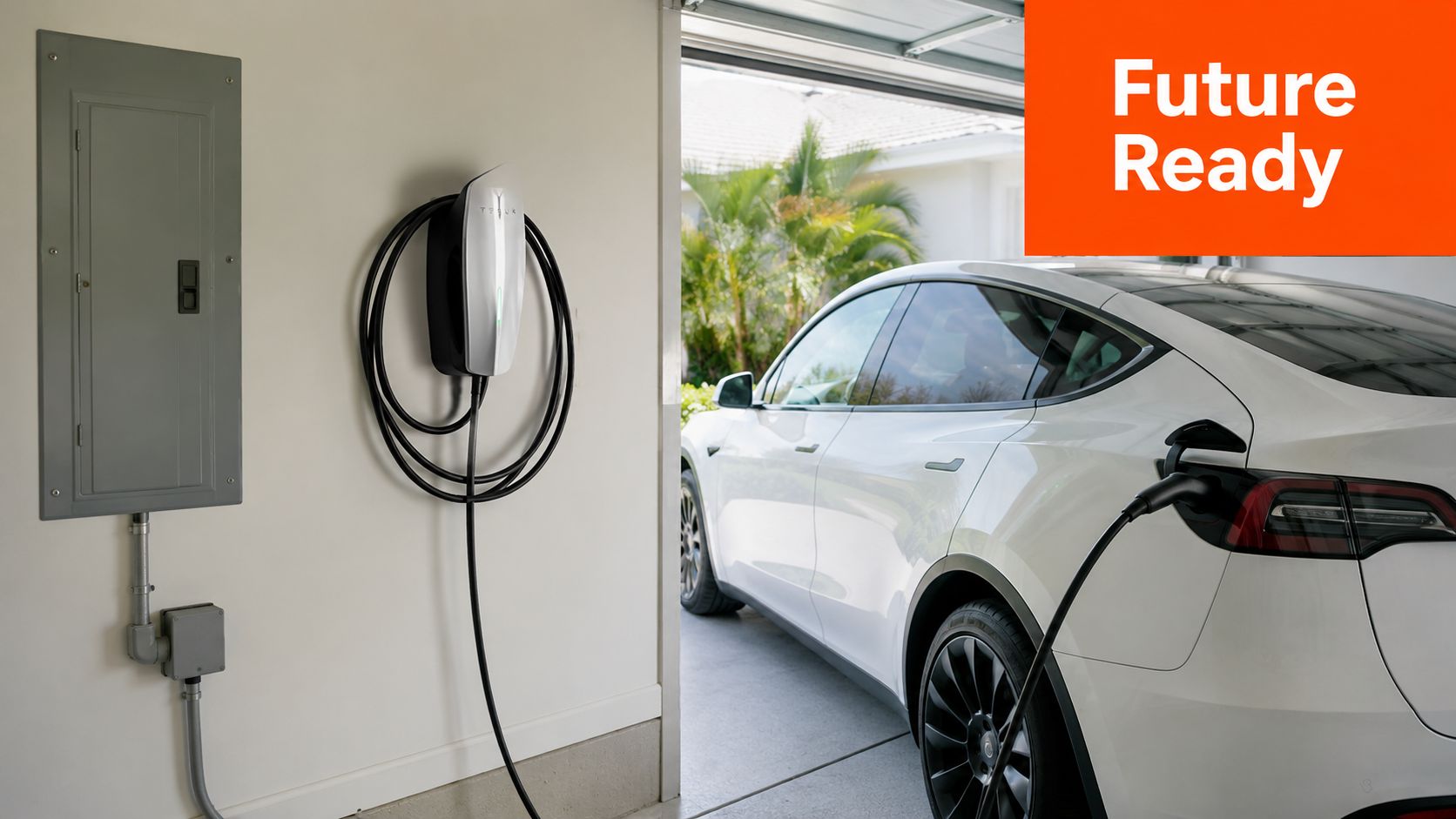
In practice, the best electrical panel for home upgrades is rarely the one with the most familiar name on the cover. It's the panel that gives you safe distribution, room for expansion, and a clean path for things Florida homeowners are adding now, especially EV charging, better HVAC, backup planning, and more all-electric equipment. Homeowners comparing residential charging needs with larger property planning may also find this guide for facility managers on EV charging useful because it shows how charging demand changes the conversation around electrical infrastructure.
What the panel really does for your house
Your panel is the control point for the whole home. It distributes power, protects branch circuits, and determines how easily an electrician can add or reorganize loads later.
If the panel is undersized, overcrowded, or worn out, every improvement downstream gets harder. That includes HVAC work, generator planning, surge protection, garage additions, pool equipment, and appliance upgrades. Even a simple service call can turn into a bigger discussion when the panel leaves no safe room to work.
What homeowners should look for first
Before anyone gets caught up in brand names, I'd narrow the decision to these issues:
- Capacity for real life: Does the service fit the house as it's used today?
- Expansion room: Are there enough legitimate spaces for future circuits?
- Florida durability: Will the enclosure and components hold up in humidity and coastal air?
- Storm readiness: Is there a clean plan for surge protection and backup priorities?
For a quick visual on home service work and what a properly planned upgrade can involve, this Heatwave service image reflects the kind of integrated home-system thinking that matters when electrical, HVAC, and other major loads all meet at the panel.

A panel upgrade isn't just a metal box swap. It changes what the house can safely support.
Choosing the Right Panel Size 100A vs 200A
Panel size is the first big fork in the road. For most homes being updated in Florida, the conversation ends up centered on whether the existing service is still enough or whether it's time to move to 200 amps.
A recent survey found that 62% of single-family homes have 200A panels, and homes built after the 2000s predominantly use 200A service. The same survey found that homes built before 1960 were 5–9 times more likely to have panels rated at 100A or less, which helps explain why older houses so often hit a wall during electrification projects (ACEEE survey on U.S. panel capacities).

Electrical Panel Amperage Comparison
| Amperage | Best For | Typical Appliances Supported |
|---|---|---|
| 100A | Smaller, older homes with modest demand | Basic lighting, receptacles, standard kitchen loads, smaller HVAC setups |
| 150A | Mid-size homes with moderate demand | Typical household circuits plus some newer appliances, depending on total load and panel space |
| 200A | Most modern homes and major remodels | Central AC, EV charging, larger kitchens, heat pumps, and multiple higher-demand electric loads |
What works and what usually doesn't
A 100A panel can still be workable in a smaller house with limited electric demand. If the home has fewer large appliances and no plans for EV charging or major electrification, it may not need immediate replacement. But once you start stacking modern loads, 100A gets tight quickly.
A 150A service can fit some in-between homes. It may suit a house that has moderate upgrades planned but isn't going fully electric. The problem is that many homeowners who stop at 150A end up outgrowing it sooner than expected when another major appliance or charging circuit gets added.
A 200A panel is the practical default for most serious upgrades. In Florida, where long cooling seasons already put steady demand on the electrical system, 200A gives breathing room for central HVAC, kitchen loads, garage circuits, pool equipment, and future additions.
Practical rule: If you already know an EV charger, heat pump, or larger remodel is coming, size the panel for that future now.
Here's a useful walkthrough before you compare options in detail:
Why 200A is usually the right answer in Florida
Florida homes don't just run lights and a refrigerator. They run cooling equipment hard for much of the year. Add a vehicle charger, an induction cooktop, electric water heating, or workshop loads, and the service needs to keep up without constant compromises.
The best electrical panel for home renovation work is usually the one that lets an electrician build a clean, code-compliant layout without forcing awkward workarounds. In many cases, that means upgrading to 200A instead of trying to squeeze one more project onto an old service.
Understanding Panel and Breaker Technology
Once size is decided, the next question is what kind of panel setup makes sense. Homeowners often use “panel” as a catch-all term, but there are a few different pieces that matter.
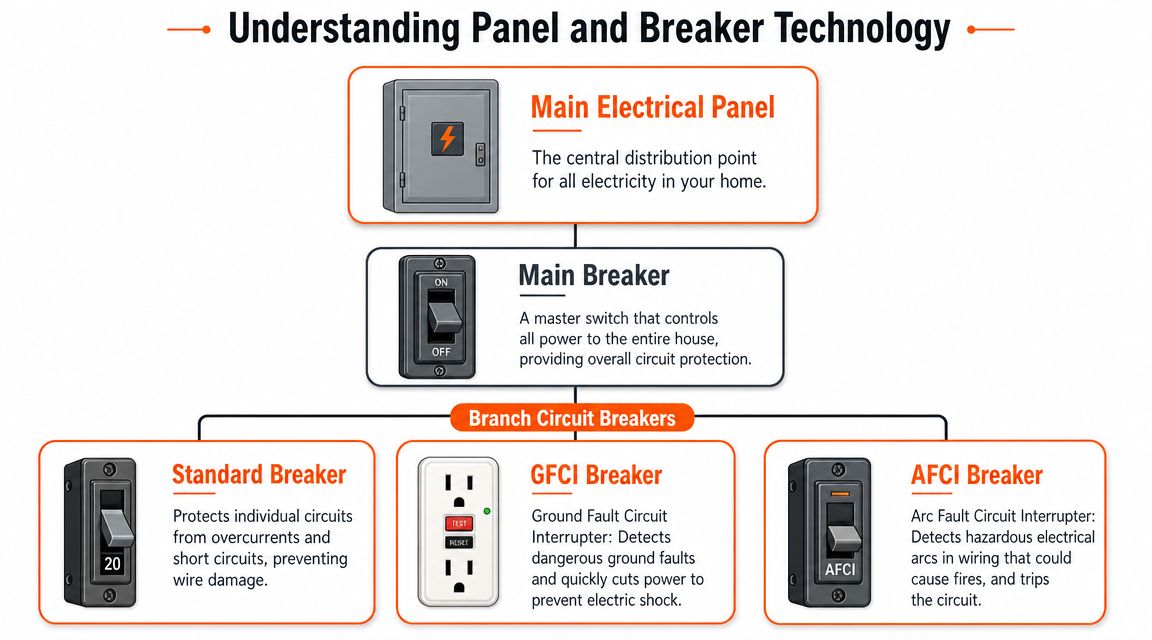
Main panel, main lug, and subpanel
A main breaker panel is the primary distribution point in most homes. It includes the service disconnect and feeds the branch circuits throughout the house.
A main lug panel is typically used where the main disconnect is located elsewhere. You'll see this in certain service configurations, additions, or when equipment is arranged to meet local requirements.
A subpanel is a secondary panel fed from the main. It's useful when circuits need to be grouped in another area, such as a garage, workshop, addition, or detached structure. A subpanel can improve organization, but it doesn't magically increase service capacity.
Homeowners who want a basic primer on how panelboards fit into electrical distribution can use this comprehensive panelboard explainer to get the terminology straight before reviewing contractor proposals.
Breakers matter as much as the box
The enclosure gets the attention, but the breakers are where a lot of the safety lives.
- Standard breakers protect circuits from overcurrent and short circuits.
- GFCI breakers are used where shock protection is critical, especially around wet locations.
- AFCI breakers are designed to detect hazardous arcing conditions associated with fire risk.
- Dual-function breakers combine protections where required by code and design.
What works well is a clean panel layout with properly matched breakers, good labeling, and room to service the equipment later. What doesn't work is a panel stuffed with mismatched devices, confusing directory notes, and no margin for future changes.
Smart panels and who they're for
Smart panels are worth serious consideration if the house is moving toward electrification, backup power, or tighter energy management. They don't just distribute power. They add circuit-level monitoring, remote control, and dynamic load balancing. The SPAN panel, for example, supports up to 32 controllable circuits and can prioritize backup loads during outages (smart panel guide with SPAN details).
That's a real functional difference. A traditional load center protects circuits. A smart panel can also help manage them.
In a house with solar, battery storage, EV charging, and a heat pump, active load management can solve problems that a standard panel alone can't.
When a smart panel makes sense
A smart panel is usually a strong fit when a homeowner wants one or more of these:
- Backup prioritization: Keep selected circuits available during an outage.
- Load management: Avoid unnecessary service upgrades where controlled balancing can help.
- Real-time visibility: See what major circuits are drawing without guesswork.
- Remote control: Shut off or prioritize circuits from an app interface.
For a simpler house with steady loads and no interest in energy monitoring, a standard 200A load center is often the right call. For a highly electrified house, the smartest option may be the best electrical panel for home use, even if it costs more upfront.
Florida-Specific Needs Corrosion and Storm Protection
Florida changes the panel conversation. A setup that's acceptable in a drier inland market can age poorly near the coast or in a humid garage here.
Salt air, year-round moisture, and storm exposure all affect equipment life. In coastal parts of Tampa Bay and Southwest Florida, I pay close attention to where the panel sits, what the enclosure is rated for, how the terminations look over time, and whether the installation leaves enough protection against weather and contamination.
Humidity and salt don't care about brand loyalty
The best panel for a Florida home isn't just one with a good reputation. It's one installed in the right location, with the right enclosure, and with hardware that can handle the environment.
If the panel is outdoors or in an exposed location, weather-rated equipment becomes important. In coastal areas, corrosion can show up on lugs, breaker stabs, grounding connections, enclosure hardware, and conduit fittings. Once corrosion gets established, resistance and heat become bigger concerns.
What works well in this climate:
- Weather-appropriate enclosures: Especially for outdoor service equipment
- Thoughtful placement: Not every exterior wall is equally harsh
- Clean workmanship: Tight terminations, proper fittings, and good sealing practices
- Room to expand: Because crowded panels are harder to maintain and modify safely
Space matters more than many homeowners realize
One issue that gets missed all the time is physical space inside the panel. For homes adding EV chargers or heat pumps, available spaces are critical. Some panels advertised with high circuit counts rely on tandem breakers, which may not be permitted for all circuits, so real expansion room matters more than marketing language suggests (discussion of panel spaces, tandems, and expandability).
That matters in Florida because many homes eventually add more than the owner planned at the start. A charger, a pool heater, a mini-split, a garage refrigerator, a transfer setup, or a workshop circuit can fill “extra room” fast.
Storm readiness starts at the panel
Lightning and utility disturbances are part of life here. Sensitive electronics, control boards, appliances, and HVAC equipment all benefit when surge protection is handled at the panel as part of the overall design.
I also tell homeowners to think beyond the panel cover. Storm readiness includes clear labeling, accessible shutoffs, secure mounting, and a setup that an electrician can inspect and service efficiently after severe weather. If you're already reviewing whole-home readiness for seasonal conditions, this Heatwave home-systems visual is a useful reminder that electrical planning works best when it's part of the broader house, not treated in isolation.

Warning Signs You Need a Panel Upgrade
Some panels fail dramatically. Most don't. They give warnings first.
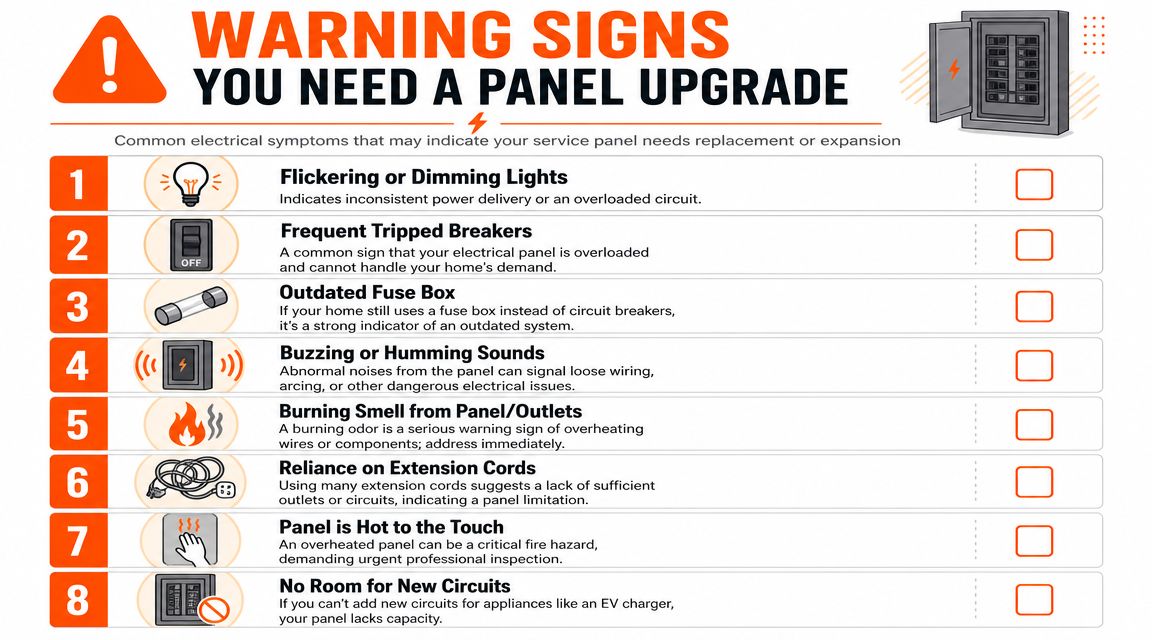
Homeowners usually notice the symptoms before they know the cause. Lights flicker. Breakers trip more often. A new appliance can't be added without rearranging half the panel. Those aren't annoyances to ignore. They're clues that the electrical system needs a closer look.
Electrical panels have a typical useful lifespan of 25 to 40 years, and any panel approaching that age, or any panel rated below 100A, should be professionally inspected because it may no longer meet modern demand and may present a safety risk (panel lifespan and inspection guidance).
Red flags that deserve a real inspection
- Frequent breaker trips: This often points to overloaded circuits or a panel that can't support how the home is being used.
- Flickering lights: Inconsistent power can indicate capacity issues, loose connections, or equipment wear.
- Warm panel cover: A panel should never be treated casually if it feels hot.
- Buzzing or crackling: Unusual sound can suggest arcing or poor connections.
- No room for new circuits: If every change requires a workaround, the panel may already be telling you it's undersized.
- Old fuse-based equipment: If the home still relies on a fuse box, that's a strong sign the system needs evaluation.
What these signs usually mean in the field
A breaker that trips once after an obvious overload is one thing. A breaker that trips routinely under normal household use is different. That's when I start looking at circuit loading, panel condition, breaker age, termination quality, and whether the service still matches the home.
Flickering lights deserve the same respect. Sometimes the issue is local to one circuit. Sometimes it points back to the panel or service equipment. Either way, guessing is a bad plan when the symptom involves unstable power.
If a panel smells hot, sounds wrong, or shows visible damage, don't reset and hope. Shut down what you safely can and call for service.
Age plus symptoms is the combination that matters
An old panel with no issues may still need inspection because time, humidity, and wear affect internal parts. A newer panel with repeated performance issues also needs attention. It's the pattern that matters.
Homeowners looking at service examples and common home-system warning signs can also review this Heatwave electrical service image as a reminder that electrical problems often show up alongside other whole-home stress points, especially during heavy cooling seasons.

Estimating Panel Upgrade Costs in Tampa Bay
Panel upgrade pricing in Tampa Bay depends on the work around the panel as much as the panel itself. Homeowners often expect one flat number, but quotes can vary based on service size, location of the equipment, grounding updates, breaker requirements, permit rules, and whether the utility connection needs related work.
Because reliable local pricing data isn't provided here, I won't invent ranges. What I can tell you is how a professional quote is usually built so you know what you're paying for and what questions to ask.
What a panel upgrade quote should include
A solid estimate typically breaks into a few parts:
- Panel and breakers: The enclosure, main breaker, branch breakers, and related hardware
- Labor: Removal of old equipment, installation, conductor terminations, labeling, testing, and cleanup
- Permit and inspection costs: Required by the local authority having jurisdiction
- Service-related extras: Mast, weatherhead, grounding, meter coordination, or repairs to surrounding equipment if needed
If a quote skips over those details, you're missing information that matters. The lowest number isn't always the lowest final bill.
Why two homes can price very differently
A straightforward indoor panel replacement is one thing. A service change that requires exterior equipment work, coordination with the utility, code corrections, and added branch circuit work is another.
That's why homeowners should ask for a written scope, not just a dollar figure. In my experience, the clearest estimates explain what's included, what might change after inspection, and what triggers additional work. Contractors who use structured takeoff tools or platforms similar to Exayard electrical estimating software tend to produce cleaner scopes because they're forced to account for real line items instead of guessing from memory.
What to ask before approving the job
Ask these questions before signing:
- Is this a panel replacement or a service upgrade?
- Are permit and inspection fees included?
- Will grounding or surge protection be part of the work?
- Are all required breakers included in the quote?
- What conditions could change the price once the old equipment is opened up?
For homeowners comparing contractors and trying to understand what professional home-service communication looks like, this Heatwave project media image gives a sense of the kind of public-facing accountability you want from any company handling panel work.

How to Hire a Licensed Electrician for Your Upgrade
A Tampa Bay homeowner calls after the first summer storm knocks out half the house, and now they want a bigger panel, a generator inlet, and room for an EV charger next year. That is not the time to guess on contractor selection. The electrician you hire will decide whether the upgrade is sized correctly, permitted correctly, and built to hold up in Florida heat, humidity, and storm season.
Panel replacement and service upgrades involve live service equipment, utility coordination, grounding, bonding, and local inspection requirements. Homeowners should verify that the electrician or electrical contractor holds the right Florida license for the job, carries insurance, and pulls permits in their own name where required. If someone offers to swap a panel without permits, treat that as a warning sign.
Core Requirements
Before you compare brands or breaker options, check the contractor.
- Active Florida licensing: Confirm the license matches electrical work, not a general handyman service
- Insurance coverage: Liability and workers' compensation protect you if something goes wrong on site
- Permit responsibility: The contractor should state clearly who is pulling permits and who will meet the inspector
- Written scope: The proposal should identify the panel, breaker package, surge protection, grounding work, and any service entrance changes
A solid electrician will also talk through load planning. That matters more than many homeowners realize. The best electrical panel for home use is not just a brand decision. It is a sizing and application decision based on what the house needs now and what you are likely to add later, especially if EV charging, a heat pump, pool equipment, or backup power may be in the plan.
Red flags homeowners should take seriously
Low bids deserve a close look. In my experience, the cheapest number often leaves out permit costs, AFCI or GFCI breakers, surge protection, grounding corrections, or weather-related equipment upgrades that become obvious once the old gear is opened up.
Be careful with vague proposals, big cash deposits, or a contractor who cannot explain why they are recommending 100A, 150A, 200A, or a smart panel. Florida homes need decisions that account for moisture exposure, corrosion near the coast, and storm resilience. If the conversation stays at "we'll just swap the box," the planning is too shallow.
One more red flag. The contractor never asks about future loads.
A good electrician should ask whether you expect to add an EV charger, replace the air conditioner with a heat pump, install a tankless water heater, or set up generator or battery backup later. Those answers affect panel size, breaker space, and whether a standard panel or smart panel makes more sense for your situation.
A competent electrician asks what the home will need five years from now, not just what is failing today.
What a good contractor discussion sounds like
A useful site visit usually covers the age and condition of the existing service, panel location, service amperage, grounding and bonding, surge protection, available circuit capacity, and any signs of rust or moisture intrusion. In coastal and high-humidity parts of Florida, I also want to know whether the equipment location is likely to shorten panel life or create corrosion issues over time.
If one company handles HVAC, plumbing, and electrical under one roof, that can help when service capacity and mechanical upgrades affect each other. Heatwave Air Conditioning, Plumbing, & Electric is one example of a company offering electrical panel services alongside other major home systems in Tampa Bay and Southwest Florida.
Homeowners often check reputation signals before signing. Reviewing a customer review graphic can be useful, but treat that as a starting point. License verification, permit history, and a clear written scope matter more than marketing.

Frequently Asked Questions About Electrical Panels
How long does an electrical panel last
A panel's typical useful lifespan is 25 to 40 years, but age alone doesn't decide replacement. Condition, environment, and load demands matter too. In Florida, humidity and corrosion can make inspection even more important as equipment ages.
Can I install an electrical panel myself
For practical and safety reasons, this is not DIY work. Panel replacement involves shock hazard, fire risk, code compliance, permitting, and utility coordination. Even if a homeowner is comfortable doing smaller electrical tasks, service equipment is a different category.
Is 100A enough for a Florida home
Sometimes, but often not for homes adding modern electric loads. A smaller older home with modest usage may still operate acceptably on 100A. Once you start adding EV charging, larger HVAC equipment, kitchen upgrades, or broader electrification, the answer is often no.
Is 200A the best choice for most upgrades
For many Florida homeowners, yes. It's commonly the right fit for modern use because it gives better headroom for cooling equipment, appliance upgrades, and future circuits. The exact answer still depends on a proper load evaluation and the physical layout of the service.
Are smart panels worth it
They can be. If you want circuit-level monitoring, remote control, load balancing, backup prioritization, or better coordination with solar and battery systems, a smart panel can offer real advantages over a standard load center. For a simpler home with stable demand, a conventional panel may be the better value.
Does a new panel increase home value
It can improve buyer confidence because it addresses safety, functionality, and readiness for newer appliances and equipment. I'd look at it less as a cosmetic value-add and more as infrastructure that makes the house easier to insure, upgrade, and live in.
Which panel brand is best
There isn't one universal answer. The right choice depends on service size, breaker availability, installation environment, expansion needs, and whether you want standard or smart-panel features. Brand matters, but fit matters more.
If your panel is undersized, aging, corroded, or out of room for the way you live now, it's worth getting a professional evaluation before the next project forces the issue. Heatwave Air Conditioning, Plumbing, & Electric provides electrical service for homeowners in Tampa Bay and Southwest Florida, including panel assessments and upgrade planning for homes adding EV charging, HVAC equipment, and other major loads.