
You're standing in the hallway with sweat on your back, the bedroom feels muggy, and the electric bill from last month is still sitting on the counter. That's when the question gets real, central air conditioner vs. window unit, and in Southwest Florida it isn't a classroom debate, it's a money-and-comfort decision that plays out every day in hot, humid homes.
A window unit looks cheap because the sticker price is cheap. Central air looks expensive because it's built to cool the whole house, not just the room you're sitting in. In this climate, that difference matters more than almost anything else.
| Option | Best Use Case | Upfront Cost | Cooling Scope | Florida Reality |
|---|---|---|---|---|
| Central air conditioner | Whole-home comfort | $3,500–$7,500 in an existing home with ductwork, or $10,000–$15,000+ if ducts must be added, according to Home Cost Lab | Entire home | Best fit for families, larger houses, and long-term ownership |
| Window unit | Single room or limited area | $150–$700 each, according to Home Cost Lab | One room or zone | Good for renters, temporary fixes, and tight budgets |
| Multiple window units | Several rooms | Low at first, but rises fast | Partial home | The hidden operating-cost trap |
| Central with ducts already in place | Whole-home cooling | Lower than a ductless retrofit, according to Home Cost Lab | Whole home | Usually the smarter long-term move in Florida |
Choosing the Right Cooling System for Your Florida Home
A homeowner in Cape Coral or Fort Myers usually calls after the same complaint shows up again and again. The living room window unit is throwing cold air, the back bedrooms still feel sticky, and everybody is fighting over the one room that stays bearable at night. That is when people start comparing a central air conditioner vs. window unit, and they usually ask the wrong question first, “What costs less today?”
Ask a better one. What keeps the house livable in August, and what still works after the first storm season? A central system is built for whole-home comfort. A window unit is built to cool one room. That difference drives the cost gap and the comfort gap, as noted in Home Cost Lab's comparison of central air and window units.
The decision comes down to your house, not the brochure
If your home already has ductwork and you are cooling a family house in Tampa Bay, Sarasota, or Port Charlotte, central air usually makes more sense. If you live in a condo, a small apartment, or you only need one room cool for now, a window unit can be the practical choice. Those are not the same job, and pretending they are leads to bad spending.
Florida changes the math. You are not buying relief for a few dry evenings. You are buying comfort through humid months, storm season, and long stretches when the AC runs most of the day. That is why local homeowners need advice that is honest about the trade-offs, not generic internet advice written for a mild-climate house.
Practical rule: If more than one room needs cooling on a regular basis, the cheap upfront option usually stops being cheap fast.
A seasoned HVAC contractor starts with three things, existing infrastructure, how many rooms need cooling, and how long you plan to stay in the home. That is the same no-nonsense approach homeowners want when they sit across the kitchen table and ask what saves money over time. The right answer is usually structural, not emotional.
The hidden costs matter too. Run several window units and you start paying for extra electrical load, more noise, more filters, and more hassle every day. Whole-home cooling also handles humidity better, which matters in Southwest Florida because a house can feel miserable long before the thermometer looks outrageous. For a local example of how homeowners and contractors talk through that reality, see this Heatwave HVAC interview screenshot from Tampa Bay news.

How Central Air and Window Units Work

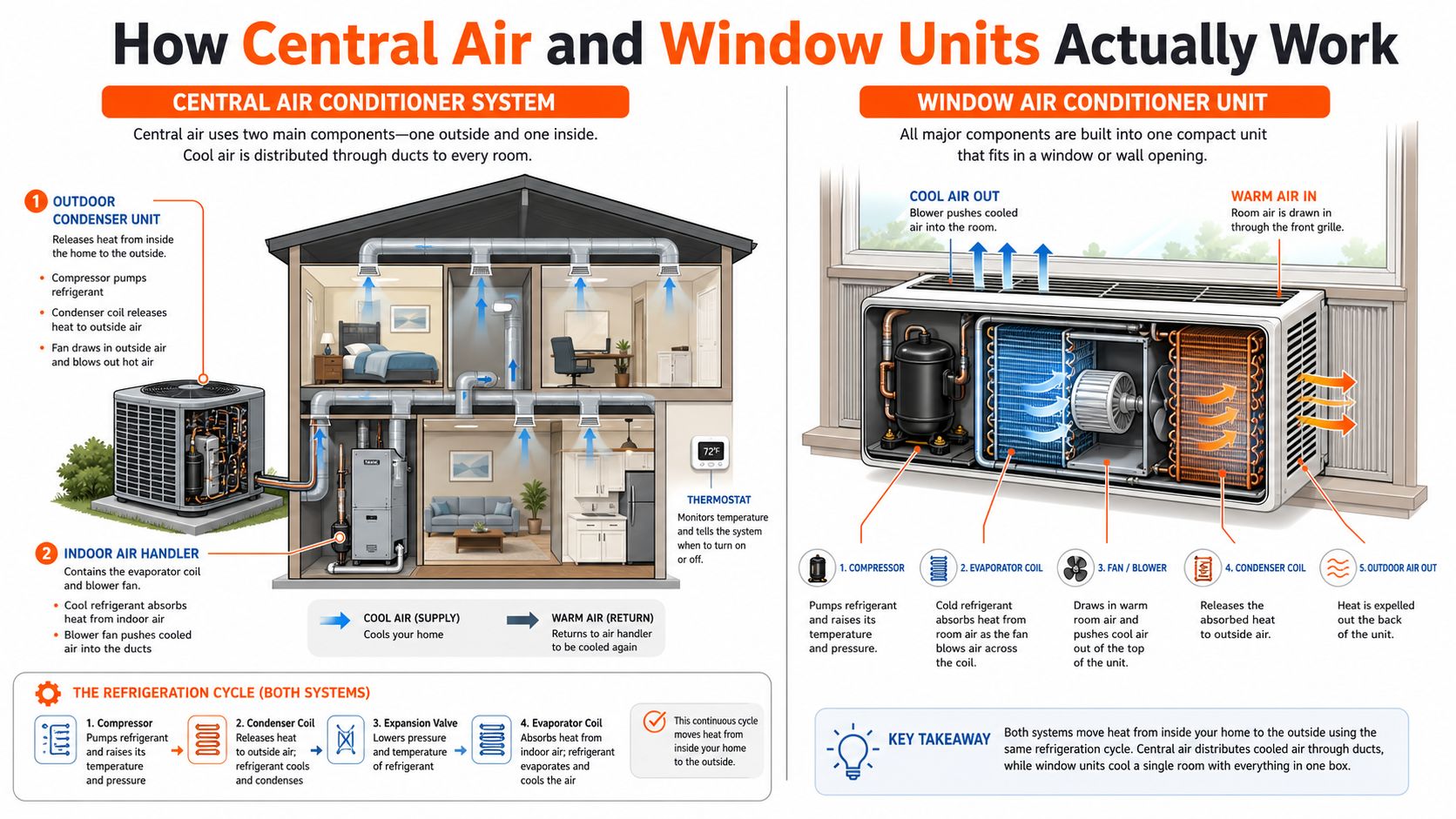
A central air conditioner cools the whole house through a connected system. A window unit cools one room or a limited area as a stand-alone appliance. That difference drives most of the split in performance, installation, maintenance, and long-term cost, as noted earlier.
One system feeds the house, the other serves the room
Central air works through a delivery network. The outdoor condenser removes heat, the indoor air handler moves air, and the ductwork sends conditioned air to each room. If the ducts are in good shape and the system is sized correctly, the house gets more even cooling instead of one cold spot and three hot ones.
A window unit is a self-contained cooling box. Everything sits in one cabinet, and the unit pushes heat outside through the window opening while it cools the room inside. There is no duct network to manage, no whole-home distribution, and no realistic expectation that it will handle a family room, three bedrooms, and a hall at the same time.
That design difference matters in Florida because the cooling load is heavier here. Humidity is not a side issue, it is part of the job. Central systems are built to work with the home as a system, while window units only handle the room they are sitting in. For a visual comparison of the two setups, see A Heatwave HVAC visual highlighting compact cooling equipment in a residential setting.
Why the design difference changes everything
Because central air moves air through ducts, it supports whole-home comfort, better temperature balance, and better filtration. Because a window unit is self-contained, it is simpler to install but far narrower in what it can realistically do. That is why one is usually the right tool for a house and the other is usually the right tool for a room.
Maintenance follows the same pattern. A central system needs attention to the equipment and the ducts, plus regular filter changes. A window unit needs cleaning, sealing, and safe placement, but it will never fix uneven temperatures across a house the way a central system can.
Central air is a house solution. A window unit is a room solution. Mixing them up leads to expensive disappointment.
Operating Costs Beyond the Sticker Price
The upfront price is the part everybody sees first, and that is usually why window units win the first round. A standard central AC installation in an existing home with ductwork is commonly estimated at $3,500–$7,500, while adding ducts can push the total to $10,000–$15,000+. A window unit usually runs $150–$700 and can often be installed by the homeowner. If you want a quick visual on how those numbers translate into real equipment, use this window-unit cost example.

That is the easy math. The hard math is what happens when the whole family wants more than one room cooled.
Multiple window units can eat up the savings
One window unit is cheap. Two are still manageable. Three or four units start changing the whole equation, because now you are paying for several compressors, several fans, several electrical loads, and several places where air leaks can creep in. Once you cool multiple rooms with multiple units, the savings can fade fast and can approach or even exceed the operating cost of a properly sized central system, especially when the home already has ductwork and the central system can run efficiently. That is the kind of hidden cost a lot of homeowners miss until the power bill shows up.
Florida makes this worse because cooling is not occasional here. In Tampa Bay, Sarasota, Port Charlotte, Cape Coral, and Fort Myers, the AC is part of daily life for much of the year. So the question is not whether a window unit can cool one room. It is whether you want to keep paying for several little systems to do the job one central system was designed to handle.
Efficiency ratings tell the same story
Modern central systems are commonly rated around SEER2 16+, with premium models above 20, while window AC units typically fall in the CEER 10–15 range. For whole-home cooling, that gap matters most when you are conditioning multiple rooms, not just one occupied space.
| Configuration | Upfront Cost Range | Efficiency Rating | Best For |
|---|---|---|---|
| One window unit | $150–$700 | CEER 10–15 | One bedroom, office, or short-term cooling |
| Two window units | $300–$1,400 | CEER 10–15 per unit | Small homes with two occupied rooms |
| Three or four window units | $450–$2,800 | CEER 10–15 per unit | Temporary partial-home cooling, not ideal long term |
| Central air with existing ductwork | $3,500–$7,500 | SEER2 16+ | Whole-home comfort and long-term ownership |
| Central air with new ducts | $10,000–$15,000+ | SEER2 16+ | Homes without usable ductwork |
The table makes the point clear. A cheap window unit is cheap only if you stop at one room. Once you are trying to cool a Florida house properly, the operating picture gets a lot less flattering for the little box in the window.
Comfort and Resilience During Florida Storm Season

Southwest Florida storms expose the weak points in a cooling setup fast. Humidity is the part homeowners underestimate most. You can cool the air and still end up with a house that feels sticky, heavy, and hard to live in. Central air usually does a better job of preserving whole-home filtration and more consistent dehumidification, and that matters for comfort, indoor air quality, and keeping mold pressure down in a humid climate.
A window unit can still save the day in one room. If the power is spotty or the main system is down, that single box can make a bedroom livable and help you sleep after a storm. It does not give the rest of the house the same protection, and it does nothing for areas where humidity keeps building. That becomes a real problem for families with seniors, pets, or anyone who needs the indoor environment to stay stable.
Storm season changes the security conversation
Window units bring trade-offs that national comparison pages often gloss over. They occupy a window, which can create a security issue. They can be noisy. They can look out of place on a home you care about. If the unit is not sealed properly, it can also let in air and water where you do not want either one. The comparison infographic showing pros of central air versus cons of window AC units during Florida storms makes that difference obvious.
Central air avoids the open-window problem, which matters when hurricane season turns rough. It also fits better with whole-home backup planning, because the house is already built around one cooling distribution system instead of a patchwork of separate rooms. The downside is simple. If the central unit fails during the worst heat, the entire home loses cooling at once.

Backup comfort is not the same as real resilience
A window unit can be a fallback for one room, and that is useful. It is still not the same as whole-home cooling when the air is thick, the lights are flickering, and the house needs to stay safe and tolerable. That gap is also part of the broader comparison in AHS's comparison of window AC and central air.
Recent inverter-based and high-efficiency window models have narrowed operating costs in some situations, and that is real. It does not change the Florida reality. During storm season, the system that handles humidity, keeps windows secure, and supports the whole house is the one that gives you the better long-term result.
In Florida, comfort is not just temperature. It is humidity control, secure windows, and a cooling plan that still works when storms interrupt normal life.
Heatwave HVAC seasonal service messaging visual
Installation Requirements and What to Expect
Central air is not a casual purchase. If the home already has ductwork in good shape, the job stays fairly straightforward. If the house lacks ducts, the project turns into a real construction decision, because adding ducts can push cost into the $10,000–$15,000+ range, as noted by Home Cost Lab.
Central air needs planning, not guesswork
A professional install is the only smart way to do central air. The system has to be sized correctly, the ductwork has to match the home's layout, and local permitting may be required, especially when new ducts are involved. A good installer also checks the electrical setup and makes sure the equipment fits the load, not just the square footage.
That matters because a badly sized system is a bad system, even if the brand name is good. Too small, and it never catches up in Florida heat. Too big, and it short cycles and handles humidity poorly. The right technician looks at the whole house, not just a sales chart.
Window units are simpler, but they still need care
Window units are easier to install, and many homeowners can do the job themselves. But easy does not mean careless. If the unit is not sealed correctly, you lose energy and invite security problems. If the window or opening is not suited to the unit, the result can be vibration, noise, and water intrusion.
Electrical load is another issue people overlook. One unit may be fine on a standard setup, but multiple window units can push an older Florida home harder than expected, and some homes may need a dedicated circuit or broader electrical attention. That is where an electrician's eye matters as much as the box itself.
For homeowners who want a clearer path, a good contractor can look at the home's ductwork, electrical capacity, and cooling needs, then tell you whether central air is realistic or what upgrades would be needed. That saves time before anyone commits to major work.
| Installation Factor | Central Air | Window Unit |
|---|---|---|
| Ductwork | Required or added | Not needed |
| Installer | Professional HVAC technician | Often homeowner-installed |
| Permits | Often needed for new ducts or system work | Usually simpler, but local rules still matter |
| Electrical | Dedicated planning is common | May need dedicated circuit if multiple units are used |
| Timeline | Usually a multi-step project | Often a same-day task |
| Service life | Commonly 15–20 years with proper maintenance, according to Home Cost Lab | Shorter and more limited by room use |
Which Option Fits Your Specific Situation
A bigger home in Tampa Bay, Sarasota, or Fort Myers with working ductwork should strongly lean toward central air. That's the setup where you get the most from whole-home comfort, and it's the setup that usually makes the most long-term sense. If you're planning to stay in the house and you care about sleeping, humidity, and consistent temperatures, central air is the grown-up answer.
A condo, apartment, or small rental is a different story. In that setting, the window unit is the simple, affordable fix, and it often makes perfect sense. No one should overspend on a cooling system that doesn't match the property.
Match the system to the life you actually live
If you're likely to sell in a few years, be honest about the property and the market. A central system can support value and comfort, but only if it fits the house. If the home has no ductwork and the economics are ugly, a temporary window-unit strategy may be smarter while you save for a bigger upgrade.
Budget-conscious homeowners can also take a phased approach. Start with one or two strategic window units, then move to central air when the budget allows and the home plan is clear. That's better than rushing into a half-baked central project or pretending multiple window units will solve a full-house problem forever.
Families with seniors or health concerns should be especially careful. In Florida's humidity, stable indoor conditions matter. Central air is the stronger choice when you need the whole home to stay comfortable, secure, and evenly cooled.
The cheapest option on paper is rarely the cheapest option over a Florida cooling season if you're trying to cool more than one room.
Quick decision checklist
- Existing ductwork in decent shape: Central air usually wins.
- Only one room needs cooling: A window unit is fine.
- Multiple bedrooms need relief every day: Central air is the better long-term answer.
- Storm resilience matters a lot: Central air gives you better whole-home security and backup power compatibility.
- You're renting or living short term: Window units keep things simple.
- You need humidity control across the house: Central air is the clear favorite.
The local climate matters in Tampa Bay, Cape Coral, and Port Charlotte because those homes spend a lot of time fighting humidity, not just heat. That's why a one-room solution can be enough for a little while, but it's rarely the right answer for the whole house.
Next Steps for Your Home Cooling Decision

Start with a real assessment, not a guess. A technician should look at the ductwork, the electrical panel, the layout of the home, and how the house gets used during Florida heat. That's the only way to know whether central air is a clean fit, whether ducts need work, or whether a window-unit plan makes more sense for now.
If you're leaning central, ask for a load-based evaluation and a clear installation plan. If you're leaning window units, choose models that fit the room, seal the opening carefully, and make sure the electrical setup can handle the load if you're running more than one. A sloppy setup costs money every month.
If you want proof that homeowners value straight answers, look at the kind of local feedback shown in this customer review graphic from Heatwave HVAC. That kind of reassurance matters when you're deciding who should touch your cooling system.
Timing matters, too. Don't wait until the hottest stretch of the year to make the call, because everyone else is trying to solve the same problem then. Get the work scheduled before the next heatwave or storm delay turns a project into an emergency.
If you want a straight answer on what fits your home, call for a free estimate, ask what your existing infrastructure can support, and make the choice before your house forces your hand. Heatwave Air Conditioning, Plumbing, & Electric can help you sort out whether central air or window units make sense for your home, your budget, and your Florida reality.
If you're weighing a central air conditioner vs. window unit for your home, Heatwave Air Conditioning, Plumbing, & Electric can give you a straight answer based on your ductwork, electrical capacity, and real cooling needs. Visit Heatwave Air Conditioning, Plumbing, & Electric to request a free estimate and get practical guidance from a local team that knows Tampa Bay and Southwest Florida homes.