
You hear the AC kick on, then a low buzz starts at the panel in the garage or utility room. Maybe it lasts a few seconds. Maybe it keeps going. Most homeowners pause, listen, and hope it's nothing.
That hesitation is common. It's also where trouble starts. A buzzing breaker isn't a normal household quirk to monitor for a few weeks. It's a warning that the circuit, the breaker, or the equipment connected to it needs attention, especially in Florida homes where air conditioners work hard for long stretches and startup loads can expose electrical problems fast.
That Unsettling Sound A Guide to Your Buzzing Circuit Breaker
A circuit breaker should operate without making noise. When you hear buzzing, humming that's louder than normal, or an irregular electrical vibration from the panel, the safest assumption is that something is wrong until proven otherwise.
Many homeowners wait. According to the Electrical Safety Foundation International, 60% of homeowners ignore the humming or buzzing of their electrical panels for more than six months, and that delay correlates with a 45% increase in the likelihood of the breaker failing completely or causing a short circuit. That's exactly why this issue deserves quick attention instead of watchful waiting.
What the sound usually means
In plain terms, the breaker is often reacting to stress. That stress may come from too much load on the circuit, a loose connection, a failing breaker, or a fault condition that isn't obvious from the outside.
In Florida, I tell homeowners to pay extra attention to timing. If the buzzing happens when the AC starts, when the air handler kicks, or when a compressor tries to restart after a short cycle, that pattern matters. It's a clue.
First rule: treat circuit breaker buzzing as a safety problem first and a repair problem second.
What to do right away
Start with distance and observation. Stand back, listen, and note when the sound starts. Does it happen only with cooling demand, only under heavy appliance use, or constantly?
If you want a simple visual reference for home systems and service categories, this Heatwave home services graphic helps homeowners think about the house as one connected system instead of separate problems.

Write down three things before you touch anything: when the noise happens, what was running at the time, and whether any breaker feels warm, smells hot, or trips. That information helps a licensed electrician separate a nuisance sound from an active hazard.
Decoding the Buzz Four Common Causes of a Noisy Breaker
A buzzing breaker isn't one diagnosis. It's one symptom. The job is figuring out what kind of electrical stress is making the breaker talk.
Loose connections
This is one of the most common and most serious causes. A breaker depends on tight, clean contact. If a conductor is loose at the breaker, neutral bar, or another connection point in the panel, electricity may arc across tiny gaps instead of flowing cleanly.
That arcing creates heat and vibration. Homeowners often describe it as a faint sizzle, chatter, or buzz that seems to come and go with load changes.
Overloaded circuit
Think of an overloaded circuit like a highway on-ramp that's trying to handle more cars than it was designed for. The breaker doesn't just see one appliance. It sees the total demand on that circuit.
In Florida, overload isn't always about plugging in too many countertop devices. It can also happen when an AC component starts under strain and pulls hard at startup. A breaker under that kind of load may buzz before it trips.
Failing breaker
Breakers wear out. Internal contacts pit. Springs weaken. Plastic housings age in hot garages and utility closets. When that happens, the breaker may stay physically in the ON position while its internal parts struggle to hold contact properly.
The sound itself is often mechanical. The verified technical standard here matters: excessive current induces an alternating magnetic field that physically vibrates the breaker's internal contacts at 60Hz or 120Hz, creating the audible noise. A buzz you can hear from over 3 feet away indicates a significant issue.
A healthy panel shouldn't announce itself across the room.
Ground fault or arc fault
Some buzzing comes from a fault path rather than a simple overload. Ground faults can create a hum or buzz even when the breaker doesn't trip right away. Arc faults can do the same, especially when damaged insulation, failing equipment, or compromised wiring creates intermittent arcing.
Why Florida homes need a closer look
The part generic articles often miss is the equipment side of the circuit. If the buzzing happens when your AC starts, the breaker may not be the root problem. The breaker may be reacting to compressor stress, hard starts, or another HVAC electrical issue that a quick panel-only inspection won't catch.
A proper diagnosis connects the panel, the circuit, and the equipment on the other end.
Is a Buzzing Circuit Breaker Dangerous Assessing the Risk Level
Yes, it can be dangerous. The key question isn't whether every buzz means immediate fire. The question is whether the sound points to loose contact, overload, or fault activity that can become a fire source. In many cases, that's exactly what it means.
According to the U.S. Consumer Product Safety Commission, electrical failures are a primary cause of home fires, and loose connections and overloaded circuits, common sources of buzzing, are responsible for over 24,000 fires, 440 deaths, and 1,570 injuries annually in the U.S.
Buzz vs Hum danger assessment
| Sound Type | Description | Potential Cause | Risk Level |
|---|---|---|---|
| Normal hum | Very faint, steady, only noticeable when you're very close to equipment | Normal electromagnetic sound from electrical equipment | Low |
| Brief startup hum | Short, soft sound during equipment startup, then it stops | Normal equipment inrush, if no heat, odor, or repeat buzzing follows | Moderate, worth noting |
| Persistent buzz | Ongoing audible noise from the breaker or panel | Loose connection, overload, failing breaker | High |
| Irregular buzz or sizzle | Uneven, sharp, crackling, or changing sound | Arcing, damaged wiring, internal breaker failure | Severe |
What raises the risk fast
Three details make me more concerned right away:
- The sound is loud at a distance and doesn't require you to stand right at the panel.
- The timing matches load changes, especially AC startup, compressor cycling, or major appliance use.
- There are companion warning signs like heat, a hot electrical smell, flickering lights, or repeat trips.
If you're trying to compare symptoms, Bulls Eye Repair's guide on bad breakers is a useful outside reference because it helps homeowners recognize when a breaker itself may be failing, not just reacting to another problem.
For Florida homeowners dealing with whole-home comfort systems, this cooling and home-system visual from Heatwave is a reminder that power issues and HVAC issues often show up together.

Safe First Steps What You Can Do and What You Must Not Do
Your job as a homeowner is observation and safe isolation, not repair.
What you can do safely
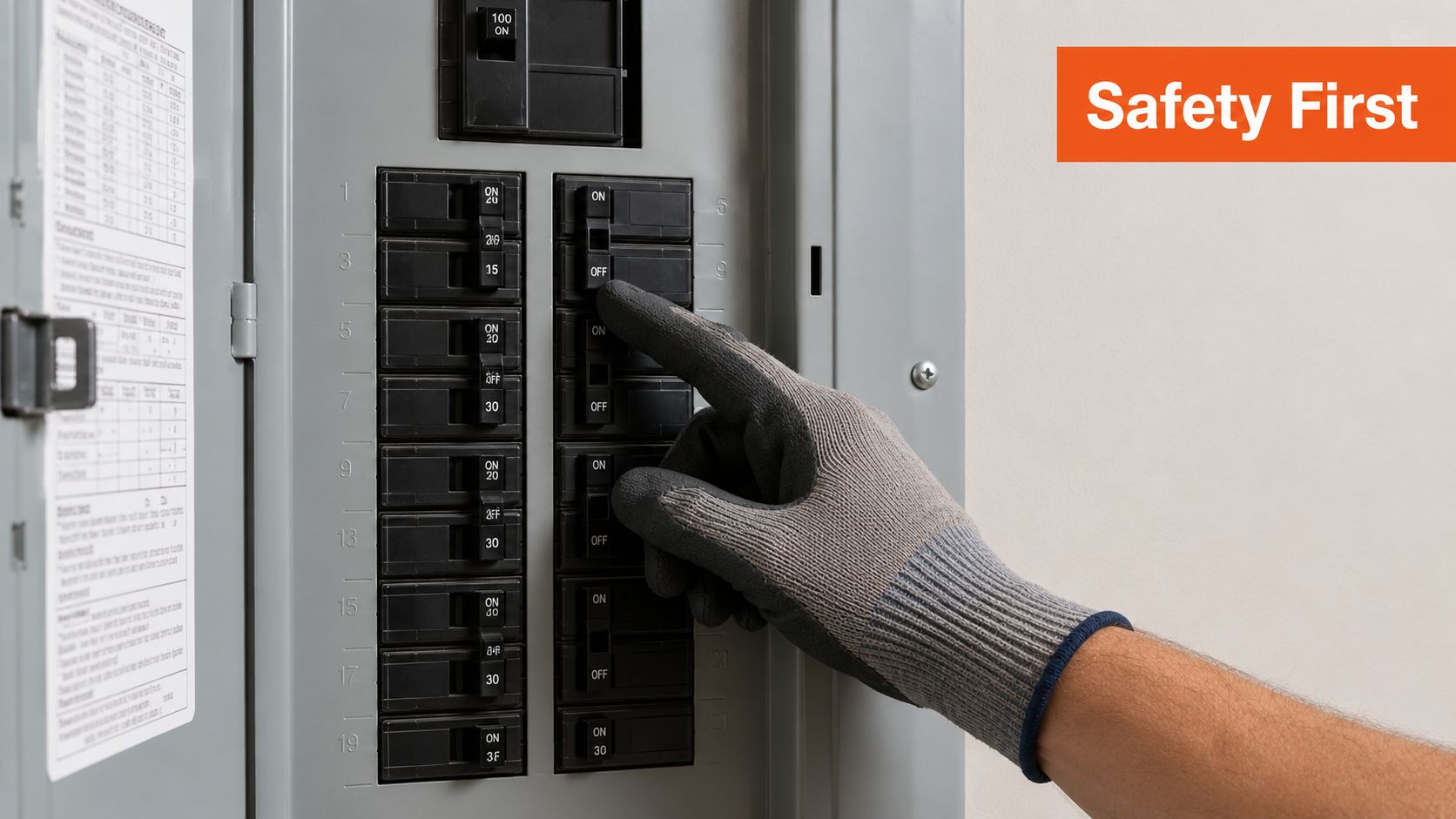
Stand near the panel without removing the cover and identify which breaker area the sound seems to come from. Then look around the house and ask what just turned on. AC condenser, air handler, pool equipment, water heater, microwave, dryer, and range circuits are frequent suspects.
A practical next step is reducing obvious load. Turn off or unplug heavy-use devices on the suspected circuit if you know what belongs there. If the sound started when multiple things were running together, that pattern is worth noting for the electrician.
- Try one reset only if the breaker has tripped and only if there's no burning smell, no visible damage, and no ongoing buzzing.
- Record the trigger so you can say, for example, "the panel buzzes every time the outdoor AC unit starts."
- Shut off the suspect breaker if the sound continues and you can do it safely without opening the panel.
For homeowners who aren't sure about reset basics, this homeowner's guide to resetting breakers gives a useful plain-language walkthrough.
What you must not do
Do not remove the panel cover. Do not tighten anything. Do not keep resetting a breaker that's buzzing or tripping. Repeated resets can force a failing breaker or damaged circuit to keep seeing fault current.
Safety limit: one reset is a check. Multiple resets are gambling.
This short video gives a helpful visual overview before you decide whether to leave the breaker off and call for service.
If you manage multiple home systems seasonally, this spring home-readiness visual from Heatwave reinforces the bigger point. Mechanical systems, plumbing loads, and electrical demand often overlap in real homes.

Professional Solutions Costs and the Florida HVAC Factor
Once a breaker starts buzzing consistently, the next step is professional diagnosis. Not guesswork. Not replacing the breaker on instinct. Diagnosis.
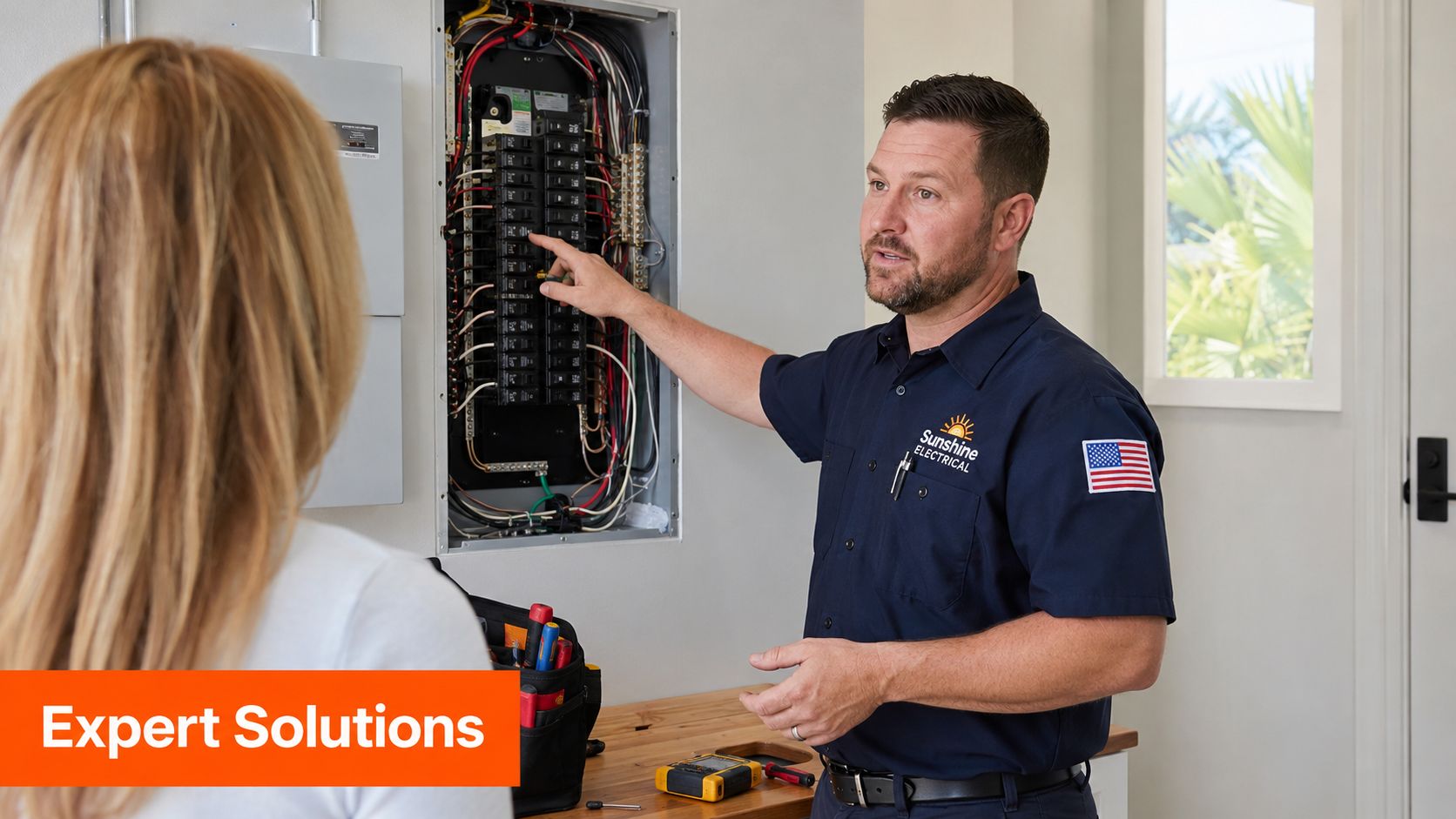
What a licensed electrician is actually checking
A good service call should answer four questions:
- Is the breaker bad because its internal mechanism is failing?
- Is the connection compromised at the breaker, bus, neutral, or equipment termination?
- Is the circuit overloaded under real operating conditions?
- Is the connected equipment causing the problem, especially the AC system?
That last point matters more in Florida than many homeowners realize. In high heat, compressors start under heavier strain. Aging motors, weak capacitors, hard-start behavior, and electrical imbalances can all show up first as panel noise.
Why the HVAC angle gets missed
The verified data here is important. The U.S. Department of Energy's 2025 data says over 40% of HVAC electrical failures in subtropical regions like Tampa Bay are misdiagnosed as simple breaker issues, leading to unnecessary and ineffective repairs. Since the prompt provided this as verified data without a public URL, it's best treated as a cited trade insight rather than linked to a source page.
That matches what many experienced techs see in the field. A homeowner hears buzzing at the panel, someone swaps the breaker, and the sound comes back because the compressor startup load was the actual trigger all along.
If the breaker buzzes when the AC starts, don't stop the diagnosis at the panel.
What the repair may involve
Sometimes the solution is straightforward. The electrician may find a loose termination, a damaged breaker, or a load issue that can be corrected cleanly.
Other times the right fix involves both electrical and HVAC work, such as:
- Breaker replacement when the breaker itself is defective or heat-damaged
- Connection repair when terminations show looseness, oxidation, or heat stress
- Circuit evaluation to verify the load matches the breaker and conductor
- HVAC electrical testing to see whether compressor startup, capacitors, contactors, or related components are over-stressing the circuit
- Soft-start evaluation in homes where AC startup surges are part of the complaint pattern
This local Tampa Bay media screenshot from Heatwave reflects the local reality well. In this region, comfort systems and electrical systems don't fail in isolation very often.

What doesn't work
Throwing parts at the problem rarely works. Replacing a breaker without checking the equipment load. Ignoring a buzzing panel because the AC still cools. Turning the breaker back on every afternoon and hoping it makes it through another heat cycle. Those are the patterns that turn a manageable repair into a larger safety issue.
Frequently Asked Questions About Buzzing Circuit Breakers
Can a buzzing breaker go away on its own
Sometimes the sound stops. That doesn't always mean the problem is solved.
There is one Florida-specific wrinkle homeowners should know. Recent NIST research from 2025 found that 25% of coastal Florida cases involve transient moisture-induced grounding faults that can dissipate within 24 hours of a weather change, but distinguishing that from permanent arcing requires professional assessment. Because the prompt provided this as verified data without a public report URL, it should be treated as a technical finding rather than linked to a public source page.
That means yes, weather-related buzzing can be temporary in some coastal conditions. No, that doesn't make it safe to assume your case is temporary.
If the breaker stops buzzing, can I ignore it
No. Intermittent electrical problems are often harder to diagnose because they come and go with load, temperature, and humidity. A breaker that only buzzes during afternoon cooling demand is still reporting a condition worth checking.
Should I just leave that breaker off
Leaving the breaker off can be the safest temporary step if the noise is persistent and tied to one circuit. But "off" is not a repair. If that breaker feeds your AC, water heater, well equipment, or another major system, you still need the underlying fault diagnosed before you restore normal use.
Is it always the breaker itself
No. The breaker is often the messenger. The root cause may be wiring, a loose connection, a grounding issue, or an HVAC startup problem.
What should I tell the electrician when I call
Be specific. Give the timing, the load, and the pattern.
When it happens
"Only when the AC starts" is much better than "sometimes."How it sounds
A steady hum, a loud buzz, or an irregular crackle point in different directions.What else you noticed
Warm panel cover, burning smell, dimming lights, a tripped breaker, or poor AC startup all matter.
For homeowners who value recent customer feedback before scheduling service, this Heatwave review snapshot is a quick way to gauge real service experiences.

Buzzing isn't a diagnosis. It's a warning. The right response is a careful inspection that looks at both the electrical panel and the equipment driving the load.
If your panel is buzzing, your AC startup is triggering noise at the breaker, or you want one team that can evaluate both the electrical side and the HVAC side, contact Heatwave Air Conditioning, Plumbing, & Electric. For homeowners in Tampa Bay, Sarasota, Port Charlotte, Cape Coral, and Fort Myers, that combined approach helps avoid the common mistake of replacing the breaker when the underlying problem is elsewhere.