
If you're in Tampa Bay or Southwest Florida, you probably know this situation already. One room feels cold enough, the hallway feels sticky, the back bedroom never catches up, and the electric bill keeps climbing anyway.
That's a common starting point when comparing central air conditioning vs window units. They're not really choosing between two machines. They're choosing between two very different ways to live through a Florida cooling season. In this climate, the right answer affects comfort, humidity, noise, upkeep, and how well your home handles months of steady heat.
Florida changes this conversation. In a mild climate, a window unit can be a workable compromise for longer. In our region, the long cooling season and constant moisture make weak spots show up fast. A system that seems “good enough” in spring can feel miserable by late summer.
I've seen homeowners wait too long because the short-term answer looked cheaper. Then they end up juggling multiple units, dealing with uneven cooling, and still not solving the muggy feel inside the house. If you want a quick local snapshot of the kind of real-world HVAC issues homeowners run into around here, this local Tampa Bay coverage image reflects the kind of concerns people bring up every season.

Choosing the Right AC for Florida's Heat
The first question isn't which unit is cheaper. The first question is what problem you're trying to solve.
If you need to cool one bedroom, a home office, or a small rental space, a window unit can absolutely do that job. It's direct, fast, and usually the simplest path when you need relief right away. That matters when the house is hot now, not next month.
If you need to cool the whole house, the conversation changes. In Florida, whole-home comfort isn't just about dropping the temperature. It's about pulling moisture out of the air, keeping rooms consistent, and avoiding that familiar pattern where one room is freezing while the rest of the house still feels damp.
Start with the mission
Ask yourself these questions first:
One room or the whole house
A window unit is built for localized cooling. Central air is built for full-house control.Temporary fix or long-term system
If you're bridging through a short-term problem, a window unit can make sense. If you're planning around years of Florida summers, short-term logic often gets expensive.Owner or renter
Renters often need something removable and low-commitment. Owners usually need to think beyond this month's purchase price.
Practical rule: If you're trying to make an entire Florida home comfortable with several window units, you're usually forcing a room-by-room tool to do a whole-house job.
What matters more in Florida
In Tampa Bay, Sarasota, Port Charlotte, Cape Coral, and Fort Myers, air conditioning runs hard and runs often. That means small inefficiencies and comfort problems don't stay small for long.
The best choice usually comes down to four things:
- Humidity control
- Energy use over time
- Noise and day-to-day comfort
- How much compromise you're willing to live with
A lot of homeowners can tolerate a window unit. Fewer prefer living with one once the heat settles in for months.
Central Air vs Window Unit at a Glance
Here's the fast version before getting into the details.
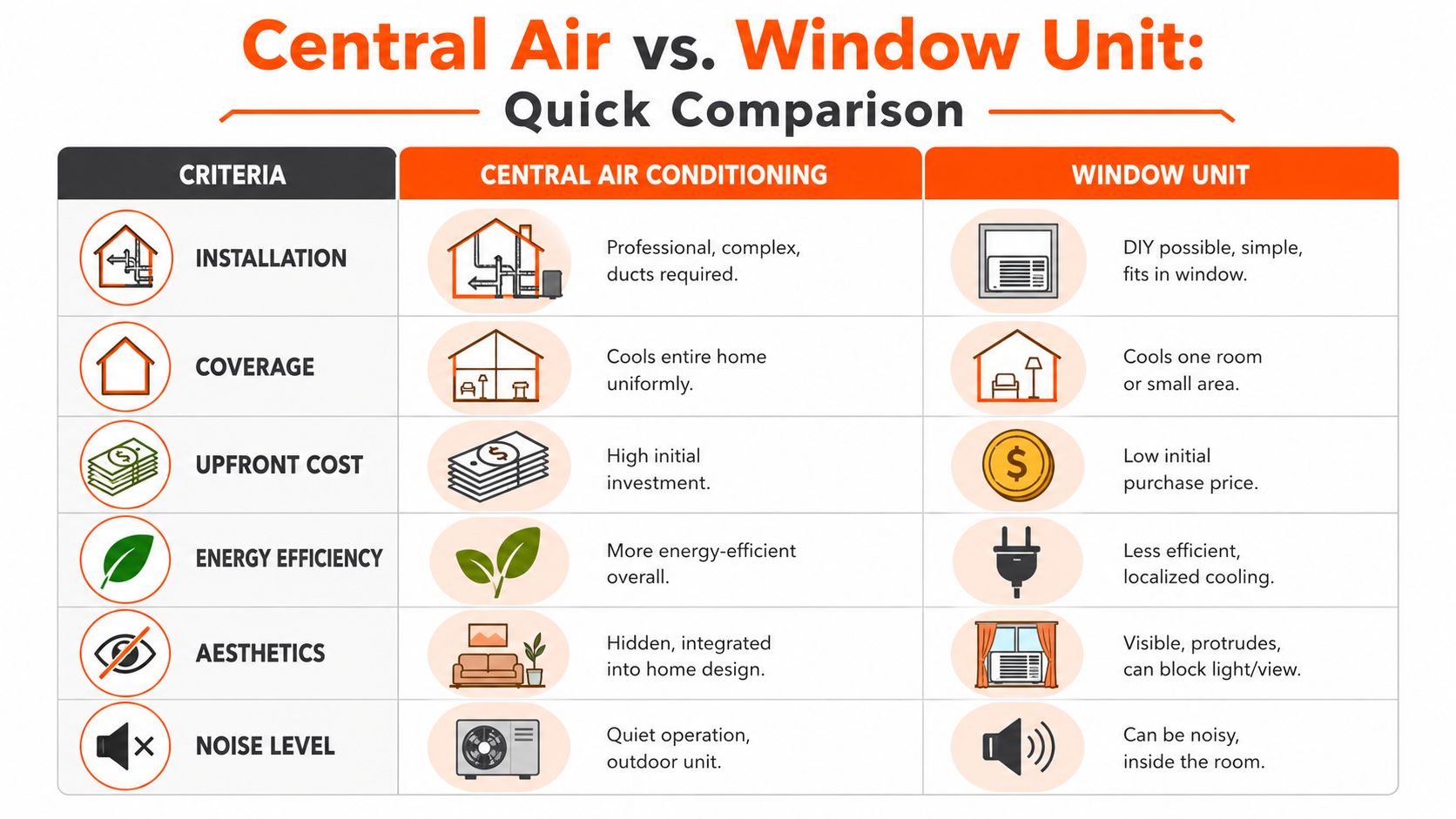
| Factor | Central Air Conditioning | Window Unit |
|---|---|---|
| Best fit | Whole-home cooling | One room or small area |
| Installation | Professional install, ductwork matters | Often simple, sometimes DIY |
| Comfort | More even temperatures across the house | Good in the room, limited beyond it |
| Humidity handling | Better for whole-home moisture control | Mostly affects the room it's in |
| Noise | Usually quieter indoors | Noise stays in the room with you |
| Appearance | Hidden except for vents and outdoor equipment | Visible, blocks part of the window |
| Upfront spending | Higher initial investment | Lower purchase cost |
| Long-term use | Better for owners planning to stay | Better for limited or temporary needs |
| Resale appeal | Fits normal whole-home HVAC expectations | Usually seen as a stopgap |
A lot of people want one simple winner. There isn't one. There's a right tool for a specific job.
When central air usually wins
Central air is the better fit when the house is your long-term home and you want it to feel consistent from room to room. It also makes more sense when you're tired of managing multiple devices, hearing them run, and working around blocked windows.
It's the system homeowners choose when they want the home to function like a complete conditioned space, not a series of cooled pockets.
To see a side-by-side visual breakdown, this video helps frame the practical differences before you decide:
When a window unit makes sense
A window unit is still a legitimate answer in a few situations:
- Single-room cooling when one room runs hotter than the rest
- Rental properties where permanent upgrades aren't practical
- Short-term relief while a larger HVAC decision is pending
- Tight upfront budget when immediate cooling matters most
A window unit is usually at its best when the problem is small and isolated. It gets stretched thin when the house is not.
Whole Home Comfort and Humidity Control
Florida comfort starts with moisture control. Temperature matters, but if the house still feels clammy, it won't feel comfortable no matter what the thermostat says.
That's where central air and window units separate fast in real use.
According to Home Cost Lab's comparison of central air and window units, central air systems maintain more consistent indoor temperatures and remove moisture from the entire home volume through a single return vent, while window units dehumidify only the immediate room they occupy. The same source says central systems typically last 15 to 20 years with proper annual maintenance, while window units usually last 8 to 12 years, making central air the stronger long-term fit for homes over 1,500 sq ft.
Why Florida homes expose the difference
In a dry climate, people can get away with more uneven cooling. In Tampa Bay and Southwest Florida, humidity moves through the house. If one bedroom is cold but the hall, living room, and closed-off corners still hold moisture, the house often feels unsettled all day.
That's why homeowners describe the problem in ways like:
- The air feels sticky by afternoon
- One room is cold, but the rest never feels right
- The house smells musty when rooms stay closed
- Sleeping is fine in one room, but mornings feel damp elsewhere
A central system addresses the house as one connected space. A window unit treats one opening and one room. That difference shows up fast in Florida.
Room comfort vs house comfort
A window unit can make the room around it feel cold quickly. That's real relief. But it also tends to create cold zones and hot spots, especially in larger homes or homes with chopped-up layouts.
Central air works differently. It's designed to condition the whole interior, which gives you a more stable feel from room to room. That steadiness matters more than many homeowners expect. Once the indoor climate stops swinging around, the house generally feels calmer, cleaner, and easier to live in.
Field insight: In Florida, people often think they have a temperature problem when they really have a humidity and distribution problem.
There's also a lifestyle difference. Window units put the mechanical noise in the room with you. Central systems usually keep the loudest components away from your living space, so bedrooms and living rooms stay quieter.
What helps if the sun load is part of the problem
Some comfort issues start with the envelope of the house, not just the AC equipment. West-facing glass, harsh afternoon sun, and rooms with poor shade can overwhelm a cooling setup faster than people expect.
If you're comparing ways to reduce heat gain at the window level, this Guide for Phoenix homeowners is useful because it lays out the trade-offs between solar screens and window tint in a practical way. The climate is different, but the logic around solar gain still applies when you're trying to keep one side of the house from overheating.
For homeowners thinking visually about airflow and home comfort, this HVAC image reference also matches the kind of indoor comfort issues that show up when cooling isn't balanced across the house.

Analyzing the Full Cost of Cooling Your Home
The cheapest unit to buy is not always the cheapest system to live with. That's the mistake I see most often when homeowners compare central air conditioning vs window units.
A window unit usually wins the first receipt. Central air often wins the longer math, especially in Florida where cooling isn't a short season.

Efficiency is where central air pulls ahead
According to Journeyman HQ's comparison of window AC and central air conditioning, central air systems typically run at 14 to 25 SEER, while window units generally top out around 10 to 12 SEER. The same source says central air can be 20% to 40% more energy-efficient for cooling entire homes, and homeowners may save 25% to 30% on monthly cooling costs when switching from multiple window units to one central system in larger homes or warmer climates.
That matches what happens in the field. A single whole-home system, when it's sized correctly and the ductwork is in good shape, usually does a better job than several separate room units working harder in different parts of the house.
What SEER actually means to a homeowner
You don't need to get deep into HVAC math to use SEER well. Higher Seasonal Energy Efficiency Ratio means the equipment delivers cooling more efficiently over a season.
For homeowners, the practical takeaway is simple:
- Higher SEER equipment uses energy more effectively
- Whole-home central systems are built for distributed cooling
- Multiple window units often duplicate effort instead of solving the house as a system
That last point matters in Florida. When the living room unit, bedroom unit, and bonus room unit are all fighting different heat loads, you're not just paying for cooling. You're paying for inefficiency, uneven comfort, and extra wear.
The full cost is not just the power bill
Ownership cost includes more than electricity.
Here's what people often miss when they focus only on purchase price:
| Cost category | Central Air | Window Units |
|---|---|---|
| Purchase and install | Higher upfront | Lower upfront |
| Cooling coverage | Whole home | Room by room |
| Replacement cycle | Longer-term equipment path | More frequent replacement tendency |
| Daily convenience | One integrated system | Multiple units to manage |
| Home appearance | Cleaner exterior and interior look | Visible from outside and inside |
Buying several low-cost units can feel frugal. Living with them for years often isn't.
When lower upfront cost is the right move
A window unit isn't a bad financial decision if the mission is narrow. If you're cooling one room, dealing with a temporary issue, or trying to get through a gap before a larger replacement, then lower upfront cost can be the right call.
But if the house needs true whole-home cooling, the lower purchase price can hide a more expensive long-term path. Florida's long cooling season exposes that quickly.
Installation and Maintenance Requirements
The installation side of this decision is straightforward. Window units are simpler. Central air is more involved. The important part is understanding what “simpler” and “more involved” mean in real life.
What installing a window unit really involves
A window unit is usually the fastest path to cold air. In many cases, a homeowner can install one without hiring a contractor. That's the appeal.
But even a simple install comes with trade-offs:
Window fit matters
If the unit doesn't seat securely, you get air leaks, water issues, and a weaker seal against outdoor humidity.Support and safety matter
A poorly mounted unit can shift, rattle, or strain the window frame.You live around the unit
It takes up the window, changes how the room looks, and limits light or view in that space.
Maintenance is also more hands-on than people expect. If you run several window units, you now have several filters to clean, several coils to keep an eye on, and several separate pieces of equipment that can fail independently.
What central air installation involves
Central air needs professional design and installation. That's not just because of the equipment. It's because the system has to match the house.
A proper install usually includes checking:
- System sizing
- Duct condition and layout
- Airflow balance
- Drainage and condensate handling
- Electrical capacity
- Permit requirements where needed
That's especially relevant in Florida markets where homes vary a lot by age, insulation quality, and layout. A system that's too large or too small won't behave the way homeowners expect, even if the equipment itself is high quality.
For homeowners who want a visual cue for the kind of home-service logistics that come with seasonal system work, this service snapshot reflects the general reality of planning ahead before equipment problems become urgent.

The maintenance difference over time
Central air usually wins on simplicity once it's installed correctly. You're maintaining one integrated system instead of several separate room units.
A practical maintenance split looks like this:
- Window units need regular cleaning at each unit, plus attention to mounting, drainage, and room-by-room performance.
- Central air benefits from scheduled professional service and routine filter changes, but daily life is easier because the equipment is not scattered through the house.
The best cooling setup is the one you can maintain consistently. Neglected equipment of any type loses performance fast in Florida.
Which Cooling System Is Right for Your Home
The right answer depends less on brand and more on your house, budget, and expectations. Some homeowners need the fastest affordable fix. Others need a system that will still make sense several summers from now.
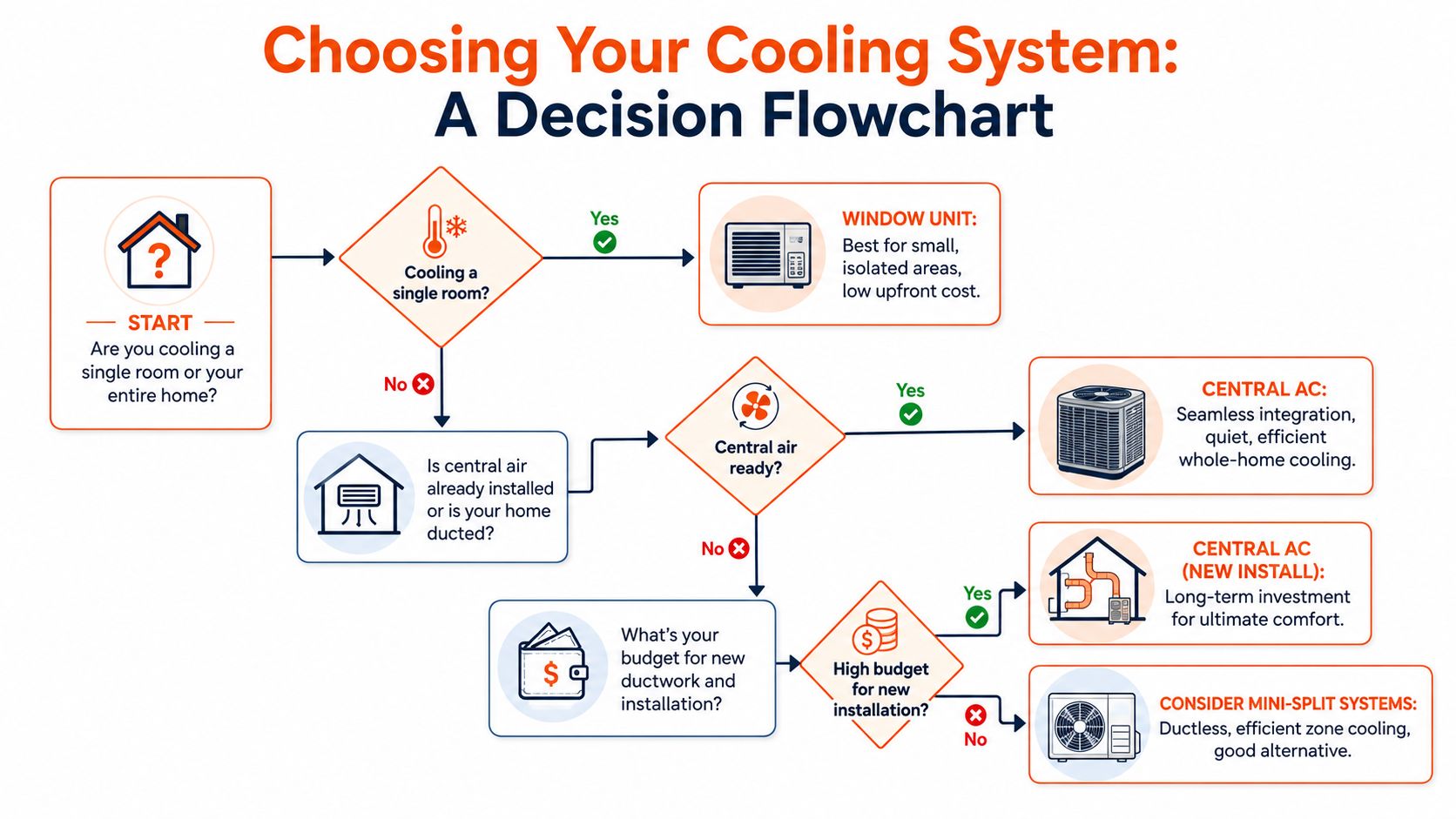
Choose a window unit if your situation looks like this
A window unit is usually the right fit when the need is limited and specific.
That includes homeowners or renters who are dealing with:
- One problem room that needs extra cooling
- A short-term gap while a larger HVAC repair or replacement is pending
- A small space where whole-home infrastructure doesn't make sense
- A strict upfront budget where immediate relief matters more than long-term optimization
If that's your situation, a window unit is not a compromise. It's an appropriate tool. The mistake is treating it like a permanent whole-house strategy when the house clearly needs more.
Choose central air if your house needs to feel consistently comfortable
Central air makes more sense when your goal is to cool the home as one environment. That's the better path for owners who want stable comfort, less indoor noise, fewer visible appliances, and a more integrated setup.
It's usually the stronger choice when:
| Home situation | Better fit |
|---|---|
| Cooling one isolated room | Window unit |
| Cooling a full-time primary residence | Central air |
| Planning to stay in the home | Central air |
| Renting or avoiding permanent changes | Window unit |
| Wanting cleaner aesthetics and quieter rooms | Central air |
Don't ignore the middle option
Sometimes the answer is neither central air nor a window unit. If the home doesn't have usable ductwork and you need better-than-window-unit performance, a ductless mini-split can be the smarter path.
That's especially true for:
- Room additions
- Converted garages
- Detached spaces
- Homes where adding ducts would be disruptive
This cooling system graphic is a useful reminder that not every home fits neatly into a two-option decision.

If you need to cool the entire house and you care about comfort in Florida, central air usually becomes the logical answer. If you need targeted relief in one room, a window unit still has a place.
The fastest way to decide
Use this simple filter:
- Cooling one room only means start with a window unit.
- Cooling the whole house means central air deserves serious attention.
- No ductwork and no interest in multiple window units means consider a mini-split before buying several box units.
That's the practical version. Keep the tool matched to the job.
Get Your Free Cooling Estimate from Heatwave
If you're still weighing central air against window units, the most useful next step is having your actual home evaluated. Online comparisons help, but they can't see your duct layout, insulation, room distribution, sun exposure, or the way humidity is building inside your house.

For many Florida homeowners, the turning point is seeing the operating difference clearly. According to Questions About HVAC's guide to central AC vs window units, an 18 SEER central system can reduce electricity consumption per BTU of cooling by 30% to 50% compared with multiple window units that operate around 10 to 12 SEER. The same source says a properly sized central system can cool an equivalent whole-home space using 1,700 to 2,000 watts, while three window units may draw 2,700 to 3,600 watts combined, with potential annual savings of $400 to $700 over a five-month cooling season in warm climates like Florida.
That doesn't mean every house should jump straight to central air. It does mean the decision deserves real numbers tied to your layout and your usage.
What a good estimate should tell you
A useful estimate should answer practical questions, not just hand you a price.
Look for clarity on:
- Whether your home is a good candidate for central air
- Whether your existing ductwork helps or hurts performance
- Whether a room-by-room strategy is solving the right problem
- What kind of efficiency and comfort improvement is realistic
If you're also paying attention to service reputation before making a decision, this customer review image is the kind of trust signal many homeowners check before booking an in-home estimate.

For homeowners in Tampa Bay, Sarasota, Port Charlotte, Cape Coral, and Fort Myers, local conditions matter. Salt air, heavy humidity, long runtime, and mixed housing stock all affect what works and what doesn't. A generic national answer won't be as useful as a home-specific recommendation.
If you're ready to stop guessing, contact Heatwave Air Conditioning, Plumbing, & Electric for a free cooling estimate. Their team serves Tampa Bay and Southwest Florida with HVAC, plumbing, and electrical expertise, and they can help you decide whether central air, a targeted room solution, or another setup makes the most sense for your home.