
Let's get straight to it: when you need a new AC installation in Southwest Florida, you can expect to pay anywhere from $4,500 to $12,000. This isn't a simple, one-size-fits-all price. That range covers everything from a straightforward central AC unit swap to a more involved, high-efficiency system installation.
Your Quick Guide to New AC Installation Costs
When your air conditioner finally calls it quits in the middle of a sweltering Tampa Bay summer, the first thing on your mind is almost always the cost of a replacement. But the final number on your quote isn’t just pulled out of thin air. It’s a combination of the equipment itself, how complex the job is, and the professional expertise needed to get it done safely and reliably.
Think of it less like buying an appliance off a shelf and more like commissioning a custom project for your home's most essential system. While the national average for a new central air system often falls between $3,900 and $7,900, Florida is a different beast. Our relentless cooling season, salty air, and specific building codes mean those numbers can easily shift. You can dig deeper into general HVAC facts and statistics on Workyard.com.
Estimated AC Installation Cost Ranges in Florida
To give you a clearer starting point, we've put together a table breaking down what you can realistically expect to pay. This financial snapshot helps you see where your project might land based on its scope.
| Project Type | Low-End Estimate | Average Cost | High-End Estimate |
|---|---|---|---|
| Standard Central AC Replacement (existing ductwork) | $4,500 | $7,500 | $10,000 |
| High-Efficiency Central AC (16+ SEER) | $6,500 | $9,000 | $12,500+ |
| Ductless Mini-Split System (single zone) | $3,500 | $5,000 | $7,000 |
| Full HVAC System Replacement (AC & Furnace/Air Handler) | $7,000 | $10,500 | $15,000+ |
Keep in mind, these are just estimates. The only way to get a firm, accurate number is to have a professional come out and assess your home’s unique needs—from its square footage and insulation to the condition of your existing ductwork.
The system you choose is, by far, the biggest factor driving your total investment. A sprawling home in Fort Myers will naturally need a more powerful—and more expensive—unit than a small condo in Sarasota. Our ultimate guide on how to choose the right HVAC system for your home breaks down all the details to help you make a smart decision.
Understanding these variables is the first step toward budgeting for your project and making sure you get the absolute best value for your new cooling system.
Decoding Your AC Installation Quote
Getting a quote for a new AC installation can feel like trying to read a foreign language. The long list of parts, services, and numbers can be a lot to take in, but every estimate really breaks down into three core pillars that shape the final cost of new ac installation. When you understand what these components are, you can compare offers like a pro and feel confident you’re getting a fair deal.
Think of your quote like a recipe. The main ingredients are the AC unit itself, the skilled labor needed to put it in, and a few other essential materials and services. Let’s break down that recipe, piece by piece.
The Heart of the System: Equipment Costs
The biggest single line item on your quote will almost always be the air conditioning unit itself. This price isn't set in stone; it can swing pretty dramatically depending on the system's performance, how long it's built to last, and its energy efficiency.
Just like with cars, brand reputation definitely plays a role. Well-known brands like Trane or American Standard often carry a higher price tag, but they've earned a reputation for reliability and solid warranties. On the flip side, brands like Goodman or Rheem can be a more budget-friendly option.
But beyond the brand name, two other critical factors drive the equipment cost:
- System Size (Tonnage): Sized in "tons," this number measures the unit's raw cooling power. A sprawling home in Fort Myers is going to need a much more powerful (and more expensive) unit than a small condo. Getting the size right is crucial—an undersized unit will run constantly and never keep up, while an oversized one will turn on and off too quickly, wasting energy and failing to dehumidify properly.
- Efficiency (SEER Rating): The Seasonal Energy Efficiency Ratio (SEER) is basically your AC's version of a car's MPG. The higher the SEER rating, the lower your monthly electric bills will be, which is a massive deal during Florida's nearly year-round cooling season. A high-efficiency unit costs more upfront, but the long-term savings can be substantial.
The Expertise Behind the Install: Labor Charges
When you look at the labor cost, it’s easy to just see it as payment for a few hours of work. In reality, that number represents a complete professional service that ensures your new system is installed safely, correctly, and up to code. It’s what separates a system that runs like a dream for 15 years from one that’s a constant source of repair bills.
A professional installation isn't just about connecting a few wires and pipes. It’s a meticulous process that protects your huge investment, keeps your warranty valid, and guarantees your family’s comfort and safety.
This all-inclusive service usually covers:
- Home Assessment & Load Calculation: A technician performs a detailed analysis of your home to figure out the exact size and type of unit you need. No guesswork involved.
- Safe Removal & Disposal: The old, heavy equipment is carefully disconnected and hauled away. This includes properly handling and reclaiming old refrigerant according to strict EPA regulations.
- Precise Installation: The new indoor and outdoor units are set, connected, and calibrated exactly to the manufacturer's specifications and local building codes.
- System Testing & Commissioning: Once everything is hooked up, the entire system is put through its paces. The technician rigorously tests airflow, refrigerant levels, and electrical connections to make sure everything is perfect.
The Often Overlooked Essentials: Other Materials and Permits
Finally, a good quote will include costs that go beyond the unit and the main installation labor. These are the necessary bits and pieces—and the administrative steps—that are easy to forget but are absolutely essential for a legal, successful installation. Think of them as the finishing touches that pull the whole project together.
These "other" costs typically include:
- Municipal Permits: Just about every city and county in Florida requires a permit for an AC installation. This ensures the work is done to code and gets inspected. A reputable contractor will handle this entire process for you.
- Electrical Upgrades: An older home might have an electrical panel that just can't handle the power demands of a modern, high-efficiency AC. If an upgrade is needed, this will be an additional cost. You can learn more about what's involved with home electrical panel upgrades to see if this might apply to your home.
- New Refrigerant Lines: To guarantee the new system is clean and free of contaminants from the old unit, it's often best practice to install a brand new "line set" connecting the indoor and outdoor units.
- Condensate Drain & Pad: A new drain line to manage moisture and a sturdy, level pad for the outdoor unit to sit on are small but non-negotiable parts of a proper job.
By understanding these three pillars—equipment, labor, and extras—you can read any AC quote with confidence, ask the right questions, and make a smart decision for your home.
How System Type And Size Affect Your Budget
Picking a new air conditioner isn't like grabbing an appliance off the shelf at a big-box store. It’s more about finding the perfect fit for your home's specific cooling demands, and the two factors that will steer your budget more than any others are the system type and its size.
Think of it like buying a pair of shoes. Too small, and they’ll be painfully ineffective. Too big, and they’ll be clunky, inefficient, and cause a different set of problems. It’s all about finding that just-right balance of power, efficiency, and price.
Let's walk through the most common options we see here in Florida and break down how each choice hits your wallet.
This graphic really helps visualize all the different pieces that come together to form the total investment.
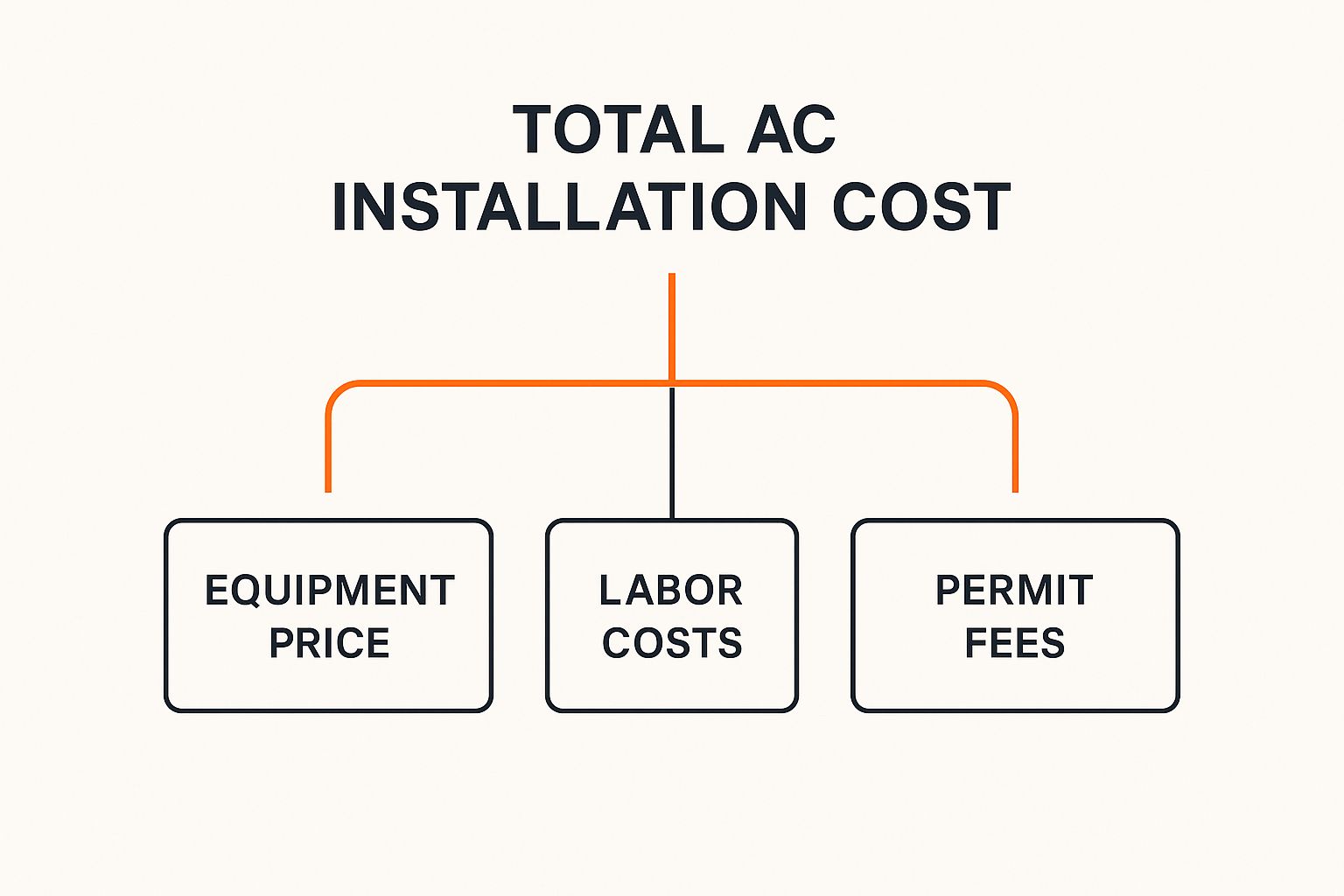
As you can tell, the equipment price tag is just one part of a much bigger financial puzzle.
Comparing Common AC System Types
Every type of air conditioning system comes with its own set of pros, cons, and, of course, a different price point. Getting a handle on these differences is the key to making a smart decision that truly fits your home and keeps your family comfortable.
- Traditional Central Air: This is the undisputed workhorse of cooling in Florida. It relies on a network of ducts to push cool air from a central air handler throughout your home. If you're simply replacing an old central AC and your ductwork is in good shape, this is usually the most direct and budget-friendly route, typically running from $4,500 to $10,000.
- Ductless Mini-Splits: These systems are the champions of flexibility. An outdoor compressor connects to one or more wall-mounted indoor units, which lets you create independent temperature "zones." They are a fantastic solution for older homes without existing ductwork, new additions, or that one room that’s always impossible to cool. A single-zone setup might fall between $3,500 and $7,000, with the cost climbing as you add more indoor units.
- Heat Pumps: A heat pump is a clever all-in-one machine that handles both cooling and heating. In the summer, it pulls heat out of your house; in the winter, it reverses the process and pulls heat in from the outside air. Given our mild Florida winters, they are an incredibly efficient choice. While they cost a bit more upfront, the savings on heating can be substantial. The price here can vary wildly, from $2,500 to as high as $39,000 for high-end geothermal systems.
Your home's existing setup is a huge factor here. A house with solid, well-maintained ductwork is a perfect match for a new central air system. But a historic home or a converted garage might be much better off with a ductless mini-split.
Why "Right-Sizing" Your Unit Is Not Negotiable
Once you’ve landed on a system type, the next crucial step is getting the size—or "tonnage"—exactly right. We’re not talking about physical weight; tonnage is a measure of cooling power. One ton equals the ability to remove 12,000 BTUs (British Thermal Units) of heat from your home per hour. Nailing this number is absolutely critical.
A unit that’s too small will run itself into the ground. It’s like a marathon runner who never gets a water break—it will chug along constantly, struggling to hit the temperature on your thermostat, which means sky-high energy bills and a system that dies an early death.
On the flip side, a unit that's too big is just as bad. It will blast your home with cold air so fast that it satisfies the thermostat before it has a chance to pull the sticky humidity out of the air. This is what causes that cold, clammy feeling we all hate in Florida. This rapid on-and-off process, known as "short-cycling," wastes a ton of energy and puts incredible strain on the compressor.
Our professional AC installation services always start with a detailed load calculation to ensure your new system is sized perfectly for your home, no guesswork involved.
Understanding SEER Ratings and Long-Term Savings
When you’re looking at quotes, it’s easy to get lost in the alphabet soup of technical terms. But there’s one you absolutely need to get familiar with: SEER, which stands for Seasonal Energy Efficiency Ratio.
Think of it like a car's MPG (miles per gallon)—the higher the number, the more efficiently it runs and the less fuel it burns to get the job done.
For your AC, that "fuel" is electricity. A higher SEER rating means your system uses far less energy to pump out the same amount of refreshingly cool air. In Florida’s nearly year-round cooling season, this single number has a massive impact on your monthly utility bills.
SEER Minimums and Why They Matter in Florida
The U.S. Department of Energy gets that a home in Tampa has very different cooling needs than one in Minnesota. That’s why they set minimum efficiency standards that change by region.
Because of our intense heat and humidity, homeowners in the Southeast—including all of Florida—are required to install new systems with a minimum rating of 14.3 SEER2 or higher. This ensures every new installation meets a modern baseline for efficiency.
But just meeting the minimum isn't always the smartest financial move. Opting for a higher SEER unit is an upfront investment that literally pays you back, month after month, on your FPL or Duke Energy bill.
The sticker price of a high-efficiency AC unit can be intimidating, but it’s crucial to see it as a long-term investment. Over a 10- to 15-year lifespan, the accumulated energy savings often blow past the initial price difference between a basic and a premium model.
For example, our selection of Heatwave Signature Air Conditioners includes models with impressive SEER ratings specifically designed for the Florida climate. Exploring energy-efficient tech like this is the best way to see how modern engineering translates directly into lower bills.
Calculating Your Potential Long-Term Savings
This is where the real magic happens. Upgrading from an old, clunky unit to a new, high-efficiency model can slash your cooling costs by a whopping 20% to 50%. An air conditioner that's just 10 years old might have a SEER rating of 10 or even less. Swapping that out for a 16 SEER unit could save you hundreds of dollars every single year.
To make this crystal clear, let’s look at how these savings can stack up.
Annual Savings by Upgrading Your AC's SEER Rating
This table shows the real-world savings you could see each year by replacing an outdated AC with a more efficient model in a typical Florida home.
| Old SEER Rating | New SEER Rating | Estimated Annual Savings |
|---|---|---|
| 8 SEER | 15 SEER | ~$450 – $600 |
| 10 SEER | 16 SEER | ~$375 – $500 |
| 10 SEER | 18 SEER | ~$440 – $650 |
| 12 SEER | 20 SEER | ~$400 – $600 |
As you can see, the jump in efficiency translates directly into serious cash back in your pocket. By weighing the upfront cost against these long-term operational savings, you can make a smarter, more financially sound decision for your home's comfort and your wallet.
Smart Ways to Save on Your New AC Installation
Knowing what goes into the cost of a new AC installation is one thing, but now for the part you’ve been waiting for—how to actually shrink that final price tag without cutting corners on quality. With the right strategy, you can make this critical home upgrade far more affordable. The secret is thinking like an informed buyer who knows where to find savings and when to make a move.
Think about it like booking a major vacation. You wouldn't just grab the first flight you see. You'd compare airlines, look for off-season deals, and hunt for special promotions. The exact same logic applies here. The global air conditioning market is valued at roughly USD 124.6 billion in 2024, which means it's a competitive space you can absolutely use to your advantage.
Time Your Purchase Strategically
One of the simplest ways to save a buck is to avoid the stampede. HVAC contractors are swamped during the peak of summer when AC units are failing left and right and in the dead of winter when furnaces decide to quit. When demand is high, so are the prices.
Instead, try to schedule your installation during the “shoulder seasons”—those mild months in spring and fall. Companies are much more likely to offer promotional deals and discounts to keep their technicians busy during these slower periods. A little bit of planning ahead can easily save you hundreds of dollars.
Seek Out Rebates and Tax Credits
Don't leave free money sitting on the table. Both the government and local utility companies want you to install a high-efficiency air conditioner because it takes a huge strain off the power grid. To sweeten the deal, they offer some pretty valuable financial incentives.
- Federal Tax Credits: The federal government often gives out tax credits for installing ENERGY STAR® certified high-efficiency systems. These credits can be worth up to 30% of the total project cost, potentially putting thousands back in your pocket.
- Manufacturer Rebates: AC manufacturers frequently run their own rebate programs on specific high-end models, especially during certain times of the year. Always ask your contractor what offers are currently available.
- Local Utility Rebates: Power companies like FPL and Duke Energy often provide direct rebates to customers who upgrade to more efficient units. It's always worth checking their websites for current programs in our area.
Stacking these incentives is a pro-level move. It’s often possible to combine a federal tax credit, a manufacturer rebate, and a local utility incentive, which can drastically slash your out-of-pocket cost.
Get Multiple Quotes but Compare Apples to Apples
Getting at least three quotes from reputable, licensed contractors is non-negotiable. But remember, the goal isn't just to find the rock-bottom price. A suspiciously cheap quote can be a red flag for cut corners, cheap materials, or an improperly sized unit that will cost you more down the road.
When you're looking at the estimates, make sure each one outlines the exact same scope of work. Look for the specific model numbers of the air handler and condenser, read the warranty details, and get a clear breakdown of labor and material costs. This is the only way to make a true apples-to-apples comparison of the value you're getting, not just the price.
Finally, don’t let the upfront cost be a barrier to getting the right system for your home. Many homeowners choose to spread the investment out over time with easy, manageable monthly payments. Exploring the available AC financing options can make it much easier to afford a high-efficiency unit that will deliver bigger savings in the long run.
Answering Your Top AC Installation Questions
As you get closer to making a decision, a few final questions always seem to pop up. That’s perfectly normal. Getting a handle on the practical side of the project helps set clear expectations and makes the whole process feel much smoother from start to finish.
We've put together this FAQ section to clear up any lingering questions about your new AC installation and what to expect. These are the most common things Florida homeowners ask us, answered directly and honestly.
How Long Does a Typical AC Installation Take?
For a standard replacement—what we call a "swap out"—where we're just replacing your old central AC unit with a new one, the job usually takes between 4 to 8 hours. This timeline assumes your existing ductwork and electrical setup are in solid shape and ready to go.
However, if the job is more complex and requires installing new ductwork throughout your home, the timeline can easily stretch to 2 or even 3 days. It really all comes down to the complexity of the job and the type of system we're putting in.
Should I Repair My Old AC or Replace It?
This is the big one, isn't it? A fantastic rule of thumb we use in the field is the "5,000 Rule."
It’s simple: multiply the age of your air conditioner (in years) by the repair cost you were just quoted. If that number is over $5,000, it's almost always a smarter financial move to replace the whole unit.
Beyond the math, there are other clear signs it’s time to say goodbye. If your AC is over 10-12 years old, still uses the now-phased-out R-22 refrigerant, or just seems to need one expensive repair after another, replacement is your best bet.
Do I Need a Permit for AC Installation in Florida?
Yes, you absolutely do. A building permit is required for a new AC installation in just about every city and county across Florida. This isn't just bureaucratic red tape; it’s a critical step to ensure the work is done safely and meets local building codes. It protects your family, your home, and its resale value.
Any reputable, licensed HVAC contractor will handle the entire permitting process for you. That means they file the paperwork, schedule the final inspection, and make sure everything is above board. The permit fee is typically just rolled into your total project quote, so there are no surprises.
If you want to dig a bit deeper into your home's cooling system, you can find further air conditioning insights on our resource page.
Ready to get a clear, no-obligation quote for your AC installation? The team at Heatwave Air Conditioning, Plumbing, & Electric is here to help you find the perfect, most cost-effective solution for your home. Get your free estimate today!