
It's late, half the house just went dark, and now there's a sharp smell near an outlet or panel. That's the moment most homeowners stop caring about “someday” electrical maintenance and start asking one simple question. Do I need help right now?
My advice is straightforward. If your electrical system is acting in a way that suggests heat, arcing, smoke, or unstable power, don't wait until morning. An emergency 24 hour electrician exists for exactly this situation. The point isn't convenience. The point is safety, fast diagnosis, and stopping a bad problem from getting worse.
Most emergency calls feel chaotic because homeowners don't know what counts as urgent, what to do first, or what the bill will look like. That confusion is normal. It's also avoidable. If you understand the warning signs, the first safety steps, and the way an after-hours call usually works, you can make a calm decision instead of a panicked one.
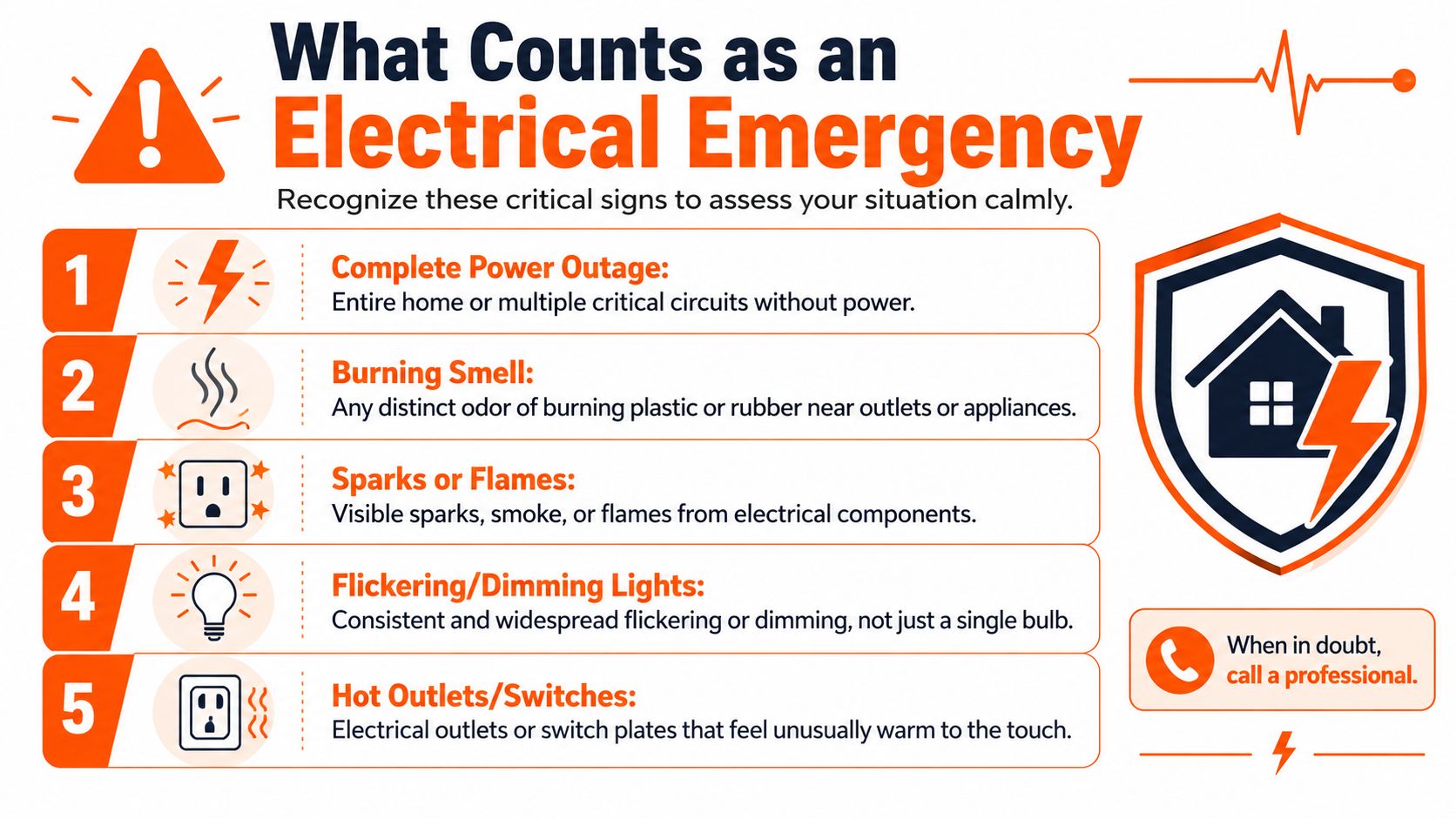
What Counts as an Electrical Emergency
A real electrical emergency usually announces itself before it fails completely. You might hear buzzing at the panel, smell hot plastic near a receptacle, or watch lights dim when they shouldn't. Those aren't random annoyances. They're warning signs.
Recognize these critical signs to assess your situation calmly.
The signs you should take seriously
Here's the short version. Call for immediate help if you have:
- Burning odors near outlets, switches, appliances, or the breaker panel
- Sparks, smoke, or visible flame from any electrical component
- Repeated breaker trips, especially if the same circuit won't stay on
- Widespread flickering or dimming that affects more than one room
- A major outage inside the home when the issue appears to be limited to your property
- Hot outlets or switch plates that feel warmer than they should
A breaker that trips once isn't always an emergency. A breaker that trips again and again is different. Consider a smoke alarm that keeps going off. The alarm itself isn't the problem. It's telling you there's a problem you haven't fixed.
Practical rule: If the symptom involves heat, smell, smoke, sparks, or repeated failure, treat it as urgent.
From a safety standpoint, the highest-risk residential electrical emergencies are burning odors, sparks, smoke, and repeated breaker trips, because they can point to overloads, loose terminations, or failing devices. Guidance also says occupants should evacuate immediately, avoid touching wires or equipment, and call 911 if smoke or fire is present, as noted by emergency electrical safety guidance from Echelon Electric NJ.
What is not usually an emergency
Not every electrical problem needs an after-hours truck roll. A single dead outlet, one bad light switch, or one flickering bulb usually falls into normal service unless it comes with heat, odor, or sparking. Annoying? Yes. Dangerous right now? Usually not.
If an electrical problem has already caused visible fire or smoke damage, DamageHelpers connects Orlando homeowners with restoration help. That can be useful after the immediate hazard is under control.
For a quick visual example of a home service warning scenario, see this household safety image reference.
Immediate Safety Steps Before Your Electrician Arrives
When there's an active electrical problem, your job is not to diagnose it. Your job is to keep people safe until the electrician gets there.
Here's the basic first-response checklist.

What you should do right away
- Keep your hands off the problem. Don't touch exposed wires, damaged outlets, a wet electrical panel, or a cord that looks burned.
- Cut power if you can do it safely. If you can reach the panel without crossing water, smoke, or sparks, shut off the main breaker.
- Clear the area. Keep kids, pets, and anyone else away from the affected room or equipment.
- Call an emergency 24 hour electrician. Give the dispatcher the exact symptom, your address, and whether you smell burning or see smoke.
That's enough. You do not need to prove how handy you are at midnight.
What not to do
- Don't use water on an electrical fire
- Don't keep resetting a breaker that trips immediately
- Don't open up fixtures or outlets to “take a look”
- Don't stand in water while touching anything electrical
If the event is part of a larger outage and you need a practical household checklist for lights, batteries, and temporary lighting, LuminAID's power outage resources are worth bookmarking.
This short video also gives a useful general overview while you wait for help:
For another home-system preparedness visual, this seasonal home service screenshot is a good reminder that prevention and access matter before emergencies happen.

If there's smoke or active fire, stop reading and call 911 first.
What to Expect When You Call a 24 Hour Electrician
It's 11:40 p.m., part of the house is dark, and you need a straight answer fast. A good emergency electrician should give you exactly that. The process should feel clear from the first phone call to the final invoice.
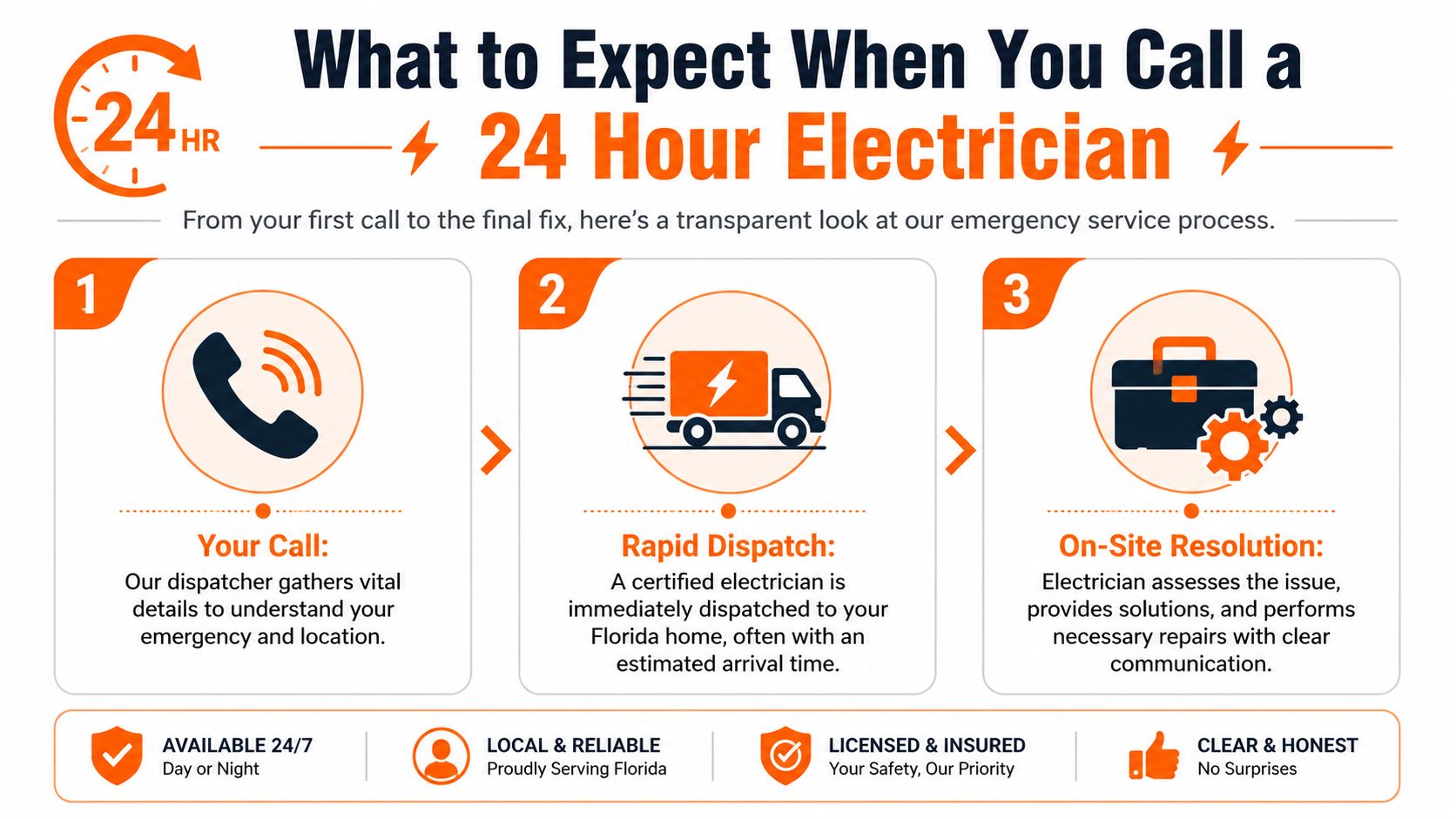
What happens on the call
The dispatcher should ask focused questions that help sort urgency and prepare the technician. Expect questions about what failed, what still has power, whether you smell something burning, and whether the issue is affecting one area or multiple parts of the home.
You should also get practical information before anyone heads your way. Ask for the arrival window, whether there is a separate after-hours charge, and what the technician is coming prepared to do. If the answers are vague, that's a warning sign.
Analysts at Craftsman Electric explain in this 24-hour emergency electrician operations overview that emergency calls are typically dispatched quickly and commonly prioritized for fast arrival. That matches what homeowners should expect. Speed matters, but clarity matters just as much.
What the electrician does when they arrive
The first goal is to identify the hazard and make the home safe. That may mean shutting off part of the system, opening the panel, testing circuits, checking damaged devices, and tracing where the failure started.
Some problems are simple and can be fixed on the spot. Others need a safe temporary correction that gets you through the night until a full repair can be scheduled with the right parts. A competent electrician will tell you which kind of job you have.
Common after-hours repairs include:
- Replacing a failed breaker
- Tightening or replacing an overheating connection
- Isolating a damaged circuit
- Disconnecting unsafe equipment
- Making a temporary safe repair when full replacement must wait
What you need before the technician leaves is a direct answer: safe to use, safe with limits, or not safe until further repair. Anything less is not good enough.
A proper emergency visit should leave you with three things: the cause of the problem, the safety status tonight, and a clear scope for any follow-up work.
When you're comparing contractors for larger projects later, the same common-sense standards still apply. This guide to choosing a solar installer is useful because it stresses documented scope, clear communication, and checking who you're hiring.
If you want a local example of how Heatwave presents its public-facing service communication, view this Heatwave interview and media image.
Understanding the cost of an emergency call
This is the part many companies gloss over, and they shouldn't. If you are calling after hours, you should expect emergency pricing to be different from daytime service. The issue is not whether there is an extra charge. The issue is whether the company explains it before work starts.
FieldEdge notes in its emergency electrical service best practices that emergency service often includes a separate after-hours fee plus labor and materials. Another industry source explains in this after-hours electrical repair cost discussion that some companies also apply a minimum labor charge for late-night calls.
Ask these questions before you approve the work:
| Question | Why it matters |
|---|---|
| Is there an after-hours fee? | Confirms the emergency trip charge |
| Is there a minimum labor charge? | Helps you avoid a billing surprise |
| What is included in the diagnostic visit? | Separates testing from repair work |
| Are parts billed separately? | Clarifies the full total |
| Can you make it safe tonight if the full repair has to wait? | Helps you decide how to proceed |
Straight answers build trust. Evasive answers do the opposite.
A professional emergency electrician does not need to hide the process or the pricing. You should know who is coming, what they are checking, what they fixed, and what the visit will cost. That is the standard to expect.
Why Florida Homeowners Trust Heatwave in an Emergency
When you call somebody into your house after hours, trust matters as much as technical skill. You're not just hiring a person to replace a breaker. You're letting someone make safety decisions for your family when the situation is tense.
That's why established local companies usually make more sense than a random listing with a phone number and a promise. Heatwave Air Conditioning, Plumbing, & Electric has nearly 20 years of experience serving Tampa Bay and Southwest Florida, and the company offers 24/7 around-the-clock emergency electrical repair with licensed electricians available for electrical service requests.

What homeowners should look for
The trust signals are simple:
- Licensed, professional technicians who can identify hazards without guessing
- Clear communication at the door so you know what's unsafe, what's fixable now, and what may need follow-up
- Service vehicles stocked for common repairs so the visit doesn't stall on basic parts
- Respect for your home and time during a stressful call
You don't need a sales pitch in an emergency. You need a calm technician, a clean explanation, and a safe outcome.
A quick way to see how a company presents customer feedback is through this review image reference.

The right electrician lowers the temperature in the room. People stop panicking because somebody competent is finally in charge.
Our Service Areas and How to Get Help Fast
If you need emergency electrical help, don't overcomplicate it. Call. That's the fastest way to get dispatched and to tell someone exactly what's happening.
Heatwave serves homeowners across Tampa Bay, Sarasota, Port Charlotte, Cape Coral, and Fort Myers. If you're in those areas and you need an emergency 24 hour electrician, a phone call is the quickest route because the dispatcher can immediately determine whether you're dealing with an active hazard or a next-day repair.
What to do when you call
Have these details ready:
- Your address
- What you see or smell
- Whether power is out in the whole house or one area
- Whether you've shut off the main breaker
- Whether there's smoke or fire
Keep the explanation plain. “Burning smell from panel.” “Outlet sparked and went dead.” “Breaker won't stay on.” That's enough to start.
If you're confirming local service presence or browsing related visual assets, you can view this location-style service graphic.

The main point is simple. Don't wait on an electrical hazard to “see if it settles down.” Electrical faults rarely improve by being ignored.
Answering Your Top Electrical Emergency Questions
Is one flickering light an emergency
Usually not.
One flickering light often comes down to a bad bulb, a failing fixture, or a loose connection at that single point. Treat it differently if the flicker shows up in multiple rooms, gets worse when large appliances start, or comes with buzzing, heat, a burning smell, or breaker trouble. That points to a broader electrical fault, and it deserves a prompt service call.
What's the difference between one breaker trip and repeated breaker trips
One breaker trip can be a simple overload. Too many devices on one circuit, one reset, problem solved.
Repeated trips are different. A breaker that keeps shutting off is doing its job by reacting to an ongoing problem, such as a short, a ground fault, or equipment pulling unsafe current. Resetting it over and over is a bad move. You are not fixing the issue. You are forcing the system to keep proving it has a fault.
Is it ever smart to try a DIY fix first
No, not during an active electrical problem.
Do not remove outlet covers, open the panel, tape damaged wires, or replace a breaker because a video made it look simple. Homeowners get hurt when they guess wrong about what is still energized. If there is heat, smoke, sparks, charring, or a breaker that will not hold, keep clear and wait for a licensed electrician.
Why does emergency service cost more than a standard appointment
Because you are paying for immediate response, after-hours availability, and a technician who can make the home safe right away.
Homeowners deserve clear pricing on this point. Emergency calls often include an after-hours charge before repair labor and materials are added, as noted earlier in this article. That does not mean the bill is a mystery. A good emergency electrician explains the service-call cost, what can be made safe that night, and what additional work, if any, needs approval before it starts.
Can the electrician always fix it on the first visit
Often, yes. Always, no.
Many emergency calls end the same night with the hazard removed and power safely restored to the affected area. Some do not. If the failure involves a damaged panel, special-order parts, utility coordination, or extensive rewiring, the first job is to stabilize the situation and prevent further risk. Then you get a clear explanation of the permanent repair and its cost before the next step.
If you're dealing with sparks, smoke, repeated breaker trips, or a burning smell, call Heatwave Air Conditioning, Plumbing, & Electric and get a licensed professional involved quickly. In an electrical emergency, fast service matters. Straight answers about safety, process, and price matter too.