
A professionally installed whole-house generator usually costs $7,000 to $15,000 all in. In most homes, the biggest pieces of that budget are the generator itself at $2,000 to $7,500 and installation labor at $3,000 to $5,000.
If you're reading this from Tampa, Sarasota, Port Charlotte, Cape Coral, or Fort Myers, you're probably not shopping for a generator out of curiosity. You're thinking about the next outage, the next storm warning, the fridge full of food, the AC going down in August, and the question every Florida homeowner asks first: what is this really going to cost me?
The short answer is that standby power is a serious investment, but it's also one of the clearest peace-of-mind upgrades you can make in a hurricane-prone area. Some homeowners compare generators with battery systems first, especially if they're weighing resilience options for blackouts. If that's part of your research, this overview of Australian solar battery backup for blackouts gives useful context on how backup approaches differ.
Local homeowners also want to know what a real installation looks like, not just a neat online estimate. A complete project includes the generator, transfer switch, electrical work, fuel connection, permits, inspections, and often some site prep. That's why the total can move around even when two houses look similar from the street.
For a quick visual on how backup equipment fits into a home resilience plan, this storm-season home systems graphic reflects the kind of practical planning many Gulf Coast homeowners are doing before peak season arrives.

The Real Price of Power During an Outage
The toughest generator conversations usually happen right after a long outage. The power drops. The house gets hot fast. Wi-Fi is gone, the refrigerator becomes a countdown clock, and everyone starts asking how long the utility restoration will take.
That's when standby power stops feeling optional.
For most homeowners, a whole-house generator lands in the $7,000 to $15,000 range installed, with the unit itself typically costing $2,000 to $7,500 for 8 to 24 kW capacity and labor adding $3,000 to $5,000, based on 2024 to 2025 whole-house generator pricing data. That same cost picture also includes added line items like transfer switches, fuel connections, and permits.
Why that number surprises people
It's common to first price the machine, not the project. One might see a generator listed online and assume that's most of the budget. It usually isn't.
A standby system has to be placed correctly, wired into the home safely, tied into a proper fuel source, and approved through permitting and inspection. In Florida, especially in coastal and storm-exposed areas, the details matter because the system needs to work when conditions are rough, not just look good on install day.
Practical rule: If a quote seems unusually low, check what's missing before you compare the price. The missing items are often permits, transfer equipment, gas work, or site prep.
What you're really buying
A generator isn't just backup electricity. You're paying for automatic response during an outage, protection for refrigeration and cooling, and a system that doesn't require extension cords or a scramble in bad weather.
That's why generator installation cost needs to be judged as a full project, not as a retail equipment purchase. The equipment matters. The install quality matters just as much.
Decoding Your Generator Installation Cost
The cleanest way to understand generator installation cost is to break it into parts. Homeowners make better decisions when they can see where the money goes instead of staring at one big number on a proposal.

A typical installed standby system usually falls between $7,000 and $15,000, with the generator unit making up about 40 to 60% of total project cost. Labor alone often runs $3,000 to $5,000, while transfer switches, fuel line connections, concrete pads, and permits can each add meaningful cost, according to this whole-house generator cost breakdown.
The five core budget buckets
Here's the straightforward version homeowners should expect to see reflected in a detailed quote.
| Component | Typical Cost Range | Notes |
|---|---|---|
| Generator unit | $2,500 to $3,500 for 10 to 13 kW units | Entry-level standby sizing for smaller essential-load needs |
| Generator unit | $4,500 to $7,500 for 16 to 24 kW units | Common range for many whole-home applications |
| Generator unit | $8,000 to $15,000 or more for 26 to 48 kW units | Larger homes and higher electrical demand |
| Labor and electrical installation | $3,000 to $5,000 | Covers professional setup, wiring, coordination, and testing |
| Transfer switch | $500 to $2,500 | Critical equipment for safe switching during outages |
| Fuel line connection | $500 to $2,000 | Depends on gas or propane setup and run complexity |
| Concrete pad | $300 to $800 | Needed when a proper base doesn't already exist |
| Permits and inspections | $100 to $500 | Local approval and final signoff costs |
| Site grading | $500 to $2,000 | Can apply if the location needs leveling or access work |
| Sub-panel integration | $500 to $1,200 | Sometimes needed on more complex electrical layouts |
Why labor takes such a large share
Homeowners sometimes assume labor should be a smaller slice of the bill. In practice, labor carries real weight because this isn't a simple appliance hookup.
The crew has to set the unit, install or connect the transfer switch, coordinate electrical work, handle fuel tie-in with the appropriate trade, and complete startup testing. If the site is tight, the existing panel is crowded, or the utility path is awkward, labor goes up because the job gets slower and more technical.
Here's a useful walkthrough if you want to see the moving parts before talking with a contractor.
What a good quote should show
A solid proposal should separate major categories instead of burying them in one bundled price. At minimum, ask for these items to be shown clearly:
- Equipment listed by model so you know what size and type you're buying.
- Transfer switch scope because this component affects both safety and price.
- Fuel connection details including whether the quote assumes a short or long run.
- Permit responsibility so you know who is pulling permits and scheduling inspections.
- Site prep notes covering pad work, trenching, access limits, or grading.
The cheapest number on paper often becomes the most expensive quote once change orders start.
Key Factors That Influence Your Final Price
Two homes can need the same standby power in theory and still receive very different proposals. The final number depends less on the street address and more on the details behind the install.
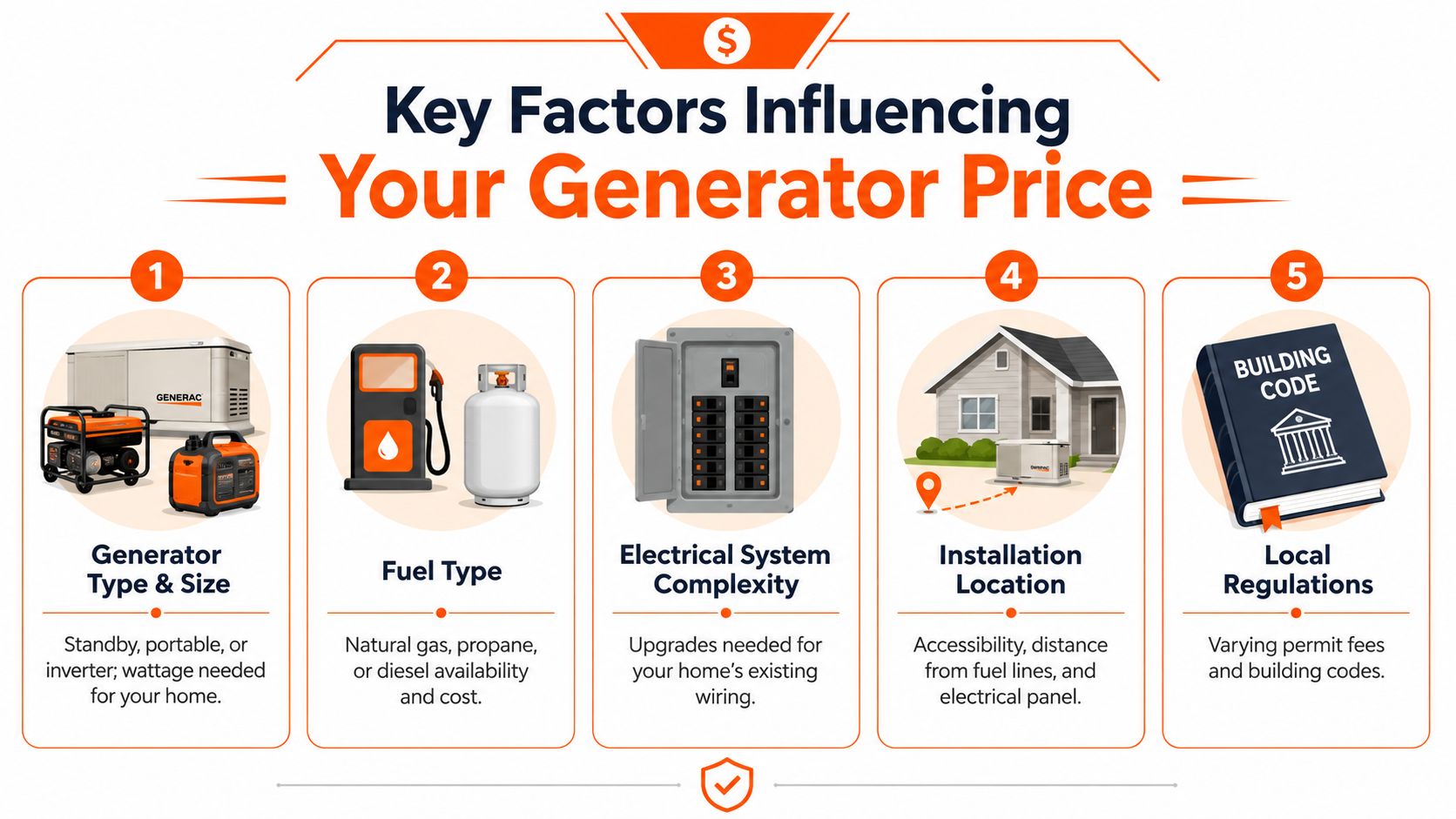
For standby generators in the 7,000 to 22,000 watt range, installation commonly runs $4,000 to $10,000, while larger systems can reach $10,000 to $35,000+. In some projects, installation costs end up 2 to 3 times the price of the generator unit itself, with transfer switch installation averaging $1,200 and concrete pad prep costing $50 to $75 per square foot, according to this generator setup budgeting guide.
Size changes everything
The first cost driver is generator capacity. A homeowner who wants to run selected essentials can often stay in a smaller equipment class. A homeowner who wants the entire house to operate normally, including larger loads, usually moves into a more expensive unit and a more demanding installation.
Bigger units don't just cost more to buy. They can also trigger heavier electrical coordination, more complicated placement, and larger transfer equipment.
Fuel source and run length matter
In Southwest Florida, natural gas and propane are both common, but neither is “plug and play.” If the generator sits close to the existing fuel source, the install is simpler. If the location requires a longer route, buried piping, or difficult access, the quote climbs.
One of the most common budgeting mistakes is assuming a standard fuel run in an ad matches your house. It often doesn't.
Site conditions can quietly raise the price
A clean installation area saves money. Tight side yards, soft ground, awkward utility paths, fencing obstacles, and drainage issues slow the job down.
A generator also needs a stable foundation. If you want to understand what goes into durable equipment foundations, that resource gives a useful look at why pad quality and placement affect long-term performance.
The existing electrical system can help or hurt
Some homes are straightforward. Others need panel-related work before the generator can be tied in correctly.
Watch for these cost triggers:
- Crowded or outdated panels that leave little room for clean integration.
- Service upgrades when the existing setup doesn't support the intended connection method.
- Sub-panel decisions if the project is being designed around selected circuits rather than broader whole-home coverage.
A generator quote is really a house quote. The installer is pricing your existing electrical system, your site conditions, and your fuel path as much as the machine itself.
Real-World Generator Costs in Tampa Bay
Florida homeowners usually don't care what a generic national average says. They want to know what projects tend to look like in Tampa Bay and down the Gulf Coast where storms, salt air, permitting, and fuel setup all shape the job.
In Florida, professional installation for a whole-home generator typically costs $2,000 to $6,000, depending on electrical upgrades, site prep, and fuel line connections. That same Florida guidance notes that for a 2,000 sq ft home, quotes often land between $9,000 and $16,000, with real examples of final pricing around $11,000 to $12,000 including gas hookup and propane tank burial, as outlined in this Florida whole-home generator cost guide.
How that applies around Tampa and Southwest Florida
In practice, homes in Tampa, Sarasota, Port Charlotte, Cape Coral, and Fort Myers often fall into the same broad pattern:
- A straightforward install on a home with easy access, a nearby fuel source, and no major panel complications tends to stay near the lower end of the normal range.
- A mid-complexity install with some electrical coordination and moderate fuel work often lands in the middle.
- A more involved project with longer utility runs, site prep, or additional electrical scope pushes higher.
That's why two neighbors can both say they “installed a generator” and still have very different invoices.
Florida financing options worth knowing
The same Florida source notes that homeowners may use the state's Property Assessed Clean Energy (PACE) program to finance generator installation through property taxes, with no upfront costs, specifically for hurricane-protection upgrades like generators. For some families, that changes the conversation from “Can we write the check now?” to “Can we budget this responsibly before storm season?”
For a local media snapshot that reflects how seriously Tampa Bay homeowners take storm-readiness decisions, this Tampa Bay community coverage image captures the kind of local planning mindset many residents bring to home protection upgrades.

If you're comparing estimates in Florida, compare scope first and price second. Labor ranges can be normal. Missing scope isn't.
Your Installation Timeline and Pro Hiring Checklist
Most generator jobs feel stressful only when the homeowner doesn't know what happens next. The process is manageable when the contractor lays it out clearly and the quote matches the actual work.
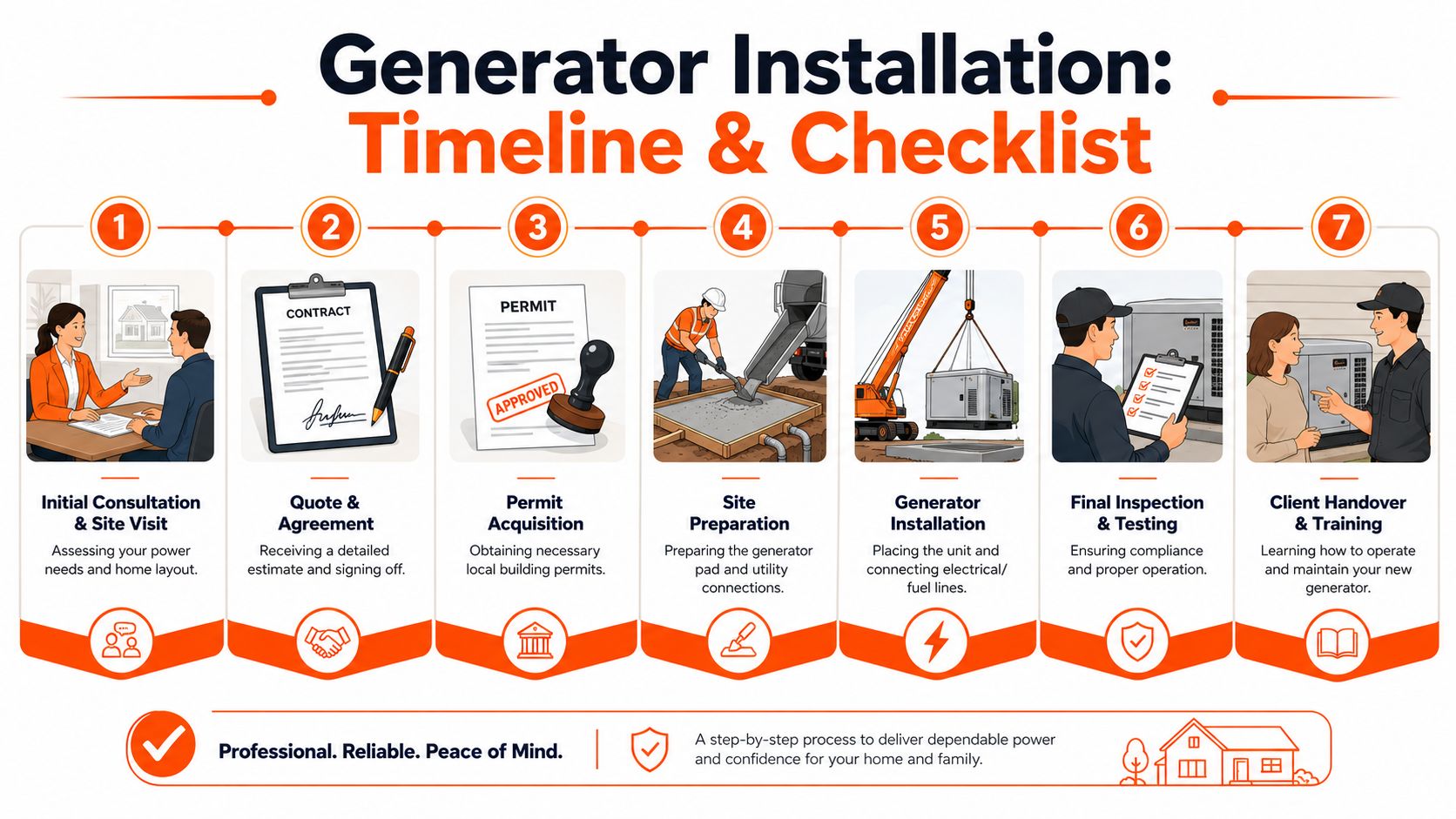
What the project usually looks like
Initial visit and load discussion
The contractor looks at your electrical service, asks what you want powered, and checks possible generator locations.Written proposal and scope review
Good companies separate equipment, labor, transfer gear, fuel work assumptions, and permit responsibility.Permitting and utility coordination
A legitimate standby install should move through the proper local channels. If a contractor tries to skip that conversation, that's a warning sign.Site preparation
The install area gets readied, including pad work or access improvements if needed.Electrical and fuel installation
The generator is set, connected, and integrated with the home's system through the appropriate trades.Inspection and testing
The system should be run, checked, and approved before anyone calls the job finished.Homeowner handoff
You should leave with clear instructions on operation, maintenance, and what to watch during storm season.
Hiring checklist that actually matters
A polished sales presentation doesn't tell you much. These questions do.
- Who pulls the permits and who schedules inspections?
- What exactly is excluded from the quote?
- Is the fuel connection included or only assumed under a basic allowance?
- What happens if the panel needs extra work after the site visit?
- Will startup, testing, and owner instruction be included in the final visit?
What works and what doesn't
What works is a contractor who prices the house fairly, not just the generator. What doesn't work is buying off a brand name alone and assuming every dealer quote covers the same scope.
Before signing, it also helps to review a contractor's local customer feedback. This customer review snapshot is the type of proof homeowners should look for when checking whether a company communicates well and follows through.

Ask one simple question before you approve a quote: “If this price changes, what are the three most likely reasons?” A good contractor will answer it directly.
Smart Ways to Save on Your Generator Installation
There are smart ways to lower generator installation cost. There are also risky ways. Homeowners need to know the difference.
The best money-saving angle right now is what many people call the DIY split. That means you buy the generator unit and transfer switch yourself, then hire a qualified installer for labor, permits, electrical coordination, and fuel hookup.
Where the savings come from
In markets like Florida, some large companies quote $17,000 to $24,000 for a 24 kW install, while independent installers may charge $7,800 for labor only. In some cases, that lets homeowners keep the total under $10,000 if they source the unit separately, creating 40 to 60% savings, according to this discussion of labor-only generator installs in Florida.
That cost gap is real. So is the work required to pull it off.
When the DIY split makes sense
This approach can work well if you're organized and comfortable managing a multi-part project. It helps most when:
- You already know the exact unit you want and can purchase it at a good price.
- You have access to a qualified installer willing to take on customer-supplied equipment.
- You understand that permits, inspections, and fuel certification still have to be handled correctly.
Where homeowners get into trouble
The dangerous version of “DIY” is assuming you can cheap out on the skilled part. You can't.
Electrical tie-in, transfer switch installation, and fuel work are not side jobs for a handyman with a truck. If those pieces are done wrong, you can create code violations, startup failures, warranty problems, or safety hazards.
Other ways to save without taking unnecessary risk:
- Right-size the system so you don't overbuy capacity you won't use.
- Get multiple detailed quotes and compare scope line by line.
- Schedule before peak storm demand when contractors aren't slammed and lead times are calmer.
Frequently Asked Questions About Generator Costs
How long does a generator project usually take
The field work itself may be relatively short once everything is lined up, but homeowners should think in phases, not just install day. Site review, proposal approval, permitting, material coordination, and final inspection all take time. The biggest delays usually come from paperwork, scheduling, and utility or fuel coordination, not from physically placing the generator.
Is a permit required for a standby generator in Florida
For a permanent standby installation, homeowners should expect permitting and inspection to be part of the job. A professional contractor should handle that process and explain what approvals are needed before work starts. If someone wants to skip permits to “save time,” that's not a shortcut worth taking.
Is a whole-house generator worth the money
For many Florida homeowners, the return isn't just financial. The value often shows up in preserved food, continued cooling, reliable lighting, protected routines, and a house that stays functional during a storm-related outage.
For some families, the biggest payoff is peace of mind. If you have kids, older relatives, refrigerated medications, or don't want your house to go dark and hot when the grid drops, the value is immediate the first time the generator takes over.
Should I buy from a dealer or source the unit myself
Either path can work. Bundled dealer installs are simpler. The DIY split can save money if you're prepared to coordinate the moving parts and still hire qualified professionals for the critical work. The wrong choice isn't dealer versus self-sourced. The wrong choice is buying based only on the lowest sticker price.
What should I ask before approving a quote
Ask for the full scope in writing. You want to know what equipment is included, whether the transfer switch is specified, how fuel work is handled, who pulls permits, what site prep is assumed, and what could trigger a change order. Clear answers upfront usually mean a smoother project later.
If you're in Tampa Bay or Southwest Florida and want a straight answer on generator installation cost, Heatwave Air Conditioning, Plumbing, & Electric can help you evaluate the full scope, compare options, and plan a code-compliant standby installation that fits your home and storm-season priorities.