
You hear it at night first. A metal clank. Then a longer rattle when the system kicks on. By morning, the air coming out of the vents feels weak, the thermostat says one thing, and the house feels like another. In Florida, that kind of problem is easy to ignore for a while because winter is shorter here. But when your heating side starts failing, it usually points to a larger system issue, especially if you have a heat pump or an older air handler.
That's when most homeowners start searching for the actual heating system replacement cost and run into the same problem. The numbers are all over the place, and most of the advice is written for colder states where furnaces are the default. Florida homes are different. Many rely on heat pumps, ductless mini-splits, or mixed heating and cooling systems where humidity control matters as much as heat output.
A useful guide has to answer the questions that affect your home in Tampa Bay, Sarasota, Port Charlotte, Cape Coral, or Fort Myers. What are you replacing. The outdoor unit, the indoor air handler, the ductwork, or the whole system? What drives the quote up? Which upgrades are worth it in a humid climate? And how do you tell whether this is one more repair or the point where replacement makes more sense?
That Noise Is Not Your Imagination
A failing heating system rarely dies all at once. It usually gives you warnings. The system starts and stops too often. Airflow drops off in one part of the house. The thermostat keeps getting adjusted because the room never feels quite right. In Florida, homeowners often notice comfort issues before they think “heater problem” because the same equipment usually handles both heating and cooling.
That matters because a noisy system in January can become a comfort problem all year. If the heat pump is struggling in heating mode, there's a good chance the rest of the system isn't operating the way it should either. Weak airflow, moisture problems, and uneven temperatures often travel together.
Practical rule: If the system is making new noises and the comfort problems are spreading room to room, don't focus only on the noise. Ask what changed in the system as a whole.
Florida adds a few local wrinkles. Many homes don't have traditional gas furnaces. They have electric heat pumps, air handlers in garages or closets, and duct systems that run through hot attics. Some homes also lean on ductless equipment in additions, enclosed lanais, or rooms that never cooled or heated properly in the first place. Hurricane exposure also affects equipment placement, electrical readiness, and how carefully the installation needs to be planned.
That's why national averages help only up to a point. They give you a starting number, not a real quote. What you need is a Florida-specific way to look at the job: system type, duct condition, humidity control, electrical capacity, and installation access.
If you're already at the stage where the noises are regular and your comfort is slipping, it helps to look at examples of local equipment setups homeowners often replace, such as this Florida HVAC system example.
Florida Heating System Replacement Costs by Type
Most homeowners ask one simple question: what does a heating system replacement cost? The problem is that this phrase lumps together very different jobs. Consumer guides place a standard HVAC replacement around $8,000 to $15,000, while furnace-only replacement is often closer to $4,000 to $10,000 installed, and heat pumps can run $6,000 to $25,000 according to ConsumerAffairs' HVAC replacement cost guide. In Florida, that distinction is even more important because heat pumps and ductless systems are usually more relevant than furnaces.
What Florida homeowners usually replace
In most Florida homes, the likely replacement falls into one of these categories:
| System Type | Average Installed Cost Range | Best For |
|---|---|---|
| Heat pump system | $6,000 to $25,000 | Homes that need one system for both cooling and heating |
| Ductless mini-split system | Qualitative only. Cost varies by layout, number of indoor units, and installation scope | Additions, room-specific comfort issues, homes without practical duct access |
| Furnace-only replacement | $4,000 to $10,000 | Homes that already use a furnace, usually less common in Florida |
| Full HVAC replacement | $8,000 to $15,000 | Homes replacing more than just the heating component |
The main takeaway is simple. A basic equipment swap sits in one price band. A whole-house system with indoor and outdoor components, controls, and duct adjustments sits in another.
Florida homeowners should usually start by asking three questions:
- What equipment do I have now. A heat pump replacement is a different project from a furnace swap.
- Is the indoor unit staying. If the air handler is old or mismatched, replacing only one side can create performance problems.
- Are the ducts part of the job. In Florida, attic duct condition can change the price and the comfort result fast.
Why heat pumps usually lead the conversation here
A heat pump makes sense in Florida because it handles both heating and cooling in a climate where cooling does most of the work. It also helps with year-round comfort when the system is properly sized and paired with the right indoor equipment. The replacement cost can vary a lot because some jobs are straightforward and others involve the air handler, controls, duct transitions, or electrical work.
Ductless systems deserve attention too. They're often the cleanest answer when one room is always uncomfortable, when a garage conversion was never ducted correctly, or when an older home doesn't lend itself to a major duct retrofit. They can also help with zoned comfort, which matters when one part of the house gets more sun or holds more humidity.
Here's a useful local mindset. Don't ask for “the cheapest heater.” Ask for the system that solves your actual comfort problem in a Florida house. That might be a conventional heat pump, a ductless setup, or a broader replacement that fixes airflow and moisture control together.
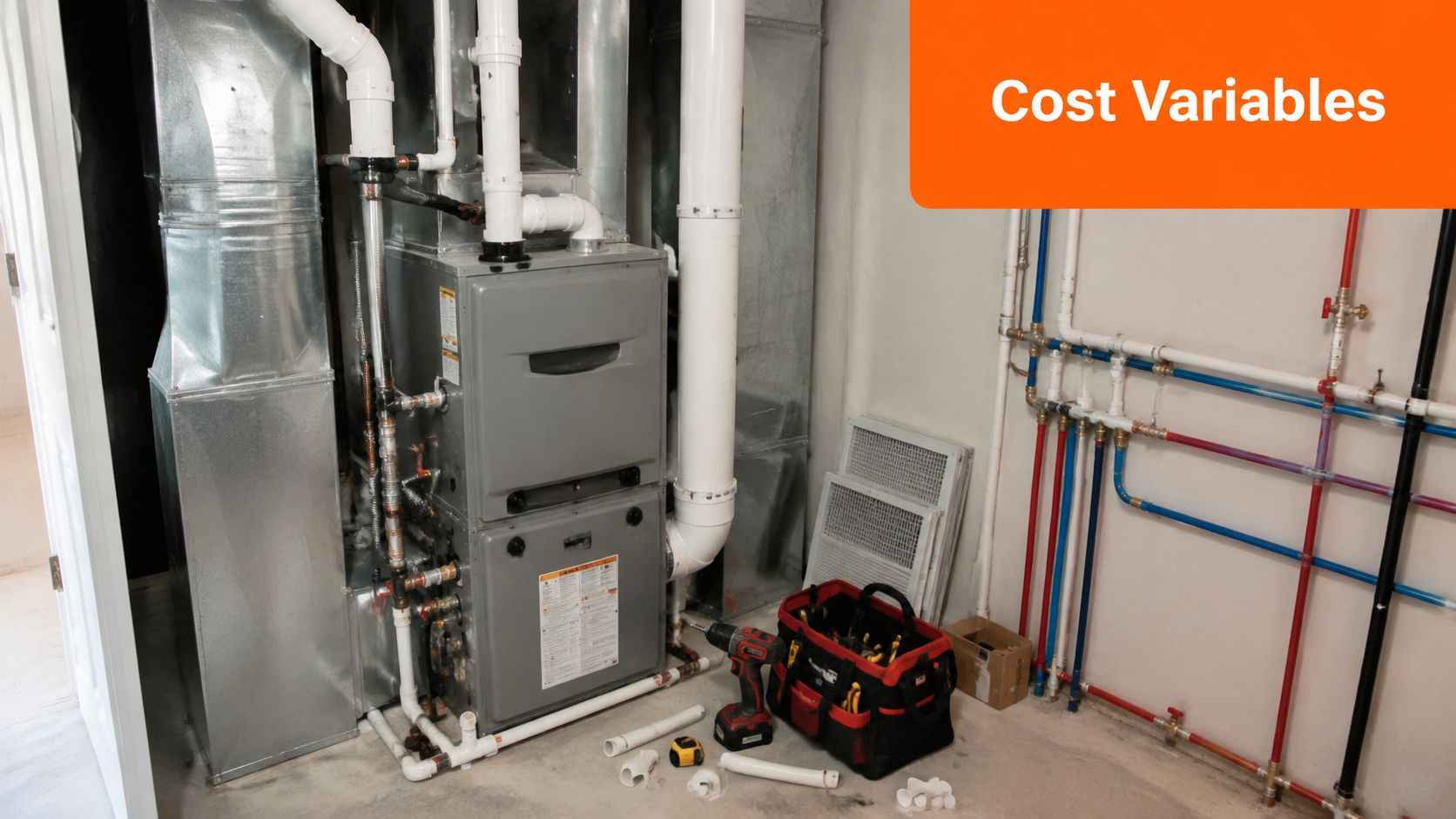
For a quick visual reference, this installed system image shows the kind of space and layout issues contractors often have to work around during replacement.

Deconstructing Your Replacement Quote
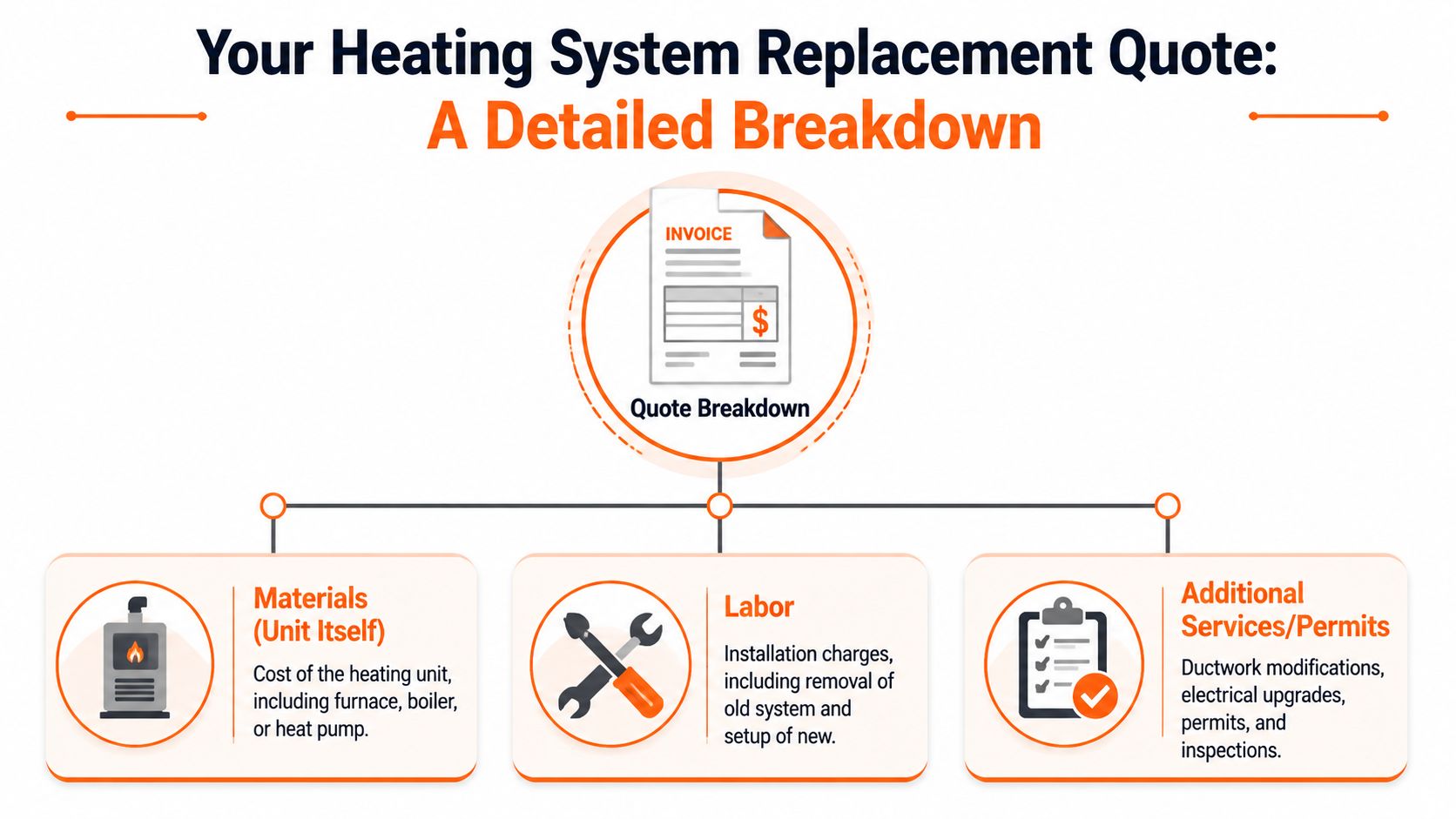
A replacement quote makes more sense when you stop looking at it as “one price for a machine” and start looking at it as a bundle of equipment, labor, and project requirements. That's how technicians look at it. The unit matters, but the finished installation is what you're paying for.
Materials and equipment
A foundational benchmark comes from furnace pricing. Synchrony reports a typical gas furnace replacement at about $7,000 for a 1,600 to 2,000 square-foot home, with a broader cost range of $3,800 to $10,000, and high-efficiency models reaching up to $12,000 in its furnace replacement cost guide. Even though many Florida homes use heat pumps instead of furnaces, the lesson still holds. The visible box isn't the whole job.
In a Florida heat pump replacement, “materials” can include the outdoor condenser, the indoor air handler, thermostat or controls, drain components, transition fittings, pads or mounting hardware, and any accessories needed to make the system operate correctly in a humid climate. If the quote includes only the outdoor side and your indoor side is aging out, you should ask why.
Labor and installation work
Labor is where a lot of homeowners underestimate the project. Synchrony notes that professional labor typically adds $1,000 to $3,000. That range makes sense because labor isn't just carrying units in and out. It includes removing old equipment, setting new components, reconnecting refrigerant and electrical, sealing and adapting duct connections, testing operation, and making sure the install meets code.
A clean install protects three things:
- Performance. Poor airflow setup can make a new system feel disappointing from day one.
- Reliability. Bad drainage, weak duct connections, or rushed electrical work can create callbacks quickly.
- Warranty compliance. Manufacturers expect professional installation and proper startup procedures.
A lower quote isn't always a lower project cost. If key installation work is missing, the “savings” usually show up later as comfort problems, repairs, or shortened equipment life.
Permits and extras
This is the part many homeowners don't expect. Synchrony also notes that ductwork repairs or modifications can add $500 to $3,000, thermostat replacement can add $150 to $400, and permits may add $50 to $300. Those add-ons are common because replacement often exposes existing issues. A return duct may be undersized. The old thermostat may not support the new equipment. The permit and inspection process may be required.
If you want to compare quotes well, ask the contractor to separate the quote into these buckets:
| Quote Component | What It Covers |
|---|---|
| Equipment | Outdoor unit, indoor unit, controls, accessories |
| Labor | Removal, installation, connections, startup, testing |
| Project extras | Duct changes, permits, thermostat, disposal, code-related work |
That breakdown makes it much easier to see whether two quotes are pricing the same job.
Key Factors That Raise or Lower Your Final Price
The biggest reason heating system replacement cost varies so much is that no two houses are installed the same way. Equipment size matters, but the home itself often matters just as much. In Florida, that means attic conditions, duct layout, humidity demands, and electrical readiness can all swing the quote.
Home configuration and ductwork
Trane notes that replacement pricing is heavily influenced by home configuration and existing ductwork, and its pricing guide shows wide ranges such as furnace replacement at $5,647 to $9,125, cold-climate heat pumps at $8,154 to $17,656, and air handlers at $5,339 to $8,908 in its residential pricing guide. You don't need a cold-climate heat pump in most of Florida, but the spread still proves the point. Installation environment changes the bill.
A system in an open garage closet is one job. A system buried in a tight attic with aging plenums and sweating duct connections is another. If the existing ductwork leaks, is undersized, or has damaged insulation, the new unit may need extra work just to deliver normal comfort.
Efficiency and system matching
Efficiency works a little like fuel economy in a vehicle. Better-rated equipment can reduce operating costs, but the upfront price usually rises with it. In Florida, that trade-off is worth looking at because your system runs for cooling far more often than it runs for heating.
But high efficiency only works when the system is matched correctly. A premium outdoor unit paired with the wrong indoor setup won't deliver what you expect. Neither will oversized equipment. Bigger isn't better in a humid climate if it short cycles and leaves the house cool but clammy.
Access, labor difficulty, and storm-readiness
Some jobs cost more because they're harder to execute properly. Tight attic access, long line-set runs, roof penetrations, or older homes with awkward utility spaces all add labor. So do projects that need upgraded mounting, drainage routing, or stronger tie-down planning in storm-prone areas.
Florida homeowners should also keep one practical question in mind. Can the home's electrical system support the replacement cleanly? If the panel is already crowded or outdated, your HVAC contractor may tell you an electrical panel upgrade needs to happen before or alongside the install. That isn't cosmetic work. It can be necessary for safe operation and code compliance.
If a contractor never looks closely at ductwork, electrical service, and install access, the quote may be fast but it probably isn't complete.
The factors worth asking about on every estimate
Use this short checklist when you compare bids:
- System size and matching. Ask how the contractor determined the proper capacity for your home.
- Indoor equipment condition. Find out whether the air handler should stay or go.
- Duct condition. Ask if the existing ducts can support the new system without hurting airflow or humidity control.
- Electrical readiness. Confirm whether disconnects, breakers, or panel capacity need attention.
- Access difficulty. Tight or hazardous install areas often raise labor for good reason.
- Feature selection. Variable-speed equipment, upgraded thermostats, and enhanced filtration can improve comfort, but they affect the total.
In Florida, the systems that work best are the ones that control temperature and moisture together. The systems that disappoint are often the ones sold on equipment price alone, without enough attention paid to airflow, drainage, and how the house is laid out.
Repair or Replace The Smart Way
A lot of homeowners call after a repair quote lands and ask the same thing. Should I fix this one more time, or am I about to throw good money after bad? That's the right question.
There is a common shortcut people use. Replace the system when the repair cost multiplied by system age exceeds $5,000. Burton Sheet Metal notes that this rule exists, but also stresses that it's only a rough guide in its HVAC replacement cost factors article. Real decisions are more nuanced than a single formula.
When repair still makes sense
Repair is usually the better call when the issue is isolated, the system hasn't had a pattern of breakdowns, and the rest of the equipment is still in solid shape. If the unit is still under warranty, that changes the math too. So does a home where comfort has been good and the current failure doesn't point to a larger airflow or moisture problem.
A smaller repair on a stable system is one thing. Repeated failures across major components are something else.
When replacement usually wins
Burton also notes that a new high-efficiency unit can cut heating and cooling costs by up to 20%, which matters when you're deciding whether to keep pouring money into an aging system. But energy savings are only one part of it. Reliability, warranty reset, quieter operation, and better humidity control often matter just as much in Florida.
Here are the signs that usually push the decision toward replacement:
- Repairs are becoming regular. If every season brings another service call, the pattern matters more than any single bill.
- Comfort keeps slipping. Hot rooms, weak airflow, and sticky indoor air often mean the issue is broader than one broken part.
- The system is mismatched or patched together. Old indoor equipment paired with newer outdoor equipment can create recurring problems.
- Safety or major component concerns exist. Some problems shouldn't be treated as “wait and see.”
The smart decision isn't always the cheaper invoice today. It's the option that gives you dependable comfort without repeating the same expense every few months.
For some homeowners, seeing how local comfort issues and replacement conversations are discussed in the media helps frame the decision. This Tampa Bay interview clip image reflects the kind of homeowner concerns that come up every season.
A better decision framework
Instead of relying only on the shortcut rule, weigh these factors together:
- Repair frequency. One repair in a long stretch is different from a series of repairs.
- Whole-system condition. Look beyond the failed part. Check airflow, duct condition, drainage, and controls.
- Operating cost. Older systems often cost more to run, especially if they've lost efficiency.
- Comfort and humidity. In Florida, that part of the equation is not optional.
- Budget and financing. The right replacement plan is one you can carry comfortably.
If the current system is unreliable and the house never feels quite right, replacement often stops a cycle that repairs can't fix.
The Replacement Process From Consultation to Comfort
Most homeowners are less worried about the equipment than they are about the disruption. They want to know what happens, how long the house will be upside down, and whether the install will turn into a surprise project. A professional replacement should feel organized from the first visit forward.
What happens before installation day
The process starts with an in-home evaluation. The contractor checks the existing system, looks at the installation area, inspects the duct setup, and talks through the comfort issues you're dealing with. In Florida, that conversation should include humidity complaints, hot and cold areas, and any rooms that never seem to behave.
Then comes system selection and the written estimate. At this stage, you want clarity on whether the quote includes just one component or the full matched system. If financing is part of the plan, that usually happens before scheduling. For homeowners comparing service approaches in markets where furnaces and boilers are more common, this overview of furnace and boiler service is useful context for how heating contractors typically structure installation and repair work.

What installation day usually looks like
A good installation day is methodical, not rushed. The crew protects the work areas, removes old equipment, sets the new components, makes the needed connections, and tests operation before calling the job done.
The exact timeline depends on scope, but homeowners should expect these steps:
- Site protection. Floors and nearby spaces are covered before removal starts.
- Old system removal. Equipment is disconnected and taken out safely.
- New equipment setting. The indoor and outdoor components are positioned and connected.
- Startup and calibration. Airflow, controls, and operating performance are checked.
- Walkthrough. The homeowner gets basic operating instructions and thermostat guidance.
What you should expect at the end
The final walkthrough matters. You should know how the thermostat works, what normal operation sounds like, where the filter is, and when maintenance should happen. You should also know whether permits and inspections still need to be finalized.
If online reputation helps you feel more comfortable choosing a contractor, it can be useful to review a local customer review snapshot before scheduling estimates.

One practical point. If you're getting quotes for a replacement in Southwest Florida or Tampa Bay, ask whether the company handles HVAC, electrical, and related coordination in-house or through partners. Heatwave Air Conditioning, Plumbing, & Electric is one local option that provides free estimates for new installations and financing options, which can simplify planning when the project touches more than the equipment itself.
How to Save on Your New Heating System
The price of a replacement can feel heavy, especially when the old system didn't fail on your schedule. The good news is that homeowners usually have more room to manage the cost than they think. The smartest approach is to reduce surprise add-ons, compare complete quotes instead of headline prices, and use financing or incentives when they fit.
Angi's 2026 guide reports an average HVAC replacement cost of about $7,500, with a common range of $5,000 to $12,500, and notes that optional ductwork can add another $3,500 in its 2026 HVAC pricing guide. That's exactly why payment planning matters. A manageable monthly payment can be more practical than delaying a failing system and risking more repairs.

Ways to keep the total under control
- Compare full-scope estimates. Make sure each quote includes the same equipment, labor, and duct or electrical assumptions.
- Ask about incentives. High-efficiency equipment may qualify for tax credits or utility rebates, depending on the program and equipment.
- Use financing strategically. Financing helps spread out a large project so you can choose the right system instead of the cheapest immediate fix.
- Address efficiency after install. Once the new system is in, small maintenance and airflow improvements help protect your investment. This guide for HVAC energy savings is a useful companion read.
A local financing page can also help you understand what monthly-payment options may look like before you call. This financing information snapshot gives homeowners a starting point for that side of the decision.

The biggest money mistake is choosing a quote that looks cheaper because important work was left out. The best value is a properly sized, properly installed system that handles Florida heat, humidity, and occasional cold mornings without constant follow-up calls.
If your system is noisy, unreliable, or no longer keeping up, the next step is to get a real quote based on your home's layout, equipment, and duct condition. Heatwave Air Conditioning, Plumbing, & Electric serves Tampa Bay and Southwest Florida with free estimates for new installations, along with financing options that can make a full replacement easier to plan.