
For homeowners here in Florida, a good starting point is to change your pleated air filter every 90 days. But if you've got furry friends or family members with allergies, you’ll want to cut that time down to every 45-60 days to keep your indoor air fresh and your AC running smoothly.
Your Florida Air Filter Replacement Schedule
Figuring out the right time to change your air filter isn't about setting a generic reminder on your phone. It’s about actively protecting your home's air and the health of your HVAC system. Think of that filter as the lungs of your home—and here in the humid, pollen-thick air of Tampa Bay and Southwest Florida, those lungs are working overtime.
Living in places like Sarasota, Port Charlotte, Cape Coral, or Fort Myers means your air filter is constantly battling moisture, dust, and a whole buffet of allergens. A clean filter is your first line of defense. A dirty one? That just makes your AC struggle, driving up energy bills and risking a breakdown.
A Quick Guide to Filter Timelines
The type of filter you use makes a huge difference. A filter's power is measured by its MERV rating, which stands for Minimum Efficiency Reporting Value. The higher the MERV rating (usually 8-13 for residential use), the more microscopic gunk like pet dander and pollen it can snatch from the air.
Here’s how the common types stack up:
- Fiberglass Filters (MERV 1-4): These are the thin, blue, see-through filters. They're cheap, but they mostly just stop large dust bunnies from getting sucked into your AC unit. In Florida, you need to change these every 30 days, no exceptions.
- Pleated Filters (MERV 5-8): This is the sweet spot for most homes in our area. The pleated design gives them more surface area to trap particles. The standard recommendation is 90 days, but that can easily change depending on what's going on inside your house.
- High-Efficiency Filters (MERV 9-13): If allergies or pets are a part of your life, these filters are a game-changer. They trap much finer particles but also get clogged faster, which can restrict airflow. Check them monthly and plan on a fresh one every 60 to 90 days.
This guide is a great visual for seeing how your household habits affect the schedule.
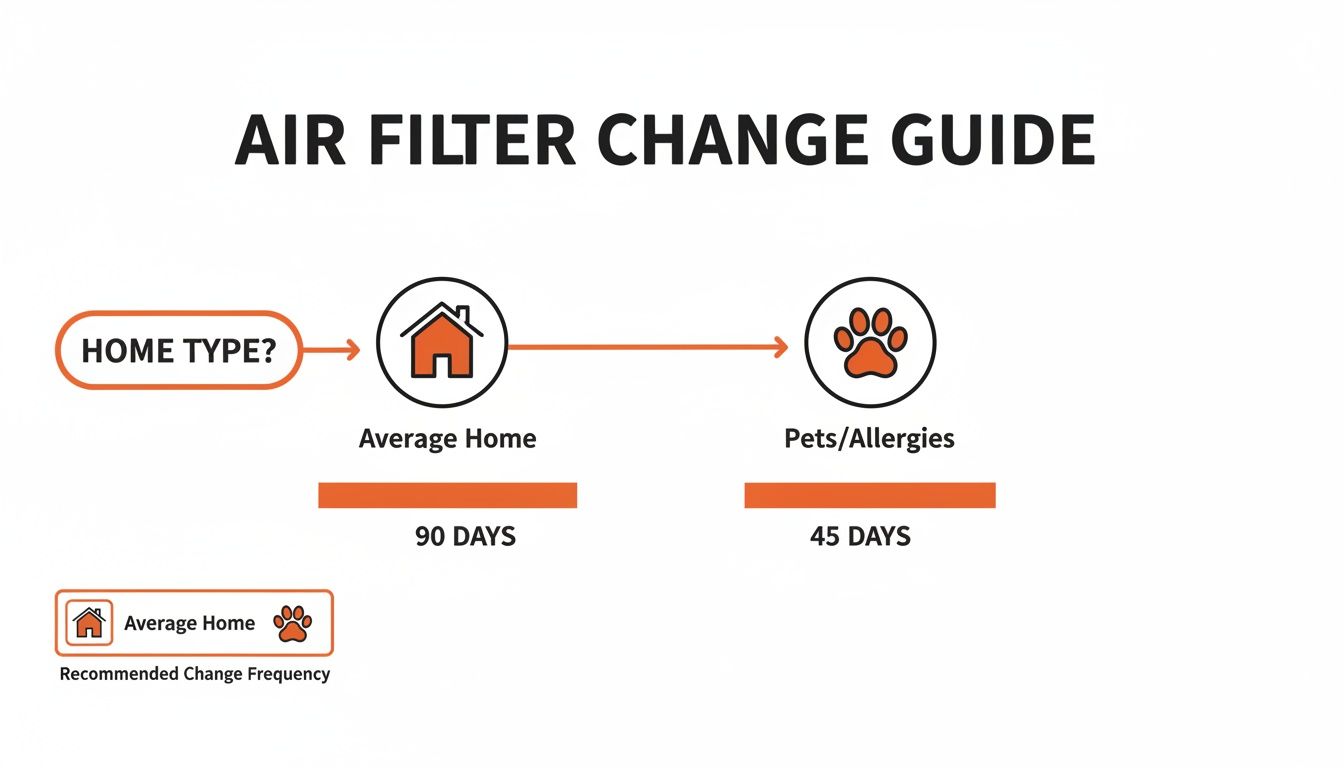
As you can see, simply having pets or allergies in the home can cut the recommended time in half. It’s a small change that makes a big impact on your air quality.
Florida Air Filter Replacement Frequency
To make it even easier, here’s a quick-glance table tailored for our unique Florida climate. Use it as a starting point and adjust based on what you see when you check your filter.
| Filter Type | General Guideline | Florida Recommendation (Average Home) | Florida Recommendation (Pets or Allergies) |
|---|---|---|---|
| Fiberglass (MERV 1-4) | 30 days | 30 days | 20-30 days |
| Pleated (MERV 5-8) | 90 days | 90 days | 45-60 days |
| High-Efficiency (MERV 9-13) | 6-12 months | 90 days | 60 days |
This simple task is a critical piece of your system’s overall health. To make sure you're covering all your bases, a good HVAC preventive maintenance checklist will always put filter changes front and center.
Regular filter swaps are a cornerstone of keeping your system happy, a topic we cover more in our guide on how often to service AC units in Port Charlotte, FL.
Why a Clean Air Filter Is Your HVAC System's Best Friend
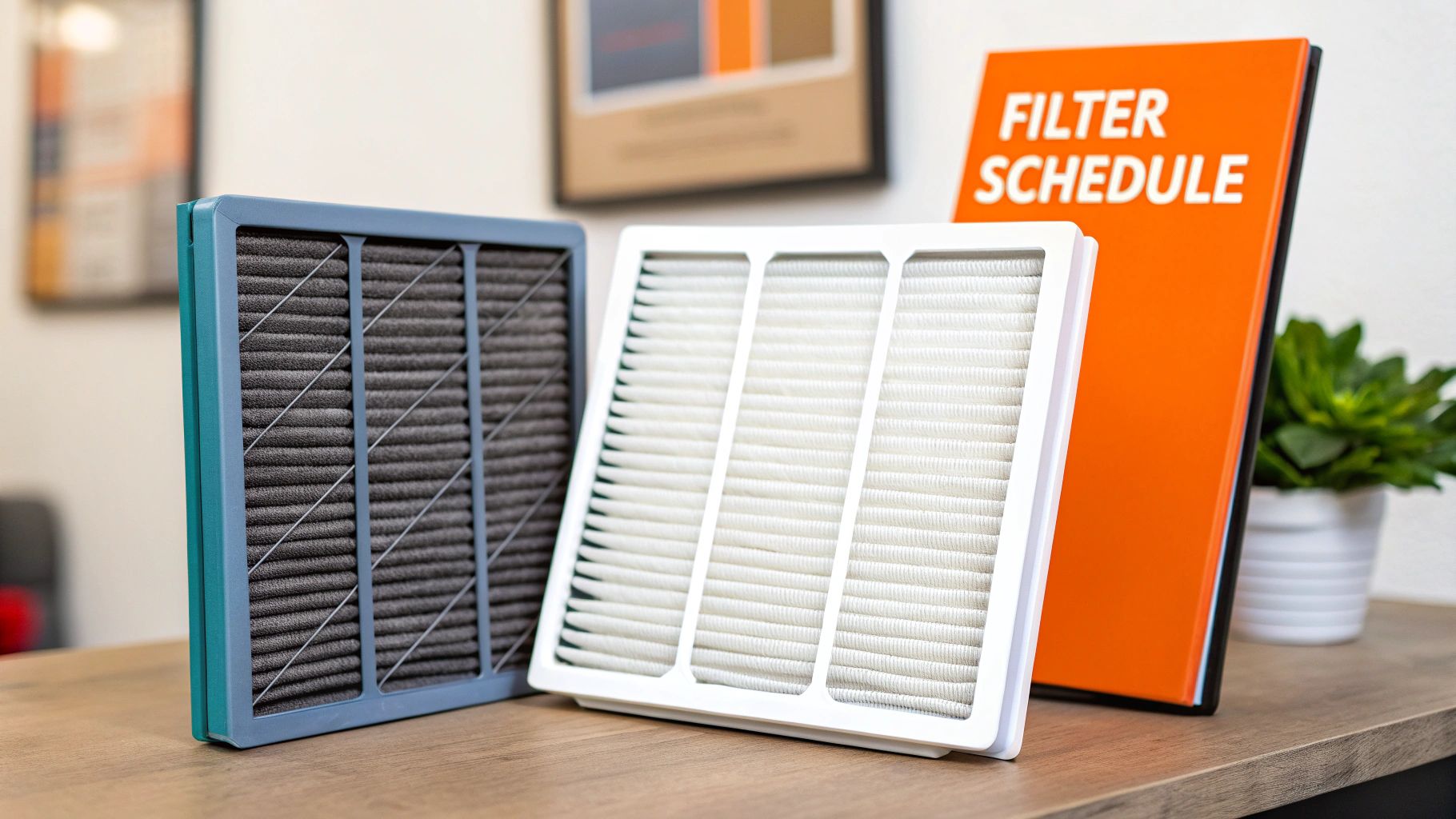
It’s one thing to know when you should change your air filter, but understanding why is what really motivates you to stick to a schedule. Think of your HVAC system like an athlete. For it to perform at its best, it needs to be able to breathe freely. The air filter is basically its set of lungs—and here in Florida, with our humidity, pollen, and dust, those lungs can get clogged up fast.
When the filter is clean, air glides right through the system. But once it’s caked with gunk, your system is trying to breathe through a straw. It has to work much harder to pull in air, putting a massive strain on its most critical (and expensive) parts. This simple, cheap maintenance task is your single best defense against an early system failure and eye-watering repair bills.
Protecting Your Health and Home
A clean air filter isn't just about protecting your equipment; it’s about protecting your family’s health. Its main job is to act as a bouncer for your home's air, trapping all sorts of nasty particles before they get a chance to circulate.
This is a huge deal in Southwest Florida, where allergens are a year-round battle. A fresh filter is constantly working to remove:
- Pollen and outdoor allergens that sneak their way inside.
- Pet dander and hair from your furry friends.
- Dust mites and other microscopic junk that settles everywhere.
- Mold spores, which absolutely love our humid climate.
By grabbing these irritants out of the air, a clean filter makes a real difference in how well you breathe inside your own home. If you're looking for even more ways to clean up your home's air, check out our resources on improving indoor air quality.
Boosting Efficiency and Lowering Costs
Beyond the health perks, a clean air filter has a direct impact on your bank account. In fact, a clogged filter is one of the top reasons HVAC systems waste so much energy. When the airflow is choked off, your system has to run longer and harder just to hit the temperature you set on the thermostat.
The Department of Energy states that a dirty air filter can jack up your energy consumption by as much as 15%. For a typical Florida home running the AC almost constantly in the summer, that’s a significant and totally avoidable expense on your monthly power bill.
Swapping out your filter is one of the easiest and most effective things you can do to keep your system efficient. It lets air flow freely, allowing your unit to cool your home quickly without burning through extra electricity. It's a tiny investment that pays for itself in energy savings and helps you avoid the kind of strain that leads to expensive breakdowns. Knowing how often should you change your air filter is the first step to unlocking those savings.
Telltale Signs Your Air Filter Needs Changing Now
While sticking to a schedule is a great rule of thumb, sometimes your home sends out an S.O.S. that your air filter needs changing right now. Your HVAC system is always talking; you just have to know how to listen. Paying attention to these clues helps you get ahead of problems before they turn into expensive repairs.
Think of it this way: you wouldn’t just ignore the oil light in your car because you weren’t technically due for a service. The same logic applies here. These signs are your system’s way of telling you it's struggling to breathe.
The Most Obvious Red Flag: A Dirty Filter
The quickest way to know for sure is to just look at it. Pull out your current filter and give it a good once-over. A brand-new filter is usually a crisp, clean white or off-white. What does yours look like?
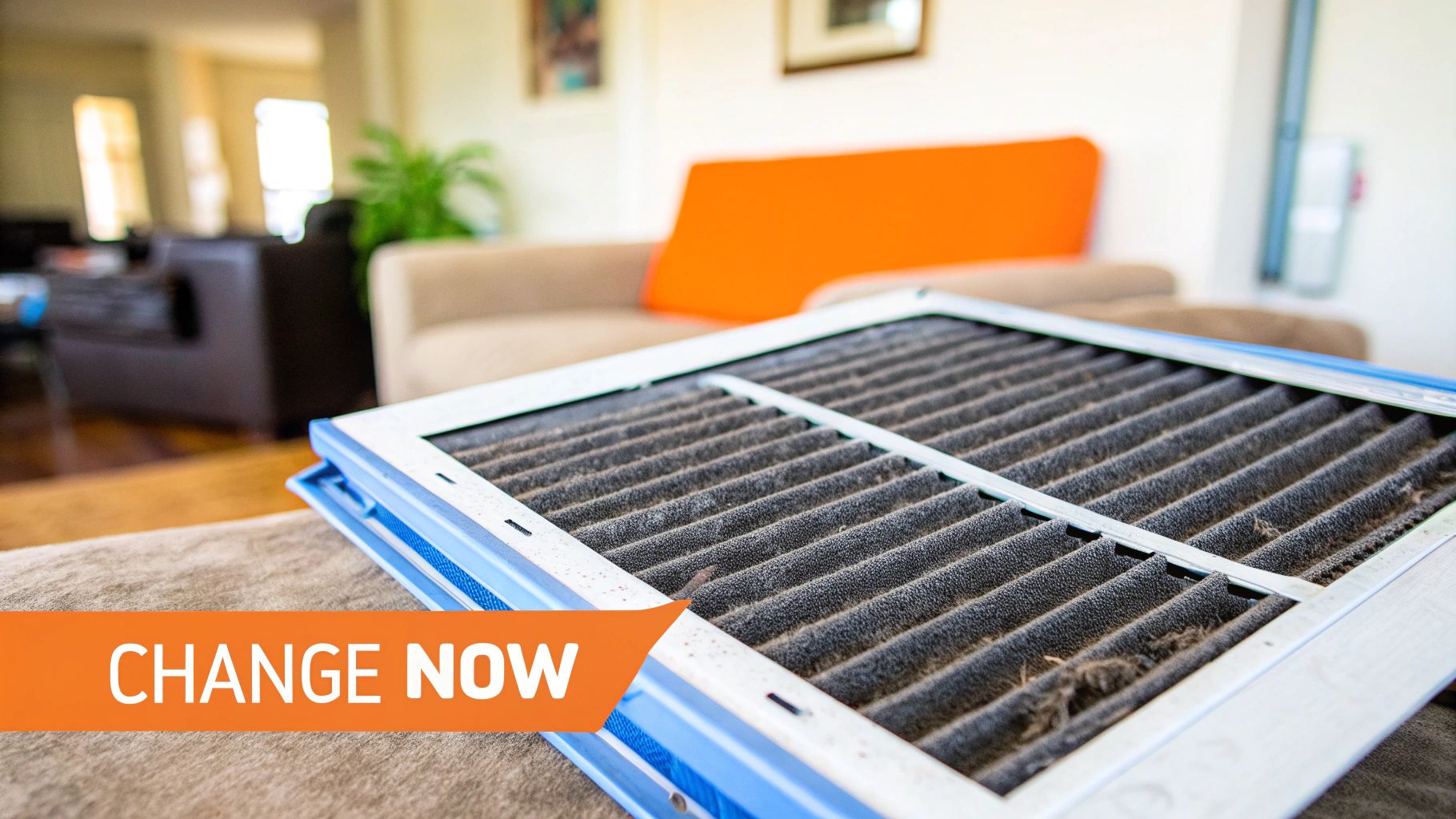
If it’s caked in a thick, gray blanket of dust, dirt, and pet hair, you have your answer. You shouldn't be able to see much light through it. That visible layer of grime is proof the filter did its job—and now it's completely full. Forcing your system to run with a filter that clogged is like trying to run a marathon in a heavy winter coat during a Florida summer. It just doesn’t work.
When Your House Starts Talking
Beyond a simple visual check, your home will give you other clues that point straight to a clogged filter. In fact, these are often the first things people notice, even if they don't immediately connect them to the HVAC system.
Here are a few common warning signs to watch for:
- More Dust on Your Furniture: Do you feel like you’re dusting constantly? A filter that’s maxed out can't grab any more particles, so all that dust gets blown right back into your rooms and settles everywhere.
- Musty or Stuffy Odors: When air can't get through a dirty filter, moisture and grime get trapped. This creates the perfect breeding ground for mildew. If you notice a damp or musty smell coming from your vents when the AC kicks on, the filter is the most likely culprit.
- Weak Airflow from Vents: Put your hand up to a vent. Does the air feel weak or sluggish? A clogged filter is a physical barrier, drastically reducing the amount of air that can get through to cool your home.
These aren't just minor annoyances; they directly impact your comfort and air quality. A simple filter change can often fix them almost instantly, bringing back that fresh, strong airflow you’re used to.
A restricted filter forces the entire HVAC system to work much harder and run longer to hit the temperature you’ve set on the thermostat. This extra strain not only causes premature wear and tear but can lead to a damaging condition known as short cycling, where the unit shuts on and off constantly.
If you think this might be happening with your AC, you can learn more about what causes it and how to fix an air conditioner short cycling on our blog.
The Financial Warning Signs
Finally, one of the most convincing signs of a dirty filter is the one that shows up in your mailbox: your monthly utility bill. An overworked HVAC system is an energy-guzzling one.
If you see a sudden, unexplained spike in your electricity costs, your air filter should be the very first thing you check. That price hike is the cost of forcing your system to fight against a wall of dirt just to do its job. Swapping in a clean filter is one of the fastest and easiest ways to get that energy consumption back to normal.
How Florida's Climate and Your Lifestyle Affect Filter Life
That 90-day filter change rule you always hear about? It’s a great baseline, but let’s be honest—it’s just a starting point. Think of it like the estimated MPG on a new car. Your actual mileage depends on how you drive, and your filter's real lifespan depends entirely on how you live.
Here in Southwest Florida, our unique environment and household habits can clog up a filter much faster than average.
Ignoring these local factors means you could be running your AC with a choked-out filter for weeks, maybe even months, longer than you should. That doesn't just tank your home's air quality; it puts a ton of unnecessary strain on your HVAC system. The key is to create a personalized schedule that truly matches your home's needs.
Your Household's Unique Air Quality Profile
Every home has its own "air quality profile" shaped by the people and pets inside. Some houses naturally generate way more airborne particles than others, which forces the filter to work overtime and get dirty fast.
Take a look at these common household factors that almost always mean you need to change your filter more often:
- Pets: A shedding dog or cat is a non-stop source of dander, fur, and whatever else they track inside. This stuff is a filter's worst enemy and will clog it in no time.
- Allergy or Asthma Sufferers: If anyone in your home has respiratory sensitivities, a clean filter is non-negotiable. Changing it frequently ensures it's always trapping the maximum amount of pollen, dust mites, and other triggers.
- Smoking Indoors: Smoke particles are tiny, sticky, and stubborn. They not only clog a filter quickly but also cause nasty, lingering odors to get recirculated through your home if the filter isn't swapped out regularly.
- Large Families: It's simple math: more people mean more activity. More dust gets kicked up, more doors open and close, and more particles end up in the air.
To put it in perspective, if you have a golden retriever shedding all over the place, that standard 90-day pleated filter might be completely caked with fur in just 45 to 60 days. This is exactly why a quick monthly visual check is a must for pet owners.
Keeping your HVAC system in shape with pets around is a whole different ballgame. For more great advice, check out our guide on HVAC maintenance tips for pet owners in Pinellas Park, FL.
The Florida Factor: Why Our Climate Is So Tough on Filters
Living in paradise has its perks, but it also comes with a unique set of challenges for your HVAC system. Our beautiful coastal climate is relentless, keeping your air filter in a constant fight against particles you just don't see as much in other parts of the country. A filter recommendation for a home in a dry, northern state simply doesn't apply here.
The local environment in places like Tampa, Sarasota, and Fort Myers creates a perfect storm of filter-clogging elements:
- High Humidity: All this moisture in the air makes dust and dirt particles sticky. They clump together on the filter, creating a dense mat that blocks airflow. Worse, that dampness can encourage mold to grow on a dirty filter.
- Year-Round Pollen: Unlike places with four distinct seasons, Florida always has something blooming and spewing pollen into the air. Your filter never really gets a break from this constant barrage of allergens.
- Coastal Sand and Dust: Being close to the Gulf means fine sand and dust are always floating around. These tiny, abrasive particles get sucked right into your system, making your filter's job that much harder.
This combination of factors is why local, experienced advice is so important. For homeowners in Fort Myers or Cape Coral who run their AC nearly year-round, changing the filter every 1-3 months is absolutely essential to avoid a major drop in efficiency. While a good pleated filter (MERV 8+) might last you up to 90 days, those basic fiberglass ones often tap out in just 30 days thanks to our humidity and pollen.
Your Step-By-Step Guide to Changing an Air Filter
Knowing when to change your air filter is half the battle. The other half is knowing how to do it right. Good news—this is one of the easiest DIY maintenance jobs a homeowner can tackle. You don't need any special tools, and the whole thing usually takes less than five minutes.
It’s a simple win for your home’s health and your wallet. Let's walk through the process together, step-by-step, so you can get it right every time.
Step 1: Turn Off Your HVAC System
First thing's first: safety. Before you even think about opening a panel, head over to your thermostat and switch the entire system to OFF.
This is a crucial step. It keeps the unit from suddenly kicking on while the filter compartment is open, which would suck dust and all sorts of gunk directly into the sensitive guts of your air handler. A quick flick of a switch protects you and your expensive equipment.
Step 2: Locate the Air Filter
Now, let's find that filter. In most homes, it’s hiding in one of two places. You’ll either find it behind a large return air vent on a wall or ceiling (usually in a central hallway), or it’ll be inside a dedicated slot right on the air handler unit itself. Your air handler might be tucked away in a closet, the attic, or the garage.
The cover is typically held on by simple clips or tabs you can open by hand. Once you’ve found it, just unlatch the cover to get to the old filter.
Pro Tip: If your filter is in a ceiling vent, be ready for a little dust shower when you open it. It’s smart to have a trash bag handy to catch anything that falls out.
Step 3: Remove the Old Filter and Check the Details
Carefully slide the dirty old filter out of its slot. Take note of which way it was facing, because the new one needs to go in the same way. Before you toss it, take a good look at the cardboard frame.
You're looking for two critical pieces of information printed right on there:
- The Filter Size: The dimensions will be printed clearly on the side, like 20x25x1. You absolutely must get a replacement that's the exact same size. This ensures a tight seal with no gaps for dirty air to sneak around.
- The Airflow Arrow: You’ll also see a little arrow printed on the frame. This shows the correct direction for airflow, and it must always point towards the air handler unit, not away from it.
Once you’ve got the size jotted down, you can get rid of the old filter.
Step 4: Install the New Air Filter
Okay, you’ve got your new, correctly-sized filter. Time to finish the job.
Find the airflow arrow on the new filter’s frame. Now, carefully slide it into the slot, making sure that arrow is pointing in the right direction—again, toward the main HVAC unit.
Snap the cover back on and make sure it’s latched securely. Now for my favorite trick: grab a marker and write today’s date right on the new filter's frame. This completely eliminates the guesswork of trying to remember when you last changed it. For more simple ways to keep your system running smoothly, check out our top 5 AC maintenance tips for Florida homeowners.
Finally, you can head back to the thermostat and turn your system back on. That’s it—you're done! You’ve successfully changed your air filter and helped your AC breathe a whole lot easier.
The Hidden Costs of a Neglected Air Filter
Skipping an air filter change might seem like a harmless way to save a few minutes and a few bucks, but it's a classic case of "pay me now or pay me later." A dirty, clogged filter kicks off a chain reaction that can lead to some serious financial and mechanical headaches. It’s not just about a little extra dust on the furniture; it’s about real money leaving your wallet.
Imagine your HVAC system trying to breathe through a thick, grimy blanket. It has to fight for every bit of air it pulls in. This constant struggle doesn't go unnoticed—it shows up in three key areas: your monthly energy bills, your risk of a major breakdown, and even your family's health.
Higher Monthly Energy Bills
The most immediate consequence of a forgotten filter is the hit to your wallet. When your system has to work harder just to move air, it uses a lot more electricity. This isn’t a small jump, either; a clogged filter can inflate your HVAC system's energy consumption by up to 15%.
In a hot, humid climate like Southwest Florida where the AC runs almost nonstop, that extra 15% adds up fast. For an average monthly bill, you could easily be paying an extra $20 or more every single month—all because of a simple, inexpensive part.
This extra cost is pure waste. You’re paying more money for less comfort, since a struggling system simply can't cool your home as well. A fresh filter lets your AC breathe easy, keeping your home comfortable without burning through unnecessary power.
Costly and Avoidable HVAC Repairs
While higher energy bills are a slow burn, the risk of a sudden, expensive breakdown is a much bigger threat. The constant strain a dirty filter puts on your HVAC system causes critical parts to wear out and fail way too soon. It’s like forcing your car to drive with the emergency brake pulled—sooner or later, something is going to give.
Here are just a few of the expensive problems a clogged filter can trigger:
- Burned-Out Fan Motor: The fan motor is forced into overdrive to pull air through the gunk, causing it to overheat and eventually fail completely.
- Frozen Evaporator Coils: Restricted airflow means the cold refrigerant in the evaporator coils can't absorb enough heat from your home's air. The coils can then drop below freezing, encasing themselves in ice and bringing your AC to a screeching halt.
- Complete System Failure: Over time, the accumulated stress on every single component can lead to a total system breakdown. This could mean a full system replacement, a repair that easily runs into thousands of dollars.
The Impact on Your Family's Health
Beyond the mechanical and financial costs, there's the price of poor indoor air quality. A filter that's already full can't trap any new particles like dust, pollen, and pet dander. Instead, these irritants just get recirculated throughout your home, over and over again.
For Tampa Bay residents dealing with constant AC use, expert advice points to replacing air filters every 60-90 days to maintain system performance. Clogged filters can increase energy use by as much as 1-15%, a critical concern in areas like Cape Coral or Fort Myers where air conditioners guzzle power. A simple, regular swap can save you a significant amount on your monthly bill. You can read the full analysis of filter efficiency impacts to better understand the savings.
A Few Common Air Filter Questions We Hear All The Time
Even with a schedule on your calendar, it's totally normal to have a few questions about air filters. Honestly, getting clear answers is the best way to make smart decisions for your home's air and the health of your HVAC system in the long run.
Let’s tackle some of the most frequent questions we get from homeowners right here in the Tampa Bay area. Think of this as your go-to guide for clearing up any confusion.
Does a More Expensive Air Filter Really Make a Difference?
Yes, it often does—but it’s more about getting the right tool for the job than just the price tag. Higher-priced filters usually have a higher MERV rating, which stands for Minimum Efficiency Reporting Value. A filter with a MERV 11 rating is just flat-out better at trapping tiny particles than a basic MERV 4 filter.
If you've got allergy sufferers, pets, or anyone sensitive to airborne gunk in your house, spending a bit more on a filter with a MERV rating between 8 and 13 can make a huge difference in your indoor air quality. It's not about overspending; it's about matching the filter's strength to your home's needs.
What Happens If I Put the Air Filter in Backward?
Putting an air filter in backward is an incredibly common mistake, but it causes real problems. Filters are designed for air to flow through them in a very specific direction, and reversing it leads to a couple of major issues.
First, it tanks the filter's effectiveness. The filter material is layered to catch big stuff first, then the smaller particles. Putting it in backward completely messes up that process. Second, you’re creating a serious airflow restriction, forcing your system’s fan motor to work way harder than it should. Always, always look for the airflow arrow printed right on the filter's cardboard frame to make sure it's pointing the right way.
Think of a backward filter as a roadblock for your HVAC system. It strains the motor, wastes energy, and can cause expensive parts to wear out prematurely, all while doing a terrible job of cleaning your air.
Can I Just Clean and Reuse My Disposable Air Filter?
Absolutely not. You should never try to wash or vacuum a standard disposable air filter. Whether it's one of those cheap blue fiberglass ones or the more common pleated white ones, they are strictly single-use.
The fibers are engineered to trap and hold onto dirt. Trying to clean them just rips that delicate material apart, making the filter useless. Even worse, washing a filter can introduce moisture right into your HVAC system, which is the perfect recipe for growing mold and mildew. If you want a reusable option, you need to buy a specific, washable filter built for that purpose.
Is It Okay to Run My AC Without a Filter?
We can't stress this enough: never run your HVAC system without a filter, not even for a few minutes. That filter isn't just for you—its main job is to protect the delicate, expensive components inside your AC unit.
Without it, dust, pet dander, and all sorts of debris get sucked directly onto critical parts like the evaporator coils and blower motor. This gunk acts like an insulator on the coils, stopping them from cooling your air properly, and can make the fan motor overheat and burn out. The cost of a few filters is nothing compared to a massive repair bill for a damaged evaporator coil.
If you're ever unsure about how your HVAC system is running or just want a professional to take a look, the certified technicians at Heatwave Air Conditioning, Plumbing, & Electric are always here to help. You can schedule your service with us online anytime.