
Nothing kills the mood of a morning routine faster than a weak, dribbling shower, especially when you’re trying to cool off in the Florida heat. When the water pressure just isn't what it used to be, the fix usually boils down to one of three things: a clogged showerhead, a partially closed water valve, or a bigger pressure problem affecting your entire house.
The first step is always figuring out if the issue is just with your shower or if it's a house-wide problem. This one check will tell you if you're looking at a simple fix or something more involved.
Diagnosing Low Shower Pressure in Your Florida Home
Before you can fix the problem, you need to put on your detective hat. Is it just the one shower acting up, or is every faucet in your home sputtering? This is the most important question to answer right off the bat, as it separates a quick, 15-minute DIY job from a more complex plumbing issue that needs a closer look.
For a lot of us here in Tampa Bay and Sarasota, the most common culprit is a local one. Florida's hard water is notorious for leaving behind mineral deposits. Over time, that buildup clogs the tiny nozzles in your showerhead, choking off the water flow. It feels like low pressure, but the real problem is just a simple blockage.
Identifying the Scope of the Problem
Here’s a quick test to figure out what you’re up against:
- Turn on other faucets: First, check the sink in the same bathroom. Then, head to the kitchen and turn that one on.
- Compare the flow: If every faucet is putting out a weak stream, the issue is probably with your home's main water supply. But if it's only the shower, you’ve successfully narrowed it down to that specific fixture.
This simple decision tree helps visualize the diagnostic process, guiding you from the initial problem to the most likely cause.
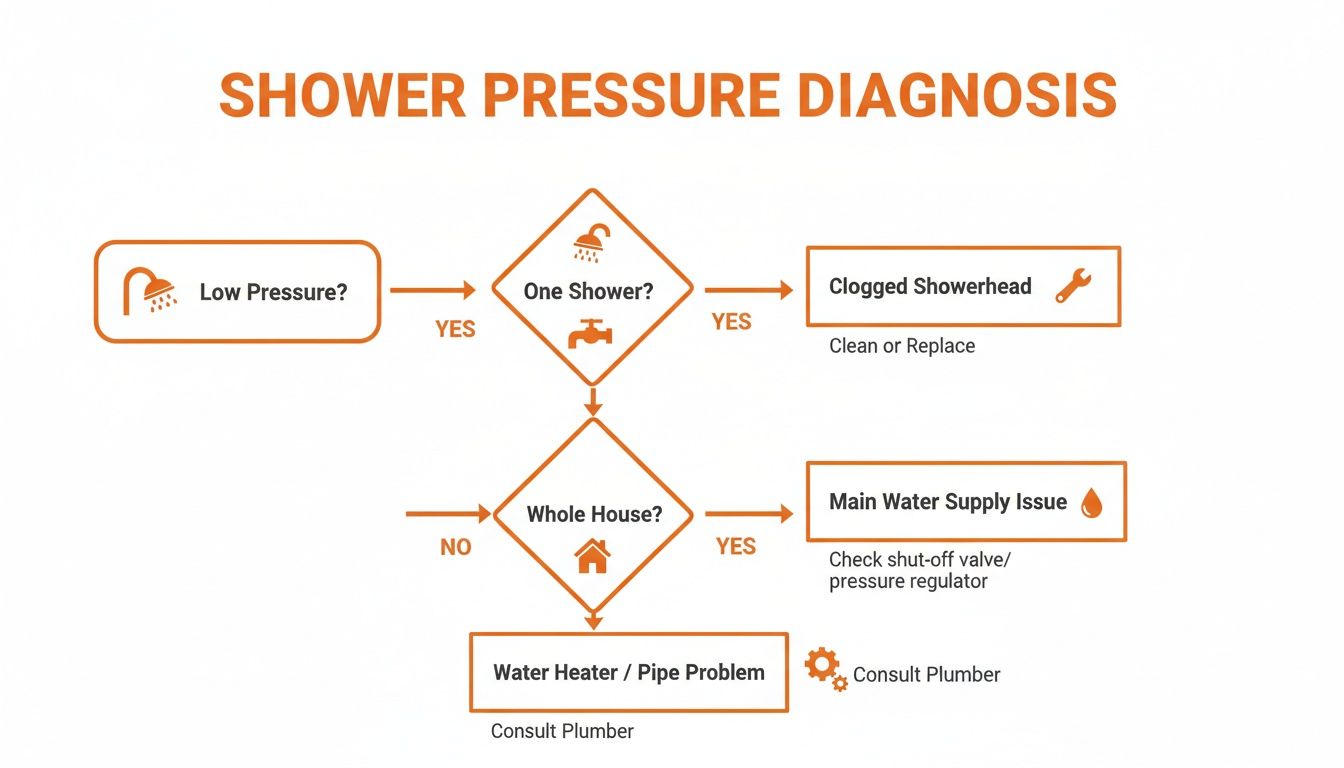
As you can see, a problem isolated to the shower points right at the fixture itself. If it’s a whole-house issue, you’re likely looking at a main line or pressure regulator problem.
Understanding the Impact of Regulations and Plumbing
Sometimes, what feels like weak pressure is actually by design—the result of regulations that have been in place for decades. Back in 1992, federal rules were passed to limit new showerheads to a maximum flow rate of 2.5 gallons per minute (GPM). This was a huge drop from the old 4.0–5.0 GPM models that were common before then.
What does this mean for you? Even if your plumbing is delivering a perfectly healthy 40–60 PSI (pounds per square inch), a clogged, older low-flow showerhead is going to feel incredibly weak. The good news is that modern high-efficiency designs have gotten much better at creating a strong spray, and upgrading can often boost the perceived force by 20–40% without using more water.
For a deeper dive into issues like these, check out our guide on common plumbing problems and solutions. You can also discover more about the evolution of water-saving fixtures from the experts at Oasense.
Simple DIY Fixes You Can Tackle This Weekend
Before you even think about calling a plumber, let’s roll up our sleeves. Many of the most common reasons for a weak shower can be fixed with a few basic tools and a little bit of your time this weekend. These are the straightforward, wallet-friendly solutions that often get that strong, satisfying spray back in action.
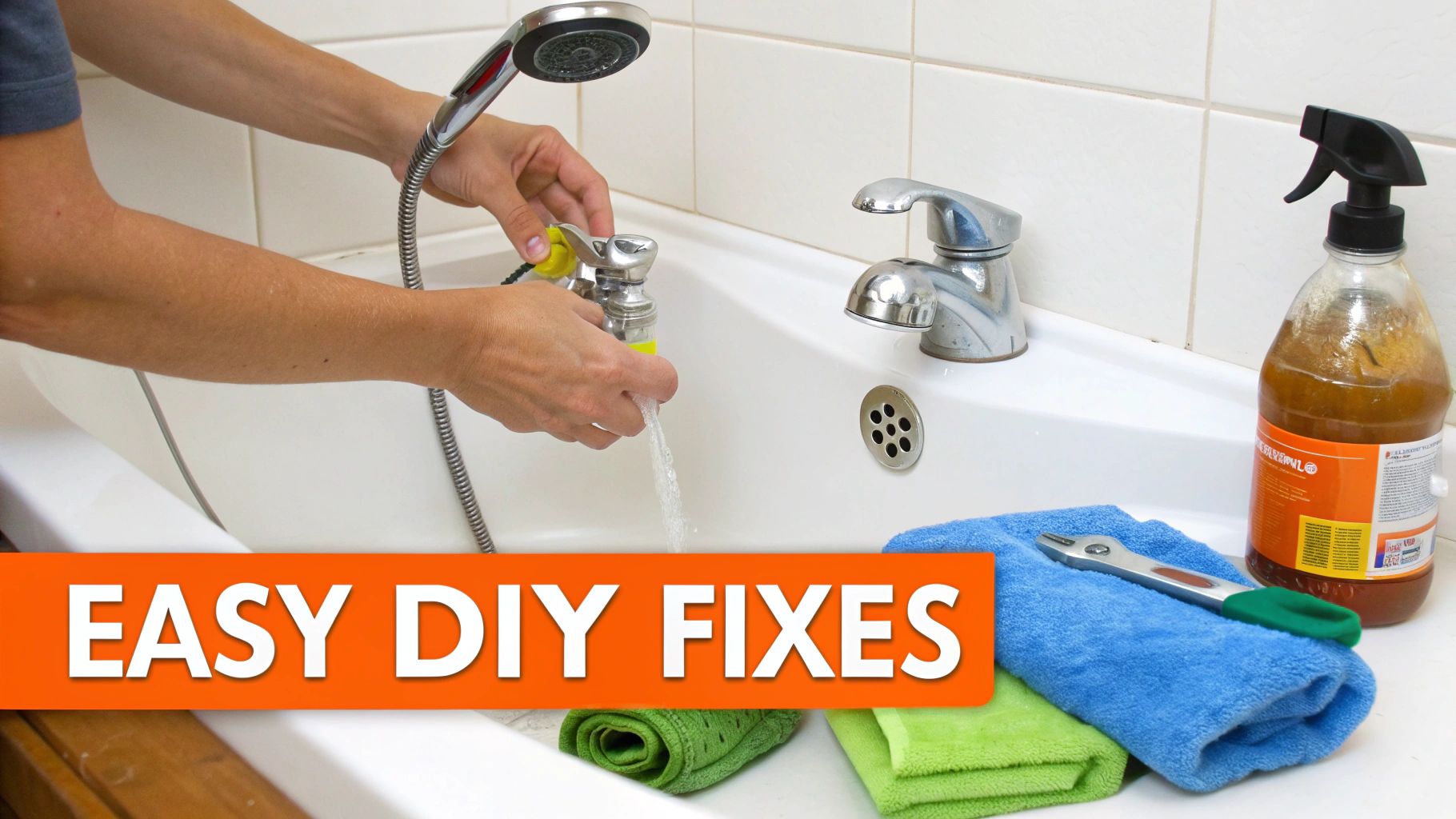
Here in Florida, we'll start with the number one offender: hard water. Over time, all those calcium and magnesium deposits create a crusty blockage inside your showerhead, slowly choking off the water flow. It's a classic problem with an equally classic—and simple—solution.
Deep Clean Your Showerhead for Immediate Results
If your shower's power has been slowly fading, it’s probably just crying out for a good cleaning. The tiny nozzles on the showerhead get clogged with mineral buildup, turning what was once a powerful jet into a disappointing dribble. The good news is that a little household white vinegar is all you need to dissolve those deposits.
Here’s how we get it done:
- Get it off: Use a pair of pliers and a soft cloth to gently unscrew the showerhead from the pipe. The cloth is key—it protects the finish from getting all scratched up.
- Give it a bath: Grab a plastic bag or a bowl and fill it with enough white vinegar to completely submerge the showerhead.
- Let it soak: Pop the showerhead in the vinegar and let it sit for at least a few hours. Overnight is even better. The acid in the vinegar will work its magic, breaking down all that crusty scale.
- Scrub and rinse: After its soak, use an old toothbrush to scrub away any stubborn gunk left in the nozzles. Give the head a thorough rinse with warm water before you screw it back on.
This simple deep clean is often all it takes. You’ll probably notice a huge difference in the flow right away.
Investigate the Flow Restrictor
Tucked inside almost every modern showerhead is a small plastic disc, often brightly colored, called a flow restrictor. Federal regulations put these in place to conserve water, limiting the flow to 2.5 GPM (gallons per minute) or less. While they’re great for the environment, a clogged or poorly designed one can be the secret saboteur of your shower pressure.
A Word of Caution: Removing the flow restrictor will definitely increase your water usage and your utility bills. It's often a better move to upgrade to a modern, high-efficiency showerhead designed to maximize pressure within the legal limits rather than just yanking this piece out.
If you decide to take a look, you’ll usually find it sitting right inside the threaded end of the showerhead. You can often gently pry it out with a small flathead screwdriver, but be careful not to damage the threads.
Check Your Shutoff Valves
It sounds almost too simple, but you'd be surprised how often a partially closed valve is the real culprit. If you’ve had any plumbing work done recently, it’s entirely possible a valve was never opened all the way back up.
You’ve got two main valves to check:
- The Shower Valve: Some showers have their own shutoff valves, usually hidden behind the decorative trim plate or in a nearby access panel.
- The Main Water Shutoff: This is the big one for your whole house. Find it and make sure the handle is turned fully counter-clockwise, which is the "open" position.
Just a quarter turn on one of these can be enough to kill your pressure. For more handy homeowner tips, our guide on seasonal plumbing tips for spring has great advice to keep your whole system running smoothly. A quick valve check only takes a minute and could solve everything instantly.
To help you decide where to start, here's a quick rundown of these common fixes.
DIY Fixes for Low Shower Pressure
| DIY Solution | Difficulty Level | Estimated Time | Potential Cost |
|---|---|---|---|
| Clean Showerhead | Easy | 1-8 hours (mostly soaking) | Under $5 (for vinegar) |
| Check Flow Restrictor | Easy | 15 minutes | $0 |
| Check Shutoff Valves | Very Easy | 5 minutes | $0 |
These fixes cover the most frequent and easiest-to-solve issues we see in the field.
If you’ve tried these initial steps and your shower is still weak, don't get discouraged. It just means the problem is likely a bit deeper in your plumbing system—maybe an issue with the shower's mixing valve or even your home's main pressure regulator. The next steps will take us beyond the fixture and into the components that control your home's water distribution.
What If a New Showerhead Is the Answer?
If cleaning your old showerhead didn’t bring back that satisfying spray, it might be time for an upgrade. Sometimes, the fixture itself is the problem. Swapping out an old, inefficient showerhead is one of the quickest and most satisfying ways to get better water pressure, but not all showerheads are created equal.
The right one can be a true game-changer, turning a pathetic dribble into a powerful, invigorating shower.
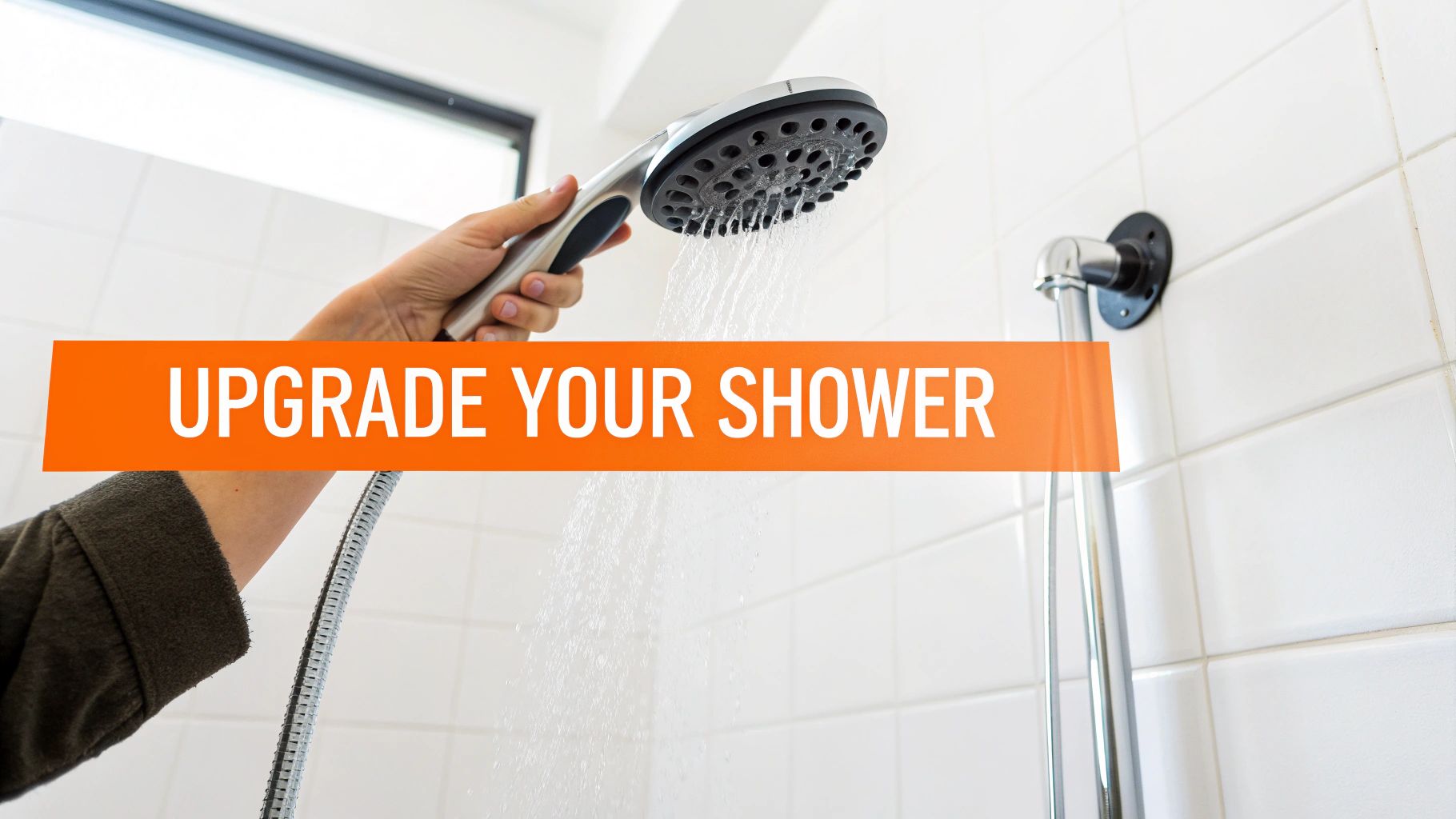
It’s not magic; it’s just smart engineering. So-called "high-pressure" showerheads don't actually increase your home's water pressure. What they do is manipulate the water flow you already have. By forcing the same amount of water through smaller, more precisely designed nozzles, they accelerate the stream and create a much stronger-feeling spray.
How High-Pressure Showerheads Actually Work
Think of it like putting your thumb over the end of a garden hose. The amount of water coming out of the spigot doesn't change, but the velocity sure does. Modern showerheads use this exact principle, often adding clever tech like air induction or compression chambers to boost the output even more—all while staying within federal water conservation laws.
This focus on smarter design has fueled massive growth in the market. The global high-pressure showerhead industry was valued at around USD 2.7 billion in 2023 and is projected to climb to USD 4.5 billion by 2032. Homeowners are driving this trend, looking for easy wins to fix low shower pressure without violating water-use regulations. You can find more insights on this growing tech at horow.com.
Comparing Your Showerhead Options
When you start shopping, you'll run into a few common types, each built for a different kind of shower experience. Knowing the difference is key to picking the right one for your bathroom.
- Standard Showerheads: These are your basic, no-frills models. They get the job done, but they often provide the least satisfying spray in a low-pressure home.
- Rain Showerheads: With their big, wide faces, these are made to feel like a gentle rainstorm. That sounds nice, but they're a terrible choice for low-pressure systems because the wide distribution makes the flow feel even weaker.
- High-Pressure Showerheads: These are specifically engineered to maximize the feeling of pressure. They usually have a smaller face and specialized nozzles to create a forceful, targeted spray. This is your best bet for a home with low water pressure.
Pro Tip: For homeowners here in Southwest Florida, hard water is a constant battle. Look for showerheads with rubber or silicone nozzles. They make it much easier to just wipe away the mineral buildup, keeping your pressure strong for way longer.
Installing Your New Showerhead
Once you’ve picked out the perfect model, the installation is a breeze—it’s a simple DIY project that usually takes less than 15 minutes and delivers immediate results.
- Get the Old One Off: Grab a pair of adjustable pliers and a soft cloth. The cloth is key—wrap it around the old showerhead base to avoid scratching the finish on the shower arm as you unscrew it.
- Clean the Threads: With the old head gone, use an old toothbrush to scrub the threads on the shower arm. Get rid of any old plumber's tape, gunk, or mineral deposits.
- Wrap on New Plumber's Tape: Take some fresh plumber's tape (also called Teflon tape) and wrap it clockwise around the threads a few times. This creates a watertight, leak-free seal.
- Screw on the New Head: Hand-tighten the new fixture onto the shower arm first. Then, use your pliers and cloth again for a gentle quarter-turn to snug it up. Don't go crazy and overtighten, or you could crack the fitting.
Upgrading your showerhead is a quick win that you’ll feel right away. If this simple fix gets you thinking about other improvements, checking out our other professional plumbing services can give you more ideas for making your home even better.
What If the Whole House Has Low Water Pressure?
So, you've checked the showerhead, and it's sparkling clean, but the water pressure is still just a sad trickle. And it's not just the shower—the kitchen sink, the bathroom faucet, they're all disappointingly weak. When the problem is house-wide, it's time to stop looking at individual fixtures and start investigating the heart of your plumbing system.
This usually means the culprit is a central component that governs water flow for your entire home. Let's walk through the most common suspects.
Our first stop is a device you might not even know exists: the Pressure Reducing Valve, or PRV. Think of this bell-shaped valve as your home's water pressure gatekeeper. If it's not set correctly or it's starting to fail, it could easily be the reason every faucet in your house feels weak.
Locating and Adjusting Your Pressure Reducing Valve
So, what does a PRV do? It takes the super high-pressure water coming in from the city's main line (which can top 100 PSI) and dials it down to a level that's safe for your home's pipes and appliances. Most houses are designed to run comfortably between 40 and 60 PSI. Go any higher, and you risk damaging your plumbing; any lower, and you get the frustratingly low pressure you're dealing with now.
You can usually find the PRV near where your main water line enters the house. Look for a brass, bell-shaped fitting right after the main shutoff valve. Garages, utility closets, and basements are the most common spots.
Found it? Great. Here’s how you can carefully check and adjust it:
- Get a Pressure Reading First. Before you touch anything, you need to know your starting point. Grab a water pressure gauge from any hardware store and screw it onto an outdoor spigot or your washing machine's cold water hookup. This gives you your baseline PSI.
- Make Tiny Adjustments. On top of the PRV, you'll see a screw or bolt, often held in place by a locknut. Loosen the locknut first. Then, turn the adjustment screw clockwise to increase the pressure or counter-clockwise to decrease it.
- A Little Goes a Long Way. Only make small, quarter-turn adjustments at a time. After each little turn, head back to your gauge and check the pressure again. You're looking for that sweet spot right around 50-55 PSI, which delivers a strong flow without putting your pipes under unnecessary stress.
A Quick Word of Caution: Never, ever set your home's water pressure above 60 PSI. Pushing it higher can cause serious leaks, damage your water heater, and even void the warranties on your appliances. If you're not 100% confident doing this yourself, it's always smarter to call a pro.
Adjusting the PRV often solves the problem instantly, but it’s not the only thing that can cause pressure issues.
Could It Be the Shower Mixing Valve?
If you've checked the PRV and the pressure is fine, but your shower is still the only fixture acting up, the problem might be the shower's mixing valve. This is the part hidden inside the wall, right behind the handle you use to turn on the water and set the temperature.
Inside that valve is a cartridge that controls the mix of hot and cold water. Over time, these cartridges can get clogged with mineral buildup or simply wear out, severely restricting the flow before water even gets to the showerhead.
A few tell-tale signs point to a bad mixing valve cartridge:
- The shower handle feels stiff or is suddenly hard to turn.
- You're having a tough time getting the water temperature just right—it's either scalding or freezing.
- The sink and toilet in the same bathroom have great pressure, but the shower is the only weak link.
Replacing a shower valve cartridge is a more advanced DIY job. While it's definitely doable for a handy homeowner, it means shutting off the water to your house, pulling off the handle and faceplate, and carefully extracting the old cartridge to install an identical new one. A mistake here could lead to a leak inside your wall, which is a headache no one wants.
Between adjusting PRVs and replacing valve cartridges, it’s easy to get in over your head. Here in Florida, our notoriously hard water causes severe mineral buildup that makes these components fail much faster. Our experts at Heatwave can not only fix the immediate issue but also help you explore long-term solutions like whole-home water conditioners. These systems prevent mineral scale from building up in the first place, keeping your plumbing healthy and your showers powerful for years to come.
When a Professional Plumber Is Your Best Solution
While a lot of low shower pressure fixes are great for a Saturday afternoon DIY project, some problems point to something more serious hiding inside your walls. Once you've cleaned the showerhead and checked the valves, if that trickle is still there, it’s time to put the tools down and call in a pro. Ignoring these bigger symptoms can lead to some seriously expensive water damage and massive headaches down the road.
Think of it this way: the simple fixes treat the symptoms, but a licensed plumber is here to diagnose and cure the underlying disease. Problems like hidden water leaks, widespread pipe corrosion, or a failing main water line demand specialized tools and the kind of expertise needed to use them safely and correctly.
Red Flags That Demand an Expert Eye
Certain signs are dead giveaways that your problem is more than a simple adjustment. If you spot any of the following, it's a clear signal that your plumbing system needs a professional to take a look.
- A Sudden, Major Drop in Pressure: If your water pressure takes a nosedive overnight throughout the whole house, you could be looking at a major leak somewhere in your main line.
- Discolored or Smelly Water: Water that's rusty, brown, or tastes metallic can mean you've got corroded galvanized pipes. This doesn't just restrict flow—it can be a health concern.
- Damp Spots or Mold Growth: Unexplained wet patches on walls, ceilings, or floors are a classic sign of a hidden pipe leak that’s quietly damaging your home's structure.
- A Hissing Sound Inside Walls: Hear what sounds like running water even when all the faucets are off? You almost certainly have a leak that needs to be found and fixed, fast.
For us here in Florida, another big culprit is the long-term effect of hard water. Years of mineral buildup can slowly choke your pipes from the inside out, creating a system-wide blockage that no amount of showerhead cleaning will solve. That’s a job for professional-grade equipment.
For more involved home improvement projects, such as installing a curbless shower, consulting a professional plumber from the start is wise. They can ensure the new system is properly integrated with your existing plumbing to deliver optimal water pressure and prevent future issues.
The Professional Diagnostic Process
When you call a trusted team like Heatwave, you aren't just getting a quick fix; you're getting a comprehensive diagnostic service. A licensed plumber uses a systematic approach to pinpoint the exact cause of your low water pressure. This usually involves testing your system with a pressure gauge at multiple spots—from the outdoor spigot to the water heater—to see precisely where the pressure is dropping off.
This deep dive is crucial because boosting water pressure often means looking beyond the shower itself and at the entire plumbing system. The global shower system market, valued at around USD 8 billion in 2023, is growing because homeowners expect better performance. Here in Florida, with our hard water, industry data shows that mineral scale and partial blockages can slash water flow by 20–30% over a decade. A full-system inspection is the only real way to find and fix those hidden restrictions.
Once we know what we're dealing with, a professional can offer a real, lasting solution. This might involve:
- Replacing a Faulty PRV: If your Pressure Reducing Valve is old or failing, a plumber can swap it out to restore and regulate proper pressure for your entire home.
- Installing a Water Pressure Booster Pump: For homes with chronically low pressure from the city supply, a booster pump is a game-changer that actively increases the pressure coming into your house.
- Repairing Hidden Leaks: Using acoustic leak detection and other advanced tools, a pro can find and fix leaks inside your walls with minimal disruption to your home.
Making the call to a professional is about protecting your home and solving the problem for good. For homeowners in Port Charlotte and the surrounding areas, our team offers expert local plumbing services you can rely on to restore your shower's power and your peace of mind.
Common Questions About Shower Water Pressure
When you’re trying to figure out how to boost your shower pressure, a lot of questions pop up. It can be tough to separate plumbing myths from practical advice that actually works.
Here are some clear, straightforward answers to the most common questions we hear from Florida homeowners. This should help you make smarter decisions about your home's plumbing.
Can a New Showerhead Really Make a Difference?
Absolutely. While it's true a new fixture can't magically increase the water pressure coming into your home, a modern "high-pressure" showerhead is specifically engineered to make the most of the flow you already have. It’s a master of optimization.
These heads use clever designs—think smaller nozzles and internal compression chambers—to accelerate the water as it exits. The result is a much stronger, more satisfying spray that feels like a significant pressure boost. If your current showerhead is clogged with mineral deposits or is just an older, inefficient model, upgrading can provide a dramatic and immediate improvement.
Is It Safe to Remove the Flow Restrictor?
While you can physically pop out that little plastic disc, it's generally not a good idea. Those devices are there for a reason: to meet federal water conservation standards, which typically cap the flow at 2.5 GPM (gallons per minute). Removing it will definitely increase your water usage and your utility bills.
More importantly, if your home's pressure is already on the high side of normal, yanking the restrictor could push too much water through the fixture, potentially damaging it over time. A far better approach is to clean the head thoroughly or upgrade to a well-designed model that performs better within the legal limits.
Key Takeaway: A modern, high-efficiency showerhead will give you a better shower experience than an old one with the flow restrictor removed—and it won't waste water or money.
Why Does My Hot Water Have Lower Pressure?
This is a classic plumbing puzzle, and it almost always points to an issue with your water heater or the hot water lines connected to it. Over the years, sediment and mineral scale can build up inside the water heater tank. This gunk can eventually clog the hot water outlet, choking off the flow to all your fixtures.
Another common culprit is a partially closed valve on the water heater itself. It could also be mineral deposits clogging up just the hot side of your shower's mixing valve or cartridge. A professional plumber can diagnose this by flushing your water heater and inspecting the specific valves and cartridges in the system.
My Whole House Has Low Water Pressure. What's Next?
If every faucet in your home has a weak trickle, the problem is systemic, not isolated to one fixture. The first thing you should do is find your main water shutoff valve and make sure it is 100% open. Sometimes, after a repair, it doesn't get turned all the way back on.
If the valve is fully open, the issue likely involves your Pressure Reducing Valve (PRV), a hidden leak somewhere in your plumbing, or even a problem with the municipal water supply to your neighborhood. At this stage, it's best to call a professional. For a broader understanding of water-related issues or to explore other frequently asked questions beyond just pressure, consider checking out this resource for general water system advice.
When DIY fixes aren't enough, you need a team you can trust to diagnose the problem correctly and provide a lasting solution. The experts at Heatwave Air Conditioning, Plumbing, & Electric have the tools and experience to restore your home's water pressure safely and efficiently. Contact us today for a professional evaluation at https://www.heatwavehvac.com.