
So, what exactly is an electrical panel upgrade? In simple terms, it means replacing your home's main circuit breaker box. The goal is to safely boost its capacity to handle the demands of modern life, from high-powered appliances to EV chargers. This isn't a DIY job—it requires a licensed electrician to pull permits, handle the installation, and coordinate the final inspection to ensure everything is up to code.
Recognizing the Warning Signs Your Panel Needs an Upgrade
Before diving into the nuts and bolts of an upgrade, you need to know why you might need one. Think of your electrical panel as the heart of your home's electrical system. When it’s overworked or starting to fail, it sends out distress signals. These signs aren't always as dramatic as sparks flying; more often, they're subtle, persistent issues you might be tempted to ignore.
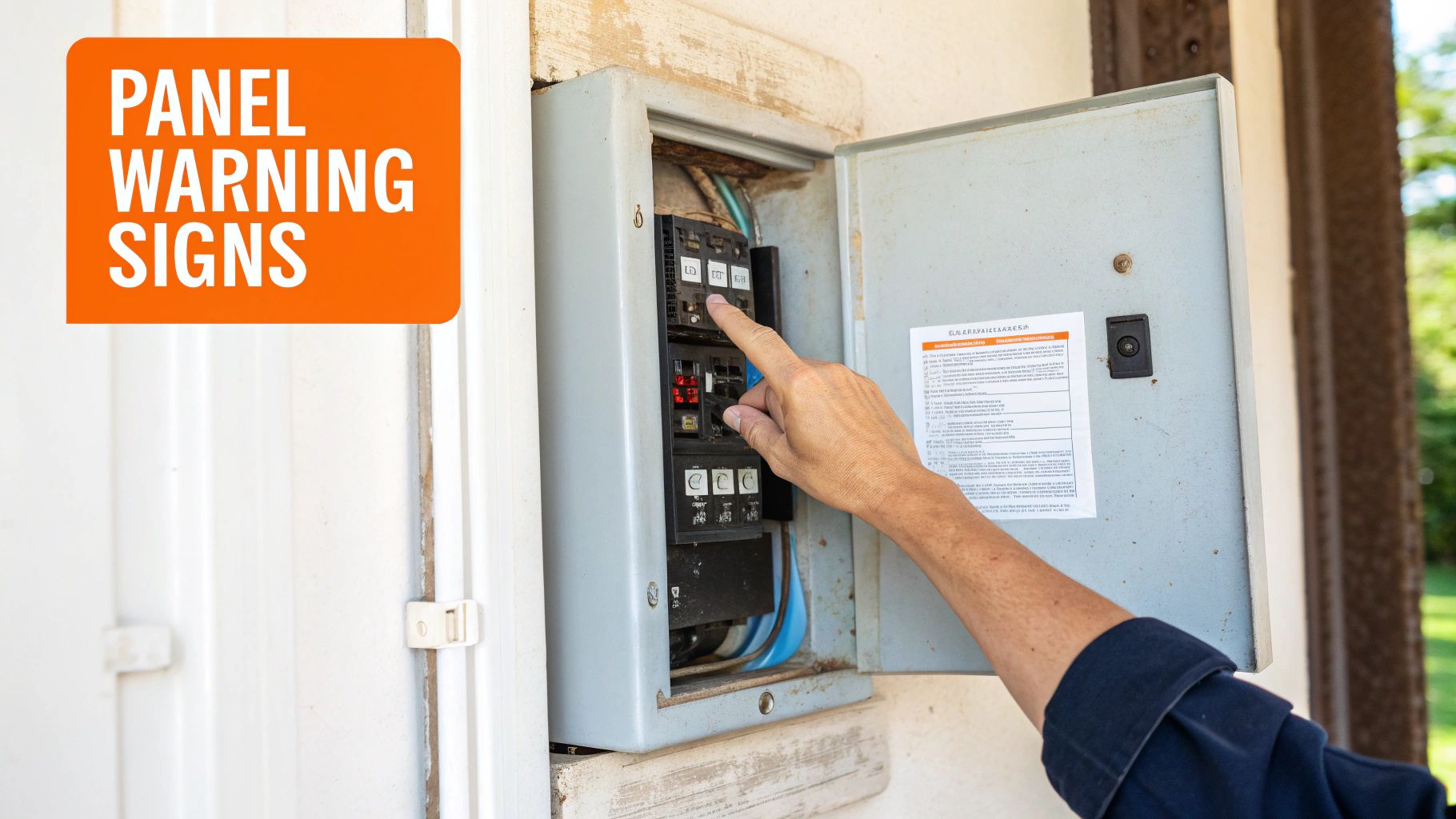
Here in Florida, our climate adds another layer of stress. The constant high humidity can lead to rust and corrosion inside the panel, which is a serious safety compromise. Ignoring these red flags isn't just an inconvenience—it's a real risk. A panel that can't keep up is a hazardous panel.
Frequent and Unexplained Breaker Trips
One of the most common complaints we hear is about breakers that trip all the time. If plugging in a vacuum or running the microwave constantly kills the power in a room, your circuits are overloaded. This is especially true on a sweltering Florida afternoon when the air conditioner kicks on and suddenly other appliances shut down.
This isn't just a nuisance. It’s your panel’s safety system practically screaming that it can't handle the electrical load. It's a clear signal that your home's power needs have outgrown what its electrical system can deliver.
Obvious Signs of an Aging System
Sometimes, the warnings are right there in plain sight. Take a close look at your electrical panel and around your home. Do you notice any of these tell-tale signs?
- Flickering or Dimming Lights: Do your lights dip or flicker when a big appliance like your HVAC unit powers on? This means that appliance is drawing more power than the circuit can comfortably provide, causing a momentary voltage drop.
- A Faint Burning Odor: Any strange smells, especially a burnt plastic or metallic scent coming from the panel area, demand immediate attention. This often points to overheating wires and is a serious fire hazard.
- Visible Rust or Corrosion: As we mentioned, our humid climate is tough on metal. Rust on the breakers or the panel box itself can interfere with the electrical connections and is a major safety concern.
- The Panel Feels Warm to the Touch: An electrical panel should never be warm. Heat is a byproduct of electrical resistance, usually caused by loose connections or an overloaded system.
To make it easier to spot trouble, here’s a quick rundown of the most common issues we see in the field.
Common Signs You Need an Electrical Panel Upgrade
| Symptom | What It Means | Recommended Action |
|---|---|---|
| Frequent Breaker Trips | Circuits are consistently overloaded, exceeding the panel's capacity. | Call an electrician to assess your home's total electrical load. |
| Flickering/Dimming Lights | Large appliances are causing voltage drops; the system is strained. | An inspection can determine if the panel or specific circuits are undersized. |
| Burning Smell or Scorch Marks | Wires are overheating, a significant fire risk. | Turn off the main breaker if safe and call an electrician immediately. |
| Visible Rust or Corrosion | Moisture has damaged the panel, compromising safety and conductivity. | The panel likely needs replacement to prevent electrical faults. |
| Outdated Fuse Box | An obsolete system not designed for modern electrical loads. | Immediate upgrade to a modern circuit breaker panel is recommended. |
| Not Enough Outlets | Over-reliance on extension cords and power strips. | A panel upgrade can support the addition of new, dedicated circuits. |
If you're noticing any of these symptoms, it's a clear sign that it's time to have a professional take a look.
An overloaded or outdated electrical panel isn't just about inconvenience. It's a critical safety issue. The U.S. Fire Administration identifies electrical malfunctions as a leading cause of home fires, making a panel upgrade a vital investment in your family's protection.
The age of your home plays a huge role, too. Many older homes in the Tampa Bay area were built when we used far less electricity. Homes built before the 1960s, for instance, often have undersized 100-amp panels. In fact, research shows these older properties have 5-9 times higher rates of inadequate panel capacity compared to homes built after 2000. You can read more in this comprehensive survey of U.S. homes.
Your Home's Future Needs
Finally, you need to think about your future plans. An upgrade isn't just about fixing today's problems—it's about getting your home ready for tomorrow. Are you planning any of these popular additions?
- Adding an electric vehicle (EV) charger
- Installing a new pool, hot tub, or spa
- Switching to an electric tankless water heater
- A major kitchen remodel with powerful new appliances
Each one of these projects adds a significant new load to your system. A proactive panel upgrade ensures you have the power you need to support a modern lifestyle, safely and reliably. This is exactly why the importance of regular electrical inspections can't be overstated—a good inspection will catch these capacity issues before they turn into emergencies.
What to Expect During the Upgrade Process
Knowing what goes on during an electrical panel upgrade can take a lot of the mystery—and anxiety—out of the project. It’s a well-orchestrated process that a professional team handles to be as quick and painless as possible. From the first call to the final sign-off, every stage is there for one reason: to give you a safe, powerful, and code-compliant electrical system.
It all starts with a detailed consultation. This is more than just a quick look-see; a qualified electrician will run what’s called a load calculation. Think of it as a complete inventory of your home's electrical appetite, both now and in the future. We'll account for everything from your new high-efficiency AC unit to that EV charger you're eyeing for next year.
This calculation is the blueprint for the entire job. It gives us the hard data needed to recommend the right panel size, ensuring this isn't just a replacement but a genuine upgrade that sets your home up for the future.
Permitting and Pre-Installation Planning
Once we’ve zeroed in on the perfect panel capacity for your home, the next big step is getting the right permits. This isn't just red tape—it's a legal requirement that protects you and guarantees the work is done to strict safety standards.
Here in Southwest Florida, that means working with local municipalities like the City of Tampa or Sarasota County. Each has its own rules and paperwork. A seasoned electrician takes care of all this for you, from filing the right forms to scheduling the necessary inspections.
Key Takeaway: The permit is your guarantee that the job is done right. It ensures an independent, third-party inspector will verify the work, holding the electrical contractor accountable and confirming everything meets the National Electrical Code (NEC).
During this planning phase, we'll also get in touch with your utility provider. To work on the system safely, we need a temporary power disconnection, often called a "meter release." Don't worry, this is all scheduled well in advance to keep the downtime to a minimum.
The Day of the Upgrade
Installation day is when the real work happens. It's a systematic process that follows a precise sequence to ensure everything is done safely and correctly.
Here’s a play-by-play of what the day usually looks like:
- Scheduled Power Outage: First things first, we'll coordinate with the utility company to shut off the power at the meter. You’ll know the exact time window ahead of schedule, but plan for the power to be out for about 4 to 8 hours.
- Removing the Old Panel: With the power off, the old panel is carefully disconnected and taken out. Every single circuit gets labeled so we know exactly where it goes in the new panel.
- Mounting the New Panel: Your new, higher-capacity panel is then securely mounted. Sometimes this requires small adjustments to the wall or the main service conduit to get a perfect fit and meet code clearances.
- Wiring and Installing Breakers: Each of your home’s circuits is meticulously wired into brand new circuit breakers. This is also the perfect time to add any modern safety devices, like Arc Fault Circuit Interrupters (AFCIs), which are now required in many parts of the home to help prevent electrical fires.
- Grounding and Bonding: This is a non-negotiable safety step. We connect the new panel to your home's grounding system—usually a set of copper rods driven deep into the earth. This system is what protects you and your expensive electronics from power surges and electrical faults.
The Final Inspection and Powering Back Up
Once the new panel is in, we're not quite done. The last, and arguably most important, step is the official inspection. A city or county electrical inspector will come out to do a thorough review of the new installation and our workmanship.
The inspector is looking to verify that everything meets the latest electrical codes. They’ll check for things like:
- Proper panel mounting and clearances
- Correct wire sizes for each circuit breaker
- Secure connections on all terminals
- Sufficient grounding and bonding
Once the inspector gives us the "green tag" or formal approval, the utility company gets the go-ahead to turn your power back on. Your electrician will then fire up the system, test every circuit, and give you a full tour of your new, safer, and more capable electrical panel.
To get a better feel for what's involved in this critical home improvement, feel free to explore our comprehensive electrical panel services.
Choosing the Right Panel Capacity for Your Home
Picking the right amperage for your new electrical panel is one of the biggest decisions you'll make during an upgrade. This isn't just about swapping out old gear; it’s about setting your home up to handle everything you own now and everything you'll want to add down the road. The choice almost always boils down to three sizes: 100-amp, 150-amp, and the modern standard, 200-amp panels.
For a smaller Florida home, maybe one that uses natural gas for the stove and water heater, a 100-amp panel might get the job done. But honestly, it leaves you with zero room to grow. A 150-amp panel offers a bit more breathing room, but for most of us, it’s just a stepping stone to what you really need.
Why 200 Amps Is the New Standard
These days, a 200-amp service is the gold standard, and for good reason. Think about a typical Southwest Florida home: you've got central AC blasting, an electric stove, a pool pump running, and a family charging a half-dozen devices. A 100-amp panel would be constantly pushed to its limit. That means tripped breakers and, more importantly, potential safety risks.
Moving up to a 200-amp panel gives you the muscle to run all your current appliances at once without breaking a sweat. Even better, it prepares your home for the future of electrification.
Upgrading your electrical panel is more than a repair; it's a strategic investment. A modern 200-amp service not only enhances your home's safety and functionality but also significantly boosts its resale value in the competitive Florida real estate market.
This isn't just a local trend. National research shows that up to 48 million single-family homes will need panel upgrades to support things like heat pumps and EV chargers. With nearly 30% of U.S. homes still running on 100 amps or less, the need for more power is undeniable.
The Power of a Professional Load Calculation
So, how do you know for sure what your home actually needs? The answer is a professional load calculation. This isn't a ballpark estimate. A licensed electrician performs a deep dive into your home's total electrical demand.
They'll account for everything, including:
- Major Appliances: Your HVAC system, water heater, refrigerator, stove, and dryer.
- Lighting and Outlets: Calculating the total potential load from all your general-use circuits.
- Specialty Equipment: Things like pool pumps, hot tubs, or that new welder in your workshop.
- Future Additions: This is key. An electrician needs to factor in any big projects you have planned.
For instance, if you're thinking about adding high-capacity 22kW EV home chargers, that's a massive power draw that has to be planned for. The same goes for backup power; if you're also considering a generator, our guide to generator installation is a great resource that goes hand-in-hand with a panel upgrade.
The infographic below breaks down the streamlined process you can expect when you bring in a pro for your upgrade.
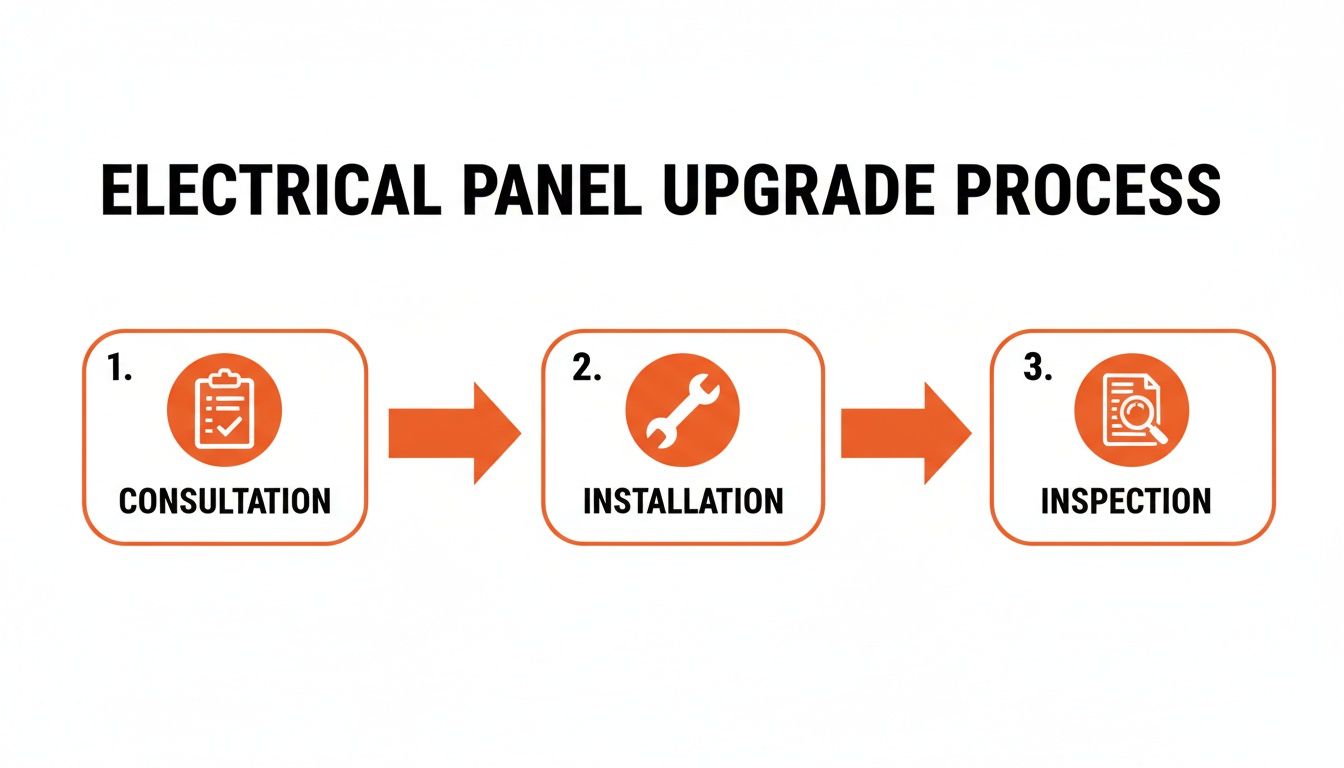
This methodical approach ensures every step, from the first conversation and load calculation to the final city inspection, is handled right for your safety and peace of mind.
The Investment: What Does a Panel Upgrade Cost in Florida?
Alright, let's get straight to the big question on every homeowner's mind: what’s this going to cost me? Upgrading your electrical panel is a serious investment in your home's safety and future, but you absolutely need to know the numbers upfront.
The final price tag isn't a simple, one-size-fits-all number. It’s a mix of a few key things, from the panel itself to the going rate for a skilled electrician's time here in Southwest Florida. The most common project we handle is the jump from an older 100-amp panel to the modern 200-amp standard. That upgrade gives your home the power it needs for today’s appliances and technology, but it’s a bit more involved than a simple swap.
What Shapes Your Final Invoice?
When an electrician gives you a quote, they’re looking at specific variables tied directly to your home's current setup. A straightforward panel replacement will naturally cost less than a project that also requires significant rewiring to bring everything up to today's demanding electrical codes.
Here are the main things we look at:
- Panel Size: Moving up to a 200-amp or even 400-amp panel means a bigger investment in the equipment itself. It often requires a new, thicker main service cable running from the utility pole to your house.
- Labor Rates: The cost for a licensed electrician's expertise can vary a bit across Florida. Labor in a dense area like Tampa might look a little different from rates in Port Charlotte or Cape Coral.
- Permit Fees: Every county, whether it's Hillsborough, Lee, or Charlotte, has its own permit fees for major electrical work. This is a non-negotiable part of the process that ensures the job is inspected and signed off on by the local authority.
- Code-Required Extras: Does your grounding system need to be updated? Do certain circuits now require special AFCI breakers for enhanced fire protection? These safety upgrades are often required by code and will be factored into the total.
Across the country, a standard 100-amp to 200-amp upgrade typically lands somewhere between $1,300 to $2,000. For a more powerful 400-amp panel, you might see figures from $2,000 to $4,000. When you factor in permits, labor, and any necessary extras, a typical panel upgrade project in our area usually settles between $1,500 and $3,500. For a deeper dive, candcair.com offers some great insights into these national cost breakdowns.
Here’s a clearer look at where the money goes for a standard 200-amp upgrade.
Estimated Cost Breakdown for a 200-Amp Panel Upgrade
| Cost Component | Typical Price Range | Notes |
|---|---|---|
| 200-Amp Electrical Panel & Breakers | $400 – $800 | Includes the main panel, main breaker, and standard circuit breakers. |
| Professional Labor | $800 – $2,000 | Covers the licensed electrician's time for removal, installation, and wiring. |
| Permit Fees | $100 – $400 | Varies by municipality (e.g., Tampa, Fort Myers, Sarasota). |
| Additional Materials | $200 – $500 | Includes wiring, conduit, grounding rods, and other necessary components. |
Keep in mind these are estimates. Your home's specific needs—like requiring a new service mast or extensive circuit labeling—can adjust the final cost.
Making a Smart Investment Feel Manageable
We get it. A necessary safety upgrade can feel like a sudden, unplanned expense. But here’s the thing: this is a true investment in your home’s safety, modern functionality, and even its resale value down the road.
You don't have to shoulder the entire cost all at once. To make this crucial project easier to manage, we offer straightforward financing solutions that break the total cost into predictable, low monthly payments. Many homeowners find this lets them move forward with the upgrade right away, without having to wait.
We believe that a safe, modern electrical system should be accessible to everyone. Financial hurdles shouldn't stand in the way. Our application process is simple and transparent, and you can learn all about our flexible payment plans by exploring our financing options here.
Your Checklist for Hiring a Licensed Florida Electrician
Picking the right professional for your electrical panel upgrade is just as important as the panel itself. Think about it—you're trusting someone with the safety of your home and family. Here in Florida, where licensing and local code knowledge are everything, you absolutely have to do your homework. This isn't a job you give to the lowest bidder; it's about finding a true partner for a project that powers your entire life.
The stakes are high. A panel that's installed incorrectly can cause anything from annoying power flickers to a catastrophic electrical fire. This checklist is your game plan for finding a qualified, trustworthy electrician in the Tampa Bay area who will get the job done safely, legally, and right the first time.
Verify Their License and Insurance
This is your non-negotiable first step. Don't even think about skipping it. In Florida, anyone touching your electrical system has to be licensed by the state. You can—and should—look them up yourself on the Florida Department of Business and Professional Regulation (DBPR) website.
Once that checks out, ask for proof of their insurance. You need to see two things:
- General Liability Insurance: This is what protects your property. If a technician accidentally drills through a pipe or damages your drywall, this insurance pays for the repairs, not you.
- Workers' Compensation: This protects you if a technician gets hurt on your property. Without it, you could be on the hook for their medical bills. Seriously.
A legitimate contractor will have their license number and insurance certificates ready to go. If they get defensive or make excuses when you ask, that’s a huge red flag. Just walk away.
Confirm Deep Experience with Local Codes
Electrical codes aren't the same everywhere. The rules in Hillsborough County can be different from Lee or Sarasota County. You need an electrician who not only knows the National Electrical Code (NEC) but is an expert in the specific local amendments and inspection quirks of your town.
This local knowledge is what makes the permitting and inspection process go smoothly. An electrician who knows the local inspectors knows what they’re looking for, which saves you from frustrating delays and expensive do-overs. This is especially true for a major job like a panel upgrade. For more general advice on hiring tradespeople, this ultimate contractor hiring checklist is a great resource.
Insist on a Detailed Written Estimate
Never, ever accept a verbal quote for a project this big. A true professional will give you a detailed, itemized estimate that breaks everything down.
Your estimate should clearly spell out:
- The total cost, with a clear separation of parts and labor.
- The exact make and model of the new panel and breakers.
- A clear scope of work, including any wiring or grounding updates that are needed.
- The cost for pulling the permit.
- Payment terms and a realistic timeline.
This document is your contract. It protects you and the electrician by making sure everyone is on the same page and helps you avoid those nasty surprise charges down the road.
Evaluate Their Local Reputation and Warranties
In the service business, a good reputation is earned. Look for a company that has been around your community for a while and has positive feedback. Check reviews on Google and Angi, sure, but also look for signs that they’re a real local business, not some fly-by-night operation.
Finally, ask direct questions about their warranties. A good company will always stand behind their work. You should get a warranty that covers both the new panel (from the manufacturer) and the electrician's labor for a set period. It shows they're confident in their skills and gives you real peace of mind. After all, a comprehensive service should always be backed by a guarantee, which is the same philosophy behind getting routine check-ups. You can see why in our guide on professional electrical wiring inspections.
Your Top Electrical Panel Upgrade Questions Answered
When it comes to a big project like swapping out your home's main electrical panel, you're going to have questions. It's a good thing. Especially here in Florida, homeowners are thinking about everything from hurricane readiness to the sheer power needed for year-round air conditioning.
Let's dive into some of the most common questions we hear from homeowners just like you. I'll give you the straight, practical answers you need to make a confident decision.
How Long Does a Panel Upgrade Actually Take?
This is almost always the first question, and for good reason. For a pretty standard upgrade—say, going from an old 100-amp panel to a modern 200-amp one—the entire job usually gets wrapped up in a single workday.
You should plan for your home to be without power for about 4 to 8 hours. We coordinate this planned outage directly with your utility provider and give you a clear time window so you can make arrangements. While the power is off, our licensed electricians are handling the whole process: removing the old box, installing and wiring the new panel and breakers, and coordinating the final inspection to get you back up and running.
Will an Upgrade Lower My Electric Bill?
While a panel upgrade isn't a magic bullet for saving energy on its own, it absolutely sets the stage for a more efficient electrical system. Think about it: an old, corroded, or overloaded panel can create resistance, which wastes energy as heat. A new panel ensures clean, stable power gets to your appliances, helping them run the way they were designed to.
The real savings kick in with what the new panel allows you to do. With a 200-amp panel, you can finally install modern, high-efficiency equipment like:
- Heat pump water heaters
- New, high-SEER central air conditioning systems
- Super-efficient induction cooktops
These appliances use a fraction of the energy their older cousins do, and that's where you'll see a real drop in your monthly utility bills.
Key Insight: A panel upgrade is the foundation for electrifying your home. It unlocks your ability to install modern, energy-sipping appliances that can dramatically cut your energy use and reliance on fossil fuels.
Can I Get a Tax Credit for Upgrading My Panel?
Yes, this is one of the best parts! The federal government knows that a modern electrical panel is a gateway to energy efficiency. Under the 25C Energy-Efficient Home Improvement Tax Credit, you may be able to claim a credit for part of your upgrade cost.
Right now, the credit typically covers 30% of the project cost, up to a $600 maximum. This applies to the panel itself, any subpanels, and the necessary wiring. To qualify, the new panel must have a capacity of at least 200 amps and be installed alongside other qualified energy upgrades, like a new heat pump or central AC. It’s a fantastic way to take some of the sting out of the initial investment.
What's the Difference Between a Fuse Box and a Circuit Breaker Panel?
This is a huge one, especially in some of Florida's classic older homes. A fuse box is old-school tech. It uses single-use fuses with a tiny metal strip inside that's designed to melt and break the circuit when it gets overloaded. Once a fuse blows, it's trash—you have to physically replace it.
A circuit breaker panel is the modern, much safer standard. Breakers are reusable switches. When they sense an overload or a short circuit, they automatically "trip" into the off position. To get the power back on, you just flip the switch. It's that simple.
Breakers are far more reliable, worlds safer, and actually built to handle the electrical loads of a 21st-century home. If your house still has a fuse box, an upgrade isn't just a good idea—it's an essential safety move.
Ready to make sure your home has the safe, reliable power it needs for today and for the future? The expert team at Heatwave Air Conditioning, Plumbing, & Electric is here to walk you through it. Get in touch for a free, no-pressure estimate on your electrical panel upgrade.