
Yes, a mini-split for your garage is an excellent upgrade, especially for those of us in Florida battling the non-stop heat and humidity. These systems are a world away from inefficient window units or the expensive hassle of trying to extend your home's central air.
Is a Mini Split for Your Garage a Smart Florida Upgrade?
Tired of your garage feeling like an oven for nine months out of the year? For so many Florida homeowners, the garage is just wasted space—a sweltering storage unit where anything heat-sensitive goes to melt and the thought of starting a project or workout is laughable.
Trying to extend your home's central AC is often a non-starter due to cost and complexity, while those loud, clunky window units barely make a dent in the oppressive humidity.

This is exactly where a ductless mini-split for your garage completely changes the equation. Think of it as giving your garage its very own, high-efficiency climate control system. It doesn’t steal air from your main HVAC unit, and it neatly avoids the need for expensive and invasive ductwork installation.
Whether you're dreaming of a serious workshop, a home gym that you’ll actually use, or one of these ultimate man cave ideas, a mini-split is what makes it possible. It effectively turns a neglected area into a valuable, comfortable extension of your home.
The Clear Advantage Over Other Options
Unlike older, less effective cooling methods, a mini-split is perfectly suited to the unique demands of a Florida garage. These systems are designed for single-zone applications, delivering powerful, targeted cooling right where you need it without the energy waste of other solutions.
The core advantage is clear: a mini split gives an unconditioned space its own independent climate system. It doesn't borrow capacity from your house, doesn't need ductwork, and handles both heating and cooling year-round, making it a highly practical solution.
For a deeper dive into evaluating your whole-home comfort needs, our guide on how to choose the right HVAC system for your home offers more context on why a zoned solution like a mini-split is so effective.
Mini Split Compared to Other Garage Cooling Methods
To really see the difference, it helps to put a mini-split side-by-side with its main competitors. The table below breaks down the key advantages in efficiency, installation, and overall comfort that make a mini-split the clear winner for a garage upgrade.
| Cooling Method | Energy Efficiency | Installation Complexity | Zoning Control | Best For |
|---|---|---|---|---|
| Ductless Mini Split | Very High | Moderate (Requires pro) | Excellent (Independent zone) | Year-round comfort, workshops, home gyms, and multi-use spaces. |
| Window AC Unit | Low to Moderate | Low (DIY friendly) | Poor (Single room only) | Temporary, budget cooling for small spaces with minimal use. |
| Central AC Extension | High | Very High (Invasive ductwork) | Poor (Tied to main system) | New construction or homes where ductwork is already planned. |
Ultimately, choosing a mini-split isn’t just about cooling your garage; it’s about reclaiming a significant part of your home’s square footage. It’s a smart investment in your comfort, your home's functionality, and its overall value.
Why a Single-Zone Mini Split Is Your Garage's Best Friend
When you need to cool just one room, it doesn't make much sense to blast your entire home's central AC. That’s the simple idea behind using a mini split for your garage. It delivers powerful, focused climate control exactly where you need it, without being wasteful or complicated.
Trying to tie your garage into your home's main HVAC system is a common mistake. It’s not just a massive, expensive project; it’s also incredibly inefficient. Your primary AC unit is forced to work overtime, which can throw off the balance in your home and lead to issues like uneven cooling throughout your house. A single-zone system keeps your garage's climate needs completely separate, as they should be.
The Genius of Simple Design
The design behind a single-zone mini split is beautifully simple. It's made of two core parts connected by a small refrigerant line set:
- An outdoor compressor/condenser unit that sits outside, handling the hard work of heat exchange.
- An indoor air-handling unit mounted high on a wall inside your garage, quietly delivering conditioned air right into the space.
This direct, one-to-one setup is what makes it perfect for a garage. There are no ducts to worry about designing, building, or cleaning. The connection between the indoor and outdoor units only needs a tiny three-inch hole through the wall, so you avoid the major construction and mess that comes with adding ductwork.
Avoiding Energy Waste and Installation Headaches
One of the biggest hidden costs of central air is energy loss through ductwork. According to the U.S. Department of Energy, leaky or poorly installed ducts can waste up to 30% of the energy you pay for.
A single-zone mini split completely sidesteps this problem. Because the conditioned air is delivered directly into the room, there's virtually no energy loss. Every bit of power you're paying for goes right into making your garage comfortable.
This ductless efficiency is a huge part of why these systems have become so popular. For Florida homeowners who use their garages as workshops, gyms, or hobby spaces, a simple, effective solution is key. It's no surprise the market for these units is projected to grow by 8.5% annually through 2034 in North America. You can read more about the mini-split market trends on gminsights.com.
The Perfect Match for Florida's Multi-Purpose Garages
As more of us look to turn our garages into truly usable parts of our homes, the need for reliable climate control has shot up. A single-zone mini split for your garage is more than just an AC—it's an upgrade to your home's functionality.
It gives you the power to use your garage all year long, protecting tools from rust-causing humidity and creating a comfortable space for any project or activity. With its targeted performance, high efficiency, and easy installation, it’s the best friend any Florida garage could ask for.
Calculating the Right BTU for Your Florida Garage
Picking the right size for your mini-split for your garage is the most critical decision you'll make in this process. Nailing the size means you get efficient, reliable comfort. But getting it wrong? You’re looking at high energy bills and a system that just can't keep up.
BTUs, or British Thermal Units, are basically the "horsepower" of an air conditioner—a simple measure of its cooling power. When you're sizing a mini-split for a garage, you have to figure out the right BTU per square foot for your space. But here in Florida, our intense heat and humidity mean our garages have very different needs than one in a cooler, drier state.
More Than Just Square Footage
A generic online chart might give you a BTU number based only on your garage's square footage, but that’s barely half the story for a Florida home. The scorching sun, thick humidity, and the way most garages are built demand a much smarter approach.
We have to account for several local factors that dramatically increase the "load," which is just the amount of heat your AC needs to remove. A one-size-fits-all number from a chart simply won't work here.
This quick guide can help you visualize the first step: choosing the right type of system for a typical garage.
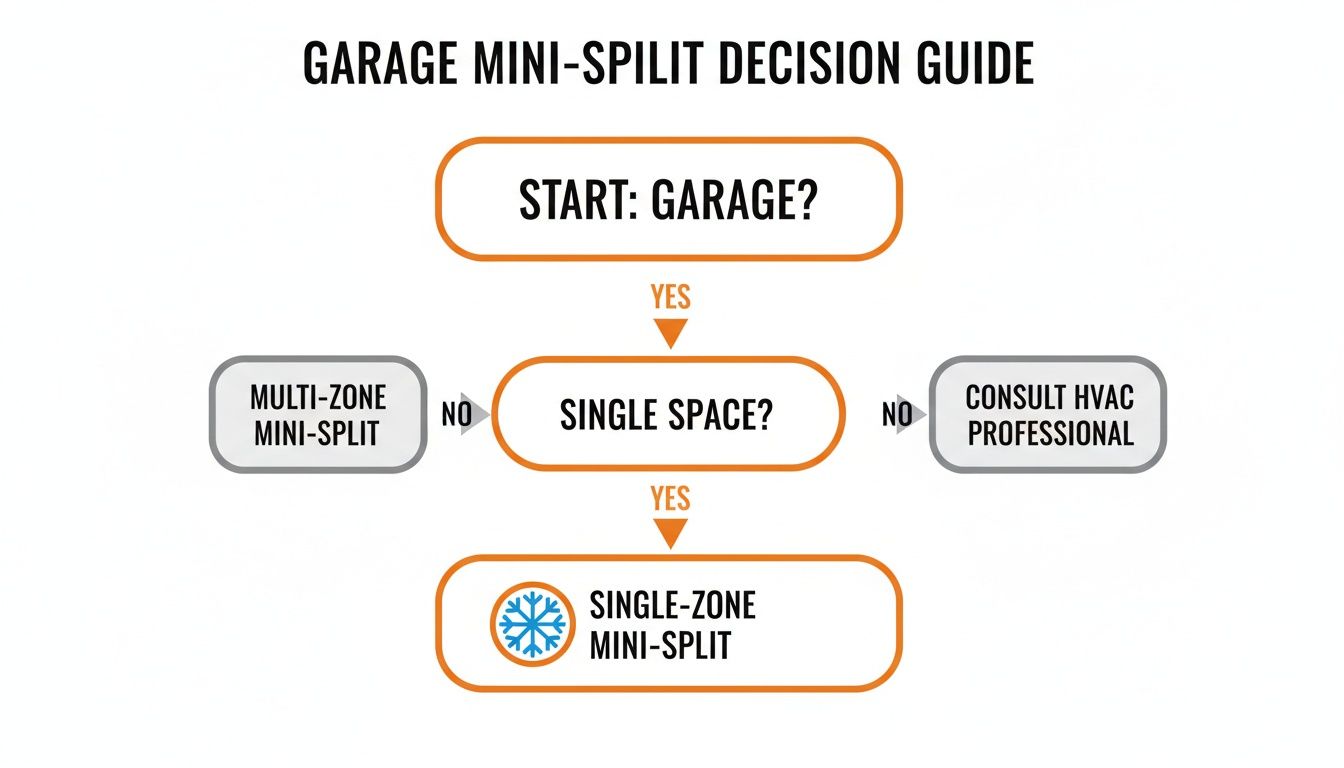
As you can see, for a single, enclosed space like a garage, a single-zone mini-split is almost always the most straightforward and effective solution.
Florida-Specific Sizing Factors
To get a real-world BTU estimate, we start with a baseline number for your garage's size and then adjust it for actual Florida conditions. These are the key variables that will push your BTU needs up.
- Poor Insulation: Most garages, especially older ones, have little to no insulation in the walls or ceiling. An uninsulated space is like trying to cool a tin can sitting in the sun—it needs a major power boost.
- West-Facing Garage Door: If you have a standard, uninsulated metal garage door that faces west, it becomes a massive heat radiator. It soaks up that brutal afternoon sun and pours heat into your garage for hours.
- Frequent Door Openings: Opening and closing that big garage door floods the space with hot, humid air. Your system needs to be powerful enough to recover quickly from that sudden influx.
- Ceiling Height: Many modern garages feature ceilings 10 feet or higher. That extra height means there's a lot more air volume to cool, which requires more BTUs than a standard 8-foot ceiling.
To help you get a better idea, here's a table with some baseline BTU numbers for common garage sizes in Florida.
Estimated BTU Needs for Florida Garages
| Garage Size | Square Footage (Approx.) | Base BTU Recommendation | Add for Poor Insulation | Add for Heavy Sun Exposure |
|---|---|---|---|---|
| 1-Car Garage | 240 sq. ft. | 9,000 BTU | +2,000 BTU | +1,500 BTU |
| 2-Car Garage | 400 sq. ft. | 12,000 BTU | +3,000 BTU | +2,000 BTU |
| 2.5-Car Garage | 576 sq. ft. | 15,000 BTU | +4,000 BTU | +2,500 BTU |
| 3-Car Garage | 640 sq. ft. | 18,000 BTU | +4,500 BTU | +3,000 BTU |
Remember, these are starting points. A garage with no insulation and a west-facing door will need a significantly higher BTU capacity than the base recommendation.
Sizing a mini-split isn't just about cooling the air; it's about removing humidity. An oversized unit cools the space too fast and shuts off, never running long enough to pull moisture from the air. This leaves you with a cold, clammy room—a classic Florida problem.
The Dangers of Incorrect Sizing
Getting the BTU capacity wrong is a frustrating and costly mistake. It’s critical to avoid going too small or too big.
An undersized mini-split will run nonstop on hot days, desperately trying to keep up but never quite getting there. This leads to sky-high energy bills and puts a ton of strain on the components, causing them to wear out fast.
Surprisingly, oversizing is just as bad. A unit that's too powerful will "short-cycle"—blasting cold air, shutting off, then turning back on a few minutes later. This constant on-and-off is incredibly inefficient, does a terrible job of removing humidity, and puts massive stress on the compressor, which can drastically shorten the system's life.
This is exactly why professional load calculations are a non-negotiable part of our AC installation services. By taking all these unique factors into account, you can be sure the mini-split for your garage is a perfect match for your needs, giving you efficient performance and total comfort, even on the most brutal Florida day.
Of course. Here is the rewritten section, designed to sound like an experienced human expert while adhering to all your requirements.
How Mini Splits Deliver Maximum Efficiency and Lower Energy Bills
So, you’ve figured out the right size for your garage mini-split. The next question is always the big one: how much money will this actually save me? The answer isn't just a little—it's a lot. And it all comes down to the incredible energy efficiency of modern ductless systems, which is what truly separates them from old, wasteful ways of cooling a space.
Think about the ductwork for your central air conditioner. It’s like a long, leaky garden hose snaking through your scorching hot attic. By the time the cool air reaches its destination, a good portion has already leaked out or warmed up along the way. That's not just a story; it's a very real problem.
The Problem With Ducts
Traditional central HVAC systems depend on a huge network of ducts to move air around. The trouble is, those ducts are almost never perfectly sealed. Here in Florida, that wastefulness is a real budget-killer.
According to the U.S. Department of Energy, these duct losses can waste about 30% of the cooled air before it ever reaches the room. A ductless mini-split, on the other hand, can be up to 30% more efficient simply by getting rid of the ducts. With air conditioners already accounting for roughly 12% of household electricity usage, that's a massive saving. You can explore detailed HVAC statistics on ServiceTitan.com to see just how big an impact efficiency makes.
A mini-split sidesteps this problem entirely. The indoor unit is right there in the garage, so there are no ducts and virtually zero energy loss. Every penny you spend on electricity goes directly into making your garage cool and comfortable.
Understanding SEER2: The Efficiency Scorecard
When you start looking at different mini-split models, you'll run into a rating called SEER2 (Seasonal Energy Efficiency Ratio 2). The easiest way to think of SEER2 is like the "miles per gallon" rating for an air conditioner. It tells you how much cooling you get for each unit of energy you use.
A higher SEER2 rating means the unit is more efficient and will cost you less to run. It's pretty straightforward:
- Federal Minimum: The government sets a baseline efficiency standard that all new systems have to meet.
- High-Efficiency: Top-tier models can have SEER2 ratings of 20, 22, or even higher.
- The Payoff: A unit with a SEER2 of 20 uses way less electricity to produce the same amount of cool air as one with a SEER2 of 15.
The key takeaway is simple: a higher SEER2 number directly translates to lower monthly energy bills. Investing in a more efficient unit often pays for itself over a few years through these direct savings.
The Magic of Inverter Technology
The other major piece of the efficiency puzzle in a mini split for your garage is its inverter-driven compressor. This technology is a giant leap forward from old-school air conditioners that only had two settings: on or off.
A traditional AC is like a driver who only knows how to floor the gas pedal or slam on the brakes. The unit kicks on at 100% power, blasts the room until it’s freezing, and then shuts off. A few minutes later, as the room heats back up, it violently starts all over again. This constant stop-and-start cycle is terribly inefficient and puts a ton of stress on the machine.
An inverter compressor is much smarter—it works like cruise control in your car. Instead of those jarring stops and starts, it smoothly adjusts its speed to perfectly match what the room needs. On a blistering hot afternoon, it might run at 80% capacity. Later in the evening, it might gently ramp down to 30% capacity just to quietly hold the temperature steady.
This "cruise control" approach gives you two huge benefits:
- Massive Energy Savings: By avoiding those power-hungry startups, the system uses far less electricity.
- Superior Comfort: You get a steady, even temperature without the constant hot and cold swings of an older system.
It's this combination of ductless delivery and inverter technology that makes a mini-split such a smart financial choice for cooling your garage. You get all the comfort you need without the energy waste you'd expect.
DIY Installation vs. Professional Expertise for Your Garage AC
So, you've picked out the perfect mini split for your garage. That's a great first step. Now comes the big question: do you tackle the installation yourself or bring in a professional? With DIY kits all over the internet, the idea of saving a few hundred bucks is definitely tempting.
But here in Florida, a professional installation isn’t just an extra cost—it's a critical investment in safety, performance, and your own peace of mind. A mini-split installation is a whole different ballgame than mounting a TV. It involves high-voltage electrical work and handling federally regulated refrigerant, and getting either of those wrong can lead to some serious headaches, from voided warranties and a system that barely cools to catastrophic failure or even a house fire.
The Risks of a DIY Garage AC Installation
While the weekend warrior spirit is something we admire, installing a mini-split comes with some unique risks. It’s not just about getting the unit hung on the wall; it’s about making sure it runs safely and efficiently for years to come.
Before you start, you need to honestly assess the challenges involved:
- Refrigerant Handling: In the United States, you're required to have an EPA 608 certification to handle refrigerants. Even a tiny leak during the install not only hurts the environment but also means your system will never cool properly. A pro uses specialized tools like a vacuum pump and micron gauge to guarantee a perfectly sealed, moisture-free system.
- Electrical Work: Most mini-splits need a dedicated 240V circuit, which is not a simple plug-and-play job. Improper wiring is a major fire hazard and is a guaranteed way to fail a building inspection. If your home's main panel is already pretty full, you might need a pro to even see if it can handle the new load. You can learn more about what’s involved in assessing and upgrading a home electrical panel to see why this is strictly a job for a licensed electrician.
- Improper Unit Placement: Where you put the indoor and outdoor units matters. A lot. Placing the indoor unit on the wrong wall or at a slight, incorrect angle can mess with condensation drainage, causing water to run down your drywall and inviting mold and rot.
A professional installation is your best insurance policy. It protects your equipment's warranty, guarantees compliance with Florida’s strict building codes, and ensures the system delivers the peak performance and efficiency you're paying for.
The Professional Installation Process: A Step-by-Step Breakdown
When you hire a certified Heatwave technician, you aren’t just getting someone with a toolbox. You’re getting a systematic process designed from start to finish to ensure a perfect installation.
This process covers every detail, protecting your investment and making sure your garage stays comfortable for the long haul. Here’s what you can expect a professional to do:
- Confirm Load Calculation: First, the technician will double-check that the BTU size of your unit is the right match for your garage's specific needs, factoring in insulation, sun exposure, and ceiling height.
- Permit Management: In nearly every county in Florida, installing a new mini-split requires a permit. A professional contractor handles all this paperwork, ensuring the job is 100% compliant with local codes.
- Secure and Level Mounting: Both the indoor and outdoor units will be securely mounted. The outdoor unit is set on a hurricane-rated pad to keep it perfectly level and stable—a crucial detail for proper operation and a long lifespan.
- Expert Refrigerant Line Connection: The technician will carefully run, connect, and flare the refrigerant lines. Then, they use a vacuum pump to pull all air and moisture out of the lines, a step that is absolutely essential for the system's health.
- Safe Electrical Connection: A licensed expert will safely run the new electrical circuit and connect all high-voltage and low-voltage wiring according to code.
- System Commissioning: Once everything is connected, the tech releases the refrigerant, fires up the system, and tests its performance. They check temperatures, pressures, and airflow to confirm it's running exactly to factory specifications.
Ultimately, choosing a professional to install your mini split for your garage ensures the job is done right, safely, and legally. It’s the smartest way to protect your new equipment and enjoy worry-free comfort from day one.
Keeping Your Garage Mini Split in Peak Condition
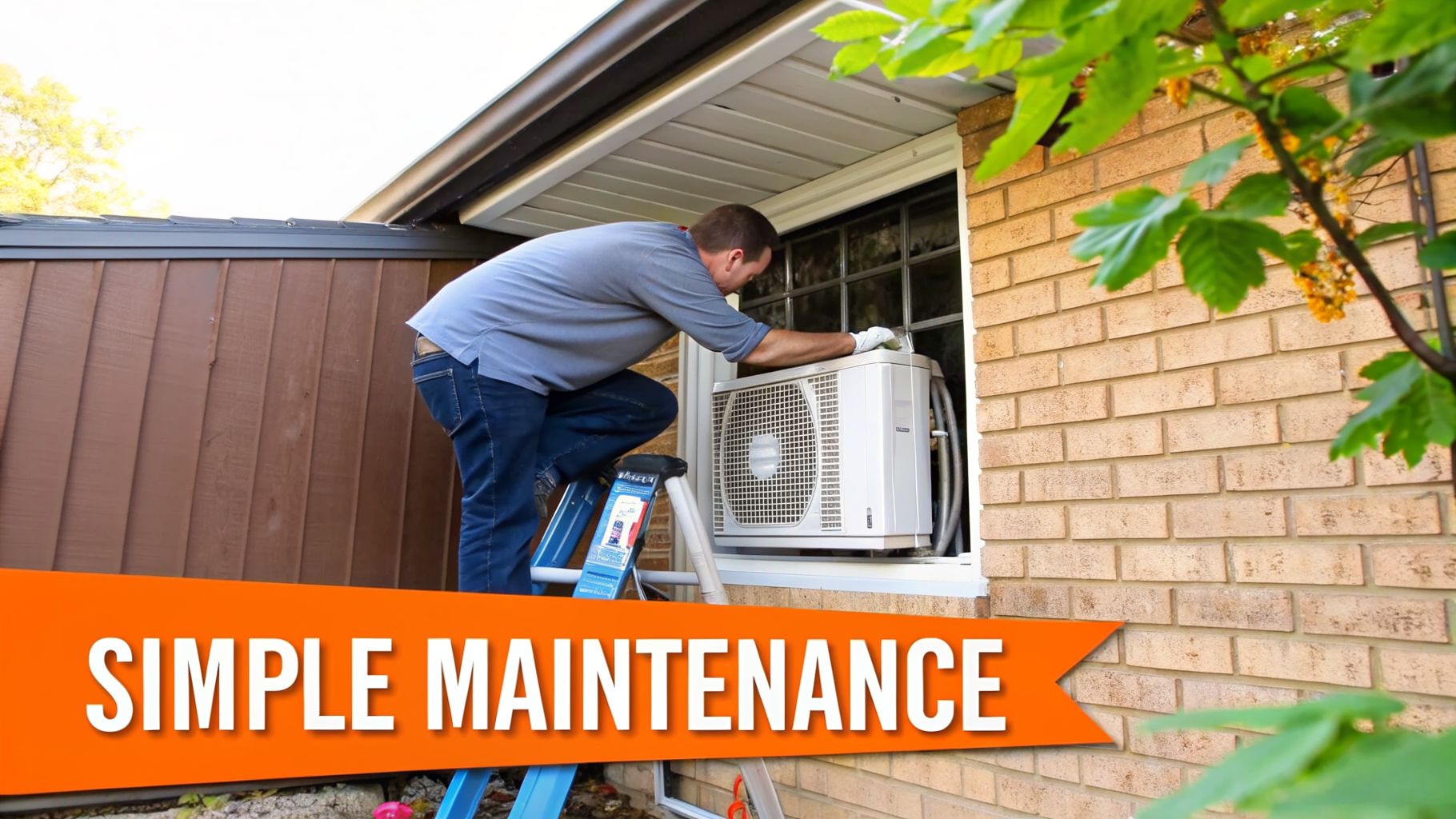
Once your mini split for your garage is up and running, a little bit of upkeep is all you need to protect that investment and keep it humming along efficiently for years to come. Think of it like basic car care—a few simple tasks can prevent major headaches down the road.
Luckily, mini-split maintenance is incredibly straightforward. It really boils down to a couple of easy DIY jobs and one essential professional check-up each year.
Simple Homeowner Maintenance Tasks
You don’t have to be an HVAC technician to handle the most important upkeep for your garage mini-split. In fact, these two simple habits will make the biggest difference in keeping your system running smoothly.
- Clean the Indoor Unit Filter: This is your number one job. When a filter gets clogged with dust and grime, it forces the whole system to work harder, which drives up your energy bill and reduces performance. Just slide the washable filter out every 2 to 4 weeks, give it a good rinse with water, let it dry completely, and pop it back in. It’s no harder than cleaning the lint trap on your dryer.
- Keep the Outdoor Unit Clear: Your outdoor condenser needs plenty of room to breathe. Take a quick look every so often to make sure leaves, grass clippings, or other yard debris aren't piled up against the sides. A quick sweep or a gentle rinse with a garden hose is usually all it takes.
These quick checks only take a few minutes but pay off big time by preventing unnecessary strain on your system. If you start noticing strange noises or a dip in performance even with regular cleaning, it might be a sign of something more. Our guide on common ductless mini-split troubleshooting tips can help you figure out what's going on.
Why an Annual Professional Tune-Up Is Essential
While your DIY cleaning is crucial, some maintenance absolutely requires the tools and expertise of a certified technician. An annual professional tune-up is the single best thing you can do to guarantee your mini-split’s long life and catch small problems before they turn into expensive repairs.
Think of an annual tune-up as a comprehensive health check for your system. A technician can inspect the internal components, check electrical connections, and verify refrigerant levels—things that are impossible to assess on your own but are critical for peak performance.
During a professional tune-up, a Heatwave technician will perform a deep cleaning of the indoor and outdoor coils to remove stubborn grime that your regular rinse can't. This buildup suffocates the system and kills its efficiency.
They will also inspect all the electrical connections for safety and test the refrigerant charge to make sure it's at the precise level needed for optimal cooling. This yearly service is the key to getting the most out of your mini split for your garage.
Alright, you've probably got some practical questions buzzing around your head even after learning all the great things a mini-split can do for your garage. That's totally normal. Let's tackle some of the most common questions we hear from homeowners just like you.
What’s the Real Cost to Install a Mini Split in My Garage?
For a professional, single-zone mini-split installation here in Florida, you're typically looking at a range from a few thousand to several thousand dollars. I know that’s a wide range, but the final price tag really comes down to a handful of key details.
The biggest cost factors are:
- Unit Size (BTU): It makes sense that a more powerful unit for a big 3-car garage will have a higher price tag than a smaller one for a 1-car space.
- Efficiency (SEER2): High-efficiency models cost more upfront, but they’re the ones that deliver those nice, low energy bills month after month.
- Brand and Features: Just like with cars or appliances, premium brands or units with all the latest bells and whistles can affect the total cost.
- Installation Complexity: This covers things like how far apart the indoor and outdoor units are (requiring longer refrigerant lines) and whether we need to run a brand-new electrical circuit.
Because every garage is different, the only way to get a firm number is with a free, in-home estimate. That’s how we can give you an exact quote that fits your space perfectly.
Do I Really Need a Permit for a Garage Mini Split?
Yes, you absolutely do. In just about every county in Florida, installing a mini-split system requires both an electrical and a mechanical permit. This isn't just bureaucratic red tape; it's a crucial step for safety, code compliance, and your homeowner's insurance.
Think of it this way: a permit guarantees that the installation is inspected by a third party to ensure it meets all local safety codes, especially for the high-voltage electrical work. A reputable, licensed HVAC contractor will handle the entire permitting process for you, from filing the paperwork to scheduling the final inspection.
Will a Mini Split Be Too Loud for My Garage Workshop?
Not a chance. In fact, modern mini-splits are so quiet, you’ll barely know they’re running. The indoor unit, the part that’s actually in your garage, hums along at a sound level between 20 and 30 decibels—that’s literally quieter than a library.
All the real noise-making happens in the outdoor compressor unit, which is safely outside. This means your garage stays peaceful, making it the perfect upgrade for a home office, a quiet creative studio, or a workshop where you need to be able to focus.
Ready to turn that hot, stuffy garage into a comfortable, year-round space? The experts at Heatwave Air Conditioning, Plumbing, & Electric can give you a free, no-obligation estimate and help you find the perfect mini-split for your needs. Schedule your free estimate online today!