
When your mini-split suddenly stops working, it's easy to jump to the worst conclusion. But before you start budgeting for a major mini-split repair, take a deep breath. More often than not, the culprit is something simple—like a dirty filter or the wrong setting on the remote.
Think of it like troubleshooting your Wi-Fi router. Your first instinct is to unplug it and plug it back in, right? A quick check of the basics can often get your mini-split back up and running just as easily.
Your Quick Guide to Mini-Split Problems
A glitchy mini-split can throw off the comfort of your entire home, but figuring out what’s wrong doesn’t have to be a headache. The symptoms your unit is showing—whether it's making a weird noise or just not cooling—are usually direct clues to the root of the problem.
Learning to match what you see and hear with the most likely cause is the key. This simple process can save you a ton of time and stress, helping you figure out if you're dealing with a quick DIY fix or something that needs a professional’s touch.
These systems are becoming incredibly popular, which means more and more homeowners are learning how to care for them. The global market for split HVAC systems was valued at around USD 54.5 billion in 2025 and is expected to soar to USD 131.9 billion by 2035. That's a lot of homes relying on these efficient units, which makes understanding them more valuable than ever.
Common Symptoms and First Steps
Let's connect the dots between common symptoms and their likely causes. You'd be surprised how many seemingly serious issues, like weak airflow, trace back to basic maintenance you can do yourself. This isn't just true for mini-splits; it applies to most cooling systems. For a wider look, you can check out our guide on common AC problems and solutions.
Important Safety Note: Before you touch anything, turn off the power to both the indoor and outdoor units at your circuit breaker. Safety first, always. This is non-negotiable for preventing electrical shock and protecting your system from damage.
We've put together a quick troubleshooting table to act as your first-response cheat sheet. Use it to narrow down the issue before you do anything else.
Quick Mini-Split Troubleshooting Guide
This table is your starting point for diagnosing what's going on with your unit. Just find the symptom you're experiencing to see the most common cause and what you should try first.
| Symptom | Potential Cause | First Action Step |
|---|---|---|
| Unit Not Cooling/Heating | Dirty air filters or incorrect remote settings. | Clean or replace the air filters and double-check that the remote is on the right mode (cool/heat) and temperature. |
| Leaking Water Indoors | Clogged condensate drain line. | Turn the unit off. Go outside and find where the drain line exits, then check for any obvious clogs or blockages. |
| Making Unusual Noises | Debris in the outdoor unit or a loose internal part. | Power the system down and take a look at the outdoor unit. Clear away any leaves, twigs, or other debris you see. |
| Ice on Outdoor Unit | Restricted airflow or low refrigerant. | Check and clean the air filters first. If the ice comes back, it's time to call a professional. |
| System Won't Turn On | Tripped circuit breaker or dead remote batteries. | Head to your electrical panel to check for a tripped breaker and pop some fresh batteries in your remote. |
If you've run through these steps and your mini-split is still giving you trouble, it’s a good sign that a deeper issue needs a professional eye.
Understanding How Your Mini Split Works
Before you can really start troubleshooting a mini split repair, you have to get a feel for what’s happening inside the unit. The easiest way to think about it is like a heat delivery service, but in reverse. Its main job is to grab heat from inside your house and shuttle it outside, leaving you with wonderfully cool air.
This whole process is a constant loop, and the star of the show is a substance called refrigerant. The refrigerant is like a dedicated courier, constantly traveling between the indoor and outdoor units, moving heat energy along with it.
The Key Players in Your System
Your mini split has two main pieces of hardware that work in tandem, connected by a set of lines. Each part has a very specific job in the heat-transfer cycle. Knowing what each one does is the first step to figuring out where a problem might be coming from.
- The Indoor Unit (Evaporator): This is the familiar unit mounted on your wall. Its whole purpose is to absorb heat from the air in your room. A fan pulls your warm indoor air over a set of cold evaporator coils filled with refrigerant. Just like a cold glass of sweet tea "sweats" by absorbing warmth from the air, these coils soak up the heat from your room.
- The Outdoor Unit (Condenser/Compressor): Sitting outside your home, this unit is where all that collected heat gets dropped off. The compressor—which is really the heart of the whole system—pumps the now-warm refrigerant outside. There, another fan blows outdoor air over the condenser coils, releasing all that heat back into the atmosphere.
- The Line Set: Think of this as the superhighway for the refrigerant. It's the insulated tubing that connects the indoor and outdoor units, giving the refrigerant a clear path to travel back and forth.
This straightforward logic—spot a symptom, understand the cause, and then take action—is the foundation of all good HVAC troubleshooting.

As you can see, a successful repair doesn't start with a wrench. It starts with a little observation.
The Cooling Cycle Step by Step
Let’s trace the refrigerant's path through one full cycle. It’s a surprisingly slick process that repeats over and over again to keep you cool.
- Heat Absorption: The refrigerant starts its journey as a cold, low-pressure liquid when it enters the indoor unit's coils. The fan inside pulls your warm room air across these super-chilled coils.
- State Change: As that warm air hits the cold coils, the refrigerant absorbs the heat and boils, turning into a low-pressure gas. This is the magic moment where heat is actually removed from your living space.
- Journey to the Compressor: This gas then cruises through the line set to the compressor in the outdoor unit. The compressor's job is to squeeze this gas, which cranks up its pressure and makes it get very hot.
- Heat Release: Now a hot, high-pressure gas, the refrigerant flows into the outdoor condenser coils. The fan on the outdoor unit blasts air across these coils, pulling the heat out of the refrigerant and sending it into the outside air.
- Return Trip: As it rapidly cools, the refrigerant condenses back into a high-pressure liquid. It then goes through a tiny expansion valve, which causes its pressure and temperature to plummet, getting it ready to head back inside and start the whole process over again.
This whole cycle is exactly why a simple problem like a dirty filter or a clogged outdoor unit can cause so much trouble. If air can't flow freely over either set of coils, the refrigerant can't do its job of absorbing or releasing heat, and the entire system grinds to a halt. Once you understand this flow, it's much easier to picture what’s going wrong when your system starts acting up.
Identifying Common Mini Split Problems
Now that you have a handle on how your mini split works, we can start connecting the dots when things go wrong. Think of it like being a detective. That weird noise or puddle of water isn't random—it's a clue pointing you straight to the root of the problem.
Getting the diagnosis right is the most important part of any mini split repair. When you take a moment to figure out what’s really going on, you can skip the guesswork and focus on the actual fix. It turns a frustrating breakdown into a puzzle you can solve.
Your Mini Split Is Not Cooling Effectively
This is, without a doubt, the most common and annoying problem you’ll run into. You set the thermostat to arctic blast, but the room just won't get cool. Before you start thinking the worst, know this: a loss of cooling power is almost always an airflow problem, not a total system failure.
Your system needs a steady, clear flow of air across both the indoor and outdoor coils to do its job. If anything gets in the way of that airflow, the whole heat transfer process grinds to a halt.
Here are the usual suspects for poor cooling:
- Clogged Air Filters: This is culprit number one, every time. A filter caked in dust is like trying to breathe through a thick blanket. It stops the indoor unit from pulling in enough warm air to cool down.
- Dirty Evaporator or Condenser Coils: Over the months and years, both sets of coils get coated in a layer of grime. This buildup acts like insulation, making it tough for the refrigerant to absorb heat from your room or dump it outside.
- Obstructed Outdoor Unit: The unit outside needs to breathe. If it’s smothered by overgrown bushes, buried in leaves, or blocked by patio furniture, it can't get rid of the heat it has collected. The whole system will struggle as a result.
If you’re noticing that some rooms are cold while others are warm, you might be dealing with a bigger airflow issue. You can learn more by checking out our guide on what causes uneven cooling in your home.
The Indoor Unit Is Leaking Water
Seeing water dripping from the indoor unit and down your wall is definitely alarming, but it's usually not a sign of a catastrophic failure. This problem is almost always tied to a simple drainage backup. As your mini split cools the air, it pulls out humidity, which turns into condensation on the cold evaporator coils.
That water is supposed to drip into a catch pan and then flow safely outside through a condensate drain line. When that line gets clogged—usually with a bit of algae or gunk—the water has nowhere to go but back into your house.
The Outdoor Unit Is Covered in Ice
Finding your outdoor unit looking like a block of ice, even on a hot Florida day, is a dead giveaway that something is seriously wrong with the heat exchange. A "freeze-up" like this happens when the refrigerant inside the coils gets way too cold, causing any moisture in the air to freeze solid on contact.
This typically points to one of two main issues:
- Severe Airflow Restriction: Just like with poor cooling, a filthy filter or blocked coils means not enough warm air is passing over the evaporator. Without that warmth, the refrigerant just keeps getting colder until it hits freezing.
- Low Refrigerant Levels: If there's a leak somewhere in the system, the refrigerant pressure will drop. This pressure drop causes a rapid temperature drop, which is a fast track to ice forming on the coils.
You Hear Strange Noises
A happy mini split is a quiet one, making little more than a gentle hum. Any new, loud, or weird sounds are your system's way of telling you a mechanical part needs attention.
- Rattling or Banging: This usually means something is loose. It could be a fan blade that’s off-kilter or even just a twig or leaf that got sucked into the outdoor unit.
- Hissing or Whistling: A sharp, high-pitched hissing is the classic sign of a refrigerant leak. Since refrigerant is a controlled substance, this is a serious problem that needs a professional right away.
- Buzzing or Humming: A loud, angry buzz often points to an electrical issue. It could be a failing capacitor, a bad contactor, or something wrong with the compressor’s wiring. Don't ignore this one.
These systems have become a powerhouse in home comfort for a reason. In fact, mini split air conditioners now make up nearly 47% of the total split systems market revenue. With the whole market valued at over USD 127 billion in 2025, knowing how to spot these common problems is more valuable than ever. You can discover more insights about the global split systems market and see why these units are so popular.
Safe and Simple DIY Troubleshooting Steps
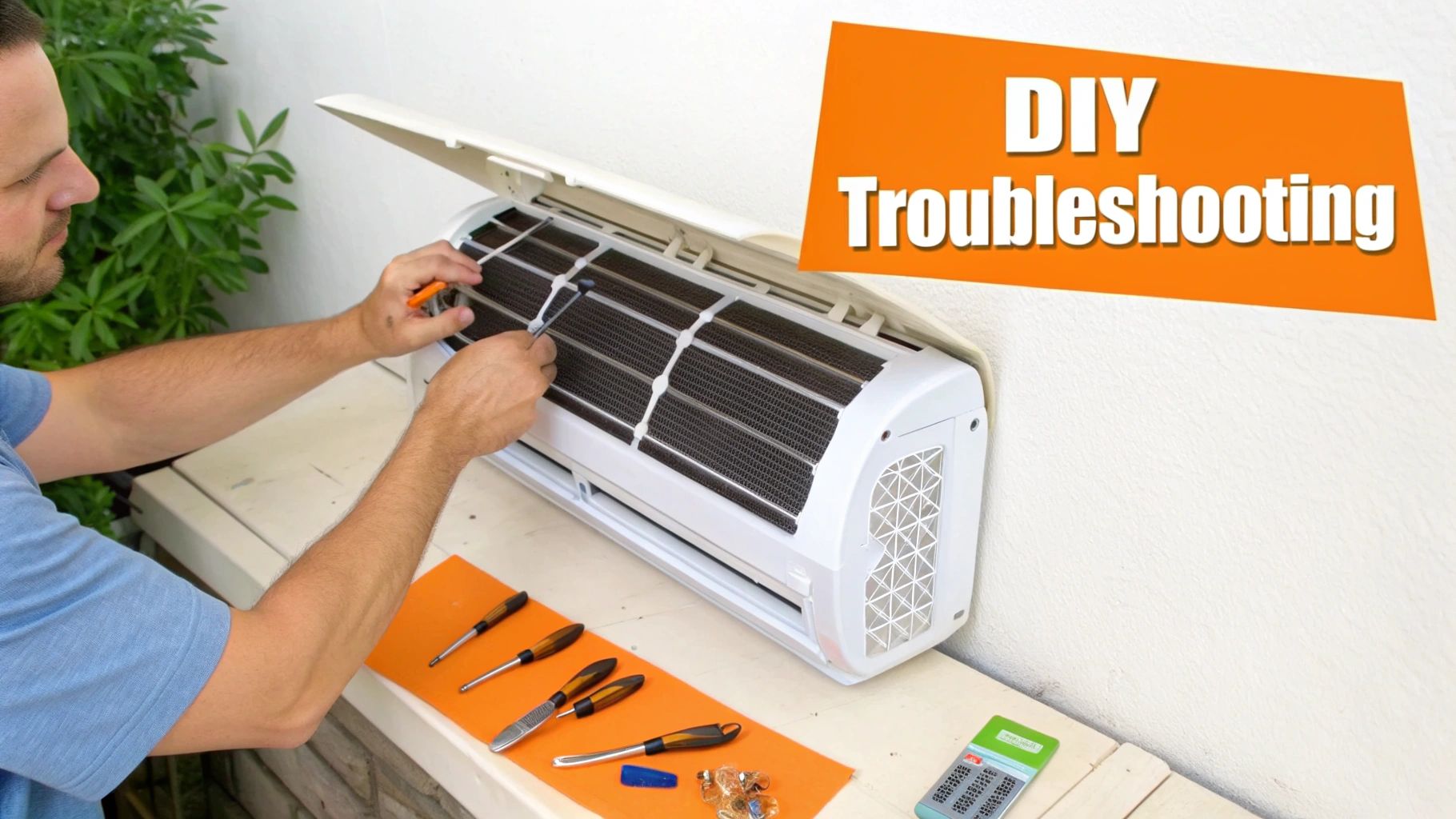
Alright, now that you know how to spot the clues your mini-split is sending, let's roll up our sleeves and get into some basic troubleshooting. You’d be surprised how many common issues that seem like they need a professional mini split repair are actually simple fixes you can handle yourself with a bit of confidence.
Think of this as first aid for your HVAC system. By tackling these smaller tasks, you can often get your home comfortable again right away and save the cost of a service call. The goal here is to empower you to handle the easy stuff safely, so you know exactly when it’s time to call in the pros.
Your Essential First Step: Powering Down
Before you even think about touching your mini-split system, the absolute first thing you must do is cut the power. This isn't just a friendly suggestion—it's a critical safety rule. It protects you from dangerous electrical shock and keeps you from accidentally frying the unit's sensitive electronics.
Safety is Non-Negotiable: Head over to your home's main electrical panel (your breaker box) and find the circuit breaker for your mini-split. You’ll probably see two of them—one for the indoor unit and another for the outdoor one. Flip them both to the "OFF" position.
When you're dealing with any appliance, it's also smart to know how to tell if a circuit breaker is bad, since a faulty breaker can be the root cause of power problems. For a deeper dive into home electrical safety, check out our guide to essential electrical safety tips for homeowners.
Step 1: Clean the Air Filters
A dirty, clogged filter is the #1 culprit behind weak cooling, icing up, and poor airflow. Cleaning it is the easiest and most effective maintenance you can do.
Tools You'll Need:
- A soft brush or cloth
- Mild soap and water (optional)
The Process:
- Open the Indoor Unit: Gently lift the front panel on the wall-mounted unit. It should click open and stay up on its own.
- Remove the Filters: The mesh filters are made to slide or pop right out. Pay attention to how they're seated so you can slide them back in the right way.
- Clean Them Up: If they're just dusty, a quick wipe or a gentle pass with a vacuum's brush attachment will do the trick. For anything stickier, wash them in lukewarm water with a tiny drop of mild soap, rinse well, and let them air dry completely before putting them back.
- Reinstall and Close: Once they're bone dry, slide the filters back into their slots and snap the front panel shut.
Checking your filters every 30-60 days can single-handedly prevent a huge number of performance issues.
Step 2: Inspect the Outdoor Unit
Your outdoor unit—the condenser—needs to breathe easily to push heat away from your home. Over time, it can get choked up with leaves, grass clippings, and other yard debris.
Tools You'll Need:
- Work gloves
- A garden hose with a gentle spray nozzle
The Process:
- Clear the Area: With the power still off, pull on your gloves and clear away any leaves, twigs, or grass cuttings stuck in the fins or around the unit's base. You want to create at least a 2-foot clearance on all sides.
- Gently Rinse the Fins: Grab your garden hose and, using a low-pressure setting, gently spray the condenser fins from the inside out. This pushes the dirt away from the unit instead of deeper into it. Never, ever use a high-pressure washer—it will bend those delicate aluminum fins in a heartbeat.
- Check for Damage: Give the unit a quick visual inspection for any bent fins or other obvious physical damage.
Step 3: Clear the Condensate Drain Line
If you're seeing water dripping from your indoor unit, a clogged condensate line is almost always the reason. This little pipe is supposed to carry moisture outside, but it can get blocked with algae and other gunk.
Tools You'll Need:
- A wet/dry vacuum
The Process:
- Locate the Drain Line: Find the small PVC pipe that pokes out of your house near the outdoor condenser.
- Clear the Blockage: Stick the hose of a wet/dry vac over the end of that pipe. Use your hand to create a good seal around the hose and turn the vacuum on for about a minute. That suction is usually all it takes to pull the clog right out.
If you’ve tried these steps and your system still isn't working right, you've done your part. These tasks cover the most common and simple problems. Anything more complicated requires specialized tools and expertise, and that’s your cue to call a professional.
When You Need to Call a Professional
While it’s rewarding to handle basic maintenance yourself, the most important part of any DIY project is knowing your limits. For every simple fix like cleaning a filter, there’s a complex problem that demands specialized tools and certified expertise. Trying to tackle a major mini split repair without the right training isn't just risky for your system—it can be downright dangerous.
Think of it like working on your car. You wouldn't hesitate to top off your washer fluid, but you’d definitely leave rebuilding the engine to a certified mechanic. HVAC systems are no different. Certain issues are clear red flags that it’s time to put down the tools and pick up the phone.
Mini-splits are becoming a go-to choice for homeowners, and for good reason. The global market was valued at around $7.4 billion in 2024 and is projected to climb past $9.55 billion by 2032. This growth is driven by people who appreciate their efficiency, making it all the more important to know how to care for them properly.
Red Flags for Professional Service
If you run into any of the following problems, your next step should be to schedule a visit from a licensed HVAC technician. These issues go far beyond simple upkeep and involve components that are hazardous or require sophisticated diagnostic gear to fix correctly.
- Refrigerant Leaks: Hear a hissing sound or see an oily film on the copper lines? That's a likely refrigerant leak. Handling refrigerant is regulated by the EPA and requires special certification. It's also a health hazard, making this a job strictly for the pros.
- Electrical Problems: A constantly tripping breaker, buzzing sounds from either unit, or a distinct burning smell are all serious electrical warnings. These symptoms could point to anything from a failing capacitor to a fried control board or compromised wiring. Attempting to fix these yourself could lead to severe electrical shock or even a fire.
- Compressor Failure: The compressor is the heart of your outdoor unit. If it won't start, makes loud grinding or banging noises, or trips the breaker the second it kicks on, it needs professional attention. This is one of the most complex and expensive parts of the entire system.
Trying to fix these issues on your own can void your manufacturer's warranty, lead to even more extensive (and expensive) damage, and pose a huge safety risk. A pro's value is in their ability to diagnose the root cause accurately and perform the repair safely.
When it’s time to call in the experts, you can explore how professional companies provide efficient HVAC repair services to get your system back online quickly.
For local, trusted service, Heatwave’s certified technicians are ready to handle any complex mini split repair you might face. If you're experiencing any of these serious symptoms, don't wait. Contact us for professional AC repair services to ensure your system is fixed safely and correctly the first time.
Estimating Mini Split Repair Costs

When your mini split suddenly quits, the first question that pops into your head is almost always, "How much is this going to set me back?" Nobody likes a surprise bill, especially for an unexpected home repair. Getting a handle on potential mini split repair costs ahead of time helps you budget properly and feel confident when looking at a quote.
Repair costs generally fall into a few different buckets, from quick component swaps to much more involved, labor-heavy jobs. A minor fix, like swapping out a bad capacitor, will be on the lower end. On the other hand, a major problem like a refrigerant leak is going to cost more simply because of the time, skill, and materials needed to fix it right.
Factors That Influence Repair Costs
The final invoice for a mini split repair isn’t just a random number. Several key factors come together to determine the price, and understanding them helps explain why some jobs cost more than others.
- Unit Brand and Model: Just like with cars, parts for certain high-end or less common brands can be pricier and sometimes harder to track down.
- Parts Availability: If a specific part has to be special-ordered, that can add shipping costs and tack on extra time to the repair.
- Labor Rates: The cost of skilled labor varies by region and is always a big piece of the total price.
- Repair Complexity: Replacing a fan motor is a fairly straightforward task. Diagnosing and repairing a tricky refrigerant leak takes a lot more time and expertise.
The goal is always transparency. A trustworthy technician will walk you through the costs, breaking down the price of parts and labor so you know exactly what you’re paying for before any work starts.
Unexpected repair costs can be a real headache. To help ease the burden, many homeowners find that flexible payment options make a huge difference. You can learn more about our available HVAC financing solutions and see how you can get your system back up and running without the financial strain.
Common Repair Costs and Timeframes
To give you a clearer picture, we've put together a table with some ballpark figures for common professional mini split repairs. These are general estimates, of course, as the final cost can vary based on your specific unit and situation.
Estimated Mini Split Repair Costs
This table provides estimated cost ranges for common professional mini split repairs. Prices can vary based on location, unit brand, and complexity.
| Repair Type | Estimated Cost Range | Typical Timeframe |
|---|---|---|
| Capacitor Replacement | $150 – $400 | 1-2 Hours |
| New Fan Motor | $400 – $800 | 2-3 Hours |
| Control Board Replacement | $500 – $1,200 | 2-4 Hours |
| Refrigerant Leak Repair | $700 – $2,000+ | 3-6 Hours |
Having this information in your back pocket empowers you to make an informed decision, ensuring you're financially prepared to get your home's comfort system—and your peace of mind—restored.
Your Mini Split Repair Questions, Answered
When it comes to mini splits, a little knowledge goes a long way. Dealing with repairs and maintenance can feel daunting, but getting clear, straight-to-the-point answers makes all the difference. We’ve put together this section to tackle the most common questions we hear from homeowners just like you.
Our goal is simple: give you practical information so you can keep your system running smoothly for the long haul. Understanding the basics of service schedules, safety, and when to repair versus replace will help you protect your investment and keep your home comfortable.
How Often Should My Mini Split Be Serviced?
To keep your mini split in fighting shape, you should schedule professional maintenance once a year. Think of it like a yearly physical for your HVAC system—it's all about catching small problems before they morph into big, expensive headaches.
During a professional tune-up, a technician will handle the important stuff:
- Give the indoor and outdoor coils a deep clean.
- Check refrigerant levels and system pressure.
- Inspect all the electrical connections and components.
- Test the overall performance and make sure the thermostat is accurate.
This annual service doesn't just push the lifespan of your unit—which can be 20 years or more with the right care—it also makes sure it runs as efficiently as possible. That means more money in your pocket each month instead of overpaying on energy bills.
Why Should I Never Add Refrigerant Myself?
You’ve probably seen those DIY refrigerant recharge kits online or in stores. While they might seem like a quick fix, using them on your home's mini split is a really bad idea for a few critical reasons. First off, handling refrigerant is tightly regulated by the EPA. Only licensed and certified technicians are legally allowed to buy and work with it.
More importantly, if your system is low on refrigerant, that means you have a leak somewhere. Just topping it off is like putting air in a tire with a nail in it—you haven't actually fixed the problem. A professional needs to find and repair that leak first, then correctly recharge the system to the manufacturer’s exact specs.
Is It Better to Repair or Replace My Unit?
This is the classic crossroads every homeowner eventually faces: do you spend more money fixing an older unit, or is it time to invest in a new one? There’s no single right answer, but you can make a smart call by looking at a few key factors.
A great rule of thumb we use in the field is the 50% rule. If a repair is going to cost more than half the price of a brand-new system, and your current unit is already over 10-12 years old, replacement is usually the better financial move.
Here are three things to weigh:
- Unit Age: Systems over 15 years old are getting close to the end of their expected lifespan.
- Repair Cost: How does that repair quote stack up against the price of a new, more efficient model?
- Energy Savings: A modern mini split can be worlds more efficient, offering long-term savings on your utility bills that can help make up for the initial cost.
At the end of the day, making the right call for your home's comfort and your budget is what it's all about. For expert diagnostics, honest advice, and professional mini split repair in the Tampa Bay and Southwest Florida area, trust the certified team at Heatwave Air Conditioning, Plumbing, & Electric. Schedule your service with us today!