
Electrical work is not a DIY project. Choosing the right professional is crucial for your home's safety and functionality, especially for homeowners in areas like Tampa Bay, Sarasota, and Fort Myers who rely on complex systems. Yet, with so many options, how do you distinguish a qualified expert from a potential hazard? The key lies in knowing the right questions to ask an electrician before you commit.
This guide provides a comprehensive checklist of critical inquiries that go beyond a simple price quote. We'll break down why each question is essential, what to look for in a response, and how to spot red flags early. By arming yourself with this knowledge, you can confidently hire an electrician who is licensed, experienced, and committed to quality. Let's illuminate the path to finding a trustworthy professional, ensuring your project is completed safely and to code.
1. Are you licensed, insured, and bonded?
This is the most critical question to ask an electrician before any work begins. It’s a three-part verification that confirms their professional legitimacy, your financial protection, and their accountability. A "yes" to all three parts means they meet legal standards, can cover potential damages, and guarantee their work financially.

Neglecting this step can expose you to significant risks, including shoddy workmanship, liability for on-site injuries, and financial loss if the job is abandoned. Hiring a qualified and fully credentialed professional is non-negotiable for ensuring safety and compliance with local codes.
Why It Matters
- Licensing: Confirms the electrician has passed state-mandated exams and has the required training and knowledge. In Florida, for example, electricians must be certified or registered with the Electrical Contractors' Licensing Board.
- Insurance: General liability and worker's compensation insurance protects you. If a worker is injured on your property or your home is damaged, their policy covers the costs, not your homeowner's insurance.
- Bonding: A surety bond acts as a financial guarantee. If the electrician fails to complete the job or performs substandard work, the bonding company can compensate you for your losses.
Actionable Tips
Before hiring, ask for copies of their license and proof of insurance and bonding. Don't just take their word for it; verify the license number on your state's contractor licensing board website. You can also contact the insurance provider directly to confirm the policy is active. While it may be tempting to hire a cheaper, unlicensed individual, the potential financial and safety risks are never worth it. You can learn more about how a professional company presents its credentials on our about us page.
2. What is your experience level and what certifications do you hold?
Beyond licensing, an electrician's hands-on experience and specialized certifications reveal their true expertise. This question helps you gauge if their skills match your project's specific needs, whether it's a simple outlet installation or a complex solar panel setup. A long career doesn't always equate to expertise in modern systems, so a combination of experience and up-to-date certifications is the ideal benchmark.
Hiring someone with the wrong specialization can lead to code violations, safety hazards, and costly rework. Asking about their specific background ensures the professional you choose has successfully completed projects similar to yours and is familiar with the required techniques and materials.
Why It Matters
- Experience: An electrician with decades of residential experience will understand the nuances of older homes in areas like Sarasota or Fort Myers. Their practical knowledge is invaluable for troubleshooting and safe installations.
- Certifications: These demonstrate advanced knowledge in specific areas. A Master Electrician has the highest level of certification, while others might specialize in solar installation or smart home automation.
- Specialization: Different projects demand unique skills. Commercial, industrial, and residential electrical work are distinct fields. For renewable energy projects, for instance, understanding specific industry accreditations like understanding MCS Accreditation for solar installers is crucial.
Actionable Tips
When interviewing a potential electrician, ask for specific examples of projects they've completed that are similar to yours. Request references from those jobs and inquire about their continuing education. For specialized tasks like a generator or EV charger installation, prioritize certifications in those areas over general experience. Verifying their credentials ensures you’re hiring a true expert, not just a generalist.
3. Can you provide a detailed written estimate and breakdown of costs?
A transparent, written estimate is non-negotiable for understanding the scope and cost of your electrical project. This document protects both you and the contractor by setting clear expectations from the start. A detailed breakdown should itemize labor, materials, permit fees, and other charges, preventing unexpected costs once the work is underway.

Relying on a verbal quote is a recipe for misunderstandings and potential disputes. A professional electrician will always provide a comprehensive written proposal. This document not only outlines the financials but also serves as a clear reference for the agreed-upon work, ensuring you get exactly what you paid for without any hidden fees.
Why It Matters
- Budget Clarity: An itemized estimate shows exactly where your money is going. For example, a kitchen rewire might be broken down into: $1,200 for labor (16 hours @ $75/hr), $400 for materials, and $200 for the permit, totaling $1,800.
- Prevents Surprises: It clarifies what is included, such as cleanup and inspection fees. This avoids ambiguity and the dreaded "surprise" charges that can inflate your final bill.
- Enables Comparison: With detailed estimates from multiple electricians, you can make an informed, apples-to-apples comparison of not just the total price but also the quality of materials and scope of work offered.
Actionable Tips
Always request a written estimate before authorizing any work. Ensure the document specifies payment terms, a project timeline, and how potential change orders will be handled. It's wise to ask if the price is a fixed quote or an hourly rate, as this can significantly impact the final cost. To get a detailed proposal for your next project, you can get in touch with our team through our contact us page.
4. What is your timeline, and do you guarantee project completion by a specific date?
This question is crucial for setting expectations and ensuring your project stays on track. A professional electrician should be able to provide a clear and realistic timeline, from the start date to the estimated completion. This transparency helps you plan around the work and holds the contractor accountable for their schedule.
Ambiguous timelines can lead to indefinite delays, disrupting your daily life and potentially increasing costs if the project drags on. A firm completion date, ideally included in the contract, provides a clear benchmark for success and signals the electrician's confidence in their ability to manage the job efficiently.
Why It Matters
- Planning and Coordination: A defined schedule allows you to coordinate with other trades, arrange for time off work, or make temporary living arrangements if necessary for a large project like a full home rewiring.
- Accountability: A guaranteed completion date incentivizes the electrician to finish on time. It provides you with recourse if the project experiences unreasonable delays caused by poor planning or management.
- Budget Management: Delays can have financial implications. Knowing the timeline helps you anticipate the final payment schedule and avoid the hidden costs associated with a project that extends beyond its intended duration.
Actionable Tips
When discussing the project timeline, get all commitments in writing within the official contract. Ask if the estimate includes time for city inspections or potential callbacks. For larger renovations, clarify how their work will be sequenced with other contractors. It is also wise to discuss what constitutes a delay beyond their control, such as a weather event or supply chain issue, and agree on potential penalties for missing deadlines due to their own fault.
5. Will you handle all necessary permits and inspections?
Significant electrical work, like a service panel upgrade or new construction wiring, legally requires permits and inspections to ensure it complies with local building codes. This question clarifies who is responsible for navigating this critical administrative process. A professional electrician should always manage permitting and inspections, as it demonstrates accountability and ensures the work is done to code.
Neglecting this step can lead to serious consequences, including hefty fines, difficulty selling your home, and the potential for your insurance company to deny a claim related to unpermitted work. This is one of the most important questions to ask an electrician to guarantee your project's legal compliance and safety.
Why It Matters
- Code Compliance: Permits trigger inspections from a city or county official, verifying that the work meets the National Electrical Code (NEC) and local standards, which are in place to prevent fire and electrocution hazards.
- Legal & Financial Protection: Proper permits and passed inspections are official records that your electrical system is safe. Without them, you could face legal trouble or be forced to tear out and redo the work at your own expense.
- Professional Accountability: When an electrician pulls a permit in their name, they are taking full legal responsibility for the quality and compliance of the work performed.
Actionable Tips
Always confirm that the contractor will pull all required permits under their own license. Be wary if they ask you to obtain the permit as a homeowner. Ask for the permit cost to be itemized in the quote and request copies of the permit and final inspection certificate for your records. It's also wise to understand the general requirements for an electrical wiring inspection to know what to expect.
6. What safety protocols and equipment do you use?
Electrical work is inherently dangerous, so a professional’s commitment to safety is non-negotiable. This question assesses their dedication to protecting themselves, you, and your property from electrocution, fire, and other injuries. A reputable electrician will have clear, established protocols based on industry standards like those from OSHA.
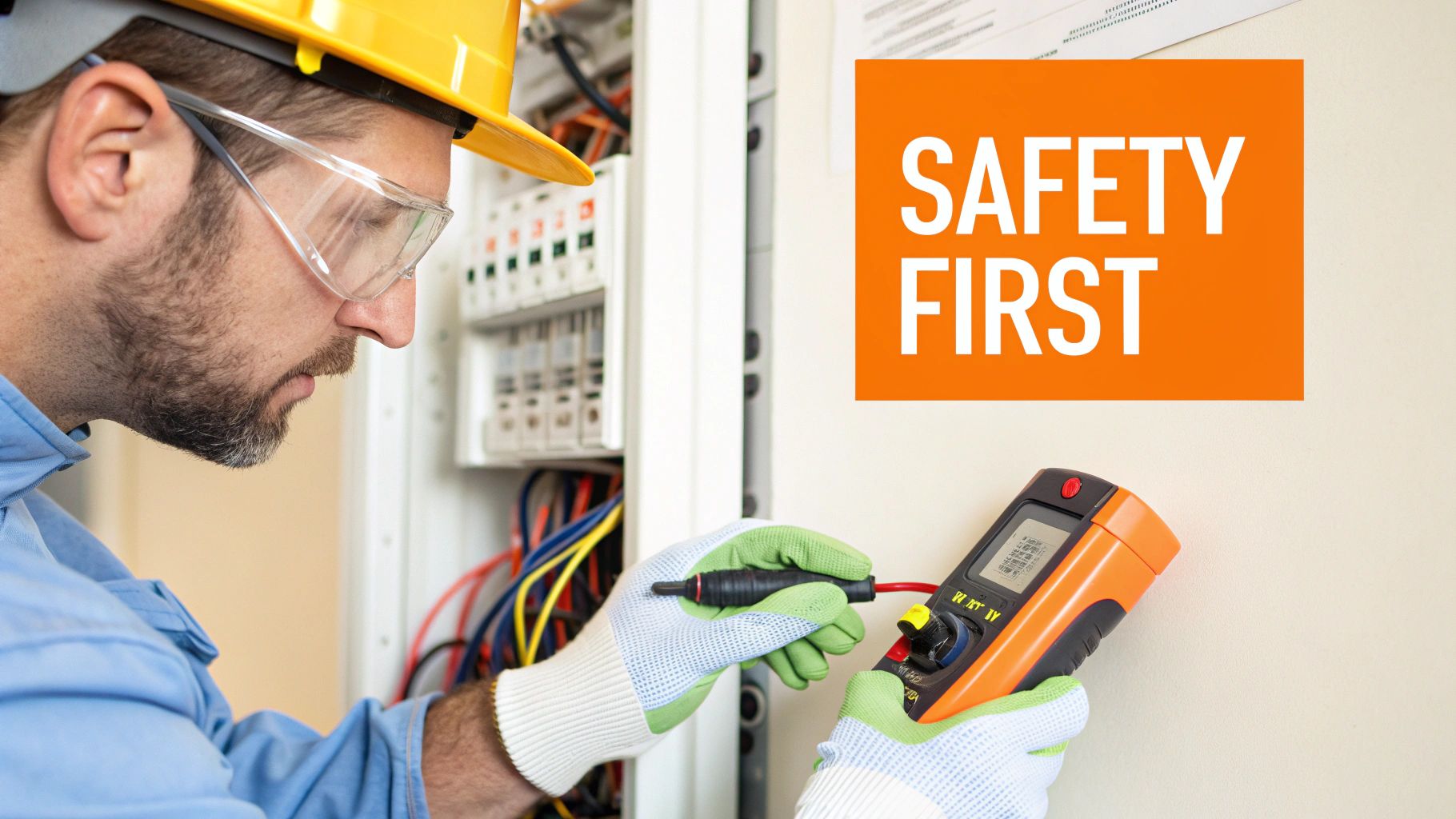
This demonstrates their professionalism and commitment to preventing accidents through proper procedures and equipment. Ignoring safety can lead to catastrophic consequences, including property damage, serious injury, or even death. A well-defined safety plan is a hallmark of a true professional.
Why It Matters
- Protecting Your Property: Proper protocols, like de-energizing and testing circuits before work, prevent short circuits that can cause electrical fires or damage your appliances.
- Worker and Homeowner Safety: The use of Personal Protective Equipment (PPE) like insulated gloves, arc-rated clothing, and safety glasses minimizes the risk of electrocution and other on-site injuries.
- Ensuring Compliance: Adherence to OSHA standards and local codes is a legal requirement that ensures the job is done correctly and safely from start to finish. Beyond general safety, inquire about their knowledge of specific standards, such as those concerning battery and fire safety considerations for homes.
Actionable Tips
Ask the electrician to outline their standard safety procedures for a job like yours. Look for non-negotiable practices, such as using a voltage tester before touching any wires. Inquire about their team's training, including OSHA certifications and first aid/CPR currency. A professional should be transparent about their safety record and be able to explain how they mitigate risks like arc flash hazards. You can discover more essential guidelines on our electrical safety tips page.
7. What warranties and guarantees do you offer on your work?
A reputable electrician stands behind their work, and a warranty is a formal commitment to quality and longevity. This question clarifies what protections you have if an installation fails or a repair doesn't hold up. A solid guarantee provides peace of mind, ensuring the contractor is responsible for fixing any issues that arise from their labor or the parts they supply.
Without a clear, written warranty, you could be left paying for follow-up repairs that should have been covered. This is one of the most important questions to ask an electrician, as it reflects their confidence in their own workmanship and their dedication to customer satisfaction long after the job is complete.
Why It Matters
- Workmanship Guarantee: This covers the labor aspect of the job. If a connection comes loose or a fixture was installed improperly, the electrician will return to fix it at no charge for a specified period, often one to five years.
- Parts Warranty: This covers the physical materials used, such as outlets, switches, or circuit breakers. These are often backed by the manufacturer, but the electrician should facilitate any claims.
- Long-Term Protection: Electrical systems are meant to last for decades. A strong warranty ensures your investment is protected against premature failure due to installation errors.
Actionable Tips
Always get the warranty terms in writing in the official contract. Ask specifically what is covered, such as a 2-year workmanship warranty on all labor or a 10-year manufacturer's warranty on an electrical panel. Clarify if the guarantee includes both parts and labor for any necessary callbacks. It's also wise to ask if the warranty is transferable should you sell your home, as this can be a valuable selling point. You can see how a professional company outlines its commitments on our guarantees page.
8. Can you provide references and examples of previous work?
A reputable electrician will gladly share evidence of their past successes. Asking for references and a portfolio is a crucial step to verify their quality of work, reliability, and customer satisfaction. While licenses and insurance confirm their qualifications on paper, seeing their finished projects and hearing from past clients provides real-world proof of their professionalism and skill.

This question validates all previous claims about their experience and expertise. It allows you to move beyond what the electrician says they can do and see what they have actually done. Genuine feedback from former customers is one of the most reliable indicators of the experience you can expect, from communication and timeliness to problem-solving on the job.
Why It Matters
- Verifies Quality: A portfolio with before-and-after photos demonstrates the electrician's workmanship and attention to detail.
- Confirms Reliability: Speaking with references will reveal if the electrician was punctual, stayed on schedule, and communicated effectively throughout the project.
- Builds Trust: A professional who is confident in their work will have a list of satisfied clients ready. Hesitation to provide references is a major red flag.
- Ensures Relevant Experience: You can request references for jobs similar to yours, such as a complete home rewire or a kitchen lighting installation, to confirm they have the specific skills required.
Actionable Tips
Don't just ask for references; actively follow up on them. Request 3-5 recent contacts for projects similar to yours and check online reviews on Google and the Better Business Bureau. When you call a reference, ask specific questions: Was the project completed on time and within budget? How did the electrician handle unexpected issues? Were you satisfied with the final result and the cleanup process? You can explore examples of professional work on our page detailing wiring and rewiring services.
8-Point Comparison: Questions to Ask an Electrician
| Item | Implementation complexity | Resource requirements | Expected outcomes | Ideal use cases | Key advantages |
|---|---|---|---|---|---|
| Are you licensed, insured, and bonded? | Low (document verification) | License, insurance certificates, bond details, verification time | Verified legal standing, liability protection, code compliance | Any hire, safety-critical or high-value projects | Legal/financial protection, assurance of training, recourse if issues arise |
| What is your experience level and what certifications do you hold? | Medium (assess relevance & depth) | Resumes, certification records, references, verification | Matched expertise to project, fewer errors, efficient execution | Complex, specialized, commercial, or new-construction work | Specialized skills, up-to-date code knowledge, faster troubleshooting |
| Can you provide a detailed written estimate and breakdown of costs? | Medium (requires itemization) | Itemized quote, material lists, labor rates, permit costs | Pricing transparency, easier bid comparison, fewer disputes | Budget-sensitive projects, competitive bidding, remodeling | Cost clarity, accountability, predictable budgeting |
| What is your timeline, and do you guarantee project completion by a specific date? | Medium (scheduling & contingency planning) | Project schedule, milestones, contract terms, buffer time | Clear start/finish dates, coordination with other trades, accountability | Projects with dependent trades, renovations, tight schedules | Predictability, improved coordination, reduced delays |
| Will you handle all necessary permits and inspections? | Medium–High (regulatory/admin work) | Permit applications, fees, inspector coordination, code knowledge | Permitted, inspected work, legal compliance, documented approvals | Panel upgrades, additions, new construction, solar installs | Avoids fines, protects resale/insurance, reduces admin burden for owner |
| What safety protocols and equipment do you use? | Medium (procedural verification) | PPE, safety training records (OSHA), testing tools, jobsite controls | Reduced risk of injury/fire, regulatory compliance, safer jobsite | High-risk tasks, live-circuit work, commercial sites | Injury prevention, lower liability, professional workmanship |
| What warranties and guarantees do you offer on your work? | Low–Medium (contract review) | Written warranty documents, parts/labor terms, transferability info | Defined recourse for defects, coverage period clarity | Major installations, long-term systems, high-cost projects | Post-job protection, incentive for quality, homeowner peace of mind |
| Can you provide references and examples of previous work? | Low (reference collection & vetting) | Client contacts, before/after photos, online reviews, portfolio | Verified past performance, expectation alignment, reliability signals | Hiring decisions, unfamiliar contractors, specialty work | Real-world validation, insight into quality and communication |
Empower Your Decision: Finalizing Your Choice for Electrical Work
Navigating the process of hiring an electrician can feel complex, but armed with the right questions, you transform from a passive customer into an empowered decision-maker. This list isn't just a simple checklist; it's a framework for vetting professionals to ensure the long-term safety, efficiency, and integrity of your home's electrical system. A truly professional electrician will welcome your diligence and provide clear, confident answers regarding their license, insurance, experience, and safety protocols.
Think of this conversation as more than just a quote comparison. You are building a partnership with a skilled tradesperson who will be responsible for one of your home's most critical systems. By asking these targeted questions to ask an electrician, you move beyond the price tag to evaluate the true value of their service. Remember that the cheapest bid is rarely the best long-term investment, especially when dealing with the potential hazards of faulty electrical work.
Key Takeaways for a Confident Choice
Your primary focus should always be on three core pillars:
- Credentials: Confirming they are licensed, insured, and bonded is non-negotiable. This protects you, your property, and the electrician.
- Transparency: A detailed, written estimate, a clear timeline, and a willingness to discuss permits and warranties are signs of a trustworthy professional.
- Proven Expertise: Don't hesitate to ask for references or to see examples of their previous work. A reputable electrician will be proud to share their successes.
By prioritizing these elements, you aren't just hiring someone to fix a problem; you are investing in peace of mind. For homeowners in Port Charlotte, Cape Coral, Fort Myers, and across Southwest Florida, these standards are essential for protecting your property. Making an informed choice now prevents costly and dangerous issues down the road. You have the knowledge to select a qualified expert who will get the job done right, ensuring your home remains a safe and reliable sanctuary.
When you're ready to connect with a team that confidently answers all these questions and more, trust the experts at Heatwave Air Conditioning, Plumbing, & Electric. Our licensed and insured electricians are committed to providing transparent, high-quality service throughout Southwest Florida. Schedule your consultation today to experience the professional difference.