
A sewer problem usually announces itself at the worst time. A toilet starts gurgling after someone runs the shower. The kitchen sink drains slowly even though you already tried a plunger. Then a smell shows up outside near the side yard, or in the bathroom, and suddenly a hidden pipe under the house feels like the only thing you can think about.
That anxiety is understandable. Sewer issues are messy, expensive when ignored, and hard to see without the right tools. In Florida, they can also be complicated by shifting soil, heavy rain, older neighborhoods, and yards filled with patios, driveways, roots, and irrigation lines that make access difficult.
The good news is that sewer problems are usually diagnosable in a straightforward way, and the right repair depends on the exact failure, not on hype. Some homes need cleaning. Some need a targeted repair. Some are good candidates for trenchless work. Others need excavation because the pipe has lost slope and no shortcut will fix that.
Your Guide to Navigating Sewer Problems in Florida
Most homeowners don't think much about the main sewer line until several fixtures begin acting strangely at once. One bathroom starts draining slowly. Then a second drain joins in. A toilet bubbles when the washing machine empties. That pattern matters because it points away from a simple fixture clog and toward a shared drainage problem farther down the line.
In established Florida communities, that kind of call is common for a reason. The broader water and sewer construction field keeps growing because older systems need repair and replacement. The U.S. Water & Sewer Line Construction industry is projected to reach $70.0 billion in 2026, according to IBISWorld's industry outlook. For homeowners, that projection reflects a basic reality: aging underground infrastructure doesn't stay trouble-free forever.
Why sewer trouble feels so overwhelming
A hidden line problem creates uncertainty. You can't see the pipe. You don't know whether it's roots, grease, a break, a collapse, or a sag. And because wastewater is involved, every delay feels risky.
That pressure leads many homeowners to make one of two mistakes:
- Waiting too long: They keep resetting toilets, using drain chemicals, or assuming the issue will pass.
- Approving the first repair pitch: They hear "trenchless" or "replacement" and agree before anyone proves what failed.
Neither approach helps. Good sewer line services start with evidence, not guessing.
Practical rule: If multiple drains are affected at the same time, treat it like a main line issue until a professional inspection proves otherwise.
What a calm response looks like
A better path is simple. Notice the symptoms. Stop using water if sewage is backing up. Get the line inspected. Then match the repair to the actual condition of the pipe.
That's how you protect the home itself. Sewer work isn't only about restoring drainage. It's also about preventing repeated backups, protecting flooring and foundations from moisture problems, and avoiding the frustration of paying for a "fix" that never addressed the underlying cause.
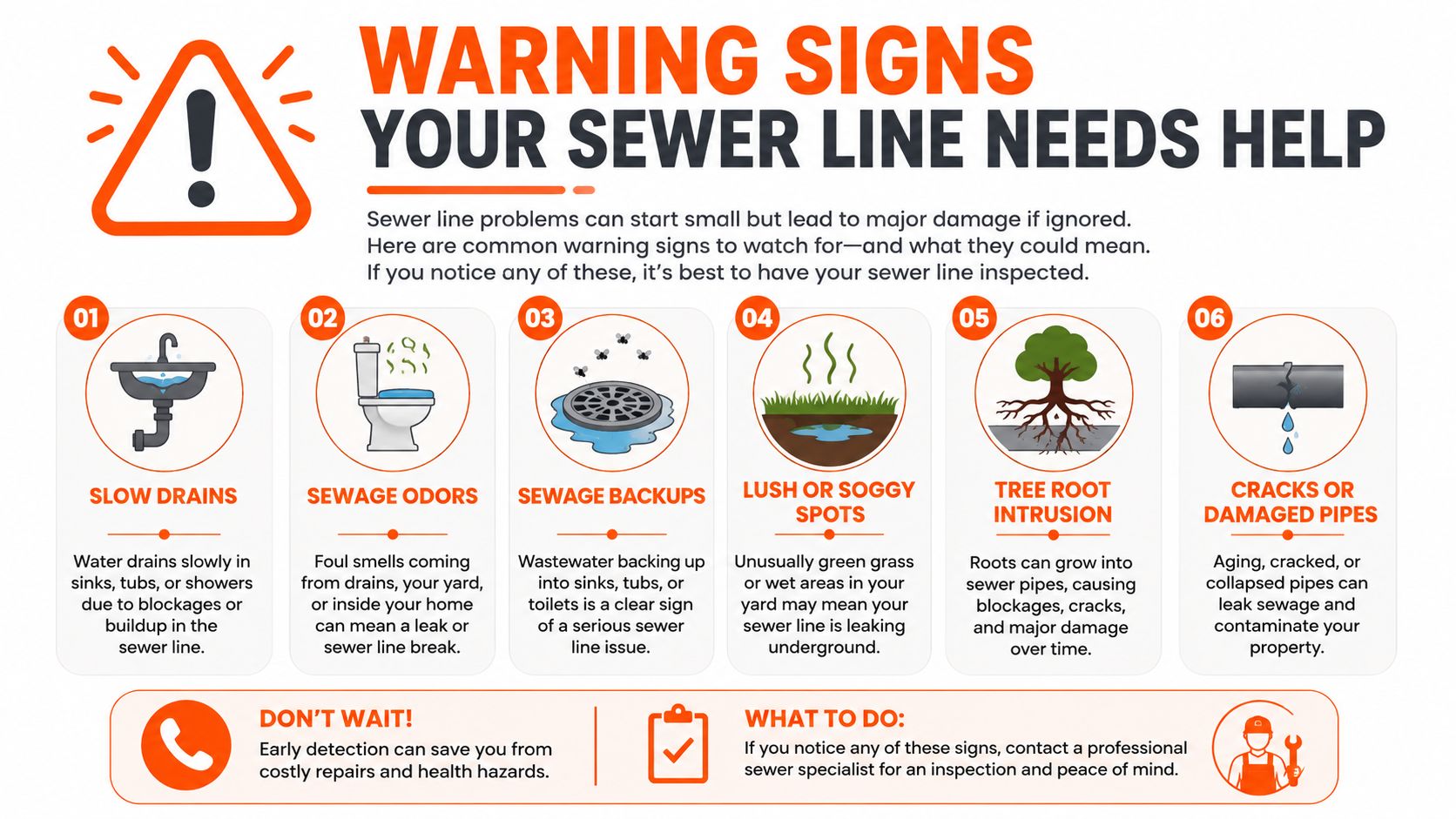
Warning Signs Your Sewer Line Needs Help
The earliest signs are often subtle. Homeowners tend to notice one annoying symptom, then another, before they realize both point to the same buried pipe.
What the common symptoms usually mean
A gurgling toilet often means air is getting trapped and pushed back through the system. Think of drinking through a straw with a partial blockage. Water tries to move, air can't escape cleanly, and you hear that bubbling sound.
A slow shower, tub, or sink, especially when more than one fixture is involved, usually means wastewater isn't moving through the main line the way it should. Sewer lines are designed to maintain a flow velocity of at least 2 feet per second, and when flow drops below that because of clogs or sagging, solids can settle and create the backups people notice inside the house, as outlined in these sewer construction specifications.
A sewage smell in the yard or near drains can point to a leak, a blocked venting path, or wastewater sitting where it shouldn't. Sewer gas has a way of revealing itself before a full backup happens.
For broader seasonal plumbing readiness, this spring plumbing checklist visual is also a useful reminder that drainage problems often build gradually before they become urgent.

Outdoor clues homeowners often miss
Not every warning sign shows up indoors first. Outside, the yard can tell you a lot.
- One patch of grass looks greener or grows faster: A leaking sewer line can feed that area with extra moisture.
- The ground feels persistently soft: Wastewater escaping below grade can saturate the soil.
- You notice insects or odors near one section of the yard: Organic waste attracts attention quickly.
- Foundation or paving movement appears near the pipe path: Soil instability doesn't always come from the sewer, but it belongs on the checklist.
When the pattern matters more than the symptom
A single slow sink might be a local stoppage. A whole-house pattern is different.
Watch for combinations like these:
| Symptom pattern | What it suggests |
|---|---|
| Toilet gurgles when the tub drains | Restricted shared drainage path |
| Lowest drain backs up first | Main line obstruction downstream |
| Indoor slow drains plus yard odor | Possible blockage with leak or seepage |
| Repeated clogs in spite of snaking | Underlying pipe defect, roots, or sag |
If the same drain issue keeps returning after basic clearing, the clog may not be the real problem. The pipe itself may be damaged or poorly pitched.
From Guesswork to Diagnosis With Camera Inspections
The smartest sewer service call often starts with a camera, not a shovel. That's because symptoms tell you something is wrong, but they don't tell you exactly where the failure is or what shape the pipe is in.

A sewer camera inspection uses a flexible cable with a waterproof camera head that enters the line through a cleanout or another access point. The technician advances the camera through the pipe while watching a live monitor. Instead of guessing, you can see roots, grease buildup, standing water, separated joints, cracks, offsets, or a complete collapse.
What the technician is looking for
A proper inspection isn't just a video tour. It answers practical questions that determine the repair plan.
- Where is the problem located: Under the yard, driveway, slab edge, or near the city connection.
- What kind of problem is it: Blockage, root intrusion, break, belly, scale buildup, or structural failure.
- How long is the affected section: That matters if a spot repair is possible.
- Is the pipe still a candidate for trenchless work: Shape and cleanliness matter.
One symptom often has very different causes. A recurring backup might come from roots entering a joint. It might also come from a sagged section holding waste. Both create slow drainage. They are not fixed the same way.
Why a camera inspection saves money even when it adds a step
Homeowners sometimes hesitate because they want the plumber to "just clear it." Sometimes that works. But if the line has an offset joint, heavy root intrusion, or a belly, clearing alone doesn't solve anything for long.
A camera inspection helps avoid two expensive mistakes:
- Digging in the wrong place
- Paying for the wrong repair method
If you want a useful outside perspective on how professionals explain this process, this resource on understanding drain backups in Las Vegas does a good job showing why camera diagnostics are so important before major sewer work.
The process often looks like this in the field:
- Access the line through a cleanout or approved entry point.
- Run the camera and document the pipe interior in real time.
- Identify the defect and mark its location if needed.
- Recommend the least invasive repair that addresses the cause.
- Confirm post-repair condition when the work is complete.
For homeowners who haven't seen it before, this short video gives a helpful visual sense of what technicians look for during an inspection.
Solving the Problem Common Sewer Repair Services
Once the line has been diagnosed, the right repair usually falls into one of several buckets. The key is to choose the service that fits the defect. The least invasive option is best only when it will hold up.
Cleaning and flow restoration
The first level of sewer line services is often mechanical cleaning or hydro jetting. Hydro jetting acts like pressure washing for the inside of a pipe. It removes grease, sludge, loose debris, and some root intrusion so wastewater can move again.
This is often the right choice when the pipe is structurally sound but packed with buildup. It's not a structural repair. It restores function and improves visibility for follow-up inspection.
One important trade-off gets overlooked here. For trenchless relining to work properly, the existing line must be cleaned back to at least 95% of its original carrying capacity, based on these sewer line cleaning specifications. If a contractor wants to line a dirty or heavily restricted pipe without proper prep, that's a red flag.
Cleaning is not just about opening a clog. In many jobs, it's the preparation step that determines whether a trenchless repair will bond correctly or fail early.
Targeted repairs for isolated damage
If the camera finds one damaged section instead of a failed line end to end, a spot repair may be enough. That can involve excavating only the affected section or using a localized trenchless patch where conditions allow.
This makes sense when the rest of the line is in decent shape and the defect is limited. A short cracked segment near a joint is a very different job from an old line with repeated failures along its full run.
Spot repairs work best when:
- The damage is isolated: One section has failed, not the entire line.
- The remaining pipe is stable: No widespread collapse, scaling, or offset joints.
- Access is practical: The crew can reach the area without unnecessary disruption.
Trenchless relining and pipe bursting
Pipe relining creates a new interior surface inside the old pipe. In simple terms, it's like installing a sleeve that hardens in place and seals certain defects without opening a trench across the yard. Pipe bursting replaces a line by pulling a new pipe through while breaking apart the old one.
These methods can be excellent when the pipe path is workable, the line doesn't need slope correction, and the property has features you'd rather not disturb, like mature landscaping, decorative hardscape, or tight access.
Trenchless methods are often a strong fit for:
| Problem type | Likely fit |
|---|---|
| Root intrusion at joints | Sometimes, after cleaning and inspection |
| Cracks or leaks in otherwise aligned pipe | Often a good candidate |
| Full replacement where access pits are possible | Often suitable |
| Pipe with incorrect slope or sagging section | Poor candidate |
Full replacement
Sometimes the line is beyond patching. Repeated root intrusion, pipe collapse, severe offsets, outdated material, or a failed slope can push the job into full replacement territory.
That doesn't automatically mean the most expensive or dramatic option. It means the line has to be rebuilt so the drainage system works properly for the long term. Good contractors explain why they chose that route and what they expect the finished system to correct.
A trustworthy recommendation ties the repair method to the inspection findings. If the explanation sounds vague, or every home somehow needs the same fix, pause and ask more questions.
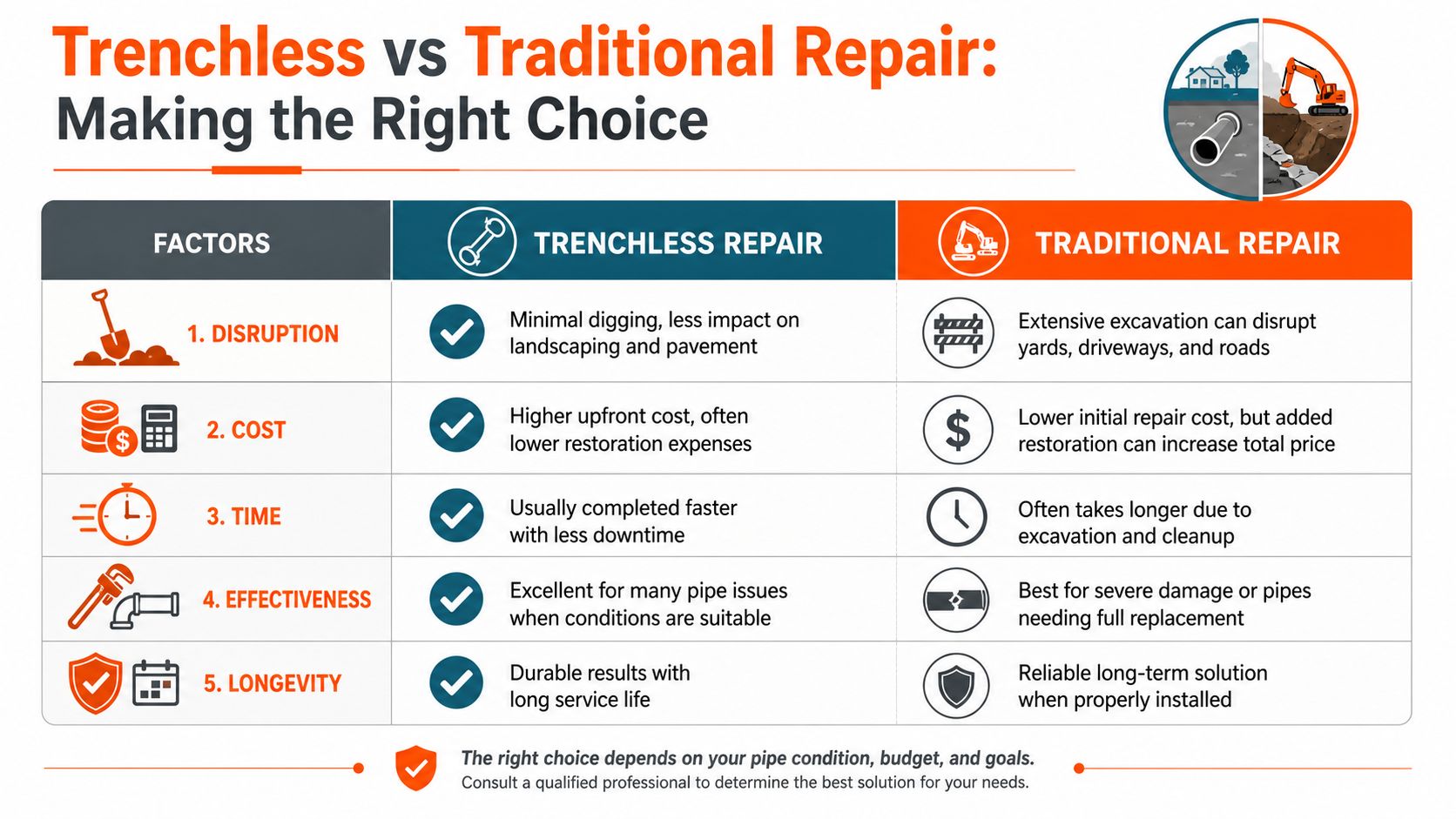
Trenchless vs Traditional Repair Making the Right Choice
Homeowners often hear trenchless presented as the modern answer and excavation presented as the old messy option. That's too simplistic. Both methods have a place. The right one depends on the defect, the property layout, and whether the existing pipe still has the correct grade.
The honest comparison
Some properties are ideal for trenchless work. Others aren't. A balanced estimate should explain both.
| Factor | Trenchless Repair (Pipe Lining/Bursting) | Traditional Repair (Open-Cut Excavation) |
|---|---|---|
| Disruption | Usually less surface disruption because access is often limited to entry points | More visible disruption because the crew excavates the pipe path or damaged section |
| Cost | Depends heavily on setup, access, and pipe condition | Depends on depth, access, restoration needs, and scope of excavation |
| Time | Often faster when the line is a strong candidate | Can take longer when digging, removal, and site restoration are required |
| Effectiveness | Strong option for certain breaks, leaks, and replacements where slope is already correct | Best when the pipe must be repositioned, rebuilt, or fully exposed |
| Longevity | Can be durable when matched to the correct condition and installed on a properly prepared line | Can be the most direct solution when structural correction is necessary |
Where trenchless shines
Trenchless methods are attractive for good reasons. They can reduce damage to lawns, preserve driveways and landscaping, and avoid a long open trench across the property. For a straight run with accessible entry points and no major alignment defects, they can be an efficient answer.
That said, "less digging" is not the same as "better repair." A sewer line doesn't care about marketing terms. It cares about alignment, support, flow, and structural condition.
The sewer belly problem
The biggest misunderstanding in this category is the sewer belly, also called a sag. That's a low spot in the pipe where wastewater and solids collect instead of flowing cleanly downhill.
A common misconception is that trenchless repair is always better. It isn't. Trenchless methods cannot fix a sewer line belly because they don't correct the slope. The reliable fix is open-trench excavation to reposition the pipe and restore proper drainage, as explained in this guide on improperly sloped drain pipes and sewer line bellies.
A line with the wrong pitch can be newly lined and still back up. If the slope is wrong, the repair has to correct the slope.
That point matters because some homeowners spend good money on a minimally invasive repair, only to keep dealing with slow drains and recurring stoppages. The pipe may be smoother after relining, but if waste still falls into a low section and sits there, the original problem remains.
How to decide without getting pushed
Ask these questions when comparing repair options:
- What defect did the camera inspection show
- Does this method correct the underlying cause or only the symptom
- If trenchless is recommended, is the pipe aligned well enough for it
- If excavation is recommended, is the damaged area localized or is the whole line compromised
- What site restoration is included after the plumbing work
A good answer should be specific. "This is less invasive" isn't enough. "The line has a sag under the driveway, and that section must be regraded" is the kind of explanation you want.
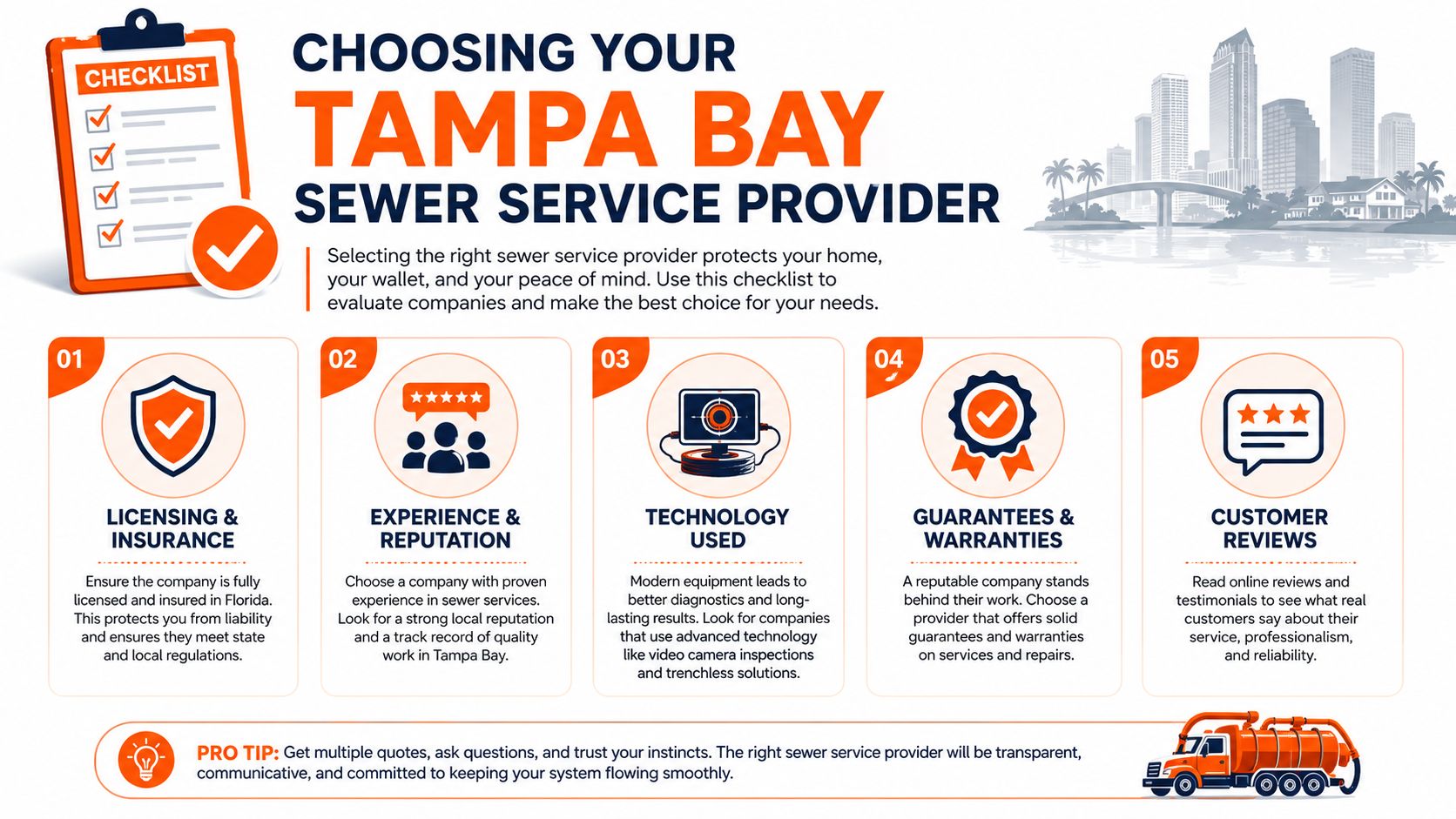
Choosing Your Tampa Bay Sewer Service Provider
The contractor you choose matters almost as much as the repair method. Sewer work is one of those jobs where a weak diagnosis creates a long chain of bad decisions. A strong provider should be able to explain what they found, show you evidence, and justify the repair in plain language.
What to check before you hire anyone
Start with the basics, but don't stop there.
- Licensing and insurance: This is non-negotiable. Sewer excavation, replacement, and code-related work should never be left to an uninsured operator.
- Camera inspection capability: If a company handles sewer line services but can't document the inside of the line, you're relying on too much assumption.
- Written scope of work: The estimate should explain what they're doing, where they're doing it, and what is included.
- Warranty terms: Ask whether both labor and materials are covered, and get that in writing.
- Emergency response: Sewer backups don't wait for business hours.
What separates a serious plumbing company from a sales operation
Look at how they communicate. A trustworthy company doesn't rush past diagnosis or force one method on every job. They should be comfortable saying, "This line is a good trenchless candidate," and just as comfortable saying, "This has to be excavated because the grade is wrong."
You should also expect clear answers on practical issues:
| Question to ask | Why it matters |
|---|---|
| Will you show me the camera findings | You need proof, not just a verbal summary |
| Who handles permits and inspections if needed | Sewer work often involves code compliance |
| What restoration is included | Yard, driveway, or landscape repair can affect the total project |
| What happens if conditions change after opening the line | Underground work sometimes reveals hidden issues |
A company that values public trust usually leaves a trail. Community visibility can be one signal among many, and this Tampa Bay Morning Blend feature image is the kind of supporting context some homeowners like to see while vetting local providers.

Don't choose a sewer contractor based only on who promises the least digging. Choose the one who can prove why the repair will work.
Reviews matter, but read them carefully
Online reviews can help if you read beyond the star rating. Look for comments about punctuality, cleanliness, explanation quality, warranty follow-through, and whether the original fix solved the problem. A sewer company can be friendly and still misdiagnose a line. You want both service and technical judgment.
Frequently Asked Questions About Florida Sewer Lines
Is a blocked sewer line my responsibility or the city's
In many cases, the homeowner is responsible for the sewer line running from the house to the connection point near the street or property boundary. The city's responsibility usually begins on the municipal side of that connection. The exact dividing line can vary by local rules, so it's worth confirming with your utility provider before assuming the problem belongs to the city.
Does homeowners insurance cover sewer line replacement
Sometimes, but not automatically. Coverage depends on the cause of the damage and the language in your policy. Many homeowners find that standard coverage is limited, especially for wear, age, or maintenance-related failure. The practical move is to review your policy now and ask your insurer whether you have any service line or sewer backup endorsements.
Can I locate my sewer line before calling for help
You can often gather useful clues. Homeowners can start by locating the main plumbing stack, checking for a cleanout near the home or property line, and looking for subtle depressions in the yard that suggest the pipe path. That won't replace a professional inspection, but it can help you describe the layout more clearly when you call.
What can I do to reduce the chance of future backups
Keep grease, wipes, paper towels, and other non-flushable items out of the system. Pay attention to recurring slow drains instead of waiting for a full backup. If your home has had sewer issues before, periodic inspection and cleaning can catch buildup or root intrusion before wastewater starts coming back into the house.
For homeowners who value recent customer feedback while deciding who to call, this Google review snapshot is one example of the kind of trust signal worth checking alongside licensing and written warranties.

If you're dealing with gurgling drains, recurring backups, yard odors, or a sewer line that just doesn't seem right, Heatwave Air Conditioning, Plumbing, & Electric can help you get clear answers and a repair plan that fits the actual problem. Their team serves Tampa Bay and Southwest Florida with plumbing expertise, emergency support, financing options, and the kind of professional communication homeowners need when serious issues impact their home.