
A lot of Florida homeowners start thinking about surge protection the same way. A summer storm rolls across Tampa Bay, the sky flashes, the lights blink once, and everybody in the house glances at the TV, the Wi-Fi router, the air conditioner, and the refrigerator display. If you've lived through hurricane season in Sarasota, Port Charlotte, Cape Coral, or Fort Myers, you already know that uneasy feeling.
What catches people off guard is that not every damaging surge arrives with a lightning strike. Some of the trouble starts inside the house, from the same equipment you use every day. That's why surge protection installation matters so much in modern Florida homes packed with smart thermostats, appliances with control boards, home office gear, security systems, and connected devices.
Protecting Your Home from More Than Just Lightning
A lot of surge damage in Tampa Bay starts the same way. A storm rolls through, power drops for a moment, service comes back on, and later that night the Wi-Fi is unstable, the refrigerator display is blank, or the air handler starts throwing a fault code. Homeowners blame the lightning, and sometimes they are right. But in Florida homes, surge problems also show up during utility restoration, after hurricane-related outages, and during normal operation of large equipment already inside the house.
That is the part many homeowners in Sarasota, Tampa, Fort Myers, and Cape Coral do not see coming. Modern homes have control boards everywhere. The condenser outside, the oven, the washer, the garage door opener, the pool pump, the security panel, and the television all depend on electronics that are far less forgiving than older equipment. A short disturbance may not destroy a device on the spot. It can weaken a board, shorten its life, or leave you chasing strange intermittent problems a few days later.
In the field, I see this most often after rough weather and rough re-energizing. Utility power can return unevenly after a storm. Large motor-driven equipment inside the home can also create smaller disturbances as it starts and stops. In a Florida house with central air running hard for most of the year, plus pool equipment and kitchen appliances cycling on and off, those events add up.
Practical rule: If your home has multiple expensive appliances, HVAC equipment, smart devices, or a home office setup, surge protection belongs in the electrical plan the same way GFCI and AFCI protection do. It protects equipment you already paid for.
Florida homeowners usually put hurricane prep first. That is the right priority. Roof, openings, drainage, and backup plans all come before convenience upgrades. If you are reviewing exterior protection too, this expert guide to storm shutters is a useful companion resource for protecting window openings before a storm.
Surge protection also fits the local code and permit reality here. In many Florida homes, the question is not whether sensitive electronics exist. The question is how much of the house depends on them now. Heatwave sees the same pattern across Southwest Florida. More connected equipment, more expensive boards, and more weather-related power events.
We share the same prevention-first approach in resources like this seasonal plumbing readiness article. The electrical side works the same way. It is usually cheaper and a lot less frustrating to prevent damage than to replace boards, reset equipment, and sort out which device failed after the storm passed.

Choosing Your Surge Protection Strategy
A Tampa Bay home can take surges from more than one direction. Afternoon lightning, utility switching, generator transfer events, and large equipment cycling on and off inside the house all put stress on electronics and control boards. That is why surge protection works best as a system, not a single device.
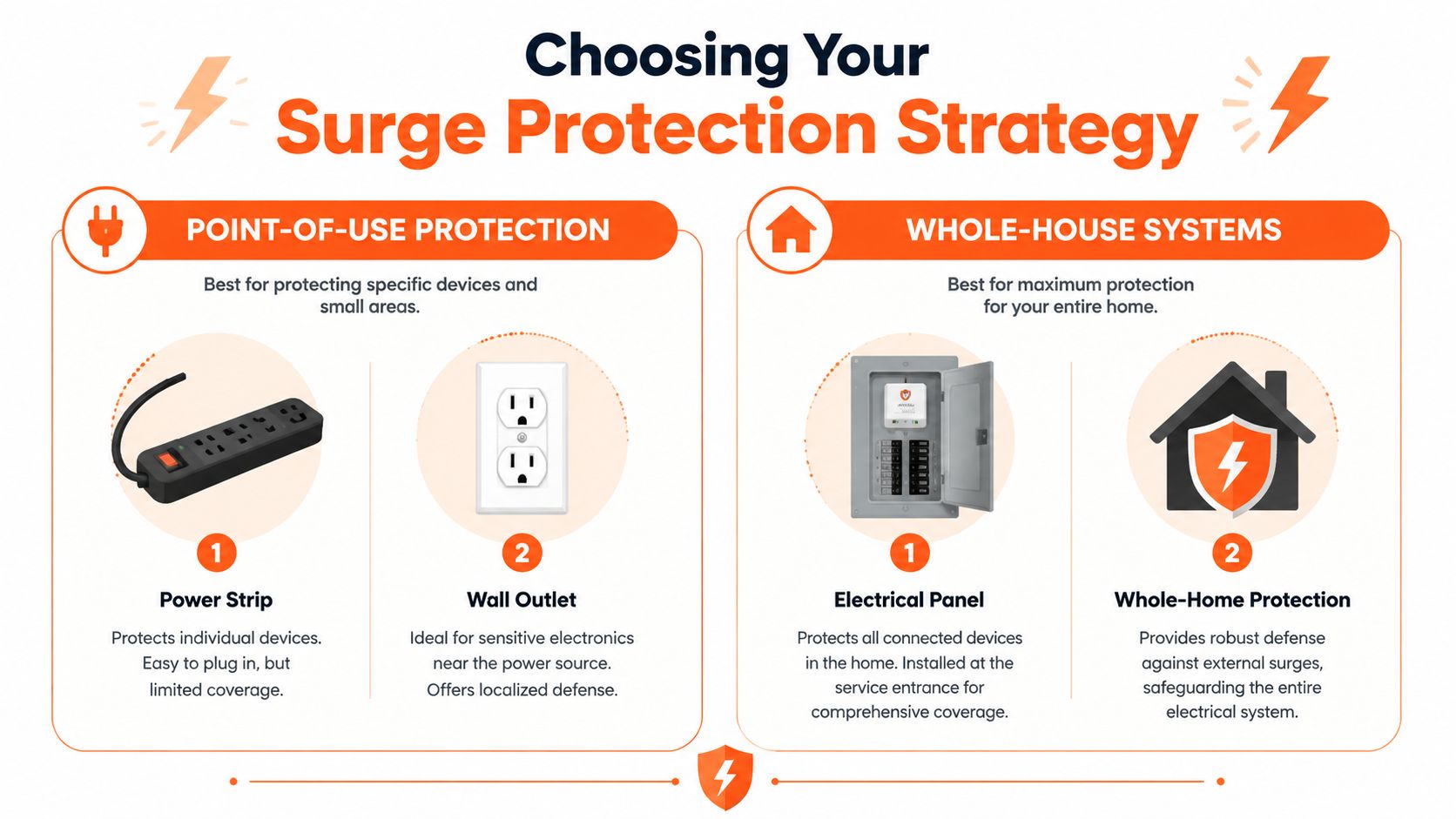
For most Florida homes, the right starting point is a layered setup. Install a whole-house SPD at the main service or distribution panel, then add point-of-use protection where outages, resets, or equipment damage would hit hardest. In practice, that usually means network gear, office equipment, entertainment systems, and any room with devices you rely on every day.
Whole-house and point-of-use are two different layers
A whole-house SPD mounts at the electrical service equipment or main panel. Its job is to clamp surges before they travel deeper into branch circuits. That broad coverage matters in homes with expensive appliances, inverter-driven HVAC systems, pool equipment, garage door openers, and other hardwired loads that a plug-in strip cannot protect the same way.
A point-of-use protector sits close to the device. It helps with the leftover surge energy that makes it past the panel SPD and with disturbances created inside the home. That second layer is a smart move for TVs, desktop setups, modems, Wi-Fi systems, security equipment, and similar electronics.
For a Florida home, the usual best fit is panel protection first, then targeted plug-in protection where a reset, repair, or replacement would be expensive or disruptive.
Whole-House vs. Point-of-Use Surge Protection
| Feature | Whole-House (Type 1 & 2) | Point-of-Use (Type 3) |
|---|---|---|
| Primary location | At service equipment or main panel | At receptacles near specific devices |
| What it protects | Broad home electrical system coverage | Individual plugged-in electronics |
| Best use | First line of defense for the home | Backup layer for sensitive devices |
| Helps with hardwired equipment | Yes | No, not in the same way |
| Installation | Requires professional panel work | Plug-in use |
| Florida value | Strong for storm-prone homes | Strong for offices, TVs, routers, and electronics centers |
How to choose for your house
Start with the panel if you do not already have protection there. That gives the house a first line of defense during the kind of power events we see across Tampa Bay and Southwest Florida, especially during storm season.
Then look at what would be the biggest headache to replace, reprogram, or live without:
- Home office equipment: Computers, monitors, routers, modems, and network switches
- Entertainment centers: TVs, sound bars, receivers, gaming systems, and streaming devices
- Smart home gear: Alarm panels, camera hubs, automation controllers, and connected thermostats
- Bedroom support devices: Powered comfort equipment or other devices a family member depends on overnight
There are trade-offs. A whole-house SPD covers the electrical system broadly, but it does not make every cheap power strip in the house equal to a quality point-of-use protector. A plug-in protector helps nearby electronics, but it does nothing for your air handler, range, pool pump, or other hardwired equipment. Good protection uses both where they make sense.
I also tell homeowners not to shop on joule rating alone. Product specs matter, but placement, panel compatibility, grounding condition, and clean installation matter just as much. The same logic shows up in other home systems. Protect the main equipment first, then support the vulnerable endpoints, as we discuss in this Heatwave article on protecting core home systems before secondary components.
One mistake shows up all the time. A homeowner plugs the TV into a strip and assumes the house is covered. It is not. In Florida, especially in older homes or homes with added circuits and newer electronics, the better question is whether the protection plan matches how the house uses power.
Anatomy of a Professional Surge Protector Installation
A Tampa Bay homeowner usually calls about surge protection after a close lightning strike, a hurricane outage, or a piece of expensive equipment that quit too soon. By that point, the key question is not whether a surge protector can be added. It is whether the installation will be done in a way that properly gives the device its best chance to work.
Placement matters more than most homeowners realize
The physical location of the SPD matters. In panel work, a few extra inches of conductor can reduce performance, especially during the fast surge events that show up here during storm season. Standards-oriented guidance says the SPD should be mounted as close as physically possible to the panel or AC entrance, with short, direct connections. Nautel explains that point well in its SPD location guidance for lightning protection.
That often runs against what a homeowner expects to see.
Clean-looking wire routing is fine, but surge protection is not a beauty contest. Long loops, extra bends, and decorative wire dressing add impedance. A neat install that takes the long way around can test out worse than a tighter, shorter layout done by an electrician who understands surge behavior.
What a careful installer is trying to accomplish
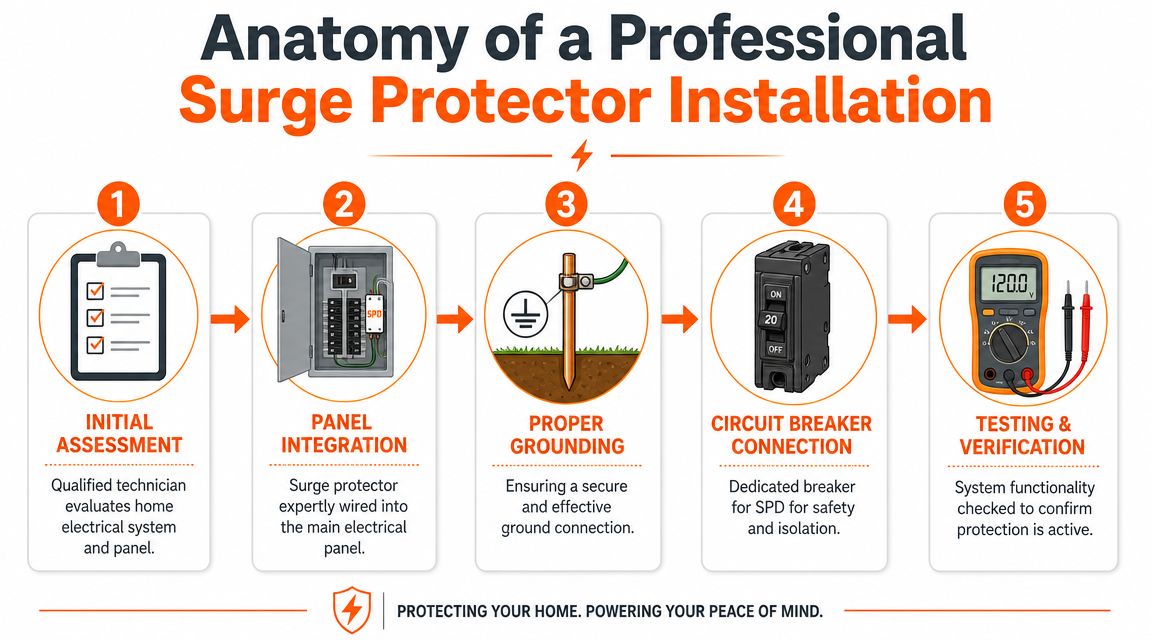
A proper installation starts with the panel itself. The electrician checks available space, panel condition, breaker compatibility, grounding and bonding, and whether the service equipment is set up for the specific SPD being installed. In older Florida homes, that matters more than people think. I see panels with crowded gutters, mixed circuit additions, corrosion near exterior equipment, and past work that looked acceptable until you opened the dead front.
NEMA's guidance for hard-wired SPDs is straightforward. Mount the device close to the protected equipment, keep conductors short and direct, avoid sharp bends and splices, and connect it through the correct breaker or disconnect. NEMA also notes that hard-wired units should use properly sized conductors, commonly AWG #10 stranded or larger depending on the installation. Their installation guidance for hard-wired SPDs covers those details.
On a professional install, the goal is usually to:
- Minimize conductor length so surge current has a shorter path
- Keep routing direct with no unnecessary loops or tight bends
- Use the correct overcurrent connection based on the SPD listing and panel design
- Leave the panel serviceable for future troubleshooting or replacement
- Verify device status after energizing instead of assuming the unit is ready because the cover is back on
Shorter and straighter usually performs better.
Grounding and bonding decide how well the SPD can do its job
This is the part many sales conversations skip. The SPD does not make a weak grounding system disappear. It works with the grounding and bonding system that is already there.
For Florida homes, that matters because lightning exposure is high and service equipment is often mounted in hot, wet, corrosive conditions. If the grounding electrode conductor is loose, the bonding is questionable, or the panel shows signs of age and moisture damage, those problems need attention during the install conversation. A homeowner in St. Petersburg, Tampa, Bradenton, or Fort Myers should expect the electrician to look beyond the device itself and inspect the path that surge energy is supposed to follow.
Post-install checks matter too. A good installer confirms terminations, breaker fit, indicator status, and overall panel condition before closing up. If you want a quick example of the kind of detail-focused electrical workmanship that supports safe panel upgrades, this panel-focused Heatwave electrical image shows the sort of environment where neat work and correct work both matter.

A quality installation also accounts for future service
Surge protectors are not install-and-ignore devices. They can fail after a major event, their indicator lights need to remain visible or at least accessible, and replacement should not require half the panel to be rebuilt.
That is one reason experienced electricians pay attention to service access. NEMA and manufacturer guidance support using an appropriately rated breaker or disconnecting means so the SPD can be isolated correctly. Berkeys explains that serviceability point in its hardwired surge protection installation overview.
For a Florida homeowner, the practical takeaway is simple. A professional surge protector installation is panel work, grounding work, and layout work all at once. The device matters, but the workmanship decides whether that device is positioned to protect your HVAC system, appliances, electronics, and other hardwired equipment during the kind of storm activity we deal with every year.
Navigating Florida Codes Permits and Costs
Florida homeowners often ask the same question once they start looking into panel-mounted protection. “Is this optional, or is this something code now expects?”
For new and replacement service work, surge protection has moved firmly into the expected category. In the United States, the 2020 National Electrical Code required a Type 1 or Type 2 SPD for all services supplying dwelling units, installed as part of the service equipment or immediately adjacent to it, with a nominal discharge current rating of at least 10 kA. The 2023 NEC clarified and broadened that requirement to include multifamily dwelling units, dormitory units, guest rooms and guest suites of hotels and motels, and patient sleeping rooms in nursing homes and limited-care facilities. Schneider Electric summarizes those NEC changes in its 2023 National Electrical Code updates for surge protection.
Why that matters in Florida
In a place like Tampa Bay or Southwest Florida, code changes like that line up with real conditions on the ground. Homes here deal with lightning exposure, storm season, utility interruptions, and power restoration after weather events. So when homeowners hear that whole-home surge protection is now part of mainstream service work, that shouldn't sound surprising. It reflects how common and important this protection has become.
For homeowners, the practical takeaway is simple. If you're replacing service equipment, upgrading a panel, or doing electrical work that touches service components, surge protection may no longer be something you “might as well add.” It may already be part of the code path for the job.
Permits and local enforcement
Permit requirements can vary by municipality and by the scope of work. In many Florida jurisdictions, panel work and service-related electrical changes trigger permit and inspection requirements. A homeowner in Tampa may run into different administrative steps than a homeowner in Fort Myers or Cape Coral, even if the electrical principles are the same.
That's why surge protection installation should be discussed in the context of the full job:
- Panel replacement: Often treated as permitted electrical work.
- Service replacement or upgrade: Commonly requires inspection.
- Adding an SPD to existing equipment: May still require local compliance review depending on the equipment and method.
The safest approach is to have a licensed electrician determine how the local authority having jurisdiction handles the specific installation.
What about cost
The exact cost depends on the panel, device type, installation complexity, breaker availability, grounding condition, and whether corrective work is needed before the SPD can be installed properly. If the grounding and bonding need attention, the project can change from a simple add-on to a more involved electrical repair.
That's why I don't like giving blind pricing over the phone for this kind of work. A clean panel with good access is one job. An older panel with crowded terminations, limited space, or grounding issues is another. What matters more than a generic price promise is whether the installation is code-compliant, serviceable, and physically laid out for real performance.
The Heatwave Installation Experience
When homeowners call about surge protection, the conversation usually starts with concern, not product specs. Maybe they've had lights flicker during a storm. Maybe they've replaced electronics before. Maybe they're upgrading a panel and want to do the job right while the work is open.

A good service visit should feel straightforward. The electrician looks at the existing panel, reviews grounding and bonding, checks space and connection options, and explains what kind of SPD setup fits the home. If the system has limitations, those should be discussed plainly. If the install is appropriate, the homeowner should know where the device will go, how it will be connected, and how to tell later whether it's still active.
What the work should include
A professional installation should be built around compliance and future serviceability, not just speed. Guidance used in the trade says SPDs should be connected through an appropriately rated circuit breaker or fused disconnect so the device can be maintained or replaced safely. That's the same practical approach described in the earlier hardwired installation reference.
For homeowners scheduling this service, the experience should include:
- A panel assessment: Not every panel presents the same mounting and routing options.
- A grounding check: The SPD depends on a proper path to ground.
- A clear installation plan: Homeowners should understand what's being added and why.
- Post-install verification: The electrician should confirm status indication and explain what to watch in the future.
If you want a sense of the company behind the service, this Heatwave media feature image gives a little more local context.

What homeowners should hear before the electrician leaves
You should know where the SPD is installed, what breaker or disconnect serves it, what the status lights mean, and what signs tell you it needs attention later. A good electrician doesn't leave that vague.
This short video gives another look at the company and service approach:
There's also a practical difference between a rushed add-on and a disciplined installation. The rushed version gets the device mounted and calls it done. The disciplined version checks whether the home's electrical system will let that SPD perform the way it should. Heatwave Air Conditioning, Plumbing, & Electric offers whole-house surge protection installation as part of its electrical services, and for Florida homeowners that kind of panel-level protection is worth discussing when storms, outages, and sensitive equipment are part of daily life.
Surge Protection FAQs for Florida Homeowners
Will a whole-house surge protector stop a direct lightning strike
No. It's better to think of an SPD as protection against surge energy and transient events, not as a magic shield against every possible electrical outcome from a direct strike. In Florida, that distinction matters. Whole-home surge protection is still very worthwhile, but it has limits.
How do I know if the surge protector is still working
Most quality units include a status indicator. Homeowners should know where that indicator is and what normal operation looks like. If the status light shows a fault, goes dark when it shouldn't, or the manufacturer's indicator says protection is gone, the unit needs to be checked.
If you can't quickly verify the SPD's status, ask the installer to show you before the job is closed out.
Why does grounding matter so much
Because the SPD needs an effective path to divert surge energy. A key part of professional installation is verifying the home's grounding system. Proper surge diversion relies on a low-resistance path to earth, generally expected to be 10 ohms or less, according to Britec's Type 2 installation guidance. If grounding and bonding are poor, the SPD has less ability to do its job well.
Do I still need plug-in surge protectors
For many homes, yes. Main panel protection and point-of-use protection do different jobs. If you have a home office, entertainment system, or other sensitive electronics, local protection still makes sense as part of a layered setup.
How often do whole-house surge protectors need replacement
There isn't one fixed schedule that fits every house. Replacement depends on the device, the electrical environment, and how often it has absorbed surge activity. What matters most is periodic inspection and checking the unit's status indication. If the device shows it's no longer providing protection, it's time for replacement.
Is this worth doing in an older Florida home
Often, yes, but older homes need a more careful look at panel condition, breaker space, grounding, and bonding. The SPD can only work well if the supporting electrical system is in shape to support it. That's one reason an on-site evaluation matters.
For homeowners paying attention to service quality, public feedback can be useful too. This Heatwave Google review image is one example of the kind of trust signal people often look for before scheduling electrical work.

If you want surge protection installation done with attention to panel layout, grounding, code compliance, and Florida storm realities, contact Heatwave Air Conditioning, Plumbing, & Electric. A licensed electrician can evaluate your existing service equipment, explain your options clearly, and recommend a setup that fits your home.