
You turn on the kitchen tap, fill a glass, and catch that unmistakable rotten egg smell. Then you try the shower. Same thing, or maybe only on the hot side. For a lot of Florida homeowners, that moment sets off immediate alarm. Is the water unsafe, is the water heater failing, or is something wrong with the well?
This is one of the most common plumbing complaints in Tampa Bay and Southwest Florida homes, especially where private wells are part of daily life. In this region, changing water conditions, low-oxygen groundwater, older plumbing, and water heater reactions can all play a part. The good news is that sulfur odor usually has a clear cause, and once you identify where it's coming from, the fix becomes much more straightforward.
That Rotten Egg Smell Is a Common Call
A sulfur smell in water rarely surprises an experienced plumber in Florida. It shows up in newer homes on well water, older houses with aging water heaters, and seasonal properties where water sits in pipes longer than anyone wants.
In Tampa Bay, Sarasota, Port Charlotte, Cape Coral, and Fort Myers, the complaint often starts the same way. The homeowner notices it first thing in the morning, or after returning to a home that sat unused. Someone runs the sink, the smell hits, and the assumption is usually the worst.
What the smell usually points to
Most of the time, water smells like sulfur because of one of two issues:
- A source-water problem where hydrogen sulfide or sulfur-related bacterial activity is present in the well water or plumbing system
- A water heater problem where the smell is mostly or only in hot water
That distinction matters more than anything else at the start. If the whole house smells, the fix usually needs to happen upstream. If only the hot water smells, the water heater becomes the first place to look.
Practical rule: If the odor changes depending on whether the water is hot or cold, don't guess. That difference is diagnostic.
Why Florida homeowners run into this so often
Private well owners in Southwest Florida deal with water conditions that shift over time. A well that was tolerable a year ago can develop a stronger sulfur odor after seasonal changes, periods of low use, or changes in groundwater conditions. That doesn't automatically mean danger, but it does mean the system should be checked with a methodical approach instead of a quick fix from the hardware store.
The main mistake homeowners make is treating every sulfur smell the same way. They shock the well when the water heater is the issue. Or they flush the heater when the well itself needs treatment. The right answer depends on where the smell begins.
Why Your Water Smells Like Rotten Eggs
That rotten egg smell usually comes from hydrogen sulfide gas, H2S. In homes across Tampa Bay and Southwest Florida, I see it show up from two places more than any others. The source water brings the odor in, or the smell is being created inside the water heater. Mosman Well Works on sulfur-smelling water explains that hydrogen sulfide commonly forms in low-oxygen water and in systems where sulfur-related bacterial activity is present.

Whole-house smell versus hot-water-only smell
Start with the pattern. If the odor shows up in both hot and cold water, especially at several fixtures, the problem usually starts in the well water or somewhere in the plumbing system. If it shows up mainly on the hot side, the water heater moves to the top of the list.
That difference saves time and money.
For many Florida well owners, the pattern can shift through the year. Changes in rainfall, drought, and water table movement can change how much sulfur odor reaches the house. In coastal and inland parts of Southwest Florida, I also see wells that smell worse after long stretches of low use or after storms that disturb local groundwater conditions. A filter that handled the water fine last season may stop keeping up when the water itself changes.
What actually creates the odor
Several conditions can produce or intensify the smell:
- Low-oxygen water allows sulfur-related bacteria to thrive
- Sulfur-bearing minerals in groundwater can release hydrogen sulfide
- Stagnant water in plumbing, pressure tanks, or unused branches gives the odor more time to build
- Water heater conditions can amplify a mild sulfur issue into a strong hot-water smell
That is why one house has the odor at every fixture, while another only notices it in one bathroom or at one sink that sits unused.
Water heaters deserve a close look
Water heaters are frequent offenders. Sediment in the tank, bacterial growth, and reactions involving the anode rod can all create or worsen sulfur odor. In practice, a magnesium anode rod is often part of the problem when the smell is limited to hot water. Swapping to a different rod material may help, but it is not a cure-all if the incoming well water already carries sulfur.
Homeowners can do a basic check themselves. Run only cold water at one faucet, then only hot water at the same faucet, then repeat at another part of the house. If the smell tracks with hot water, focus on the heater first. If you are also dealing with poor recovery, rumbling, or discolored hot water, reliable plumbing for water heaters can help you understand the maintenance side of the problem.
For well-water homes in Florida, the trade-off is simple. A quick heater fix may reduce the smell for a while, but if the well chemistry has shifted, the odor will often return until the water is tested and the treatment setup matches the current water conditions.
Is the Sulfur Smell in Your Water Dangerous
Most homeowners don't care about the chemistry first. They want to know if they can drink the water, shower in it, and let their kids use it.
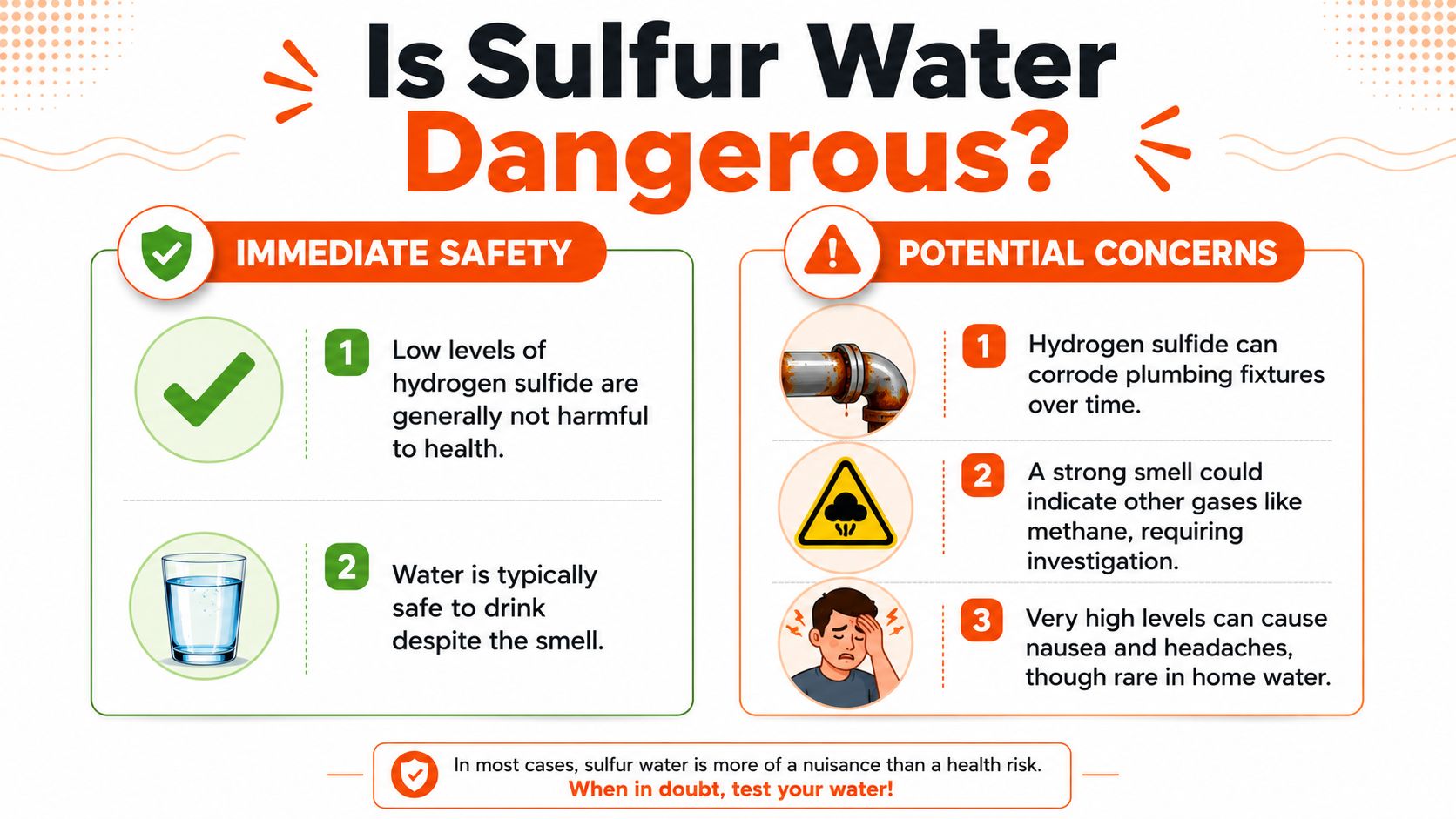
The reassuring part is this. Humans can detect hydrogen sulfide at extremely low concentrations well below 0.05 ppm, while real health impacts are not likely until air levels reach at least 2 ppm for 30 minutes of exposure, according to the Western Australia health guidance on hydrogen sulfide and public health. In plain language, your nose notices the odor far earlier than those air exposure levels associated with adverse effects.
Nuisance odor versus true red flag
That doesn't mean every sulfur smell should be ignored. It means the usual rotten egg odor from household water is more often a water quality nuisance than a toxic gas emergency.
A practical way to separate the two:
| Situation | What it usually means |
|---|---|
| Mild odor only when running water | Often a nuisance water issue tied to H₂S in water or sulfur bacteria |
| Odor only on hot water | Often a water heater-related issue |
| Strong, unusual odor in the home even when taps aren't running | Needs immediate investigation because another gas issue may be involved |
If the smell is only tied to water use, homeowners can usually stay calm and troubleshoot. If there's a persistent gas-like odor in the house unrelated to running water, stop treating it like a plumbing annoyance and investigate it as a possible safety issue.
Why you should still fix it
Even when sulfur odor isn't a direct health threat at the levels most homeowners notice, it still causes real household problems. It makes water unpleasant to drink, affects cooking, and can contribute to wear on plumbing fixtures and water-using appliances over time.
Coffee drinkers notice this fast. Taste and odor issues change the cup even when the water looks clear, which is why articles on how tap water hurts your coffee resonate with homeowners dealing with sulfur-tainted water.
If the smell is coming from the water itself, it's usually a plumbing and water-treatment problem. If the smell hangs in the air independent of the water, treat it as a safety investigation.
Your Step-by-Step Diagnostic Checklist
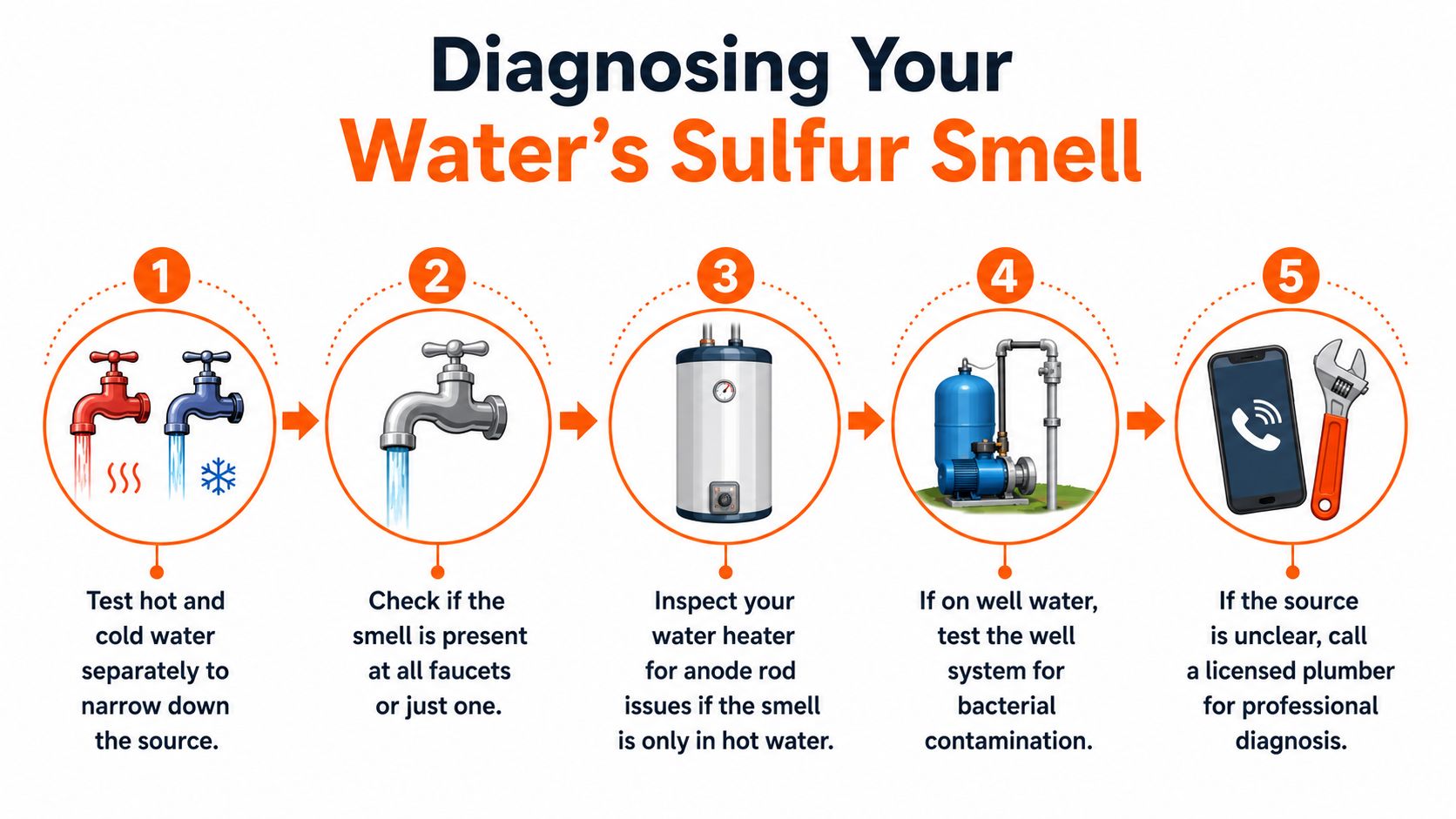
Before you buy a filter, flush a heater, or call for a well treatment, narrow the source. This part matters because sulfur odor fixes are very different depending on where the problem starts.
Start with a hot-versus-cold test
Run cold water at a sink, then hot water at the same sink. Use a clean glass if you need to compare side by side.
Only the hot water smells
Focus on the water heater. The tank, sediment, bacteria inside the heater, or the anode rod are the likely suspects.Both hot and cold smell
The source is probably upstream of the heater. On a well, that usually means the well water itself, pressure tank, or house treatment equipment.Cold smells stronger than hot
That often points away from the heater and toward source water or plumbing stagnation.
Check every part of the house
Don't rely on one faucet. Test the kitchen sink, a bathroom sink, a tub, and an outdoor spigot if you have one.
Use this quick decision grid:
| What you find | Most likely direction |
|---|---|
| One faucet only | Localized fixture or drain-area issue |
| One bathroom only | Branch plumbing or low-use area |
| Every fixture in the home | Well source or whole-house treatment issue |
| Only after water sits | Stagnation or localized bacterial activity |
If only one faucet smells, remove and clean the aerator before assuming you need a major repair. Debris and buildup at the end of the faucet can hold odor and make a localized issue seem bigger than it is.
A good seasonal plumbing checklist can also help homeowners catch stagnation and maintenance issues that contribute to odor problems, especially in part-time Florida homes. This spring plumbing readiness visual guide highlights the kind of basic upkeep that often gets skipped until odors show up.

Inspect the water heater if hot water is the issue
Look for these clues:
Tank age and maintenance history
A neglected heater is more likely to hold sediment and support odor problems.Recent periods of low use
Vacation homes and guest baths often develop stronger hot-water odor after sitting.Recurring odor after flushing
That points to a deeper heater issue, not just temporary sediment.
Here's a walk-through that helps visualize the troubleshooting process:
Pay attention if you're on a private well
For Florida well owners, sulfur odor often isn't just a single-appliance problem. If the smell is in both hot and cold water, or if it returns after basic cleanup, the well system needs attention. That can include the well itself, pressure components, or a treatment setup that no longer matches current water conditions.
Don't diagnose sulfur odor from the kitchen sink alone. Test the whole house before deciding what needs repair.
Common Fixes for Sulfur Smell in Water
The right fix depends on where the odor starts. In Southwest Florida homes, I usually separate this into two buckets. Hot-water-only odor points to the heater. Odor in both hot and cold water points to the incoming water or treatment equipment.
If the smell is only in hot water
Start with the water heater before you spend money on filtration.
Flush the water heater
Sediment collects at the bottom of the tank and gives odor-causing bacteria a place to hang on. A careful flush can reduce smell and improve heater performance at the same time.Heat-treat the tank with caution
Raising the tank temperature for a short period can kill sulfur bacteria inside the heater. As noted earlier, public health guidance allows a high-temperature treatment for this kind of problem, followed by a flush. This is not a casual DIY step. Scalding risk is real, and older heaters do not always respond well.Check the anode rod
A magnesium anode rod can react with certain water conditions and make the smell worse. Swapping to an aluminum or zinc-coated aluminum rod often helps when the odor is limited to hot water.
Trade-offs matter. A flush is inexpensive, but it may only buy time. An anode change can solve the problem, but on an older tank it can also expose corrosion or a drain valve that no longer seals well.
Homeowners who want a visual on common plumbing maintenance problems can review this Tampa Bay plumbing service example before deciding whether the heater issue looks manageable or overdue for service.

If the smell is in both hot and cold water
A whole-house odor usually needs a source-water fix, especially on private wells in Tampa Bay, Sarasota, Port Charlotte, Cape Coral, and Fort Myers. In this part of Florida, shifting water tables, heavy rain, drought swings, and seasonal demand can change well conditions faster than many homeowners expect. A treatment setup that worked two years ago may no longer match the water coming into the house.
Shock chlorination can help as a reset, but it is often temporary. Sulfur bacteria can return if the well environment still supports them. Long-term treatment usually means an oxidizing filter, air injection, or a chemical feed system with proper filtration, depending on how strong the odor is and what the water test shows, as explained by Leaf Home's sulfur water treatment overview.
Compare the common options
| Fix | Best use | Limitation |
|---|---|---|
| Water heater flush | Hot-water-only odor | May not last if the anode rod or bacteria are still causing the issue |
| High-temperature tank treatment | Bacteria inside the water heater | Temporary and carries scalding risk |
| Anode rod replacement | Heater-specific odor tied to magnesium rod | Does not address source-water odor |
| Activated carbon | Mild odor at a sink or drinking tap | Fills up fast and is a poor choice for strong whole-house sulfur smell |
| Oxidizing filter | Ongoing whole-house sulfur treatment | Must be sized correctly and maintained |
| Chemical injection with filtration | Strong sulfur odor or recurring well issues | More equipment, more maintenance, more service cost |
Activated carbon gets recommended too often for this problem. It can help with light odor at a single tap, but it is rarely the right answer for a Florida well home with sulfur smell in multiple fixtures. If the laundry, showers, and kitchen sink all smell, point-of-use filters are treating the symptom, not the source.
What usually works best in Florida well homes
For persistent well-water odor in Southwest Florida, whole-house treatment is usually the practical fix. The best setup depends on whether the problem is sulfur bacteria, dissolved hydrogen sulfide gas, iron and manganese along with sulfur, or a combination of all three.
That distinction matters in this region. Falling and rising groundwater levels can change what your well pulls in through the year, so the right answer is not always the cheapest filter on the shelf. Homeowners comparing broader treatment options can use this guide on choosing home water purification to sort out point-of-use versus whole-house equipment, then match that choice to actual test results.
A kitchen filter may improve taste, but it will not fix sulfur odor that starts at the well and travels through the entire plumbing system.
When to Call a Licensed Plumber in Southwest Florida
You run the shower in a Cape Coral or Tampa Bay home, catch that rotten egg smell again, and wonder whether this is just nasty well water or something that needs immediate attention. I treat that as a service call when the smell keeps returning, shows up in multiple fixtures, or changes suddenly after your water had been fine for months.
That pattern usually means the problem is larger than one drain, one faucet, or one filter. In Southwest Florida well homes, sulfur odor can trace back to the well, the treatment equipment, the water heater, or a mix of all three. Seasonal water table shifts in this region can also change what the well is pulling, which is why a system that worked last year may stop keeping up this year.
Call when the odor is widespread, persistent, or changing
A one-time smell from a little-used bathroom can sometimes be handled with basic troubleshooting. House-wide odor is different.
If the smell is in hot and cold water, returns soon after flushing the heater, or comes back after shock chlorination, stop guessing. At that point, the job is to identify the source and test the water before choosing treatment equipment. Smell alone cannot tell you whether you are dealing with dissolved hydrogen sulfide, sulfur bacteria, iron and manganese along with sulfur, or a water heater issue layered on top of a well-water problem.

Florida well owners have less room for trial and error
Municipal water users often have a narrower list of possible causes. Private well owners in Sarasota, Port Charlotte, Fort Myers, and nearby areas do not. Groundwater conditions can shift after heavy rain, dry spells, nearby pumping, or gradual water table changes. That can turn a mild nuisance odor into recurring whole-house sulfur problems, or expose a treatment system that was undersized from the start.
Call a licensed plumber when any of these apply:
- The sulfur smell is present in more than one fixture
- Both hot and cold water smell
- The odor came back after a heater flush or well disinfection
- You see staining, corrosion, or slimy buildup along with the smell
- Your home uses a private well
- Your treatment equipment is older, frequently bypassed, or no longer keeping up
There is also a safety line homeowners should take seriously. Sulfur odor in water is often a nuisance issue, but a sudden sulfur smell around the well area, pump equipment, utility room, or enclosed plumbing spaces should not be brushed off. If you suspect a gas issue, leave the area and call the utility or emergency services first. A plumber handles water quality and plumbing diagnosis. Gas-related hazards come before everything else.
Local experience matters here. A plumber who works in Southwest Florida sees the same regional patterns over and over, including odor problems tied to shifting well conditions, aging aeration setups, and water heaters reacting badly to untreated well water. For homeowners who want to confirm they are working with a company active in the area, this Tampa Bay Morning Blend feature image helps identify a provider with roots in the local market.
If you have well water in Southwest Florida and sulfur odor keeps coming back, professional testing and proper system sizing are the fastest way to stop wasting money on temporary fixes.
If your water smells like sulfur and you want a clear answer instead of trial and error, contact Heatwave Air Conditioning, Plumbing, & Electric. Their team serves Tampa Bay and Southwest Florida homeowners with plumbing diagnostics, water heater service, and whole-home solutions that fit the water conditions in this region.