
If you're a homeowner in Tampa Bay, Sarasota, Port Charlotte, Cape Coral, or Fort Myers, you probably know the routine. The sky turns dark in the afternoon, thunder starts rolling in, and you glance at the TV, the Wi-Fi router, the refrigerator, and the air conditioner and think, “I hope nothing gets fried this time.”
That worry isn't overblown. Florida homes pack a lot of electronics into one place now. Your AC has control boards. Your fridge has sensors. Your garage door opener has electronics. Even the lights, thermostat, and washing machine may have delicate components inside. Whole home surge protection is the system that helps stand between all of that equipment and the voltage spikes that can wreck it.
A lot of homeowners hear the phrase and assume it means one magic box solves everything. The optimal approach, however, is more effective and somewhat more intricate. A panel-mounted surge protector is a major first line of defense, but the smartest setup for a Florida home uses layers. That matters even more in a storm-heavy region where lightning, utility disturbances, and everyday appliance cycling all put stress on your home's electrical system.
Why Florida Homes Are Uniquely at Risk from Power Surges
A summer storm in Southwest Florida can build fast. One minute it's bright and sticky outside. Twenty minutes later, the windows are rattling, lightning is flashing across the sky, and the power flickers just long enough to make everybody in the house look up.
That's the kind of moment that gets people thinking about surge protection. And it should.
In this part of Florida, homeowners worry about the big dramatic event. Lightning nearby. Utility trouble during a storm. A sudden spike coming in from outside the house. That's a real risk. But it isn't the only one, and for many homes it isn't even the most frequent source of wear on electronics.
The two kinds of surges most homeowners deal with
Think of external surges like a dam breaking. They hit hard and get your attention.
Internal surges are more like a leaky faucet. They seem minor, but they keep happening. Over time, they wear things down.
According to the Electrical Safety Foundation International guidance on home surge protective devices, with NEMA-linked guidance cited by Schneider Electric, up to 80% of all surges originate inside a building. Those smaller surges can come from appliances turning on and off, and they can slowly degrade electronics instead of destroying them all at once.
Practical rule: If you only think about lightning, you're missing most of the strain your electronics deal with.
That point confuses a lot of people. They assume a surge is always some huge blast from outside. In real homes, the refrigerator cycling, the HVAC system starting, and other equipment switching on and off can create repeated small spikes.
Why this hits Florida homes especially hard
Florida homes often run air conditioning for long stretches, and many households rely on a growing list of connected devices every day. Storm season adds another layer of stress because your electrical system may see flickers, interruptions, and unstable conditions when weather moves through the area.
Now walk through your house mentally:
- Living room electronics like TVs, sound systems, and streaming devices
- Home office gear like computers, monitors, and networking equipment
- Kitchen appliances with digital controls
- Comfort systems like air conditioning and air handlers
- Garage and utility equipment such as door openers and pumps
When homeowners in this region watch a local weather segment or storm report, that concern feels pretty familiar. Even a quick Tampa Bay weather-related home systems segment is enough to remind you how often local weather puts home equipment at risk.

The big takeaway is simple. In Florida, the surge threat isn't just one violent storm event. It's storms plus the everyday electrical life of the house.
How Whole Home Surge Protection Acts as Your Electrical Gatekeeper
A whole home surge protector works a lot like a gatekeeper at the front entrance to your electrical system. It sits at the main electrical panel and watches what comes through. When voltage jumps to an unsafe level, the device steps in and sends that excess energy to ground instead of letting it continue deeper into the home.
That's the basic job. Not glamorous, but extremely important.

Where it goes and why that matters
A plug-in surge strip only protects what is plugged into that strip. A panel-mounted protector works at the service panel, so it protects the home's circuits more broadly.
As explained in DITEK's overview of how whole-home surge protection works, the device is installed at the main electrical panel to sense an overvoltage event and divert excess current to ground before it propagates through branch circuits. That's why it can help protect hard-wired loads such as HVAC equipment, refrigerators, and well pumps that can't be covered by a single plug-in protector.
That panel location is the key idea homeowners need to understand. It isn't sitting out by one TV. It's mounted where the house's electrical system begins branching out.
What it protects that plug-in strips can't
Here are the loads homeowners often forget about:
- Air conditioning equipment with boards and controls
- Kitchen appliances that are hard-wired or distributed across circuits
- Garage systems like openers
- Pumps and utility equipment that don't plug into a regular surge strip
- Downstream outlets throughout the house that benefit from panel-level protection
Think of it as a pressure-relief valve for your electrical system. It doesn't stop electricity from doing its normal job. It steps in when the pressure gets dangerous.
One more panel issue worth checking
If your home has an older electrical panel, surge protection isn't the only thing to ask about. Some legacy panels have safety concerns of their own. Homeowners who aren't sure what they have can look at Solar Energy Management LLC's Zinsco panel guide for a practical overview of one panel type that often raises red flags. It's a useful reminder that the condition of the panel matters just as much as the accessory you add to it.
Layering Your Defenses Whole Home and Plug In Protectors
One of the biggest myths in this topic is that you have to choose between a whole home surge protector and plug-in surge protectors. That's the wrong way to think about it.
The better approach is both.
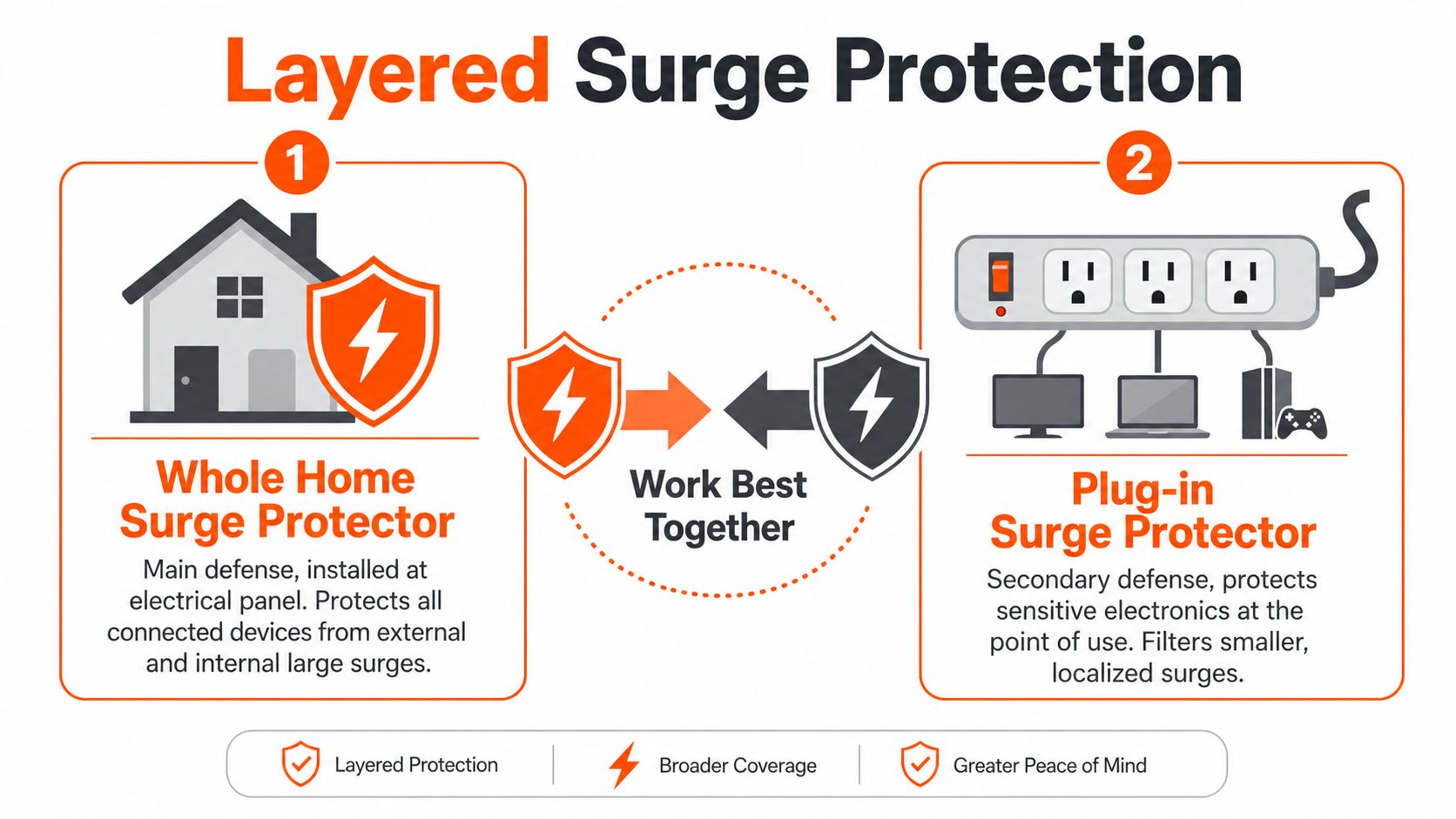
A whole home unit protects at the panel. Plug-in protectors help sensitive devices at the point of use. When homeowners use only one layer, they leave gaps.
Why one layer isn't the full story
Independent electrical guidance makes this point clearly. In this discussion of whole-home versus point-of-use surge protection, the guidance is that whole-home units are essential for reducing large incoming surges, but plug-in protectors still matter for sensitive electronics and for surges that originate downstream inside the home.
That's the layered strategy most short homeowner guides skip over.
Here's a simple comparison:
| Protection type | Main job | Best for |
|---|---|---|
| Whole home surge protector | Reduces major incoming surges at the panel | Hard-wired equipment and broad house-wide coverage |
| Plug-in surge protector | Adds a final buffer at the device | TVs, computers, gaming gear, office electronics |
A Florida example that makes sense
Say a storm rolls through Tampa Bay and the power blips. Your panel-mounted surge protector helps deal with the larger event trying to come in from outside.
Later that night, your AC cycles, the refrigerator compressor kicks on, and other equipment creates smaller electrical disturbances inside the home. That's where point-of-use protection still earns its keep for your most sensitive gear.
A castle works best with a strong outer wall and guards inside. Surge protection works the same way.
What to protect with plug-in units
Not everything needs the same level of attention. I usually tell homeowners to be more selective and more intentional.
- Office electronics deserve a plug-in surge protector because computers, monitors, and modems can be sensitive.
- Entertainment systems should have local protection, especially if you've got a large TV, soundbar, receiver, or game console together.
- Networking gear is worth special thought. If staying connected matters for work, security devices, or smart home controls, a surge protector helps, and many homeowners also look into the best battery backup for router setups so brief outages don't cut communication entirely.
- Small but critical devices like chargers for medical or mobility-related equipment may also need local protection, depending on your setup.
If you're thinking about protecting comfort-related equipment too, this home systems image from Heatwave is a good visual reminder that modern homes depend on more connected systems than is commonly understood.
The Hidden Electronics Your Surge Protector Will Save
Most homeowners first think about the obvious stuff. The TV in the family room. The desktop in the office. Maybe the game console the kids use every night.
Those matter, but the more expensive lesson usually comes from the equipment people don't see as “electronics.”
Start with the systems that run the house
Your air conditioner is one of the first places I look mentally when we talk about surge risk. Many Florida homeowners still think of the AC as mostly a motor and some refrigerant lines. Modern systems often include boards, sensors, and communicating components. When one small electronic part gets damaged, the whole system can stop doing its job.
The same goes for:
- Refrigerators with digital displays and control boards
- Dishwashers with electronic user interfaces
- Washers and dryers with smart settings and sensors
- Microwaves and wall ovens that rely on electronic controls
- Garage door openers that combine motor functions with onboard electronics
Then notice the equipment that's easy to forget
Walk through a newer home and you'll find electronics tucked almost everywhere.
Your thermostat is electronic. So are many doorbell systems, alarm panels, camera systems, irrigation controls, and smart switches. LED lighting may seem simple, but it often includes drivers and components that don't like unstable power.
Homeowners often underestimate surge risk because the vulnerable parts are hidden behind plastic covers and metal panels.
That hidden layer changes the value equation. A surge event doesn't have to destroy a giant TV to become expensive. It can knock out a control board in an appliance you depend on every day, or it can shorten the life of equipment so it fails later without much warning.
Why this matters more in modern Florida homes
A lot of homes in Tampa Bay and Southwest Florida now blend comfort systems, convenience devices, and connected technology into one electrical ecosystem. Once you start seeing the house that way, whole home surge protection makes more sense.
You're not just protecting “electronics” in the entertainment sense. You're protecting the systems that keep the home comfortable, functional, connected, and secure.
Installing a Surge Protector in Your Tampa Bay Home
A summer storm rolls across Tampa Bay, the lights flicker once, and everything seems fine. Then a few days later the AC stops responding, the internet acts strange, or a panel indicator shows a problem. That is part of what makes surge protection tricky in Florida. The damaging event can be fast, and the failure can show up later.
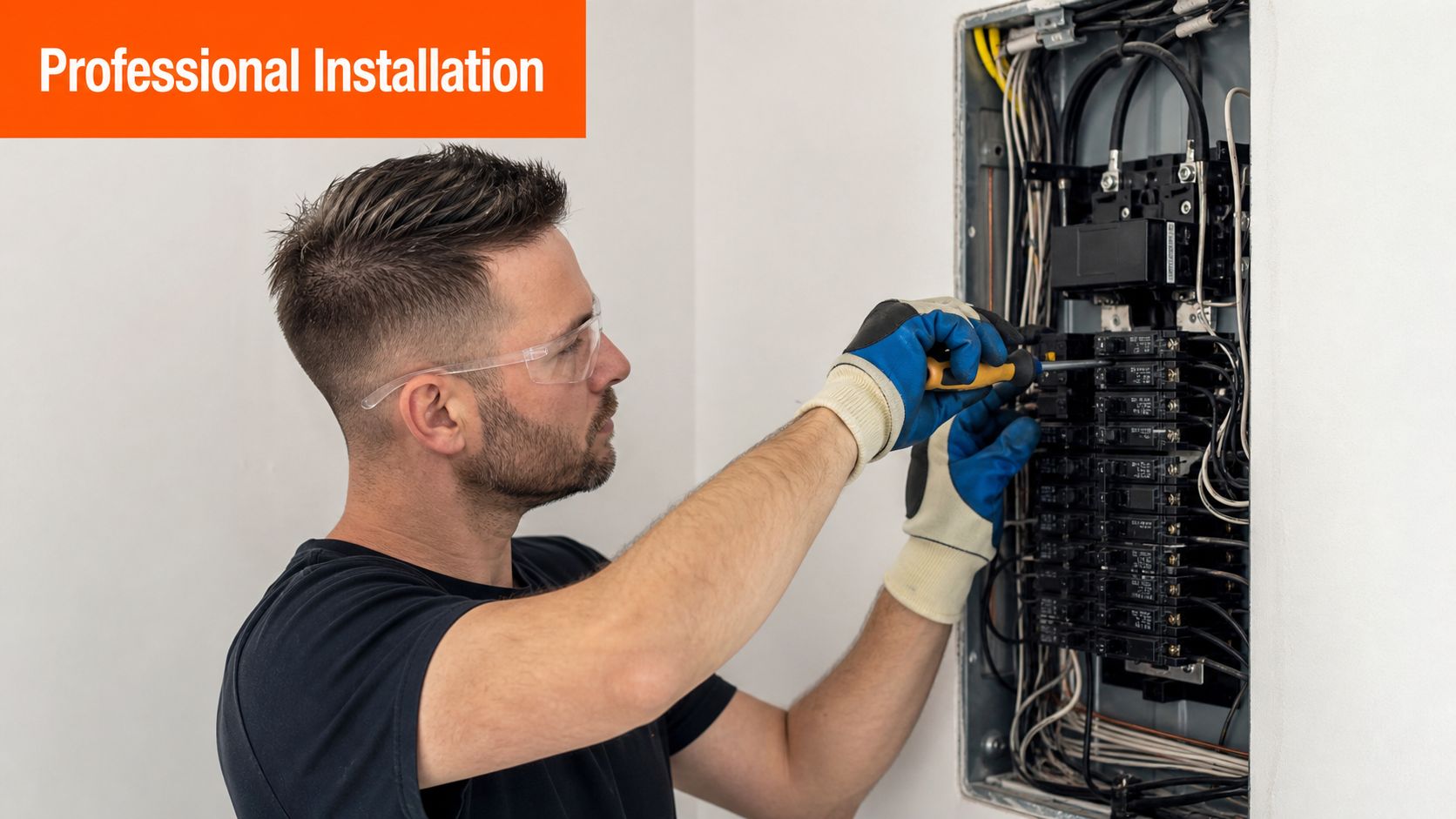
A whole home surge protector belongs at the main electrical panel, so installation calls for a licensed electrician. That panel is the front gate for the home's power. In a region often called Lightning Alley, the goal is not just to mount a device. The goal is to choose the right protective layer, connect it correctly, and make sure the panel and grounding system can support it.
What a licensed electrician checks first
A good installer starts with the panel, not the sales pitch.
That means checking whether the service panel has space for the device, whether the grounding and bonding are in good shape, and where the surge protector can be mounted for the shortest practical connection path. Shorter conductor length matters because surge energy moves fast. If the wiring path is sloppy or longer than it needs to be, protection can be less effective.
Product choice matters too. Leviton's whole-home surge protection specifications explain that residential SPDs are built around ratings such as nominal discharge current, maximum surge current, short-circuit current rating, enclosure type, and UL 1449 listing. For a homeowner, the plain-English takeaway is simple: surge protectors are not all interchangeable, and the right unit depends on the panel, the installation location, and local code requirements.
In Southwest Florida and Tampa Bay, that matters more than many basic guides admit. Homes here benefit from a layered plan. The whole home device handles surges at the panel, and plug-in protection still has a job at sensitive electronics and office equipment. A licensed electrician can tell you where that first layer belongs and whether certain equipment may need added point-of-use protection.
What installation usually costs
Most homeowners ask about price next, and that is fair.
Schneider Electric's NEC surge protection overview says professionally installed whole-house protection commonly falls in the few-hundred-dollar range, while surge damage to household equipment can climb far higher. That is the comparison. You are weighing one planned electrical upgrade against the cost and frustration of replacing boards, appliances, or comfort-system components after a rough storm week.
If you tend to group home projects by season, some homeowners also look at a seasonal home service planning visual while scheduling electrical, HVAC, and plumbing work together.
A quick video can also help homeowners see what professional work at the panel looks like.
Choosing the right installer
Ask plain, specific questions.
- Are you licensed to work on residential electrical panels in Florida?
- Which surge protector model are you recommending for my panel, and why?
- Will you inspect grounding and bonding before installation?
- Do you recommend any added protection for sensitive equipment or major appliances?
- Will you show me the status indicator after installation and explain what it means?
Those questions help you separate simple device installation from actual system evaluation. In Tampa Bay and Southwest Florida, that difference matters. A home in a high-lightning area needs more than a box added to the panel. It needs the right first line of defense, installed correctly, as part of a layered protection strategy.
For homeowners comparing local providers, Heatwave Air Conditioning, Plumbing, & Electric is one company that offers whole house surge protector installation and equipment-specific surge protection for certain systems.
Frequently Asked Questions About Surge Protection
Even after homeowners understand the basics, a few questions usually stick around. These are the ones I hear most often.
Will a whole home surge protector work during a power outage
Not in the sense people sometimes mean. It doesn't keep the power on, and it isn't a battery backup or generator.
Its job is to help manage unsafe voltage spikes. If the utility power goes out, a surge protector doesn't replace that lost power.
Does it protect against a direct lightning strike
A whole home surge protector is a major protective layer, but homeowners shouldn't think of any device as a magic shield against every possible lightning scenario.
The better mindset is risk reduction. It helps intercept and divert dangerous overvoltage events at the panel, which is valuable. In a severe event, though, outcomes can still depend on grounding, bonding, the electrical system condition, and where the energy enters.
No responsible electrician should promise that one device makes a home lightning-proof.
How do I know if my surge protector is still working
Many modern units include status lights or indicators. That's one reason product choice matters.
Ask the electrician to show you where the device is, what the indicator means, and what to do if the status changes. If you ever have a major storm event, flickering issues, or concern about the panel, it's smart to have the device checked as part of an electrical inspection.
Is whole home surge protection enough by itself
For broad protection, it's a strong first layer. For sensitive electronics, layered protection is still the smarter setup.
Computers, entertainment systems, and networking equipment often benefit from a point-of-use surge protector too. That's especially true in homes where electronics are spread across many rooms and used all day.
How long do whole home surge protectors last
There isn't one answer for every product or every house. Service life depends on the device and what it has had to absorb over time.
That's why I tell homeowners not to treat it like something you install and forget forever. Check the status indicators, keep up with electrical inspections when needed, and ask a licensed electrician what replacement signs apply to the specific model in your panel.
If you want a sense of how much homeowners value dependable service and clear explanations when making these kinds of decisions, even a quick look at a customer review snapshot shows why communication matters as much as the hardware.

Secure Your Home Before the Next Storm
For Florida homeowners, whole home surge protection isn't some extra gadget for the panel. It's part of protecting the house you live in every day. In Tampa Bay and Southwest Florida, storm season keeps reminding people that power quality matters, and modern homes have too many sensitive systems to leave unprotected.
The practical way to think about it is this. Your home has an electrical front door, and your panel-mounted surge protector helps guard it. Then your plug-in protectors help cover the electronics that need extra attention inside. That layered approach gives you broader protection for the systems you depend on most.
A lot of homeowners wait until after a storm, a panel issue, or a damaged appliance to ask about surge protection. That's understandable, but it's the expensive moment to start learning. It makes more sense to address the risk before the next round of afternoon thunderstorms shows up over the Gulf.
If you're already thinking about other seasonal home prep, this spring home readiness visual fits the same mindset. Protect the home before the weather makes the decision for you.

If you want real peace of mind, talk with a licensed electrician, ask about your panel, ask about layered protection, and get a recommendation based on how your home is wired and used.
If you're ready to protect your electronics, appliances, and hard-wired home systems before the next Florida storm rolls in, contact Heatwave Air Conditioning, Plumbing, & Electric for a professional consultation and a free estimate. They also offer financing options for new installations, which can make whole home surge protection easier to plan into a larger home improvement budget.