
Most homeowners pay between $12,000 and $17,000 for a whole house generator installation, and in Tampa Bay, local factors can push the total to $20,000 or more. If you're pricing backup power because storm season is getting closer, that's the number range you should start with, not the lower averages that often mix in smaller backup units.
You probably got here after thinking through a familiar Florida problem. The lights flicker, the AC shuts off, the fridge goes quiet, and the weather app says the outage could last a while. In Tampa Bay, that's not just an inconvenience. It can mean a hot house, spoiled food, no internet, no garage door, and no reliable way to keep daily life moving.
A whole house generator solves a real problem, but the whole house generator installation cost often surprises homeowners because the generator itself is only one part of the bill. The final price usually includes the unit, transfer switch, fuel connection, pad, labor, permits, inspections, and sometimes site work that only shows up after an on-site visit.
A lot of online pricing guides make this harder than it needs to be. They throw out one average number, but they don't always explain what kind of system that number describes. That's where people get into trouble. They budget for a basic backup setup and later learn that a true standby generator for full-home coverage is a different project entirely.
Introduction to Generator Cost Planning
A summer outage in Tampa Bay usually starts the same way. The power drops, the house warms up fast, and within an hour you are doing mental math about the AC, refrigerator, Wi-Fi, garage door, and phone chargers. Cost planning matters before you request quotes because standby generator pricing has layers that many homeowners do not see at first glance.
The biggest budgeting mistake is treating the generator like the whole project. It is only one piece of the system. The final number also depends on the transfer equipment, electrical labor, fuel connection, pad, permits, inspections, and the time it takes to make all of those parts work together safely.
Florida adds costs that many national articles barely mention.
In Tampa Bay, one home may have natural gas close to the meter and an easy path to the generator location. Another may need a longer gas line route, trenching, bollards, a larger propane setup, or extra labor to meet clearance rules near windows, doors, and equipment. Permitting can add time, and time often adds labor, rescheduling, or rental costs if site work has to happen in stages.
A useful comparison is an AC replacement. Homeowners know the outdoor unit price is not the same as the installed project price. Generator planning works the same way. The metal box outside has a price tag, but the working backup power system depends on everything around it.
That is why two homes with similar square footage can end up with very different totals.
Three questions usually sharpen the budget early:
- What needs to stay on during an outage? Powering the whole home costs more than covering selected circuits.
- What fuel will the unit use? Natural gas, propane, and diesel can change installation labor and utility work.
- What does the property layout require? Distance from the electric panel, fuel source, and approved placement area affects material and labor costs.
Another point many guides skip is lifecycle cost. The purchase and installation get the attention, but ownership continues after startup. Maintenance visits, battery replacement, load testing, fuel supply planning, and occasional repairs all belong in the budget if you want the generator to start during the outage that matters most.
If you want a local visual reference while you compare quotes, this Tampa Bay homeowner resource image adds local context that broad national pricing summaries often miss.

Understanding Core Generator Concepts
A common planning mistake is treating every generator as the same kind of backup. For a Tampa Bay homeowner, that can throw the budget off before the first estimate even arrives. A portable unit and a permanently installed standby generator serve different jobs, connect to the home in different ways, and lead to very different installation costs.
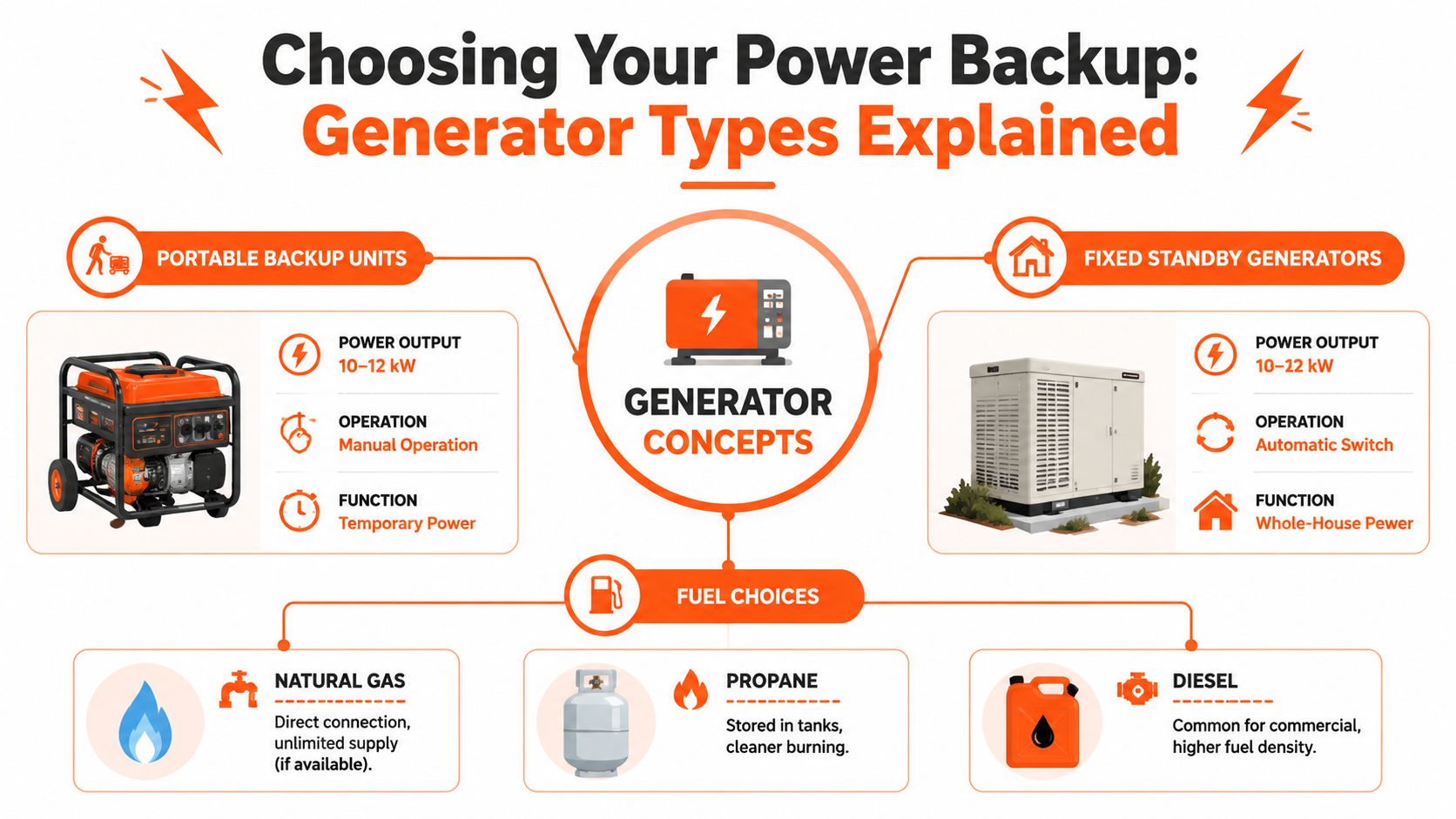
Portable versus standby
A portable generator is temporary backup. It usually powers a few selected items, often through extension cords or a manual connection setup. A standby generator is part of the house. It sits on a pad outside, connects to fuel and electrical systems, and starts automatically when utility power drops.
That difference shapes cost from the ground up.
The planning notes for this article describe portable units in the 10 to 12 kW range and standby units in the 18 to 22 kW range. More capacity usually means more than a larger machine. It can also mean a larger pad, a transfer switch, more involved electrical work, and a bigger fuel supply path.
For homeowners, a simple way to picture it is this: a portable unit acts like emergency camping gear. A standby system acts more like a second utility service waiting on standby. One is brought out when needed. The other is built into the property and has to meet code every step of the way.
That is also why low national averages can cause confusion. As noted earlier, some published averages blend small backup units with true permanently installed standby systems. If a quote does not clearly mention a standby generator, an automatic transfer switch, and permanent installation labor, it may not reflect a real whole-home backup project.
A local maintenance and infrastructure example can help here. If you have ever looked at home system prep advice for Florida properties, the same principle applies. The equipment matters, but the connections, location, and site conditions often decide how simple or expensive the project becomes.

Fuel choice changes the installation
Fuel is not just a matter of preference at the time of purchase. It affects trenching, utility coordination, tank placement, inspection requirements, and long-term operating cost.
- Natural gas: Often the easiest day-to-day fuel if service is already available, but many Florida homes still need a gas line extension or meter review before the generator can be connected.
- Propane: Common where natural gas is unavailable. It adds tank sizing, tank placement, refill planning, and delivery access to the project.
- Diesel: More common in commercial settings or specialty residential applications. It brings a different storage and maintenance discussion.
In Florida, hidden cost differences often start here. A generator may fit the budget on paper, then the property needs a longer gas run, a larger propane setup, or utility work that adds time and cost before installation can even start.
Capacity is really a lifestyle decision
Homeowners usually ask about size in electrical terms, but the easier question is about daily life during an outage.
Do you want to keep the refrigerator, a few lights, and phone chargers running? That points toward a smaller backup plan. Do you want central AC during an August outage, plus kitchen circuits, internet, bedroom outlets, and normal household use? That usually points toward a standby generator sized for larger loads.
In Tampa Bay, air conditioning changes the conversation quickly. A house without backup cooling can feel very different from a house that only loses a few noncritical circuits. For many families, generator sizing is really a comfort and safety choice disguised as a math problem.
| System type | Typical use | Operation style | What it usually means for cost |
|---|---|---|---|
| Portable backup unit | Limited essentials | Manual setup | Lower equipment cost, but fewer conveniences and less coverage |
| Fixed standby generator | Whole-home or near whole-home backup | Automatic transfer | Higher installed cost because it becomes part of the home's electrical and fuel systems |
One more concept often gets missed. The generator itself is only one piece of ownership. Fuel consumption, routine maintenance, battery replacement, and periodic service visits continue long after installation day. In Florida, where storm seasons test backup systems regularly, those lifecycle costs deserve attention just as much as the upfront equipment price.
Detailed Cost Components Breakdown
A generator proposal gets easier to judge once you break it into buckets. Homeowners in Tampa Bay often focus on the box sitting outside, but the installed price works more like a kitchen remodel than an appliance purchase. The equipment matters, yet the wiring, fuel routing, pad, permits, and labor often decide whether the final number feels reasonable or surprisingly high.
This visual gives a quick snapshot of the moving parts.
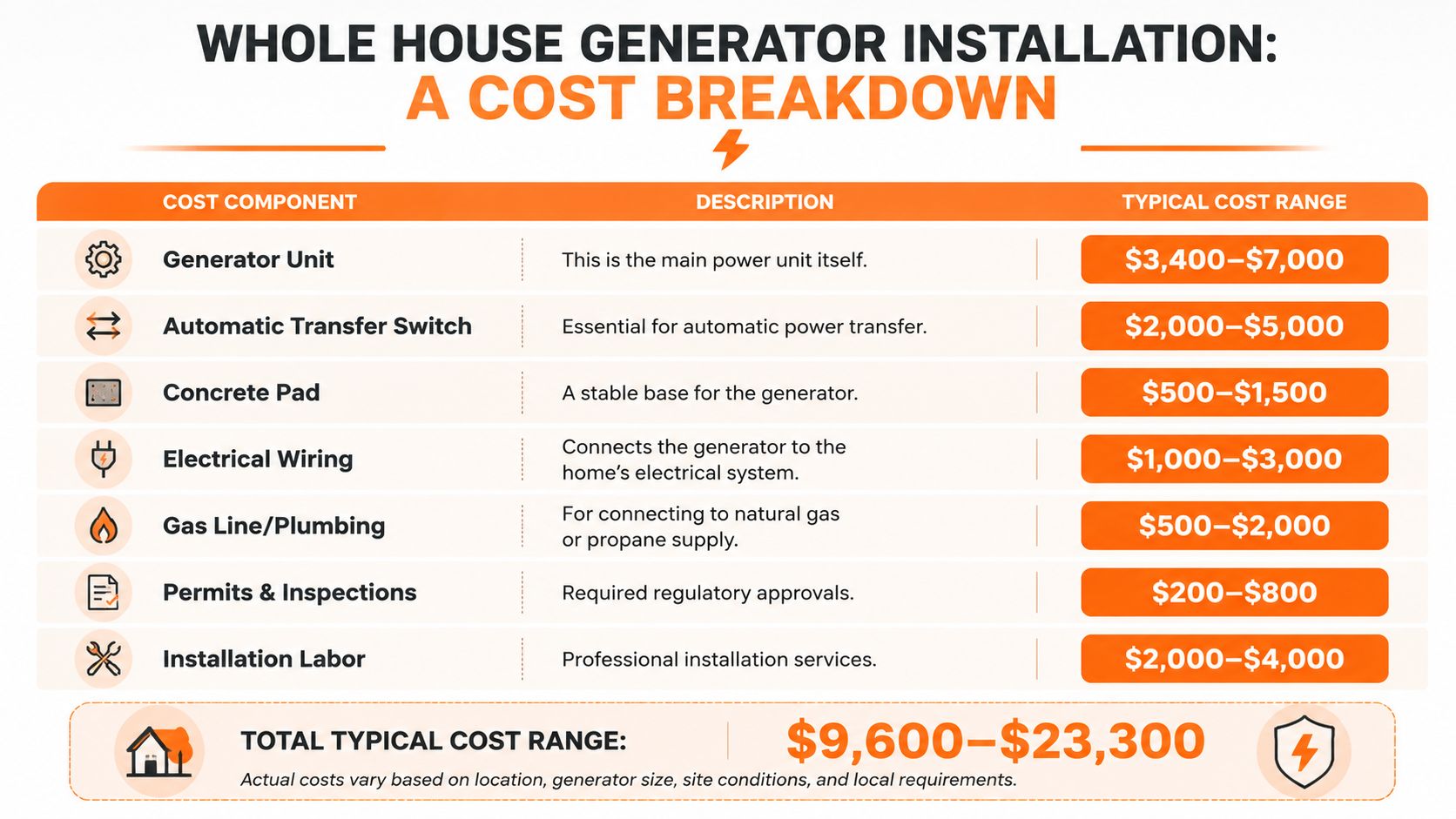
National cost guides often place a standard air-cooled standby installation for a typical whole-home setup in the broad five-figure range. The useful lesson is less about chasing one average and more about understanding which line items are tied to the generator model and which are created by your property.
The major parts of the invoice
A standby generator installation usually includes these core components:
| Cost component | Typical range | Why it matters |
|---|---|---|
| Generator unit | qualitative | The equipment cost rises with output, brand, sound level, and enclosure design |
| Transfer switch and related equipment | qualitative | Lets the home switch from utility power to generator power safely |
| Concrete pad | qualitative | Gives the unit a stable, code-compliant base |
| Electrical connection | qualitative | Ties the generator into the service panel and protected circuits |
| Fuel hookup | qualitative | Connects natural gas or propane to the unit |
| Permits and inspections | qualitative | Required for compliance and signoff |
| Labor | qualitative | Covers layout, installation, wiring, plumbing, testing, and coordination |
The easiest way to avoid confusion is to separate unit cost from installed cost. The generator is the engine. The rest of the project is the plumbing, wiring, controls, and site work that let that engine serve your house safely. A generator that looks affordable online can become a very different purchase once the installer has to extend gas piping, add electrical protection, or work around a tight side yard.
Labor usually changes the most from house to house.
A simple job may involve short runs, clear access, and a nearby panel. A harder job can require trenching, longer conduit or gas routing, extra disconnects, coordination between trades, and more inspection steps. In Florida, installers also have to pay close attention to drainage, placement clearances, and how the unit will sit through heavy rain and storm season use.
A quick comparison shows why two neighbors can get very different quotes for the same model:
- Home A: Generator pad near the meter, short fuel connection, open work area, panel close by.
- Home B: Generator set farther from utilities, narrow access path, longer wiring route, fuel line extension needed.
The machine may match. The labor and materials often do not.
For a grounding visual on utility routing and site planning, this local plumbing and systems layout example helps show why infrastructure paths can change the final price.
Here is a walkthrough video if you want to see how these parts come together on a real project.
Why line items do not always add up neatly online
Online examples often make installation look additive, as if you can total a generator, a switch, a pad, and a permit and land on the final number. Real proposals are usually bundled. One contractor may group small materials into labor. Another may list trenching, startup, permit handling, and load management controls separately. A cleaner quote format does not always mean a cheaper project.
A better question is whether the quote explains the work. Can you see how the installer handled fuel connection, electrical tie-in, site prep, startup, and inspection? If not, the low number may only be low because some pieces are still missing.
That matters even more in Florida. Hidden costs often start outside the generator itself, especially with fuel line distance, utility routing, and permit timing. Those expenses are easy to miss during early budgeting, and they are a big reason installed totals can drift far above the price of the equipment alone.
Regional Factors in Tampa Bay and Florida
Florida changes the equation. A quote that looks reasonable in another state can miss costs that show up quickly in Tampa Bay, Sarasota, Port Charlotte, Cape Coral, or Fort Myers.
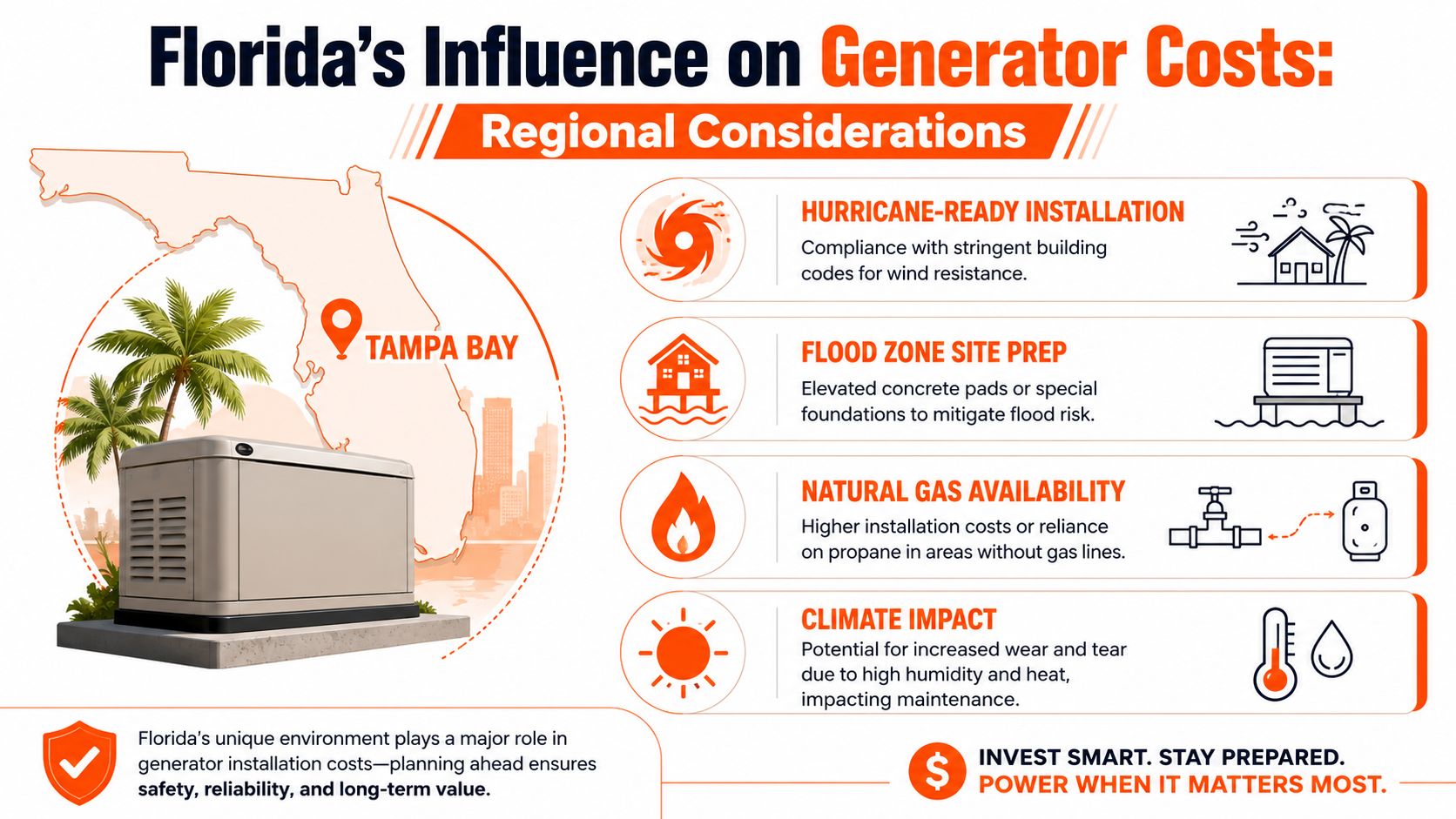
Fuel infrastructure is often the hidden bill
The biggest surprise for many homeowners isn't the generator. It's the fuel setup.
This Florida-focused generator cost breakdown notes that propane tank installation adds $1,000 to $5,000, and natural gas line extensions run $2,000 to $5,000. Those costs are often left out of national averages, yet they're common in Tampa Bay where some neighborhoods don't have convenient gas access near the desired generator location.
That means two houses on the same street can have very different totals:
- House with gas near the install site: The fuel side may be straightforward.
- House without usable gas access: The owner may need a propane solution or a longer gas extension.
- House with limited yard layout: Placement rules and routing can make the fuel connection more complicated.
Florida site conditions add practical complications
Tampa Bay homeowners also deal with placement issues that don't always show up in broad national guides. Heavy rain, drainage patterns, lot lines, utility conflicts, and storm exposure all affect where the unit can safely sit.
Some projects need more than a simple pad in an open corner. The installer may need to choose a location that balances accessibility, clearances, utility routing, and local code requirements. If the ideal electrical location conflicts with the easiest fuel route, cost climbs because the job becomes a tradeoff instead of a straight line.
Here are the regional factors that deserve extra attention:
- Hurricane-minded placement: The unit must be mounted and located in a way that supports safe, code-conscious installation during severe weather exposure.
- Flood-aware pad decisions: Some homes need more thought about elevation, drainage, and how water moves through the lot.
- Permit timing: Local offices and utility coordination can slow the process, especially during busy storm-prep periods.
- Heat and humidity exposure: Long-term maintenance planning matters more when equipment lives outdoors in a harsh climate.
In Florida, the "same generator" can be a very different project because the lot, fuel path, and code environment aren't the same.
Why local totals often exceed national expectations
Broad national averages are useful for orientation. They aren't enough for final budgeting in a hurricane-prone coastal market.
That's why homeowners in Tampa Bay should treat national pricing as a starting point, not a promise. Local permitting, utility access, and site prep can move the number substantially before the generator even arrives. If a quote feels higher than what you saw online, the right question isn't "Why is this contractor expensive?" It's "What does this property require that the average guide didn't include?"
Financing Options and Lifecycle Costs
A Tampa Bay homeowner often budgets for the generator itself, then gets surprised later by the costs of owning it. The pattern is familiar. The unit is installed, storm season arrives, and the questions start: Who services it? How much fuel will it burn during a two-day outage? What happens if the battery fails in year three?
A standby generator works more like a split HVAC system than a countertop appliance. You buy the equipment once, but the overall budget includes upkeep, operating cost, and eventual replacement parts over many years. In Florida, that long view matters even more because salt air, heat, humidity, and storm use put outdoor equipment under steady stress.
How to think about financing
Financing should start with the full ownership picture, not just the monthly payment. A lower payment can still be a poor fit if it leaves no room for annual maintenance, fuel, or small repairs.
A simple way to compare options is to treat the project like two buckets of money. The first bucket is the one-time installation. The second is the years of ownership that follow.
Ask these questions before you sign:
- What is the full installed price, in writing?
- Which items are included, and which are listed as allowances or possible add-ons?
- Is fuel-line extension work included if the gas meter or propane connection is far from the unit?
- Can your monthly payment still leave room for annual service and outage fuel?
- What warranty coverage applies to parts, labor, and routine maintenance requirements?
That third question matters more in Florida than many buyers expect. A quote can look reasonable at first glance, then rise once the contractor maps the actual gas route across the property. Long fuel runs, trenching around hardscape, and utility coordination can change the financial picture quickly.
If you're comparing local payment options, Heatwave Air Conditioning, Plumbing, & Electric offers financing information through its home service financing resources. It is one option homeowners may review alongside bank loans, credit union products, or cash payment.

The costs that continue after installation
Ownership costs are where budgeting usually gets more realistic.
Start with routine maintenance. The engine, battery, oil, filters, and controls need scheduled attention so the system starts when the grid goes down. Skipping service to save money often works like skipping maintenance on a car you only drive during emergencies. It may seem fine until the exact day you need it most.
Fuel is the next variable. Natural gas often feels simpler during planning because there is no tank to refill, but usage during a long outage still affects operating cost. Propane adds another layer because tank size, refill timing, and supplier access during regional storms all matter.
Then come repair and replacement items. Batteries age out. Sensors fail. Control boards and starters can wear over time. Homes with larger generators or more frequent outage use may see those costs sooner than expected.
Florida adds one more budgeting layer. Outdoor equipment here deals with sun, moisture, and storm exposure year after year. That does not mean every generator becomes expensive to own. It means the homeowner who plans for service from day one usually has fewer unpleasant surprises later.
A better budgeting mindset
A stronger planning question is simple: can this home afford to own the system, not just install it?
For many Tampa Bay households, the smartest budget includes four lines: installation, annual maintenance, outage fuel, and a repair reserve. That last line is the one many online guides skip. It is also the line that keeps a generator from becoming a financial headache after the first big storm.
If you want a useful comparison point, review your proposal with the same care you would use for a guide to a modern building inspection. The goal is the same. Find the hidden conditions before they become expensive conditions.
Installation Timeline and Common Pitfalls
A generator project usually feels slower than homeowners expect because several trades and approvals have to line up. The equipment isn't the hard part. Coordination is.
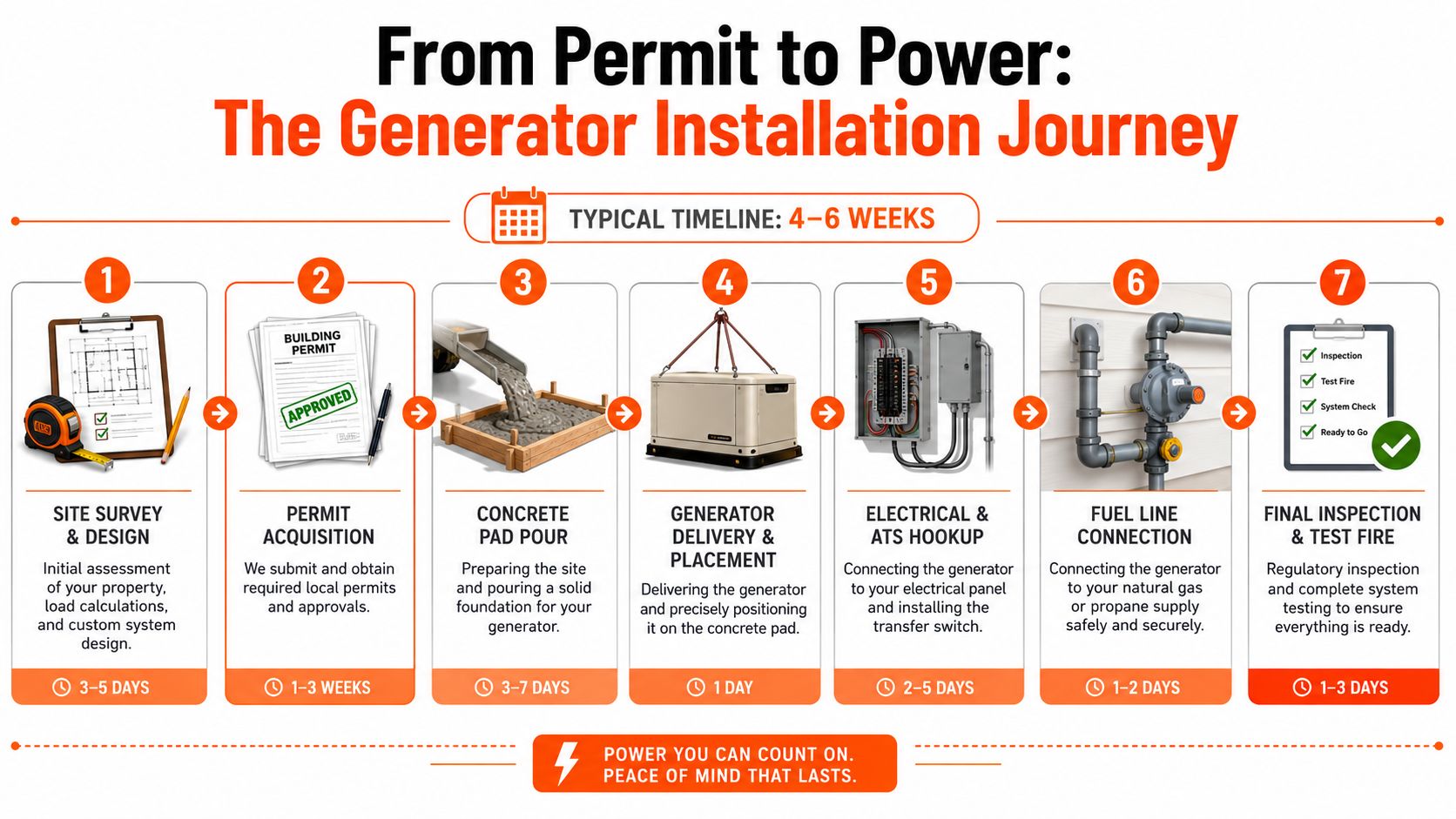
The planning timeline for this article uses a 4 to 6 week example, and that fits how many homeowners experience the process when permits, scheduling, and inspections move normally. Some projects move faster. Others slow down because local approvals or utility coordination take longer than expected.
The usual sequence
A professional installation often follows this order:
Site survey and design
The contractor checks electrical service, fuel access, clearances, and placement options.Permit application
Paperwork starts before equipment can be installed. This is often where the first delay appears.Pad preparation
The generator location is prepared and the base is set.Equipment placement
The unit is delivered and positioned.Electrical and transfer switch hookup
The home is wired for safe automatic switching.Fuel connection
Natural gas or propane is tied into the system.Inspection and test run
The final signoff confirms safe operation.
If you want a broader sense of how inspections work in property and repair projects, this guide to a modern building inspection is a useful outside reference.
Where delays usually happen
The most common scheduling problems aren't dramatic. They're small bottlenecks that stack up.
- Permit backlogs: Local review times can stretch, especially during busy seasons.
- Weather interruptions: Rain can affect pad work, access, or crew scheduling.
- Fuel coordination: Gas or propane details sometimes take longer than expected.
- Last-minute scope changes: Homeowners may add circuits or request a different placement after design is done.
A lot of frustration disappears when homeowners understand that "installation day" isn't the whole project. It's just one stage in a chain of approvals and trade work.
For a simple visual reminder that seasonal home-system scheduling matters, this holiday-season readiness image fits the same planning mindset.
Ask the contractor what could delay approval, not just when the crew can start.
Real-World Tampa Bay Cost Scenarios
A Tampa homeowner can call two contractors for what sounds like the same standby generator and get two very different quotes. One home has a short natural gas run, clear side-yard placement, and no major panel surprises. Another needs the generator set farther from the meter, extra trenching, and more permit coordination. The equipment may be similar. The total project cost is not.
That is why real-world scenarios matter more than a generic online average. In Tampa Bay, the property itself often changes the price as much as the generator size.
Scenario one: straightforward suburban install
A homeowner in a typical Tampa Bay subdivision wants backup power for central AC, the refrigerator, lighting, internet, and a few daily-use outlets. The electric meter and gas service are fairly close to the planned generator pad. Access to the side yard is open, so the crew does not spend extra time working around fencing, pool screens, or tight clearance issues.
This kind of project usually stays on the more predictable end of the local range discussed earlier. The reason is simple. Fewer obstacles mean fewer labor hours, less material for fuel and electrical runs, and a lower chance of revisions after the permit is submitted.
The quote can still surprise homeowners who started with the wrong comparison point. A standby generator is closer to adding a small permanent utility system to your home than buying an appliance. You are paying for equipment, electrical integration, fuel connection, site work, startup testing, and approvals.
Scenario two: larger lot, longer fuel path, more hidden cost
Now consider a home in a more spread-out part of Hillsborough, Pinellas, or Pasco County. The owner wants broad whole-home coverage, but the preferred generator location sits far from the gas meter or propane supply. That longer route can require more pipe, trenching, labor, and coordination with the fuel provider.
This is one of the Florida cost traps many national guides miss. A fuel line extension can add meaningful cost even before the generator itself changes. If the home uses propane, tank placement and setup can push the total higher as well.
Permitting can also get more expensive in time, even when the fee itself does not look dramatic on paper. If site placement raises clearance questions or the municipality asks for revisions, the project can sit in review longer and require more back-and-forth between trades. Homeowners feel that delay as schedule stress first, then as cost if labor or scope changes follow.
What these Tampa Bay examples actually teach
The easiest way to read a quote is to separate the generator from the property conditions around it.
- Short fuel runs help control cost. Longer gas or propane routing works like adding distance to a plumbing line. Material and labor both rise.
- Access affects labor. Tight side yards, fencing, decorative hardscape, and pool enclosures can slow pad work and equipment placement.
- Florida approvals can change the total. Permit revisions and placement questions do not always look large in the estimate, but they can affect labor planning and timeline.
- Bigger coverage goals raise more than the equipment price. They can also change transfer switch sizing, electrical work, and fuel demand.
- Lifecycle cost still matters after install. Maintenance visits, battery replacement, and fuel use during outages belong in the overall budget, not just the purchase price.
For homeowners comparing bids, a clear estimate layout helps you see whether the price difference comes from the generator itself or from site and fuel conditions. This generator project estimate graphic reflects the kind of organized presentation that makes those line items easier to understand.

A good rule is to compare your home to homes with similar lot layout, fuel access, and local approval requirements. That gives you a much better planning target than a national average ever will.
Conclusion and Call to Action
A whole house generator is one of those projects where the right budget starts with the right definition. If you're pricing a true standby system for full-home backup, most homeowners should think in the $12,000 to $17,000 range, not the much lower figures that often reflect smaller or less complete setups.
In Tampa Bay, the final number can rise because Florida adds real-world complications. Fuel line extensions, propane tank installation, site placement, local permits, and longer labor paths all change the project. That's why two homes with similar square footage can receive very different quotes.
The smartest approach is to evaluate the project in layers:
- Generator size and coverage goals
- Fuel availability and routing
- Pad and placement requirements
- Electrical integration
- Permits, inspections, and timeline
- Long-term maintenance and ownership costs
A written estimate should help you see each of those layers clearly. If it doesn't, ask questions until it does. A standby generator isn't just backup equipment. It's part of your home's electrical and comfort infrastructure, and it should be planned that way.
If you're comparing bids, it's also worth looking at proof of local customer experience and service process. A quick review of Heatwave customer feedback can help you understand how homeowners evaluate communication, scheduling, and follow-through before committing to a major installation.

If you're ready to price backup power for your home, contact Heatwave Air Conditioning, Plumbing, & Electric for a free on-site estimate. A site visit can clarify the drivers behind your whole house generator installation cost, including fuel access, placement, labor scope, and Florida-specific permit requirements, so you can plan with confidence instead of guessing from generic averages.