
You turn on the shower and get a weak spray. The kitchen faucet takes too long to fill a pot. The dishwasher sounds like it’s struggling to do a simple job. When that starts happening, most homeowners jump straight to the worst-case scenario. Hidden leak. Bad pipes. Expensive repair.
Sometimes it is a bigger plumbing issue. Often, it isn’t.
Low water pressure usually leaves clues if you check the right things in the right order. In Tampa Bay and Southwest Florida, the answer is often tied to local conditions that generic plumbing advice misses. Hard water leaves scale behind. Older homes still have aging galvanized lines. Many properties outside denser city areas rely on private wells, where pumps, pressure switches, tanks, and sediment filters create a completely different diagnostic path.
That Frustrating Trickle Understanding Low Water Pressure
Low water pressure feels small until it affects everything. A shower takes longer. Laundry drags out. Washing dishes becomes one more daily annoyance. People typically notice the symptom first, not the pattern.
The pattern matters. If one sink is weak, that points in one direction. If every fixture in the house is weak, that points in another. If only the hot water side is slow, the plumbing path is different again. Good diagnosis starts by narrowing the problem before touching a tool.
A lot of homeowners ask the same question in the same words: why is my water pressure low if nothing seems broken? That’s a fair question because many pressure problems build slowly. Mineral scale forms little by little. Old valves stop opening fully. Pipe interiors narrow over time. A pressure problem can also show up suddenly after utility work, a storm event, or a failing plumbing component.
Practical rule: Start with the simplest checks first. Pressure problems that affect one fixture are usually much easier to solve than problems that affect the whole house.
For Florida homes, local context matters. Older neighborhoods often deal with aging piping. Coastal and groundwater conditions can leave more mineral residue inside plumbing components. Homes on wells need a different troubleshooting process than homes on city water.
If you want a broader look at plumbing issues that tend to show up together, common plumbing problems and solutions is a useful reference point. Low pressure often overlaps with leaks, valve issues, fixture clogs, and water heater sediment.
Your First Five Minutes Low Pressure Checklist
Before you assume the pipes in the walls are failing, do a fast check that tells you whether the problem is outside your house, inside your house, or only at one fixture.

Ask one neighbor first
If your neighbor has the same issue at the same time, your house may not be the main problem. That matters even more in Florida right now. A recent Florida-focused report notes that after the 2025 Atlantic hurricane season, which saw 4 major storms, some Tampa Bay and Southwest Florida areas experienced regional PSI drops of 15-25% because damaged mains and extra sediment affected local utility systems, according to this discussion of post-storm low pressure conditions.
If the whole street seems affected, call your utility before scheduling invasive plumbing work.
Check whether it’s everywhere or just one spot
Walk room to room and test:
- Kitchen faucet hot and cold: Does one side run weaker than the other?
- Bathroom sinks: Is the weak flow isolated to one fixture?
- Shower and tub: Does the pressure drop only when another fixture runs?
- Appliances: If the sink seems fine but the dishwasher or washer acts slow, that’s a different clue.
A whole-house issue usually points to a supply problem, a valve issue, a regulator issue, a leak, or major internal restriction. One weak fixture usually points to a clog or fixture-level issue.
Confirm both water valves are fully open
Two valves deserve attention:
- Main shutoff valve where water enters the home
- Meter-side valve near the water meter
A partially closed valve can cut flow enough to feel like a larger problem. Don’t force anything if it feels stuck or corroded. Just verify whether it appears fully open.
If pressure changed suddenly after recent work, somebody may have reopened a valve only partway.
Pay attention to hot-only or cold-only pressure
This is one of the fastest ways to avoid guessing. If cold pressure is normal and hot is weak, the issue usually isn’t the city supply. It’s more likely inside the house, often near the water heater or in the hot-water piping path.
Pinpointing Common Culprits Inside Your Home
If the quick checks didn’t answer it, the next suspects are the components homeowners use every day and rarely think about until they stop working right.
Aerators and showerheads clog faster than people think
In Florida, hard water leaves deposits in the smallest openings first. Faucet aerators and showerheads take the hit. In some Southwest Florida areas, calcium hardness often exceeds 200-400 mg/L, and that buildup can reduce pipe diameter by up to 50% over 10-20 years. It can also drag fixture flow from a standard 8-12 GPM supply down to below 4 GPM at the point of use, as described in this hard-water pressure analysis.
For a simple fixture check:
- Unscrew the aerator from the faucet tip
- Look for white scale or grit
- Rinse and brush the screen
- Reinstall and test again
Do the same with the showerhead if one bathroom is noticeably worse than the rest.
A clogged aerator creates a very specific symptom. The faucet is weak, but the rest of the house may be normal. That’s good news because it usually means the plumbing system itself isn’t the main problem.
Pressure reducing valve problems look like system-wide trouble
Some homes have a pressure reducing valve, often called a PRV, on the main water line. It’s usually bell-shaped and designed to tame incoming street pressure before it reaches fixtures, appliances, and piping inside the house.
When a PRV starts failing, homeowners often notice one of two patterns. Pressure drops throughout the house, or pressure becomes inconsistent from one day to the next. The hard part is that a bad PRV can mimic other plumbing problems.
A PRV isn’t a part to adjust casually. You need accurate gauge readings before deciding whether it needs adjustment or replacement.
Hot water pressure issues often start at the heater
If the cold side feels acceptable but the hot side doesn’t, check the water heater path. Sediment collects in tank-style heaters, especially where mineral-heavy water is common. That sediment can restrict flow and make hot-water delivery feel weak or uneven.
If your home has a tank unit and it hasn’t been serviced in a long time, that’s a clue. Water heater service and repair options become relevant when low pressure shows up mainly on the hot side.
Weak hot water and normal cold water usually means you should stop looking at the street and start looking at the heater, shutoff components, or hot-side plumbing.
Hidden leaks steal pressure before water reaches the faucet
Leaks don’t always leave a puddle where you can see it. A slow leak behind a wall, under a slab, or in an exterior line can reduce available flow and pressure.
A simple homeowner check is the water meter test:
- Turn off all faucets and appliances
- Make sure no irrigation is running
- Look at the water meter
- Wait a bit without using water
- Check whether the meter moved
If the meter keeps moving while everything is off, water may be escaping somewhere in the system. That’s when pressure loss becomes more than an inconvenience.
When Old Pipes Are the Problem
In older parts of Tampa Bay and Southwest Florida, low pressure often isn’t a single failed part. It’s the plumbing system aging from the inside out.
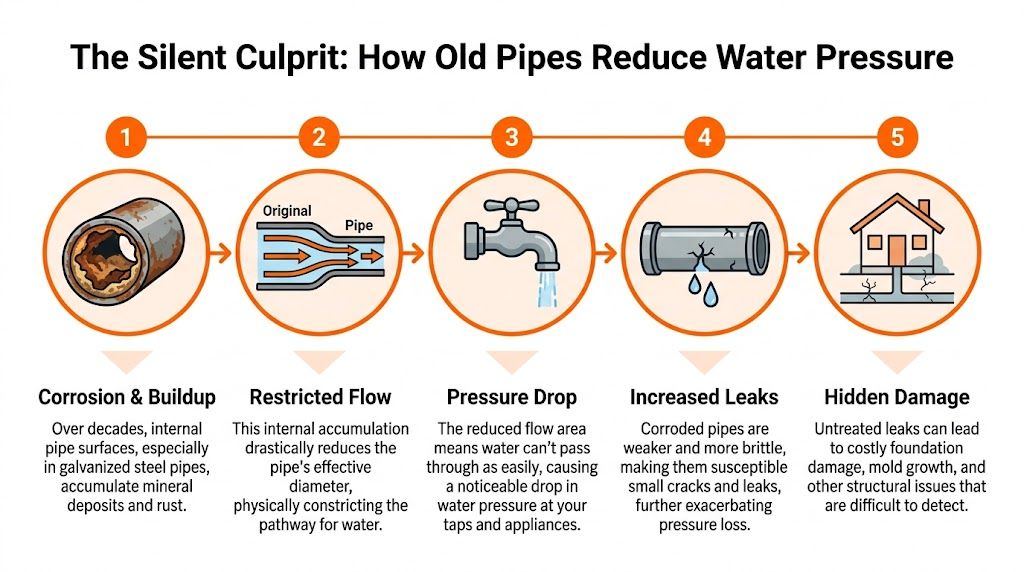
What aging galvanized pipe does over time
A lot of mid-century homes were built with galvanized steel water lines. Those pipes worked for their era, but they don’t age gracefully. Rust and mineral deposits build on the inside wall. The waterway gets tighter and rougher. Flow drops. Pressure at fixtures feels weaker and weaker.
That’s why older homeowners sometimes say the pressure “used to be better years ago.” They’re usually right. This type of restriction tends to develop gradually.
In homes built before 1980, over 40% of plumbing service calls involve corrosion-related issues, and in severe cases rust and mineral deposits can constrict water flow by 50-70%, according to this review of corrosion-driven pressure loss in older homes.
Signs that point to a pipe system problem
One clogged faucet is a maintenance issue. A pattern across the house is different.
Look for combinations like these:
- Multiple weak fixtures: Kitchen, shower, and bathroom sinks all feel reduced
- Discolored water: Brown, rusty, or yellow-tinted water after sitting
- Pressure that worsened over years: Not overnight, but gradually
- Recurring clogs at aerators: You clean one screen and it clogs again
Those signs usually mean debris and corrosion are traveling through the system, not just collecting at one faucet.
Old galvanized plumbing behaves a lot like a narrowing artery. The pipe may still be there, but the open path inside it isn’t what it used to be.
Why spot repairs often don’t solve it
Trade-offs are a significant factor. Replacing one short section of bad pipe can help if the problem is isolated. It won’t fix a house full of restricted lines. Descaling may help in some systems, but it isn’t always the right move for heavily deteriorated pipe because the pipe wall itself may already be compromised.
When corrosion is widespread, homeowners usually end up comparing short-term patching against a planned repipe. Modern materials such as PEX change the conversation because they don’t rust the way galvanized steel does.
If you suspect hidden water loss along with old piping, residential leak detection in St. Petersburg is one of the services used to separate “restricted flow” from “water escaping somewhere you can’t see.” That distinction matters before committing to larger repairs.
Water Pressure Issues Unique to Southwest Florida
National plumbing advice usually starts and ends with city water, clogged fixtures, and maybe a bad regulator. That leaves out a big part of the picture for this region.

Municipal supply isn’t always as steady as homeowners assume
In a fast-growing area, pressure at the property line can fluctuate more than people expect. Utility work, storm recovery, sediment intrusion, and local demand all play a role. If your pressure drops at certain times of day, or changes after regional weather events, that doesn’t automatically mean your house piping failed overnight.
This is one reason local diagnosis matters. A Tampa homeowner, a Sarasota homeowner, and a Cape Coral homeowner may ask the same question, but the answer can be different because the water source and infrastructure conditions differ.
Well systems follow a different troubleshooting path
In rural and semi-rural parts of Southwest Florida, low pressure often starts at the well equipment, not the indoor plumbing. A worn or failing well pump is a primary cause, and these pumps typically operate efficiently for only 10-15 years before wear begins to cut performance, especially where sand abrasion is common in Florida aquifers, according to this explanation of well-pump pressure loss.
That wear shows up in practical ways. The house may have enough pressure early in a cycle and then lose force quickly. The pump may run too long. Fixtures may surge and then weaken.
Sediment filters and pressure components get overlooked
Florida’s sandy conditions create another problem that city-water guides often ignore. A whole-house sediment filter can clog heavily enough to choke flow before the water even reaches faucets. Pressure switches and pressure tanks can also cause erratic behavior when they start failing.
A useful way to think about well diagnosis is this small comparison:
| System type | First suspect when pressure is low | What homeowners often miss |
|---|---|---|
| City water home | Main valve, PRV, internal restriction, leak | Utility-side issue after storms or local work |
| Private well home | Pump, pressure switch, tank, sediment filter | Filter restriction before any indoor plumbing issue |
That’s why a well house with low pressure shouldn’t be diagnosed like a subdivision home on municipal service.
A clogged sediment filter can make a healthy plumbing system look broken.
For homes affected by storms, flood conditions, or sediment-heavy recovery periods, plumbing maintenance in hurricane-affected areas is part of the local reality. Post-storm pressure complaints often need someone to separate municipal supply problems, debris-related restriction, and well-equipment failures.
DIY Fixes vs When to Call a Heatwave Plumber
Some low-pressure problems are homeowner-friendly. Some are not. The mistake is treating them all the same.

What you can usually handle yourself
These are reasonable first steps for most homeowners:
- Clean faucet aerators and showerheads: Good first move when the issue is isolated
- Check that shutoff valves are fully open: Simple, fast, and often overlooked
- Compare hot and cold performance: Helps narrow the problem without disassembly
- Run a meter check for hidden leaks: Useful as a screening test before calling for service
These steps are low risk and give you better information.
What usually needs professional tools
Some repairs look simple from the outside but carry real downside if diagnosed wrong.
- PRV testing or replacement: This needs accurate pressure readings, not guesswork
- Leak location behind walls or under slabs: Proper detection equipment matters
- Well pump, pressure switch, or tank diagnosis: Well systems can be damaged by trial-and-error part swapping
- Repipe decisions: You need to know whether the issue is isolated, systemic, or both
Many city-focused articles miss a major local cause. In Florida’s coastal regions, neglected sediment filters on well systems are a major overlooked reason for low pressure, and homeowner forums report 30-50% pressure loss from that single issue, according to this Florida well-system discussion. That’s exactly the kind of issue that can send homeowners chasing the wrong repair.
A practical line to draw
If one fixture is weak, start with cleaning and simple checks.
If the whole house is weak, pressure changes suddenly, the meter suggests a leak, the home has old galvanized piping, or the property runs on a private well, stop experimenting and get a proper diagnosis. Heatwave plumbing services are one local option for that kind of system-wide troubleshooting, especially when the issue could involve leak detection, pressure regulation, repiping, or well-related components.
Frequently Asked Questions About Low Water Pressure
What’s a good water pressure reading
Residential systems generally target 40-60 PSI. That range is the practical sweet spot for most homes because fixtures work normally without putting excessive stress on the plumbing. If pressure falls below that range, homeowners usually notice weaker showers, slower filling fixtures, or appliance performance issues.
For homes on wells, that same 40-60 PSI target is commonly used at the pressure tank and switch setup, which helps explain why a weak pump or failing pressure control can be felt so clearly throughout the house.
Can my neighbor’s water usage affect my pressure
Yes, it can. This is more noticeable in some neighborhoods than others, especially where local infrastructure is older or under temporary strain. Morning and evening demand can create a temporary dip in available pressure.
That said, neighbor usage usually causes a timing pattern. It does not usually explain a constant, all-day weak flow inside one house. If pressure is low all the time, look deeper than peak demand.
Does a water softener help with low pressure
Not directly. A softener does not boost pressure the way a pump or regulator issue can. What it can do is reduce future mineral buildup that would otherwise keep narrowing fixtures and pipe interiors over time.
A neglected or undersized treatment system can also become part of the problem if it restricts flow. So the answer is nuanced. A softener can support long-term plumbing health, but it isn’t a direct fix for an active low-pressure problem.
Low water pressure usually has a specific cause. The key is finding the right one before spending money on the wrong repair. If your Tampa Bay or Southwest Florida home still has weak pressure after the basic checks, contact Heatwave Air Conditioning, Plumbing, & Electric to schedule a professional plumbing evaluation. Certified technicians handle leak detection, water heater issues, pipe problems, and well-system troubleshooting across the region.