
That moment of realization hits you like a ton of bricks on a sweltering Florida afternoon: the air coming from your vents is warm. Your mind immediately jumps to the worst-case scenario—a huge repair bill.
But hold on. Before you start to panic, take a deep breath. More often than not, the reason your AC isn't blowing cold air is something incredibly simple, and you can likely fix it yourself in just a few minutes without any special tools.
Your First Steps When The AC Stops Cooling
Let's start with the two most common culprits I see on service calls: the thermostat and the circuit breaker. Getting these quick checks out of the way is the first step in smart troubleshooting and could save you the cost of a service visit.
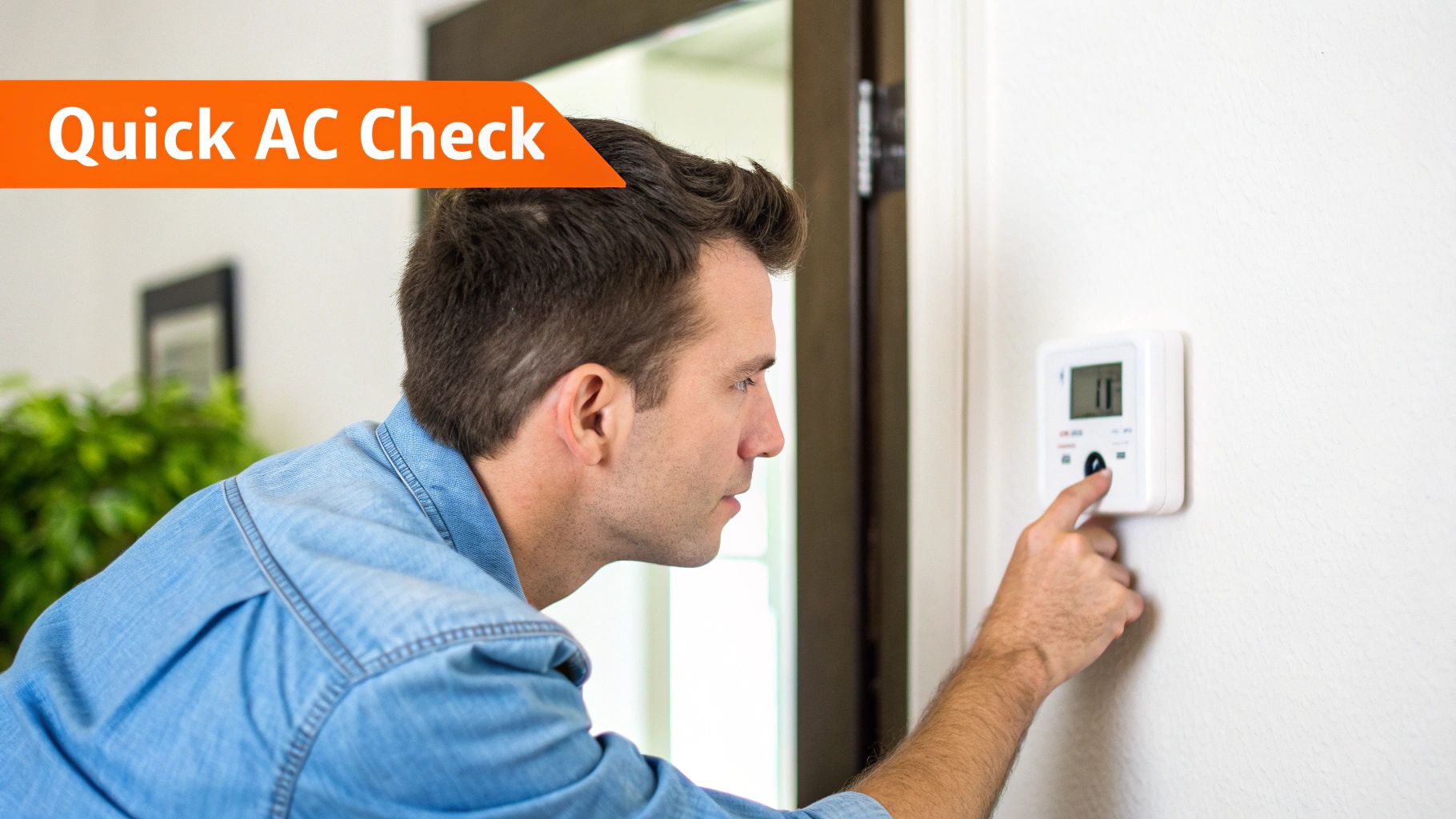
Begin at the Control Center: Your Thermostat
Think of your thermostat as the brain of your entire cooling system. A simple wrong setting is one of the top reasons for warm air problems, and it’s an easy thing to overlook in a busy household.
First, walk over and confirm the system is actually set to 'Cool'. It sounds almost too obvious, but you'd be surprised how often it gets accidentally bumped to 'Heat' or 'Fan Only.' If it's on 'Fan Only,' the blower will run and circulate air, but the outdoor cooling unit will never turn on. The result? Room-temperature air.
Next, look at the temperature setting. Is it set several degrees lower than the current temperature in the room? Your AC will only kick on when the thermostat senses that the room is warmer than your target temperature.
Finally, what about the batteries? Many digital thermostats run on batteries. If that screen is blank or flashing a low-battery icon, a fresh set of AAs might be all you need to get your cool air back.
Pro Tip: If you have a programmable thermostat, double-check the schedule. I’ve seen cases where an incorrect "away" or "sleep" setting was telling the AC to run at a higher temperature right when the homeowner was expecting it to cool down.
Check for Tripped Circuit Breakers
Here in the Tampa Bay area, summer thunderstorms and power surges are just a part of life. These electrical fluctuations can easily trip a circuit breaker, which is a safety feature designed to protect your expensive HVAC equipment from damage. A tripped breaker is one of the most frequent culprits behind a suddenly dead AC.
Your air conditioning system is a powerful appliance, so it usually has two separate breakers:
- One for the indoor unit (the air handler, often in a closet or attic).
- One for the outdoor unit (the condenser).
If just one of these gets tripped—say, the one for the outdoor unit—you'll get a classic symptom: the indoor fan blows air, but it’s not cold because the condenser outside isn't running to cool it.
To check, find your home's main electrical panel (usually in the garage, a utility closet, or laundry room). Open it up and scan for breakers labeled "AC," "HVAC," "Condenser," or "Air Handler." A tripped breaker won't be in the 'On' or 'Off' position; it'll be stuck in the middle.
To reset it, you have to push the switch firmly to the full 'Off' position first. Then, you can flip it back to 'On'. If it trips again right away, do not keep resetting it. This is a clear signal of a more serious electrical problem that requires a professional diagnosis. To learn more about what could be going on, check out our guide on common AC problems and solutions.
Once you've methodically checked the thermostat and the breaker panel, you can confidently rule out the simplest issues. If you're still sweating, it's time to move on to inspecting the physical equipment itself.
Time to Check Your Indoor and Outdoor AC Units
Alright, so you've checked the thermostat and the circuit breakers, and everything looks good there. The next move is to do a quick visual inspection of your AC system's two workhorses: the indoor air handler and the outdoor condenser.
You don't need any special tools for this. More often than not, a simple walkthrough is all it takes to spot the problem and figure out why your air isn't blowing cold.
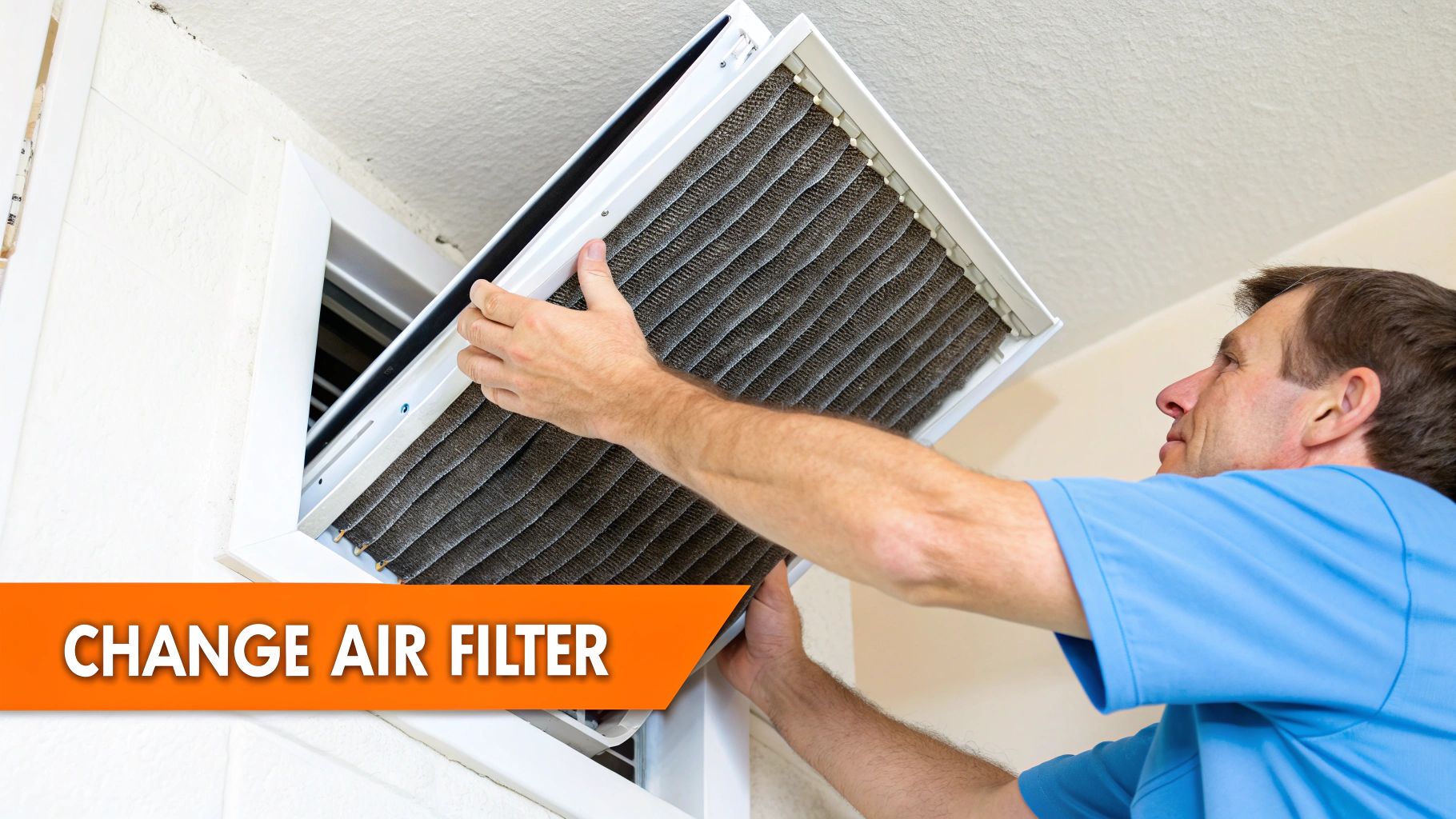
Tackle the #1 Culprit: A Clogged Air Filter
Let's start inside with the single most common reason for an AC breakdown. I'm talking about the air filter. It's amazing how many cooling problems I've seen that trace back to a filter that's completely choked with dust and grime.
Think about it—if your AC can't breathe, it can't cool.
A clogged filter restricts airflow, which means not enough warm household air can pass over the evaporator coil. This causes the coil to get way too cold and eventually freeze up into a solid block of ice. Once that happens, the cooling process comes to a screeching halt. Your system will be running, but you'll only feel warm air coming from the vents.
First, you need to find the filter. It's usually in one of two spots:
- Behind a large return air grille, typically on a wall or ceiling.
- In a slide-in slot right on the indoor air handler unit (often in a closet, attic, or garage).
Once you've got it out, hold it up to a light. Can't see through it? It's toast. Pop in a new one, and make sure the little arrows on the filter's cardboard frame are pointing towards the air handler, following the direction of the airflow.
Assess Your Outdoor Condenser Unit
With the filter checked off, head outside to the condenser. That's the big metal box with the fan on top that's responsible for dumping all the heat from inside your house out into the atmosphere. To do its job, it needs plenty of room to breathe.
Take a look around the unit. Are there overgrown bushes, weeds, or patio furniture crowding it? You need to maintain at least two feet of clear space on all sides and above the unit. A condenser that's being suffocated by landscaping simply can't get rid of heat effectively, crippling its cooling power.
Next, get a closer look at the metal fins that wrap around the unit. Down here in Florida, these things get caked with all sorts of gunk:
- Grass clippings after mowing
- Pollen, especially during the spring
- Leaves and twigs
- That fluffy "cotton" from nearby trees
If the fins are dirty, you can give them a gentle cleaning. First, kill the power to the unit at both the circuit breaker and the outdoor disconnect box. Then, just use a regular garden hose with a gentle spray to rinse the debris away. If you can, spray from the inside out to push the dirt off. Whatever you do, never use a pressure washer—it will bend those delicate fins in a second.
Important Takeaway: I can't stress this enough: a dirty air filter and a blocked condenser are the top two reasons an AC stops blowing cold. Checking these two things first can save you the cost and hassle of a service call.
Listen for Any Alarming Noises
While you're outside, just listen. A healthy AC makes a steady, low humming noise. If you hear anything else, it's often a cry for help.
Keep an ear out for these sounds in particular:
- Grinding or Squealing: This is a classic sign of a failing fan motor. If that fan gives out, the unit can't shed heat and will quickly overheat.
- Loud Banging or Clanking: This is serious. It could mean a part inside the compressor has broken loose. Shut the system down immediately to prevent catastrophic failure.
- Hissing: A hissing sound almost always means you have a refrigerant leak.
Any of these noises signal an internal mechanical problem that's definitely not a DIY fix. Turn the system off at the breaker to prevent more damage and give a professional a call. These sounds often point to bigger electrical or mechanical issues. You can learn more about how we track down these types of problems in our guide to diagnosing air conditioner electrical issues.
In our hot and humid climate, simple blockages are extremely common. For Tampa Bay homeowners, clogged filters or failing fans from heavy use cause 30-50% of 'not blowing cold' calls, according to industry patterns. This issue is made worse by rising temperatures—a 1°C global rise by 2050 could boost cooling degree days by 25%. As demand for cooling grows, systems are overworked, leading to failures like refrigerant leaks or compressor burnout where cold air simply vanishes. To understand more about these trends, explore the full research on how the global cooling market is shifting.
Decoding Refrigerant Leaks And Frozen Coils
If your AC is running but the air coming out of the vents is lukewarm at best, we need to talk about refrigerant. A lot of folks think of it like gas in a car—something that just gets "used up" over time. That’s actually a huge misconception. Your air conditioner is a sealed, closed-loop system, which means the refrigerant level should never drop unless there’s a leak somewhere.
Simply "topping off" the refrigerant is just a band-aid fix. It completely ignores the root cause and is a surefire guarantee you’ll be calling for help again when the next heatwave hits. A refrigerant leak is a serious problem that needs to be properly diagnosed and repaired.
The Tell-Tale Signs of Low Refrigerant
A system that's low on refrigerant will give you plenty of warning signs before it gives up the ghost entirely. One of the first things you'll probably notice is your AC running nonstop, struggling to hit the temperature you’ve set on the thermostat.
Beyond that, listen for specific sounds coming from your AC units. A distinct hissing or bubbling sound is a dead giveaway that refrigerant is escaping from a line. You might also see your FPL bill creeping up, which makes sense—the system is working overtime for less and less cooling.
- Weak Airflow from Vents: While a clogged filter is a common culprit, a frozen evaporator coil from low refrigerant will also choke off the airflow.
- Ice on Copper Lines: Take a look at the larger of the two copper lines running into your outdoor condenser. If it’s caked in ice, that's a classic symptom of a refrigerant issue.
- Visible Frost on the Indoor Coil: If you can get a peek at your indoor evaporator coil (it's usually located above your furnace in the air handler), you might find it encased in a block of ice.
Why Your AC Coils Freeze Over
It seems backward, right? How does a lack of coolant make parts of your AC too cold? It all comes down to pressure. The evaporator coil inside your air handler needs refrigerant flowing through it at a very specific pressure to effectively absorb heat from your home's air.
When the refrigerant level drops because of a leak, the pressure inside the coil plummets. This forces the remaining refrigerant to expand more than it's supposed to, causing the coil's surface temperature to dive below freezing. In our humid Florida air, moisture instantly condenses on that super-chilled coil and freezes solid.
Once ice starts to build up, it creates a snowball effect. The ice acts as an insulator, preventing the coil from absorbing heat, which just makes it get even colder and freeze even faster. Before you know it, the whole coil is a solid block of ice, completely obstructing airflow and bringing the cooling process to a dead halt.
This is a critical problem. A frozen coil doesn't just mean your ac not blowing cold air; it also puts immense strain on your system's most expensive component: the compressor. You can learn more about protecting this vital part in our detailed guide on what to do when you need an AC compressor repair in Sarasota.
The issue of inefficient systems is more common than you'd think. Here in Southwest Florida, a staggering 40-60% of our service calls for an AC not blowing cold are related to low refrigerant or iced-over coils, especially on those 100+°F days. On a global scale, many consumers unknowingly buy AC units that are half as efficient as the best models available. This inefficiency is a massive energy drain, as air conditioning already accounts for 10% of worldwide electricity use—a figure expected to triple by 2050. You can read more about the global air conditioning market on consultancy-me.com.
If you spot ice, your best first move is to turn the AC system off completely at the thermostat. Then, switch the fan to the "Fan Only" setting to help it thaw out. This won't fix the leak, but it can prevent more serious damage while you wait for a pro. Remember, handling refrigerant requires an EPA certification, so this is definitely a problem that calls for an expert.
Knowing When To Call An HVAC Professional
It’s one thing to feel a sense of accomplishment after swapping out a dirty filter and getting your AC back on track. It’s another thing entirely to push your luck with a complex repair. Knowing your limits is probably the most important part of DIY troubleshooting.
Pushing past those basic checks can turn a simple fix into a total system replacement. Even worse, it can be downright dangerous. This is where you need to draw a hard line in the sand between what a homeowner can safely handle and what absolutely demands a professional’s touch.
Some warning signs are more than just suggestions—they’re giant, flashing red lights telling you to put the tools down and pick up the phone. These are non-negotiable symptoms of a serious malfunction that requires trained hands, specialized equipment, and a whole lot of experience to fix safely.
Electrical Warning Signs
Let's be blunt: electrical issues are the most dangerous part of an HVAC system for a homeowner. We're talking about high-voltage components that can cause serious harm. Don't take chances here.
Keep a close eye on your circuit breaker. If you reset it and it immediately trips again, do not keep resetting it. A breaker that keeps tripping is screaming that there's a serious problem, like a short circuit or a compressor that's drawing way too much power. Forcing it to stay on is a legitimate fire hazard.
And then there's your nose. Any unusual smells, especially a burning odor like melting plastic or wires, is a major red flag. This points to an overheating motor or a severe electrical fault. If you smell that, kill the power to your entire system at the breaker panel and call for emergency service right away.
Alarming Sounds And Visual Cues
Your air conditioner has its own language, and most of it is spoken through sound. A gentle, consistent hum is perfectly normal. Loud, sudden, or strange noises? That’s your system crying out for help.
- Loud Grinding or Screeching: This is often the sound of a failing motor or shot bearings. If you let it keep running, that component is going to seize up entirely, leading to a much more expensive repair.
- Banging or Clanking: A loud, metallic banging noise is an emergency. It could easily be a part inside the compressor that has broken loose, and if it keeps running, it can completely destroy the compressor itself.
Another huge visual clue is ice. A thick layer of ice on your coils is never a good sign. Sure, a filthy filter can cause a one-time freeze-up. But if the ice comes back after you've changed the filter and let the unit completely thaw, you're almost certainly looking at a refrigerant leak.
This flowchart can help you visualize the process when you've got warm air blowing from your vents.
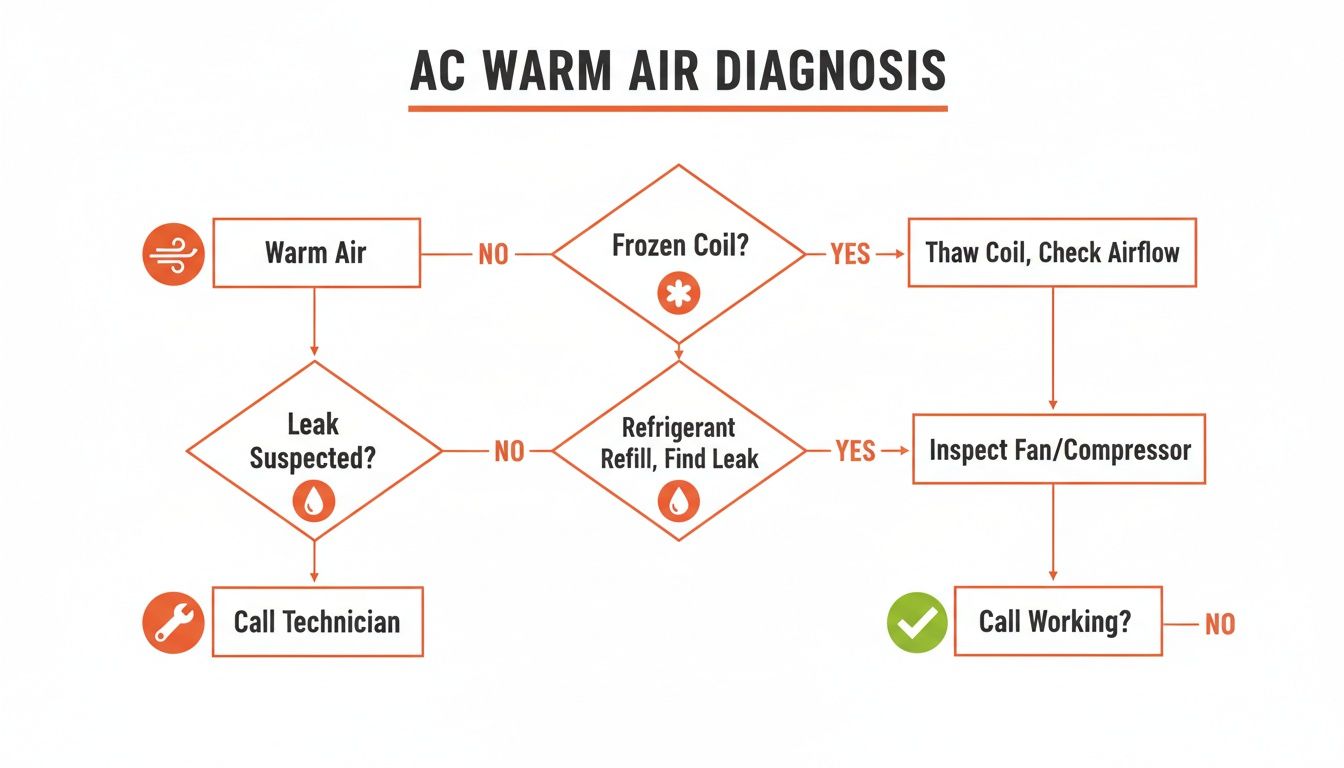
As you can see, a frozen coil points directly toward checking for a refrigerant leak—a job that is strictly for the pros.
The Dangers Of Refrigerant
I see this all the time—homeowners thinking they can just "top off" their system with a can of refrigerant from the auto parts store. This is a huge mistake for a couple of reasons. First, it's illegal to handle refrigerant without an EPA certification. Second, your AC is a sealed system. If it's low on refrigerant, it means you have a leak somewhere. Period.
A certified technician doesn't just dump more refrigerant in. They use specialized tools like electronic sniffers and dye tests to find the exact source of the leak, repair it properly, and then recharge the system to the manufacturer's precise specifications. Simply adding more is like putting air in a tire with a nail in it—it's a temporary, wasteful fix.
We've laid out some clear scenarios where DIY troubleshooting is fine and when it's time to call for backup. This table should make it even clearer.
DIY vs Professional Repair Decision Guide
| Observed Symptom | Your Safe Action | When To Call A Pro Immediately |
|---|---|---|
| Warm air blowing | Check thermostat settings. Change the air filter. | If filters are clean and settings are correct. |
| AC won't turn on | Check thermostat batteries. Check and reset the breaker (once). | If breaker trips again or you suspect electrical issues. |
| Ice on the outdoor unit | Turn the system off. Change the air filter. Let the unit thaw completely. | If the ice returns after thawing. |
| Strange noises | Turn the system off immediately. | Any loud grinding, screeching, or banging sounds. |
| Burning smells | Shut off power at the breaker panel. | Any smell of burning plastic, wires, or a chemical odor. |
| Water pooling around unit | Clear the condensate drain line if you know how. | If you can't clear the blockage or see a major leak. |
Ultimately, DIY fixes are fantastic for the simple stuff, but knowing when to stop is the mark of a smart homeowner. For anything involving serious electrical faults, loud mechanical noises, or refrigerant issues, making the call to a professional is the safest, smartest, and most cost-effective decision you can make.
Staying on top of regular maintenance can stop many of these problems before they even start. If you want to know more, you can learn more about why you should get an AC tune-up and how it keeps your system healthy.
Preventing Future Breakdowns With Smart Maintenance
So you’ve made it through troubleshooting your AC and hopefully got that cool air flowing again. The last thing you want is a repeat performance during the next blistering Florida heatwave. Honestly, the best repair is the one you never have to make, and that’s where proactive maintenance becomes your system’s best friend.
Think of it as a small investment that pays you back big time—in reliability, lower energy bills, and pure peace of mind.
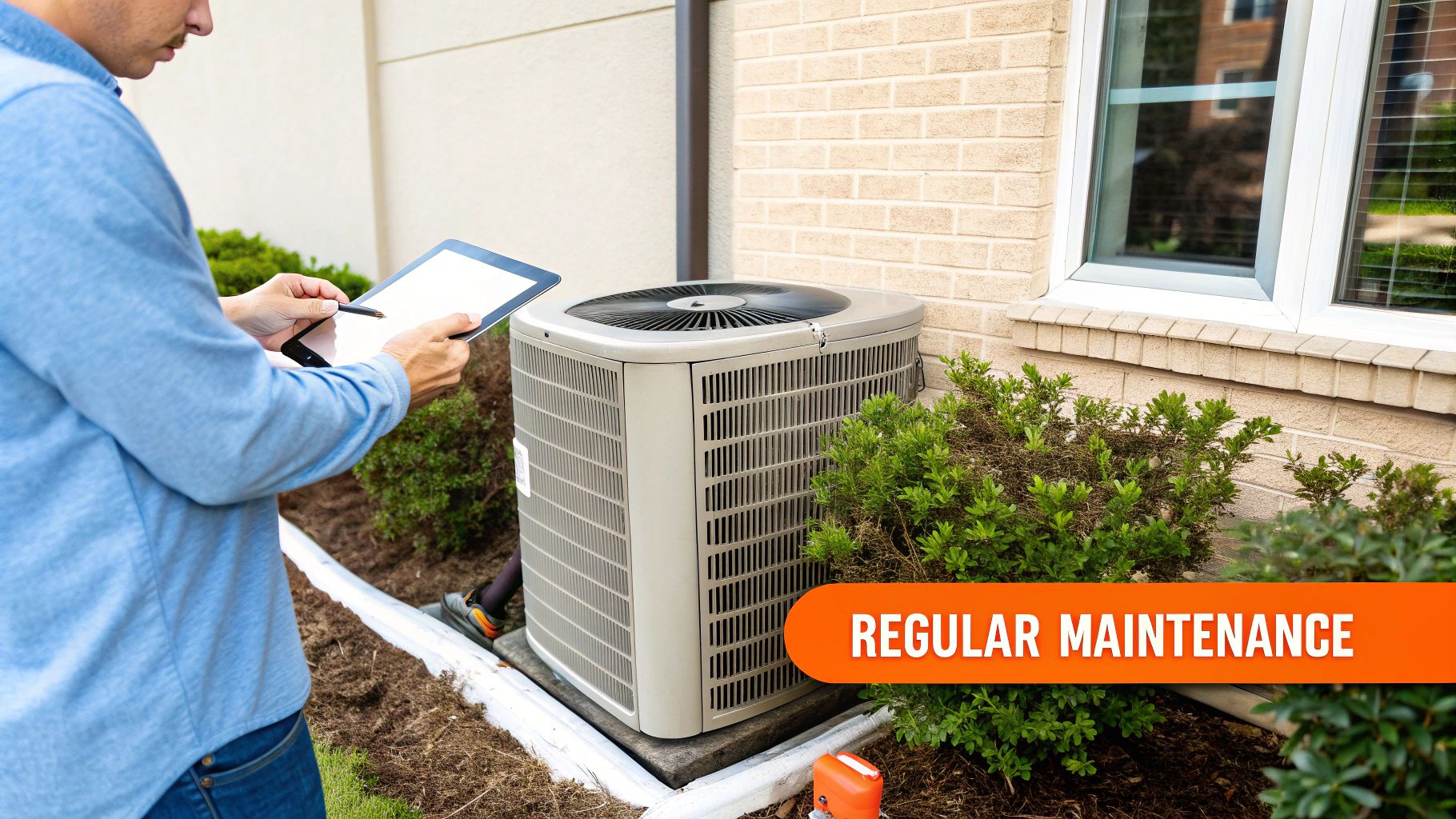
Neglecting your system, especially in our demanding climate, is like trying to run a marathon without any training. It’s not a matter of if it will break down, but when. A little consistent care is all it takes to head off most common cooling failures.
Your Year-Round Homeowner Checklist
You don't need to be an HVAC wizard to keep your system in good shape. Just building a few simple habits into your routine can dramatically reduce the strain on your air conditioner and help you catch small issues before they snowball into expensive emergencies.
Here are the essential tasks every homeowner should get into the habit of doing:
Change Your Air Filter Religiously. I know, we’ve mentioned it before, but it’s just that important. A clogged filter is the #1 cause of restricted airflow, which leads to frozen coils and an overworked, inefficient system. Set a reminder on your phone or calendar to check it monthly and replace it at least every 60-90 days.
Keep the Outdoor Unit Clear. Your condenser unit needs to breathe. Every time you mow the lawn or after a big storm, take a quick walk around it. Make sure there are at least two feet of clearance on all sides, free from overgrown bushes, palm fronds, leaves, and grass clippings.
Check the Condensate Drain Line. In Florida’s oppressive humidity, your AC pulls gallons of water from the air daily. That water has to go somewhere, and it exits through a PVC pipe called a condensate line. When that line gets clogged with algae and sludge—and it will—water can back up, trip a safety switch, and shut your entire system down. Pouring a cup of distilled vinegar down the line every few months helps keep it flowing freely.
The Value of an Annual Professional Tune-Up
While your own efforts are crucial, they can't replace the trained eye and specialized tools of a professional. An annual tune-up is, without a doubt, the single best thing you can do to ensure your AC survives our grueling summer season. A technician does way more than a basic cleaning; they perform a comprehensive health check on your entire system.
A professional tune-up is about prevention, not just reaction. A technician can spot a capacitor that's about to fail, a fan motor drawing too much power, or a minor refrigerant leak long before it leaves you with an AC not blowing cold on a 95-degree afternoon.
During a tune-up, a technician will typically:
- Thoroughly Clean Coils: They have the tools and chemicals to deep clean both the indoor evaporator and outdoor condenser coils, which immediately boosts efficiency and cooling power.
- Test Electrical Components: They’ll check capacitors, relays, and contactors for wear, replacing parts that are on the verge of failure.
- Verify Refrigerant Levels: They ensure the refrigerant charge matches the manufacturer's precise specifications—something that’s critical for peak performance.
- Inspect All Moving Parts: This includes lubricating motors and inspecting fan blades to ensure everything is running smoothly and quietly.
This preventative care helps your system run more efficiently (saving you money) and provides priceless peace of mind. For more detailed insights, feel free to explore our list of the top 5 essential AC maintenance tips for Florida homeowners.
When an AC fails to blow cold here, it’s often due to dirty coils or low refrigerant from relentless overuse. This problem is only getting bigger on a global scale. The total number of residential air conditioners worldwide is projected to skyrocket from 900 million to a staggering 3.7 billion by 2050. Without big improvements in energy efficiency, that surge could raise global temperatures, putting even more strain on systems right here in Sarasota and Fort Myers. Taking care of your unit isn't just about your own comfort; it’s about making sure it can handle the increasing demands of a warming world.
Common Questions About AC Cooling Issues
When your AC gives up in the middle of a Florida summer, questions start piling up almost as fast as the heat. Homeowners often face the same handful of concerns when their system is running but not cooling. Here are straightforward answers to the questions we hear most often.
Why Is My AC Running But Not Cooling The House?
This is easily the most common call we get, and it usually points to one of a few key culprits. The first thing to check is always airflow. A severely clogged air filter or blocked vents will literally choke your system, stopping it from circulating enough cool air through your home.
Another frequent cause is a dirty outdoor condenser unit. When that big fan unit outside is caked in dirt, leaves, or grass clippings, it can't release the heat it has pulled from your home. This cripples its ability to cool. More seriously, these symptoms often point to a refrigerant leak. Since refrigerant is the lifeblood of your AC, low levels mean it simply can’t absorb heat, and that requires a pro to find and fix the leak.
What Is The Average Cost To Fix An AC Not Blowing Cold In Florida?
The cost can really vary because it depends entirely on what’s causing the problem. A relatively simple fix, like replacing a faulty capacitor that helps the motors run, might cost you a few hundred dollars.
A more involved repair, like tracking down and sealing a refrigerant leak, can range anywhere from $400 to over $1,500. The final price depends on where the leak is and how difficult it is to access. If a major component like the compressor has failed, you could be looking at a repair cost exceeding $2,000. At that point, investing that money into a new, more efficient unit often makes more financial sense.
Our Commitment: We believe in transparency. Before any work begins, we provide clear, upfront pricing and explain all your options so you can make an informed decision without any surprises.
Can I Just Add More Refrigerant To My AC Myself?
The short answer is a firm no. First and foremost, it's illegal for anyone without an EPA certification to handle refrigerants due to their environmental impact. They aren't something you can just buy off the shelf for a reason.
More importantly, your AC is a closed-loop system. If it’s low on refrigerant, it means there is a leak somewhere. Adding more is like putting air in a tire with a nail in it—it’s a temporary, wasteful, and expensive band-aid that doesn't solve the real problem. A certified technician has to find the leak, repair it properly, and then charge the system to the manufacturer’s exact specifications.
How Often Should I Service My AC In The Tampa Bay Area?
Given our long and intense cooling season here in Southwest Florida, we strongly recommend professional maintenance at least once a year. The ideal time for this is in the spring, just before the summer heat really settles in for the long haul.
This preventative check-up allows a technician to clean the unit, verify refrigerant levels, and test critical components before they're pushed to their limits. As temperatures soar, one of the most pressing questions homeowners face is whether their unit can handle the strain, prompting many to ask, "Will your A/C make it through summer?" Regular service is the best way to ensure the answer is a confident yes, helping you avoid surprise breakdowns and keep your energy bills from skyrocketing.
When your comfort is on the line, you need a team you can trust to get the job done right. For expert AC repair and maintenance in the Tampa Bay and Southwest Florida area, count on Heatwave Air Conditioning, Plumbing, & Electric. Schedule your service call online or give us a call today.