
When your AC refuses to turn on, it's usually one of three things: a tripped circuit breaker, the wrong thermostat settings, or a clogged condensate drain line that's triggered a safety shutoff. Checking these simple things first often solves the problem in minutes, no service call needed.
Your Quick Diagnostic for a Non-Starting AC
On a blistering Southwest Florida day, the last thing you want is a silent air conditioner. That sudden stop of the familiar hum can send a wave of panic through any homeowner, but don't jump to the worst conclusion just yet. More often than not, the reason your AC won't start is a minor issue you can identify—and sometimes even fix—yourself.
Think of this as your pre-flight checklist before calling for backup. We'll walk through the most common culprits that prevent an AC from powering on, giving you the know-how to look at your system with a more experienced eye.
Start Your Troubleshooting Here
To figure out why your AC isn't kicking on, it helps to know the basics of how an air conditioner works. A little context goes a long way in understanding why something as simple as a tripped breaker can bring the entire cooling process to a screeching halt.
This simple decision tree is a great visual for the very first steps you should take.
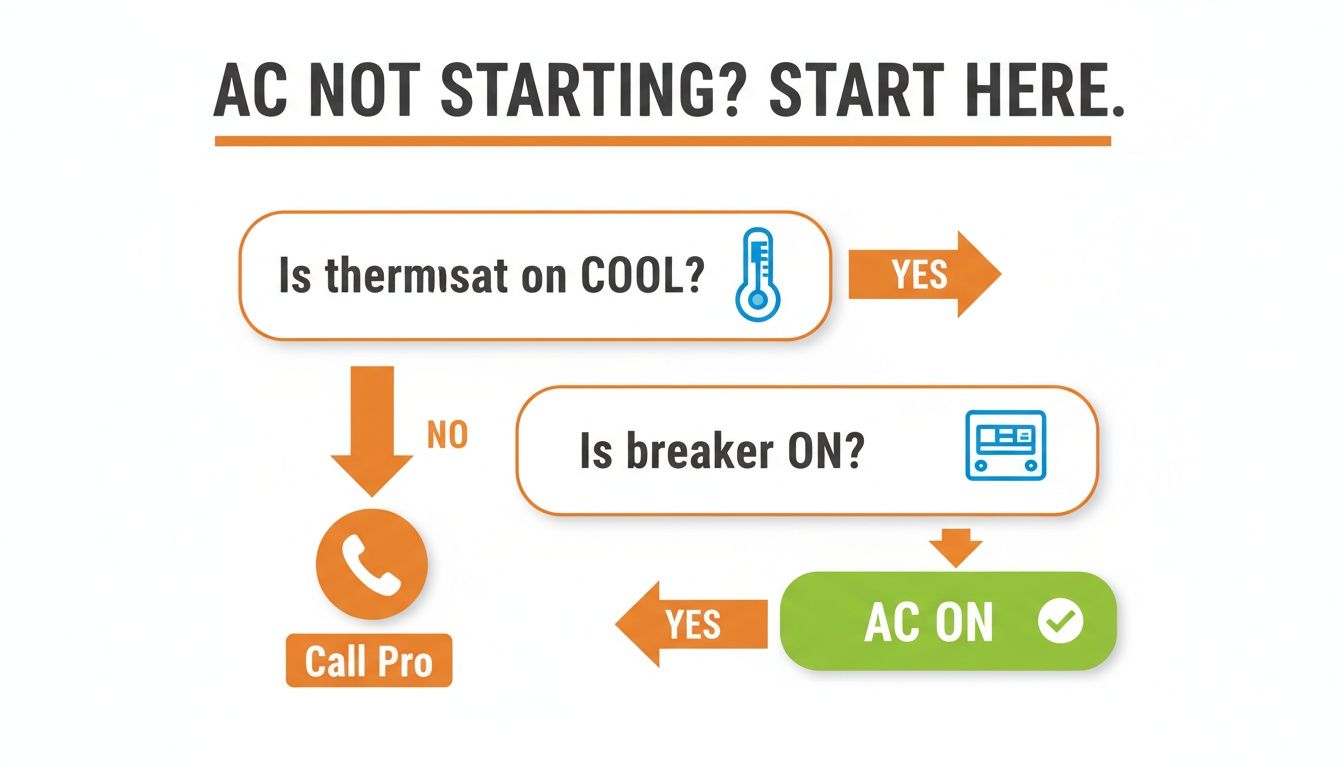
As you can see, the diagnostic process should always start with the easiest and most common issues: the thermostat and the circuit breaker. These two points account for a huge number of our service calls, and they're simple enough for any homeowner to inspect safely.
Pro Tip: If you have to flip a breaker or the power just came back on, give your system about five minutes before expecting it to start. Many modern AC units have a built-in delay to protect the compressor from damage caused by rapid on-and-off power cycles.
To help you get a quick read on the situation, I've put together a table of the most common issues we see in the field. This breaks down what's likely happening, what to look for, and whether it’s something you can handle or if it's time to call a pro.
Common Reasons Your AC Won't Turn On
| Potential Problem | What to Look For | DIY Fix or Call a Pro? |
|---|---|---|
| Incorrect Thermostat Settings | The thermostat is set to "Heat," "Fan," or "Off," or the temperature is set higher than the room temp. | DIY Fix – Easy to check and adjust. |
| Tripped Circuit Breaker | A breaker switch in your electrical panel is in the "Off" or middle position. | DIY Fix – You can safely reset it once. |
| Clogged Condensate Drain | Water is pooled in the drain pan, and a small float switch has tripped. | DIY Fix – You can clear the line with a wet/dry vac. |
| Blown Fuse at Disconnect Box | The outdoor unit (condenser) has no power, but the indoor unit runs. | Call a Pro – Involves high voltage. |
| Failed Capacitor or Contactor | You hear a humming or buzzing noise from the outdoor unit, but the fan isn't spinning. | Call a Pro – Requires electrical testing and replacement. |
| Compressor Failure | The system trips the breaker immediately upon trying to start; loud, unusual noises. | Call a Pro – This is a major component replacement. |
This table covers the big ones, but remember, if you ever feel unsure or the problem involves taking apart the unit, it's always safer to let a licensed technician handle it.
Ultimately, a little preventative care goes a long way in avoiding these surprise shutdowns. Staying on top of a few simple routines will keep your system running reliably when you need it most. You can learn more in our guide covering the top 5 AC maintenance tips specifically for Florida homeowners.
Start with the Smartest Fixes: Thermostat and Controls
Before you jump to conclusions and assume your AC has a major mechanical problem, it's always smart to check its "brain" first—the thermostat. You’d be amazed how many of our service calls, especially here in the Tampa Bay area, boil down to a simple issue with this little control panel.
The thermostat is the command center for your entire cooling system. A tiny oversight here can easily trick you into thinking the whole unit is dead.
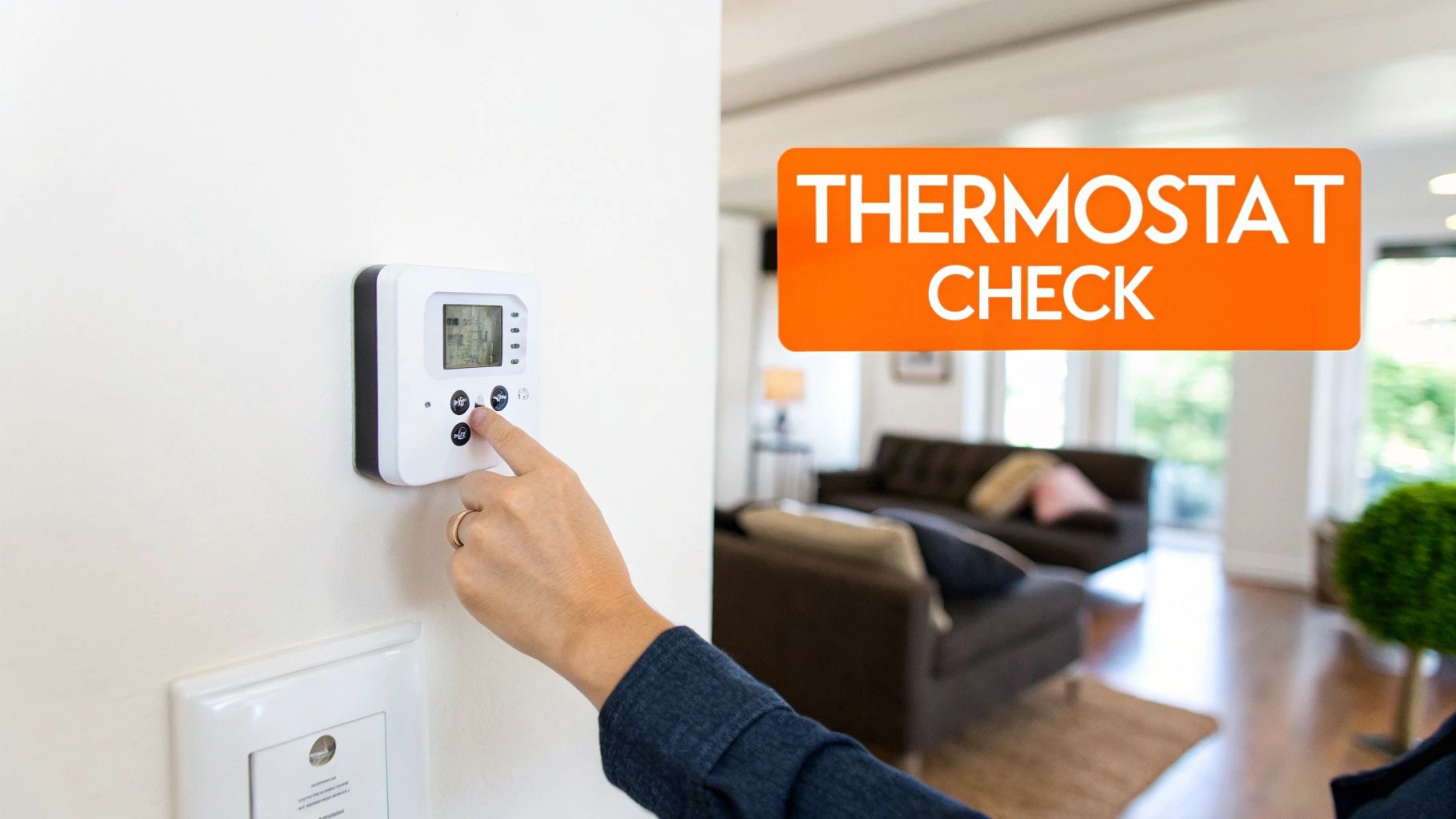
So, the very first thing to do is make sure the thermostat is set correctly. I know it sounds almost too obvious, but it’s the most common reason your AC is not turning on. Someone in the house might have accidentally switched it to "Heat" or "Fan Only," or even just turned it off.
Correct Thermostat Settings
Your goal here is simple: rule out the easy stuff before you start worrying about anything more serious. Take a quick look at your thermostat's display for these key settings:
- System Mode: Make sure it’s set to "Cool." If it’s on "Heat" or "Off," your air conditioner is never going to kick on.
- Temperature Setting: This is a big one. The temperature you set must be lower than the current temperature in the room. Your AC has no reason to run if you have it set to 78°F and the room is already a comfortable 75°F.
- Fan Setting: When you're trying to figure out what's wrong, it’s best to have the fan set to "Auto." This tells the fan to only run when the system is actively cooling.
After confirming the settings are right, try dropping the temperature down by about five degrees. Give it a few minutes. This should be more than enough to trigger the system to start. If you still get nothing, the next logical step is to check its power source.
I once had a client in Sarasota who was absolutely convinced their entire HVAC system had failed overnight. After checking everything, it turned out the thermostat’s batteries had simply died. A two-dollar fix saved them a much more expensive and stressful experience.
A lot of digital thermostats, particularly older models, run on standard AA or AAA batteries. A completely blank screen is a dead giveaway, but weak batteries can also cause strange behavior, like preventing the thermostat from sending the signal to the air conditioner. I always tell homeowners to keep a fresh set on hand just in case.
What About Smart Thermostats?
If you have a newer, connected model, the troubleshooting process is a bit different. They don't usually have batteries you can just swap out, but they can lose their connection to your Wi-Fi network, which can stop them from working correctly.
Often, a simple power cycle—turning it off and back on again at the circuit breaker—is enough to resolve these minor software glitches. Understanding more about how smart home technology for your HVAC operates can give you a leg up in diagnosing these kinds of issues. If a quick restart doesn't do the trick, checking your home's internet connection is the next best step.
Troubleshooting Your Power Supply and Breakers
Okay, so you've ruled out the thermostat. The next logical place to look is your home’s electrical system. Your air conditioner is a power-hungry machine, and any little hiccup in its electrical supply will bring it to a dead stop. This is one of the first things we check on a service call, especially during a brutal Fort Myers heatwave when the grid is working overtime.
Your circuit breaker panel is the nerve center for all the electricity in your home. Its job is to protect your expensive appliances by automatically cutting power—"tripping"—if it senses an overload or a short circuit. Finding the right breaker is a simple but critical step.
Locating and Inspecting Your AC Breaker
Most of us have our breaker panel tucked away in a garage, utility closet, or basement. When you open that little metal door, you'll see rows of switches. Your HVAC system is a big appliance, so it gets its own double-pole breaker. This just means it's two switches linked together with a single bar. Look for a label that says "AC," "HVAC," "Air Cond," or something similar.
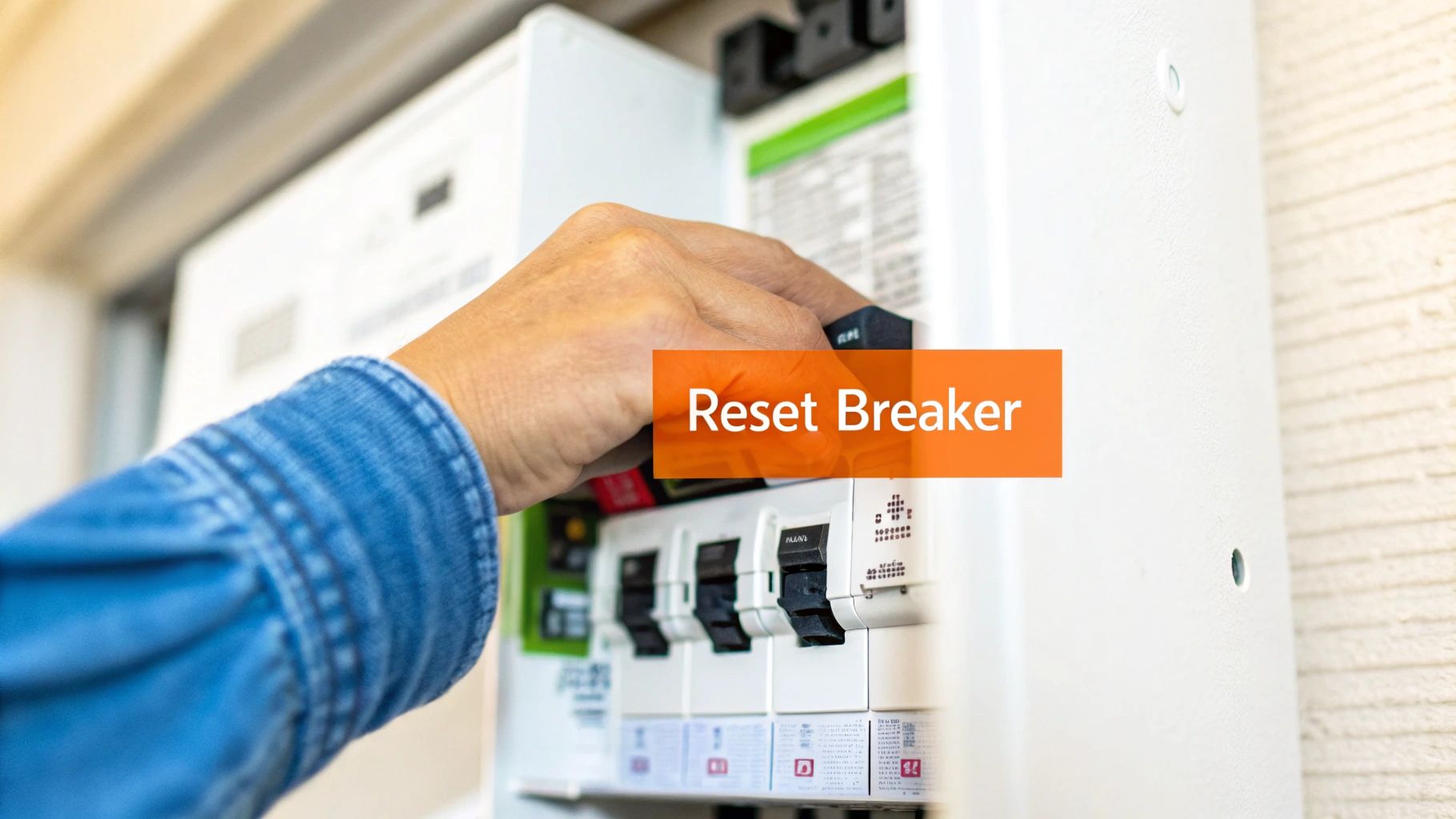
A tripped breaker is a classic reason for an AC to suddenly quit. In fact, it’s one of the most common causes of a tripped breaker. If the breaker has tripped, it won’t be firmly in the "On" or "Off" position. You'll see it sitting awkwardly in the middle, slightly out of line with the others.
To reset it the right way:
- First, push the breaker switch all the way to the full "Off" position. You need to do this to properly re-engage the internal spring.
- Then, flip it back to the "On" position. You should hear and feel a solid click.
If it stays on, you might have just fixed the problem! Give your AC unit a few minutes—most have a built-in delay to protect the compressor—and listen for it to kick on.
When a Breaker Trips Repeatedly
Now, this is important. If you reset the breaker and it immediately trips again, do not keep resetting it.
Think of a tripping breaker as a warning sign. It’s telling you there's a serious electrical fault somewhere in the AC unit or your home’s wiring. Forcing it back on over and over again is like ignoring a smoke alarm—you could cause serious damage to your AC system or even create a fire hazard.
A tripped breaker is behind up to 30% of all AC service calls we get when the temperature soars. Central AC units pull between 3,000 to 5,000 watts of power. In older Florida homes, that high demand can cause breakers to trip 40% more often than in newer homes with more robust electrical systems.
If the breaker won't stay on, it's time to put the tools down and call a professional. There's likely a deeper problem that needs an expert eye. Our guide on diagnosing air conditioner electrical issues can give you a better idea of what could be going on.
One last thing to check is the outdoor disconnect switch. This is a small metal box mounted on the wall right next to your outdoor condenser unit. Inside, you'll find either a pull-out handle or a simple breaker switch. It’s there so technicians can safely kill the power to the unit while working on it. Just make sure the handle is pushed in all the way or the switch is flipped to "On." It’s not uncommon for it to get bumped or turned off by accident during yard work.
Digging Into Airflow and Drainage Problems
Okay, so you've checked the thermostat and you know the power is on. Now it's time to look at two of the biggest culprits for AC shutdowns here in Florida: choked-off airflow and clogged drains. These problems can sneak up on you, causing your system to shut itself down as a safety measure before you even realize something's wrong.
A really dirty air filter is like trying to breathe through a straw. When your AC unit can't pull in enough air, it has to work way too hard. This over-exertion can cause the indoor evaporator coil to get so cold it literally freezes into a block of ice. To prevent catastrophic damage, a built-in safety switch will just shut the whole thing off.
That Pesky (and Critical) Air Filter
I can't tell you how many service calls in Port Charlotte end with me pulling out an air filter that's completely caked with dust and grime. It’s infuriating for homeowners, but it’s a simple fix. In fact, a clogged filter is behind 25% of all AC-won't-start-up calls, according to recent industry data.
Filters that haven't been touched in over three months can block 50-75% of the air your system needs, triggering those safety shutoffs. Here in Florida, our high humidity and pollen counts lead to 40% more filter-related failures than the national average, making this one maintenance task you absolutely can't skip.
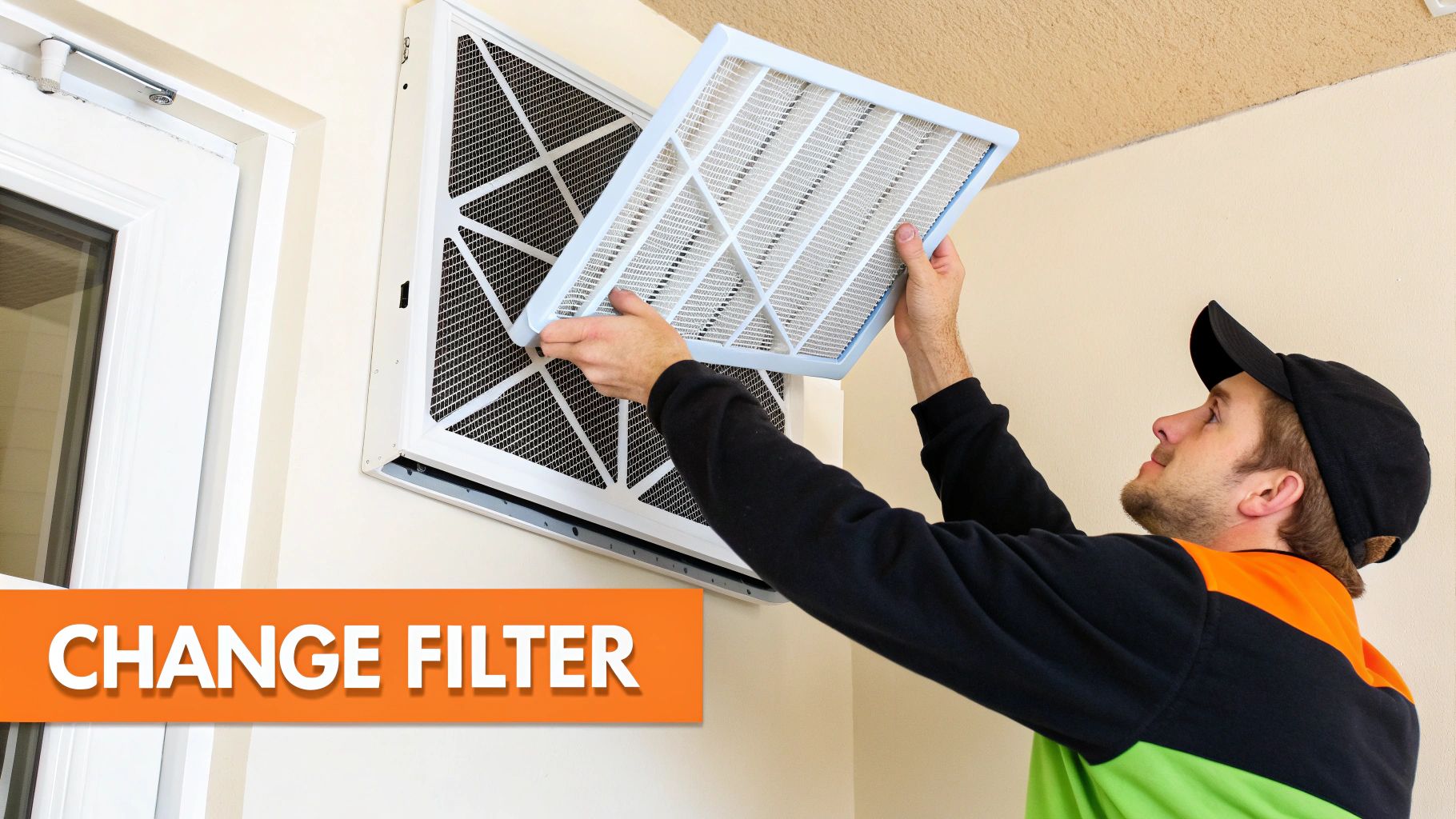
Your filter is usually in a slot right on the indoor air handler unit or tucked behind a large return air grille on a wall or ceiling. Just slide the old one out. Can you see light through it? If not, it’s way past due for a replacement. A clean filter does more than just prevent shutdowns; it's also key to even cooling. If some rooms feel like an icebox while others are stuffy, poor airflow is often the reason. You can learn more about how airflow impacts AC uneven cooling in our detailed guide.
Checking the Condensate Drain Line
Another prime suspect is your AC's condensate drain line. As your system cools your home, it pulls a ton of moisture from the air. This water collects in a drain pan and is supposed to flow outside through a simple PVC pipe. But in our humid climate, that pipe is the perfect place for algae and mold to grow.
If that gunk builds up and creates a clog, the water in the drain pan has nowhere to go. It will rise until it hits a small safety device called a condensate overflow switch.
This little switch is your system's last line of defense against a nasty indoor flood. When tripped, it cuts power to the entire AC system until the blockage is cleared and the water level drops back to normal. It’s a very common and effective safety feature.
You can often diagnose this problem yourself. Just take a look at the drain pan, which is typically located right under your indoor air handler. See any standing water? That's your sign.
For a minor clog, you might be able to clear it with a wet/dry shop vacuum. Just put the vacuum hose on the end of the drainpipe outside and let it suck the blockage out. If you're not comfortable with that or the clog won't budge, it’s best to call in a pro. The last thing you want is to accidentally cause more damage.
Knowing When to Call an HVAC Professional
While it's empowering to fix a simple AC issue yourself, it's just as important to know when to put the tools down. Pushing past your limits isn't just risky for your HVAC system—it can be dangerous for you, too.
Certain symptoms are clear signals of a serious internal problem. These aren't just minor hiccups; they're your AC's way of telling you it needs an expert with specialized tools and training. Trying to force a fix at this point can quickly turn a manageable repair into a complete—and expensive—system replacement.
Listening for Signs of Component Failure
If you’ve already worked through the basic checks and your AC still won’t cooperate, it’s time to listen closely. The sounds your unit makes can often point directly to the failing part.
A continuous buzzing or humming from the outdoor unit is one of the most common red flags. More often than not, this points to a bad capacitor. Think of the capacitor as a small battery that gives the motors a powerful jolt to get started. When it fails, the compressor or fan motor tries to start but can't, resulting in that tell-tale hum.
If the outdoor unit is completely silent even though your thermostat is calling for cool air, the problem could be the contactor. This is essentially a heavy-duty switch that allows high-voltage power to flow to the compressor and fan. A faulty contactor means the power never reaches the components that do the cooling.
Safety First: Don't even think about messing with these parts yourself. The capacitor and contactor are high-voltage components. A capacitor can hold a dangerous electrical charge long after the power is off. This is a job strictly for a trained, licensed technician.
The Major Red Flags You Can't Ignore
Beyond specific noises, a few scenarios should make you stop troubleshooting immediately and pick up the phone. These are the big ones that signal deeper, more hazardous problems.
-
A Breaker That Instantly Trips Again: A breaker can trip once for any number of reasons. But if you reset it and it immediately snaps back off, you have a direct short or a serious electrical overload in the system. Continuing to reset it is a major fire risk.
-
Any Smell of Burning Plastic or Wires: This one is non-negotiable. An electrical burning smell near either the indoor or outdoor unit means something is overheating badly. Shut off all power at the breaker panel right away to prevent a potential fire.
-
Loud, Grinding, or Banging Noises: A hum might be a capacitor, but a violent, mechanical grinding or banging sound is often the cry for help from a failing compressor. The compressor is the heart and the single most expensive part of your AC. Running it in this state can cause catastrophic, irreversible damage.
The components inside your air conditioner—from the high-voltage electrical parts to the high-pressure refrigerant lines—are not meant for DIY repairs. An experienced technician has the diagnostic tools to safely pinpoint the exact problem and the knowledge to handle these complex systems. When you see these serious signs, your best move is to step back and let an expert take it from here.
Your Questions About a Non-Starting AC Answered
Even after going through the basic troubleshooting, you might still be scratching your head about why your AC won’t kick on. We hear a lot of the same questions from homeowners across Southwest Florida, so we’ve gathered the most common ones here to give you some clear, straightforward answers.
These scenarios often go beyond the usual thermostat and breaker checks, pointing to issues specific to our humid climate or the simple age of the system. Let’s dive into what might be going on.
My Thermostat and Breaker Are Fine. Why Is My AC Not Turning On?
This is a frustrating spot to be in, but it’s actually a good thing—it helps narrow down the possibilities. If you've confirmed you have power and the thermostat is set correctly, the next two likely culprits are related to airflow and drainage, which are huge factors here in Florida.
A severely clogged air filter can literally choke the system, causing it to overheat and trip an internal safety switch. In the same way, our constant humidity means your AC produces a ton of water. If the condensate drain line gets clogged with algae (a common Florida problem), a safety float switch will cut power to prevent water from backing up and damaging your home.
If both the filter and drain line are clear, you're likely looking at an internal component failure, like a bad capacitor. For a deeper look at similar issues, you can find more information by reviewing some of the most common AC problems and solutions we encounter.
How Often Should I Really Change My AC Filter in Florida?
With our high humidity, constant pollen, and year-round cooling season, checking your filter monthly is an excellent habit to get into. For the standard one-inch disposable filters most homes use, you should plan on replacing them at least every 90 days.
However, that schedule can shrink depending on your household:
- Got Pets? Pet dander and hair clog filters fast. Plan on changing it every 60 days.
- Allergy Sufferers? To keep your indoor air quality high, a fresh filter every 30-45 days is ideal.
- Peak Pollen Season: During the spring and fall, a monthly change can make a massive difference for your system and your sinuses.
This is the single cheapest and most effective piece of maintenance you can do to prevent your AC from failing on a sweltering afternoon.
Pro Tip: When you slide a new filter in, grab a marker and write the date on the side. This takes all the guesswork out of knowing when it was last changed and helps you stick to a consistent schedule.
Is It Safe to Fix a Buzzing Outdoor AC Unit Myself?
Absolutely not. A buzzing or humming sound from the outdoor unit almost always points to an electrical problem, most often a failed capacitor. A capacitor is a small part that holds a powerful electrical charge—think of it as a battery that gives the motors the jolt they need to start.
Even after you’ve shut off the power at the breaker, a capacitor can still hold enough electricity to deliver a serious shock. Some online videos might make a replacement look easy, but the risk of injury is significant. This is not a DIY job. A licensed HVAC technician has the proper tools and training to safely diagnose the issue, discharge the old capacitor, and install the correct new one without risk.
Should I Repair or Replace an Older AC That Won't Turn On?
This decision really comes down to the unit's age and the cost of the repair. We often use the "5,000 Rule" as a guide: multiply the age of your unit by the estimated repair cost. If that number is over $5,000, replacement is usually the smarter financial move.
For example, if your 10-year-old unit needs a $600 repair, the math looks like this: 10 x 600 = 6,000. That's over the $5,000 threshold, suggesting it's time to consider a new system.
If your AC is over 10-12 years old and needs a major, expensive repair like a new compressor, it's almost always better to put that money toward a new, high-efficiency system. A modern unit will dramatically lower your FPL bill, provide more reliable cooling, and come with a full warranty for your peace of mind.
If you've tried these steps and are still stuck with a silent AC, it's time to call in the experts. Heatwave Air Conditioning, Plumbing, & Electric is here to provide fast, reliable service to get your home cool and comfortable again. Schedule your service today by visiting us at https://www.heatwavehvac.com.