
When you look at an electrical outlet, you probably just see a simple part of your wall. But behind that plastic cover is a system governed by a strict set of rules—the electrical code. This code isn't just about passing an inspection; it's a carefully designed safety net for your home, dictating everything from outlet spacing to the types of life-saving devices required to prevent fires and shock.
These standards are the backbone of a safe electrical system, protecting you from hazards you can't even see.
Why The Electrical Code For Outlets Matters In Florida

Think of the electrical code as the rulebook every electrician, builder, and inspector has to follow. It’s based on the National Electrical Code (NEC), which sets the minimum safety standards for the entire country. Florida adopts the NEC to ensure every home is wired safely, but why is this so critical here?
It all boils down to protecting your family and your property from two major threats:
- Fire Prevention: Faulty wiring and overloaded circuits are some of the most common causes of house fires. The code specifies exactly how to install wiring and outlets to keep them from overheating.
- Shock Protection: Special devices like Ground-Fault Circuit Interrupters (GFCIs) are required in any area with moisture, like kitchens and bathrooms. They're designed to shut off power in an instant if they detect a problem, preventing a potentially fatal shock.
Florida’s Unique Electrical Challenges
Living in the Sunshine State means dealing with more than just heat. Our climate creates unique challenges for a home’s electrical system.
The constant high humidity can cause corrosion on electrical connections, leading to poor contacts that arc and create a fire risk. Then there are the thunderstorms and hurricanes, which bring dangerous power surges and the threat of water getting into your walls. A code-compliant system is built to handle these Florida-specific issues, often requiring weather-resistant outlets and extra-duty covers for any receptacle outside.
Following the code isn’t about meeting a bureaucratic requirement; it's about installing a system designed to withstand real-world conditions, giving you lasting peace of mind. A compliant electrical system is a resilient one.
A huge part of meeting the electrical code is ensuring everything is installed correctly, from the breaker panel all the way to the plug. This involves understanding the fundamentals of NEC-compliant wire and breaker sizing to make sure circuits are never overloaded. While this guide will give you a great starting point, the best way to know for sure if your home is safe is to have a professional take a look. You can learn more about the importance of regular electrical inspections to keep your system safe and up-to-date, year after year.
How Electrical Safety Codes Have Evolved Over Time
The complex rules for electrical outlets we follow today weren't created overnight. They were built over a century of learning, often from tragic accidents and hard-won experience. The story of the National Electrical Code (NEC) is really about making our homes safer, one lesson at a time.
Back in the late 1800s, when electricity first lit up American homes, wiring was a chaotic free-for-all. With no real standards, installations were wildly inconsistent and, frankly, dangerous. This lack of guidance led to far too many house fires and put anyone using this new technology at risk.
The turning point came when the dangers became impossible to ignore. By 1895, the U.S. was dealing with five different electrical codes, which just made things more confusing. To fix this mess, the National Board of Fire Underwriters brought them all together into the first National Electrical Code (NEC) in 1897. This landmark document, which Florida and 47 other states now follow, created the first real framework for safe electrical work. You can read more about the NEC's origins on Sunco.com.
From Basic Rules To Advanced Protection
The first NEC was pretty simple, but it laid the foundation for everything we have now. Each new edition is a direct response to new technologies and a better understanding of electrical dangers. Think of it as a living document that gets smarter with every update.
A major early milestone was the introduction of grounded outlets. Before grounding, if there was a fault, that stray electricity had nowhere safe to go, turning appliances into serious shock hazards. The third prong on modern plugs creates that essential safety path, directing dangerous current into the ground instead of through a person.
The NEC isn't a static rulebook; it's updated every three years. This cycle ensures the code keeps up with new tech, materials, and safety data, constantly refining the rules to handle modern electrical demands.
For example, the rules for kitchen outlets have changed dramatically. In the 1990s, the code just said you needed an outlet for every four feet of countertop. Today, the rules are much more specific, with guidelines for islands, peninsulas, and other work areas to make sure outlets are both convenient and safely placed.
How Real Events Shape The Code
Almost every rule in the NEC has a story behind it, and many were written in response to real-world tragedies. The requirements for safety devices like GFCIs and AFCIs are perfect examples of this.
Data showed a frightening number of electrocutions were happening in wet areas like bathrooms and kitchens. This led directly to the rule requiring GFCIs in those locations. In the same way, fire investigators discovered that arcing faults inside walls were a major cause of house fires, which spurred the development and mandate of AFCI protection.
This constant evolution proves the electrical code for outlets is more than just a list of regulations. It’s a dynamic shield, constantly being reinforced with new knowledge to protect us from hidden dangers. Every update, from requiring tamper-resistant outlets to protect kids to defining spacing near a sink, is a lesson learned and applied to make every home safer.
Understanding GFCI And AFCI Outlet Protection
When we talk about electrical safety in your home, two terms pop up constantly: GFCI and AFCI. They might sound like technical jargon, but these aren't just letters—they’re specialized safety devices built right into your outlets and circuit breakers. Each one is designed to prevent a very specific, and very serious, kind of danger.
GFCI: The Shock Shield
Think of a Ground-Fault Circuit Interrupter (GFCI) as your personal shock shield, especially anywhere near water. Its job is to constantly monitor the electricity flowing through an outlet. If it senses even the slightest imbalance—like when electricity takes a shortcut through water or, worse, a person—it snaps the power off in a millisecond to prevent a dangerous shock.
The widespread adoption of GFCI outlets is a huge reason modern homes are so much safer. In fact, this single advancement is credited with cutting electrocution deaths by over 70% since the 1970s. Discover more insights about this life-saving history from ElectElectric.com.
You’ll know a GFCI outlet by its tell-tale "TEST" and "RESET" buttons. The NEC requires them in any area where water and electricity might meet:
- Kitchens (for all countertop receptacles)
- Bathrooms
- Garages and unfinished basements
- Laundry areas
- All outdoor outlets
AFCI: The Fire Marshal
If the GFCI is a shock shield, then the Arc-Fault Circuit Interrupter (AFCI) is your home's vigilant fire marshal. It's designed to listen for a completely different hazard: dangerous electrical arcs. These are tiny sparks that happen when wiring is old, damaged, or pinched inside a wall. These arcs can get incredibly hot, easily igniting nearby wood framing or insulation and starting a fire.
An AFCI is smart enough to tell the difference between a harmless arc (like flipping a switch) and a hazardous one. When it detects danger, it cuts power to the circuit immediately, stopping a fire before it even has a chance to start. To get a better sense of these protective devices, learning about a Residual Current Device (RCD) can offer more context on similar electrical safety principles.
The NEC now mandates AFCI protection in nearly all living areas of new homes, including bedrooms, living rooms, and hallways, because statistics show these are where most arc-fault fires start.
Here in Florida, where high humidity can make wires degrade faster and summer storms can cause hidden damage, having both GFCI and AFCI protection is non-negotiable. It’s more than just a code rule; it’s a critical defense for your home and family. These devices work quietly behind the scenes, offering constant protection against the most common electrical dangers. For more ways to keep your home safe, check out our guide on essential electrical safety tips.
A Room By Room Guide To Outlet Placement Rules
Trying to make sense of electrical code requirements for outlets can feel overwhelming, but the rules are actually quite logical. They’re all designed with two things in mind: your safety and your convenience, making sure you have power right where you need it without creating a hazard.
Let's break down the requirements, room by room, so you know exactly what to look for in your own home.
Living Rooms, Bedrooms, and Hallways
We'll start in the most common areas of your home, like living rooms, dens, and bedrooms. In these spaces, the electrical code for outlets follows a simple but powerful guideline called the “6-foot/12-foot rule.”
Think of it this way: from any point along a wall, you should never be more than 6 feet away from an outlet. This ensures you can plug in a lamp or charge your phone using a standard 6-foot cord, eliminating the need for extension cords. To achieve this, an outlet must be placed every 12 feet along the wall. The rule also specifies that any wall section 2 feet wide or more needs its own outlet. It’s all about preventing trips and reducing fire risk from overloaded extension cords.
Kitchens: The Heart Of Electrical Demands
Kitchens are easily the most power-hungry room in any house, and they have special rules to match. The code here is all about providing plenty of power for small appliances right on the countertops where you use them.
The basic rule is that any countertop space 12 inches or wider must have a receptacle. This area of the code has seen some updates over the years. The 2023 NEC, for example, offers more flexibility, especially for kitchen islands and peninsulas. The key takeaway for homeowners is that outlets must be accessible and placed to ensure safety.
The image below highlights the two essential types of protective outlets, which are an absolute must in kitchens and other areas where water is present.
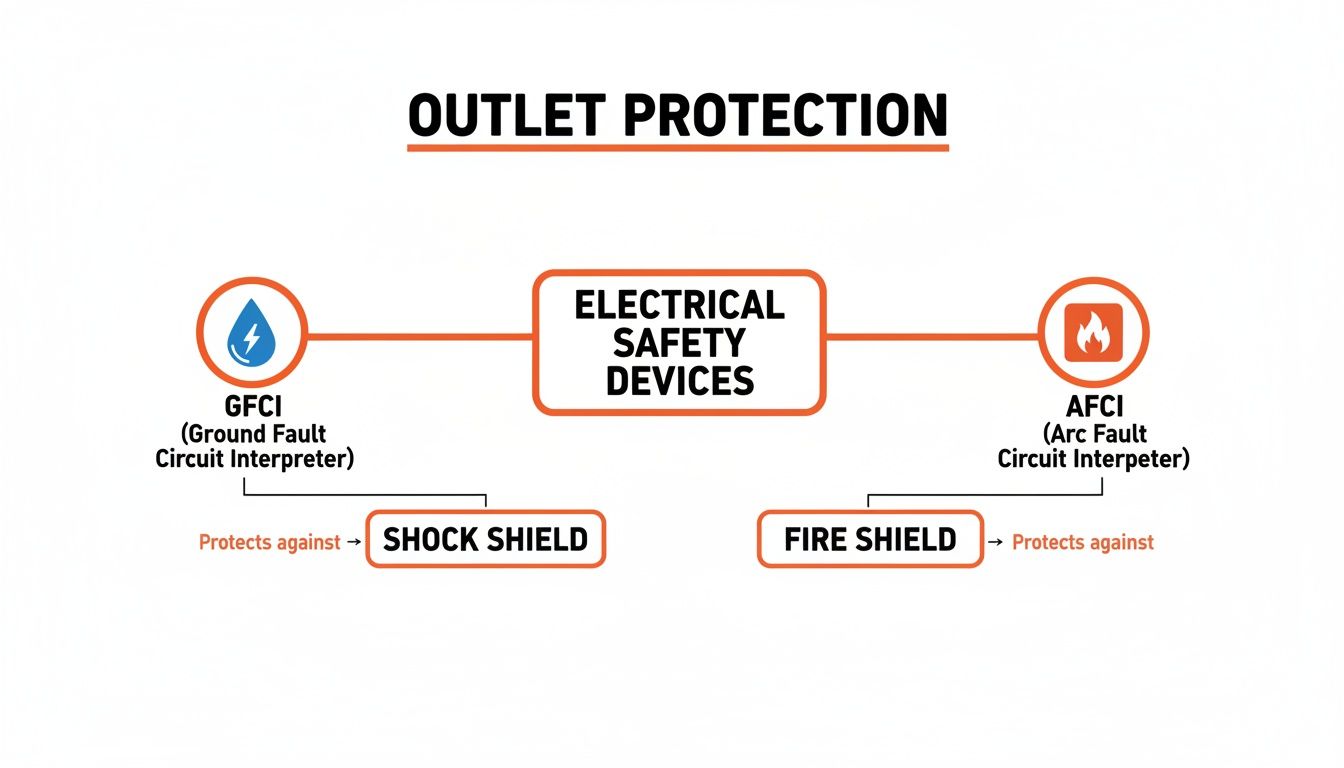
As you can see, GFCIs are your "shock shield" near water sources, while AFCIs act as a "fire shield" to prevent dangerous arcs in your home's wiring.
Bathrooms, Garages, and Outdoor Spaces
Bathrooms have a very direct and important rule: at least one GFCI-protected outlet must be installed within 3 feet of the outside edge of every sink. This keeps power handy for things like hair dryers and electric razors while providing critical shock protection.
Garages and any unfinished basements are required to have at least one GFCI-protected outlet, too. But for outdoor spaces—a huge part of the Florida lifestyle—the rules get even more specific to handle the elements.
- Front and Rear Outlets: Every home must have at least one receptacle outlet at the front and one at the rear. These outlets can't be more than 6.5 feet above the ground.
- Weather-Resistant: All outdoor outlets must be rated as weather-resistant to stand up to our humidity, salt air, and rain.
- GFCI Protection: There are no exceptions here. Every single outdoor outlet must have GFCI protection.
- In-Use Covers: They also need "in-use" or "extra-duty" covers, which are designed to keep the plug dry even when something is plugged into it.
These rules work together to make your home functional while fortifying it against electrical dangers. If your home's layout presents unique challenges or you're unsure about compliance, it's always best to consult a professional about your wiring and rewiring services to guarantee everything is safe and up to code.
Tamper Resistant Outlets And Other Modern Requirements

While GFCI and AFCI devices are fantastic at preventing shocks and fires, the modern electrical code for outlets includes another layer of protection aimed squarely at the youngest members of your household. If you have small children, you've probably used those little plastic outlet caps, but the NEC has a far more effective—and permanent—solution.
Say hello to the Tamper-Resistant Receptacle (TRR), a true game-changer for home safety. Think of it as an outlet with a built-in security guard. Inside the slots are spring-loaded shutters that block anything from getting in unless a proper two- or three-prong plug is pushed in evenly. This simple mechanism is incredibly effective at stopping curious kids from inserting foreign objects like keys, paper clips, or hairpins.
Since 2008, the NEC has required TRRs to be installed in all new and renovated homes. This rule covers nearly every area, from living rooms and bedrooms to even outdoor locations. Their impact on safety has been profound.
Understanding Circuit Amperage And Dedicated Circuits
Beyond the type of outlet, the code also gets specific about how much power each circuit can handle. You’ve definitely seen outlets with two standard vertical slots and a ground hole—those are for your typical 15-amp circuits. But sometimes you’ll see an outlet with a T-shaped neutral slot, which is your clue that it’s part of a 20-amp circuit.
So, why the difference? A 20-amp circuit can handle more power-hungry appliances without constantly tripping the breaker. The NEC actually requires them in certain areas for this very reason:
- Kitchens: To power countertop appliances like blenders, mixers, and air fryers.
- Bathrooms: For high-wattage devices like powerful hair dryers.
- Laundry Rooms: To handle the serious power demands of modern washing machines.
On top of that, some major appliances need a circuit all to themselves. We call this a dedicated circuit, and it’s required for devices that draw a large, continuous amount of power. Your refrigerator, dishwasher, microwave, and garbage disposal should each have their own dedicated circuit to prevent overloads and ensure they run safely and efficiently.
Outlet Height And Other Key Considerations
The electrical code for outlets even gets down to a standard height. While there’s a little bit of flexibility, most outlets are installed with the bottom of the box somewhere between 12 and 18 inches from the finished floor. This keeps them accessible without being so low that they’re a nuisance.
The history of U.S. outlets shows a clear evolution, from basic knife switches to the advanced designs we have today. The adoption of tamper-resistant outlets in the 2014 NEC was a massive leap forward, helping cut child-related outlet injuries by an incredible 70%. This is vital, especially when you consider that children cause around 12% of all outlet-related mishaps.
Here in Florida, outlet safety is even more critical. State data shows 6% of home insurance claims are tied to outlet issues, and that number spiked 15% after major storms like Hurricane Ian. Discover more insights about how outlet design evolved for safety with this video.
When You Should Call A Professional Electrician
Knowing your way around the electrical code is great for any homeowner, but when it comes to actually doing the work, this is one area where DIY is a definite don’t. Your home’s electrical system isn't forgiving. A small mistake can lead to serious risks, from electrical shocks and fires to a voided home insurance policy.
Learning to spot the warning signs that your electrical system is in trouble is one of the most important safety skills you can have. Your home will often tell you when it’s time to call in an expert.
Red Flags That Demand A Professional
Never brush off signs of electrical distress. These symptoms often point to dangerous issues hiding behind your walls that go way beyond a simple fix. If you notice any of the following, it's time to call an electrician right away:
- Flickering or Dimming Lights: This is a classic sign of a loose connection somewhere in the circuit. Those loose connections can spark and create a serious fire hazard.
- Warm or Discolored Outlets: An outlet should always be cool to the touch. If you feel any warmth, it’s a major red flag for a bad connection or an overloaded circuit.
- Frequently Tripping Breakers: A circuit breaker that trips over and over isn't just an annoyance. It's your electrical system's safety switch telling you that a circuit is overloaded or shorting out, and it needs a professional diagnosis.
- Buzzing Sounds or Burning Smells: Any strange smells or sounds coming from an outlet, switch, or your electrical panel are urgent warnings. Shut off the breaker to that area if you can and call for help.
A licensed electrician does more than just fix the immediate problem. They get to the root cause, making sure the repair is safe, permanent, and fully compliant with the electrical code for outlets and all other NEC standards.
If your house still has old two-prong outlets, it’s missing the ground wire that is essential for modern electrical safety. Upgrading them isn't just for convenience—it's a critical safety improvement for your family. For these situations and any of the red flags above, our team provides expert electrical repair services to get your home back in safe working order.
Frequently Asked Questions About Florida Outlet Codes
Figuring out the electrical code for outlets can bring up a lot of questions, especially for homeowners here in Florida. Let's walk through some of the most common concerns we hear about cost, safety, and how to handle outlets in older homes.
Do I Need to Upgrade My Older Home's Outlets?
Not necessarily, but it’s a good idea for safety. If your house was built back in the 1980s, its existing wiring is likely "grandfathered" in. This just means you aren't required to do a full-home upgrade to meet the newest code unless you're doing a major renovation.
However, we strongly recommend upgrading outlets in high-risk areas for your family's safety. This means swapping out old receptacles for GFCI outlets in kitchens, bathrooms, garages, and outdoor spaces to prevent dangerous shocks. Most older homes also lack AFCI protection, which is your best defense against electrical fires caused by damaged wiring.
What Is the Difference Between a GFCI Outlet and a Breaker?
Both of these devices provide the exact same life-saving ground-fault protection, they just do it from different spots in your electrical system.
- A GFCI outlet is installed right at the wall. It protects itself and any other regular outlets that are connected "downstream" on the same circuit.
- A GFCI breaker is installed directly in your main electrical panel. From there, it protects the entire circuit from that single point.
The best choice really depends on your home’s existing wiring. An experienced electrician can take a look at your setup and figure out which option is the most effective and budget-friendly for you.
Key Takeaway: While both a GFCI outlet and a breaker achieve the same safety goal, the installation strategy depends on your home's unique electrical layout and which solution provides the most comprehensive protection.
If you're dealing with an outlet that's suddenly stopped working, our guide can help you troubleshoot if an electrical outlet is not working properly.
When in doubt, always put safety first. For a professional inspection or to upgrade your home’s outlets to meet current safety standards, trust the experts at Heatwave Air Conditioning, Plumbing, & Electric. Schedule your service by visiting us at https://www.heatwavehvac.com.