
Transform Your Basement from Chilly to Cozy
Even in Florida, a basement can feel colder than the rest of the house. Concrete stays cool, the space gets less sun, and humidity can make a room feel clammy instead of comfortable. That's frustrating when you want to turn that square footage into a gym, movie room, workshop, or guest suite.
Most homeowners I talk to start by asking which heater to buy. The better question is whether the basement is losing heat and holding moisture before you spend money on equipment. Basements are often cooler because they sit below grade and are surrounded by concrete, so passive heat from upstairs usually isn't enough. Good basement heating options need to fit the room, the way you use it, and the realities of a humid Gulf Coast climate.
If you're in Tampa Bay, Sarasota, Port Charlotte, Cape Coral, or Fort Myers, you also have a different challenge than homeowners up north. You need warmth on cooler days, but you also need year-round humidity control and practical operating costs. In many Florida homes, the best answer isn't the hottest system. It's the one that heats predictably without making the room damp, stuffy, or expensive to run.
For homeowners who are also comparing broader efficiency ideas, Hallmoore Developments heating advice is a useful companion read.
1. Forced Air Furnace Systems
If your home already has ductwork, this is usually the first option worth checking. Extending an existing HVAC system can be the most direct way to heat a basement, but only if the equipment has enough capacity and the duct layout makes sense. A technician should evaluate the added load first, then determine whether registers and ducts can be extended into the basement based on this basement HVAC guidance.
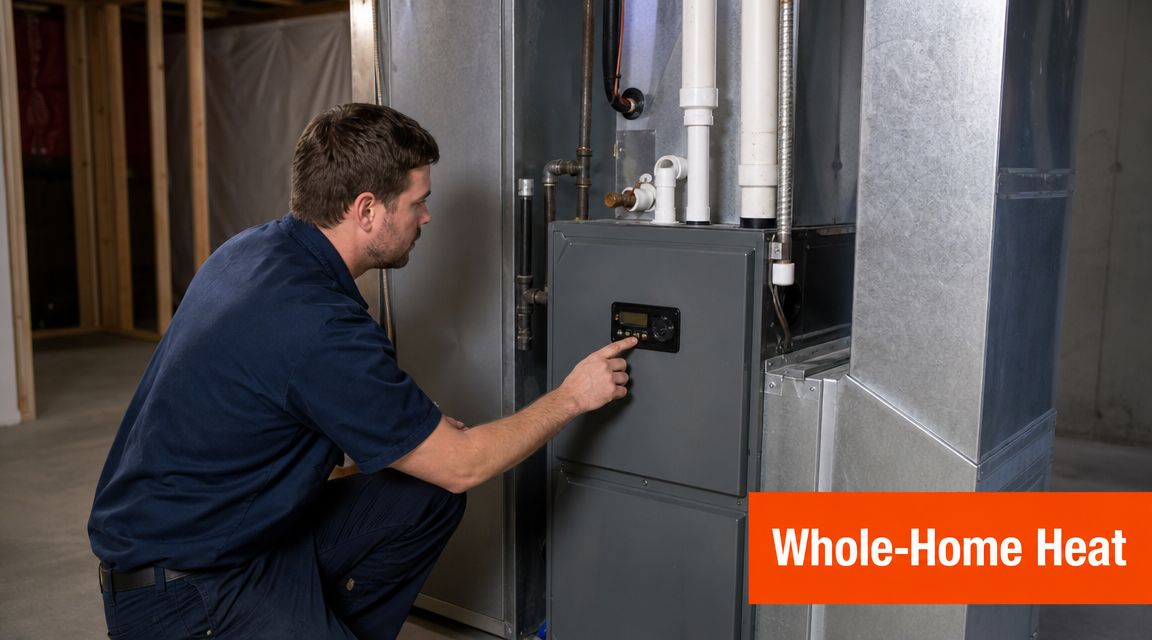
In Florida, this can work well when the basement is part of the home's regular living area and the upstairs system already runs efficiently. I've seen it make sense in finished lower levels where homeowners want one thermostat strategy and don't want a separate wall-mounted unit. It tends to be less attractive when the basement is far from the air handler, has low ceilings, or has no easy path for return air.
What makes or breaks it
A forced-air extension isn't just about adding one supply vent. The basement needs balanced airflow, including return air, or the room can end up stuffy and uneven.
- Seal the ductwork well: Leaky ducts waste conditioned air and can make an already cool basement feel under-served.
- Add dampers where needed: Dampers help keep the basement from stealing airflow from bedrooms or living areas upstairs.
- Check return air paths: Without return air, comfort drops fast and pressure problems show up.
- Maintain the system yearly: Clean filters, blower checks, and airflow testing matter before the cool season arrives.
Practical rule: If the central system is already struggling upstairs, extending it into the basement usually magnifies the problem instead of solving it.
There's also an efficiency argument for doing this the right way. Industry summaries note that energy-efficient HVAC upgrades can cut energy consumption by 20% to 50%, and high-efficiency models may reduce home heating costs by 30% to 70%. That doesn't mean every basement project should use the main system, but it does mean a well-planned central setup can be a strong long-term choice.
2. Heat Pump Systems
For many Tampa Bay and Southwest Florida homes, a heat pump is the most natural fit. Our winters are mild, and a heat pump gives you heating and cooling in one system, which matters more here than it does in places that need long stretches of heavy winter heat.
This option is especially appealing for a finished basement used every day. Think of a Sarasota media room, a Cape Coral home office, or a Fort Myers guest suite where comfort matters year-round, not just on the occasional chilly morning.
Why heat pumps fit Florida well
Heat pumps move heat instead of generating it through electric resistance. That makes them a practical comfort system in climates where you need moderate heat and long cooling seasons. If you're weighing the two main approaches, this guide on the difference between a heat pump and furnace helps clarify how each system behaves in a real home.
Cold-climate market data also shows why heat pumps get so much attention in retrofit projects. Ductless systems in North America are projected to grow at an 8.4% CAGR because they reduce installation disruption and work well in spaces like basements, attics, and converted rooms. Even though Florida isn't a cold-climate market in the usual sense, that same retrofit advantage shows up here.
A few practical tips matter:
- Keep the outdoor unit clear: Landscaping, leaves, and debris reduce performance.
- Use a programmable thermostat: That helps match run times to when the basement is occupied.
- Check refrigerant charge and airflow: Heat pumps are less forgiving than many homeowners realize.
- Think about backup heat only if needed: In most Southwest Florida homes, backup heat is more of a peace-of-mind measure than a daily necessity.
For a basement that needs regular comfort without overcomplicating the mechanical plan, a heat pump is often the shortest path to a room people use.
For readers comparing broader installation trends, Eastbourne heat pump installations offers an outside-market perspective on why these systems keep gaining ground.
3. Ductless Mini-Split Systems
A mini-split is one of my favorite basement heating options for Florida homes that don't have basement ductwork. It gives you zoning, it avoids major demolition, and it handles both heating and cooling. That last part matters because many finished basements here need dehumidified cooling more often than they need heat.
If you're turning a lower level into a guest suite in Port Charlotte or a quiet office in Tampa Bay, a mini-split often solves the comfort problem without touching the rest of the home's duct system.
Where mini-splits shine
Modern basement heating options are often grouped into four big categories: central HVAC extensions, ductless mini-splits or heat pumps, radiant floors, and standalone heaters as outlined in this basement heating overview. Mini-splits stand out in that mix because they're made for retrofit conditions.
They're also efficient compared with resistance heat. Modern heat pump systems can reduce electricity use for heating by up to 75% compared with electric resistance heating. In a Florida basement, that matters most when the room becomes a regular living space rather than an occasional hobby room.
If you want a primer before choosing equipment, this explanation of what a mini-split heat pump is lays out the basics.
A mini-split usually works best when the basement needs its own schedule. Warm for guests this weekend. Cooler and drier during the workweek. Off or setback when empty.
Installation details that matter
Placement changes performance. Mount the indoor unit high enough for good air throw, keep the line set protected and insulated, and choose an outdoor location that won't trap leaves or block service access.
This is not the prettiest option to every homeowner. Some people don't love the look of a wall unit. But when the alternative is tearing open ceilings to run ducts, a mini-split often wins on simplicity and control.
4. Baseboard Electric Heaters
Baseboard heat is simple. No ductwork, no refrigerant lines, no outdoor unit. For a small basement room that only needs occasional warmth, that simplicity is the main selling point.
In Florida, I'd call this a targeted solution, not a whole-basement strategy in most homes. A hobby room in Cape Coral, a small workshop in Fort Myers, or a lightly used finished corner can sometimes do fine with baseboard heaters if the room is insulated and the expectations are realistic.
Good fit for small spaces, weak fit for large ones
Electric resistance heat is easy to install, but it's usually more expensive to operate than heat pump-based systems over time. Canadian market data notes that heat pumps can use about 50% less energy than baseboard heaters, which tells you why baseboard heat is rarely the first choice for larger finished spaces.
That doesn't make baseboards wrong. It makes them situational.
- Use them in smaller rooms: They make more sense where you only need to warm one contained area.
- Keep clearance in front of them: Furniture, boxes, and curtains create safety and performance problems.
- Pair them with insulation improvements: Otherwise you're paying to heat wall losses and drafts.
- Add thermostat control: Basic timers and programmable controls help reduce waste.
If rising utility bills are already on your radar, this breakdown of what causes high electricity bills is worth reading before you commit to resistance heat.
For unfinished or utility-heavy basement areas, baseboard units can be cleaner and more durable than dragging a portable heater around. For a large family room, though, they often feel like a compromise you keep paying for.
5. Hydronic Radiant Floor Heating
Hydronic radiant floors are the comfort-first option. Warm water circulates through tubing in the floor, and the room heats from the ground up. The result is even, quiet heat without the drafty feel some homeowners notice with forced air.
That matters in a basement because the floor is often the coldest surface in the room. If you've ever walked barefoot onto a finished basement slab in January, you already understand the appeal.

Best during major renovation
This is rarely the easiest retrofit. It shines when you're already rebuilding the floor or starting from scratch in a high-end finish-out. In Sarasota and Naples projects where homeowners want a polished guest suite, spa-style bath, or upscale lounge, radiant floors can feel excellent.
Hydronic systems also have strong market credibility. They held the largest share of the global radiant-heating market in 2024 at 64.8%, reflecting broad use in residential and retrofit applications. In practical terms, homeowners and contractors keep choosing them because the comfort is real.
Don't skip the floor assembly details
The floor system matters as much as the tubing. Slab insulation, moisture control, and finished-floor material all affect how well the system responds.
If you install radiant heat over a poorly planned slab, you can still end up with slow response and wasted heat.
Tile and concrete transfer heat well. Thick carpet and poorly insulated assemblies usually don't. You also need to account for added floor height, which can affect transitions, doors, and stair geometry.
Later in the decision process, it helps to see the installation sequence visually:
For homeowners who care most about comfort underfoot and even temperature, hydronic radiant heat is hard to beat. It just asks for more planning than almost any other option on this list.
For another perspective on materials and performance, benefits of warm floors in Cumming is a helpful supplemental read.
6. Radiant Panel Heating Electric
Radiant panels are a smart niche option when floor height is tight and wall space is available. Instead of heating air the way a duct system does, they warm surfaces and people directly. In a finished basement office, studio, or reading room, that can create a very calm, draft-free feel.
This isn't the most common basement heating option in Florida, but it does solve a real problem. Some lower levels don't have room for bulky duct runs, and some homeowners don't want a floor retrofit. Ceiling-mounted or wall-mounted electric radiant panels give you a cleaner installation path.
Where they work best
These systems make the most sense in smaller finished spaces with a defined use pattern. Think of an art room in Naples, a photography studio in Sarasota, or a basement lounge where a homeowner wants quiet heat with no visible grille work.
A few rules help:
- Mount for clear exposure: Don't place panels where shelving or tall furniture blocks the radiant path.
- Insulate above ceiling panels: Otherwise too much heat moves where you don't want it.
- Use room-specific controls: Zoned operation is where this approach earns its keep.
- Be honest about scale: Radiant panels are better for targeted comfort than for heating a sprawling basement with many partitions.
The trade-off is straightforward. Installation can be less invasive than some other systems, but operating cost can still resemble other electric resistance approaches depending on usage. That's why I usually recommend radiant panels for rooms with clear occupancy patterns, not broad open basements used all day by the whole family.
7. Portable Space Heaters
Portable heaters are common because they're easy. You buy one, plug it in, and get quick warmth. For temporary use, they absolutely have a place.
They're often described as ideal for smaller basements, while being less energy-efficient for larger areas and not recommended for long unattended use in this basement heating summary. That's exactly how I'd frame them for Florida homeowners.
Useful as backup, not as a plan
If a cold snap rolls through Tampa Bay and you want to take the chill off a workshop for an hour, a portable heater can do that. The same goes for an unfinished basement area during a short project or for temporary comfort while a permanent system is being installed.
But portable units fall apart fast when homeowners try to make them their main heating strategy.
- Keep open clearance around the unit: Don't crowd it with storage bins, towels, or cardboard.
- Never leave it running unattended: This matters even more in utility spaces or unfinished areas.
- Use a stable, level location: Basement floors often collect clutter, cords, and trip hazards.
- Watch the circuit load: One heater on an already busy basement circuit can create nuisance trips or worse.
Small portable heaters solve short-term discomfort. They don't solve insulation problems, air leakage, or basement moisture.
For unfinished spaces, they can still be practical because you can unplug and store them when you're done. For finished guest areas or family rooms, though, they usually feel like a workaround rather than a real upgrade.
8. Heat Recovery Ventilation with Basement Integration
A lot of basement comfort complaints are really air-quality and moisture complaints. The room feels cold, but what the homeowner notices is stale air, dampness, and that slightly clammy feeling that shows up in enclosed lower levels.
That's why ventilation deserves a place in any serious discussion of basement heating options. In a humid climate like ours, an ERV-style approach is often more useful than homeowners expect because it helps manage fresh air without treating ventilation as an afterthought.
Why air exchange matters in Florida basements
One of the most overlooked truths in basement work is that insulation and draft control often come first. Guidance from Warmup notes that insulating walls, ceilings, windows, and doors can retain heat without adding a new heater, and one recommendation calls for rigid foam board at R-13 to R-15 between studs with ceiling insulation of at least R-30. In real homes, that means a fresh-air strategy works best when the enclosure is already tightened up.
If your basement includes a bedroom, workout area, or media room with limited natural air movement, ventilation becomes even more important. This guide on how to improve indoor air quality is a useful starting point for the air side of the equation.
Practical use in the field
I wouldn't install ventilation as a substitute for heating. I would absolutely use it as part of a complete basement comfort plan. In Southwest Florida, that often means pairing controlled ventilation with dehumidification and the right heating source rather than trying to “heat away” dampness.
The biggest mistake is assuming a warmer room is automatically a drier, healthier room. It isn't. If stale air and humidity are the underlying problem, better ventilation can make the basement feel more comfortable before you even change the heating equipment.
9. Integrated Smart Zoning Systems
Sometimes the best basement heating option isn't a new heat source. It's better control of the one you already own. Smart zoning uses dampers, thermostats, and control logic to send conditioned air where it's needed instead of treating the whole house as one uniform box.
That can be especially useful in larger Tampa Bay homes where the basement isn't occupied on the same schedule as the main floor. A rec room may need warmth in the evening, while storage space needs very little. A guest room may need weekend comfort and weekday setback.
Best for homes with existing central equipment
Smart zoning pairs naturally with a forced-air system or some heat pump ducted setups. It can reduce the “basement is always colder” complaint without forcing the upstairs rooms to overheat.
If your house already has central equipment and accessible duct runs, zoning often deserves a serious look before you add standalone heaters. It's also one of the cleanest ways to align comfort with use patterns. This overview of smart home technology for HVAC shows how connected thermostats and controls fit into that approach.
In many finished basements, the real fix is control. Not more equipment.
There's also a broader retrofit point here. Existing basement-heating content often lists options but doesn't explain the practical tradeoffs around ductwork, electrical capacity, climate, and installation complexity. One guide highlights that gap well, especially for homeowners trying to sort out finished versus unfinished spaces and homes without ductwork in this retrofit-focused basement heating discussion.
If you already have a decent central system, smart zoning can be the difference between a basement that's technically heated and one that feels comfortable when people use it.
Basement Heating: 9-Option Comparison
| System | Implementation complexity | Resource requirements | Expected outcomes | Ideal use cases | Key advantages |
|---|---|---|---|---|---|
| Forced Air Furnace Systems | Moderate, ductwork and venting required | Fuel (gas/propane/oil), ducts, blower, thermostat, annual maintenance | Fast, whole-basement heating with consistent temperatures | Homes with existing ductwork or new construction, whole-house heating | Integrates with AC, quick delivery, consistent distribution |
| Heat Pump Systems | Moderate–High, outdoor unit and refrigerant lines (geothermal more complex) | Electricity, outdoor unit, refrigerant piping, professional installation, possible backup heating | Efficient year-round heating and cooling, lower operating costs | Mild climates (Florida), energy-efficient homes, retrofits or new builds | Dual heating/cooling, high efficiency, quieter operation |
| Ductless Mini-Split Systems | Low–Moderate, small lineset routing, indoor heads installation | Outdoor compressor, indoor heads, electrical circuit, installer | Zoned, localized heating/cooling with fast comfort | Finished basements without ducts, room-specific zones, retrofits | No ductwork, individual zone control, energy efficient |
| Baseboard Electric Heaters | Low, simple wall-mounted units, minor electrical work | Standard or dedicated electrical circuits, occasional maintenance | Localized, reliable heat; higher operating costs for continuous use | Workshops, hobby rooms, supplemental/temporary basement heating | Low upfront cost, easy install, independent zone control |
| Hydronic Radiant Floor Heating | High, floor renovation, tubing, boiler integration | Boiler/water heater, PEX tubing, floor work, significant labor and design | Even, comfortable radiant heat; energy-efficient long-term | New construction or major renovations, high-end finished basements | Invisible heating, eliminates drafts/cold spots, zoned comfort |
| Radiant Panel Heating (Electric) | Moderate, electrical upgrades and panel placement | Ceiling/wall panels, increased electrical capacity, professional install | Clean, invisible zone heating with minimal air movement | Modern finished basements, studios, spaces needing even heat | Invisible aesthetic, low dust circulation, zone-specific control |
| Portable Space Heaters | Very low, plug-and-play, no installation | Standard outlet(s), safety features, user supervision | Immediate targeted warmth; unsuitable as primary system | Temporary construction, emergency heat, small supplemental areas | Lowest upfront cost, portable, instant heat |
| Heat Recovery Ventilation (HRV) with Basement Integration | High, ductwork design and system integration | HRV unit, ducts, filters, electrical hookup, periodic maintenance | Improved indoor air quality, humidity control, reduced HVAC load | Basements requiring fresh air and moisture control, energy-efficient builds | Fresh air with heat recovery, moisture management, long-term savings |
| Integrated Smart Zoning Systems | Moderate–High, dampers, controls, duct compatibility required | Motorized dampers, smart thermostats, compatible ductwork, installer, reliable WiFi | Precise multi-zone temperature control and energy savings | Multi-zone basements, smart homes, large finished basement areas | Reduces energy waste, remote control, tailored comfort per zone |
Your Tampa Bay Basement A Checklist for the Right Choice
The right basement heating choice usually comes down to three things. What equipment your home already has, how often you'll use the basement, and whether the room has a heat-loss or moisture problem that hasn't been fixed yet.
If your home already has ductwork and the main system has capacity, extending that system can be a clean answer. It tends to work best when the basement is part of the daily living space and when return air, airflow balance, and zoning are handled properly. If the existing equipment is undersized or the duct path is awkward, forcing the issue usually leads to uneven comfort upstairs and downstairs.
For many Florida homes, heat pumps and ductless mini-splits are the most practical fit. They heat and cool, which matters in a climate where the basement may need cooling and humidity management more often than real winter heat. A mini-split is often the easiest answer for a finished room without ducts. A broader heat pump strategy makes sense when you're already upgrading the home's HVAC system.
Radiant options are more specialized. Hydronic radiant floors offer excellent comfort, especially in higher-end remodels or new construction, but they need planning around floor buildup, slab details, and moisture control. Electric radiant panels can work well in smaller finished rooms where you want quiet, targeted heat without adding ducts or rebuilding the floor.
Baseboard heaters and portable space heaters belong lower on the list for most finished basements. They can be useful in small rooms, workshops, or temporary situations, but they're rarely the best long-term answer for a large lower level that people use every day. If a basement feels cold because air is leaking, insulation is weak, or humidity is high, those systems often treat the symptom while the underlying problem stays in place.
That's the part homeowners in Tampa Bay and Southwest Florida shouldn't ignore. Humidity control matters just as much as warmth. Before spending money on equipment, check the envelope. Tighten drafts, insulate where appropriate, and think about ventilation if the air feels stale or damp. A better-sealed basement often needs less heat and feels better year-round.
If you want whole-home integration, a heat pump or central system extension with smart zoning is often the strongest investment. If you need flexible comfort in one finished room without ductwork, a mini-split is hard to beat. If comfort underfoot is the priority and you're already renovating, radiant heat deserves a serious look.
For homeowners who want a site-specific recommendation, Heatwave Air Conditioning, Plumbing, & Electric serves Tampa Bay and Southwest Florida and can assess HVAC, electrical, and ventilation factors together before you commit to a basement heating setup.
If you're planning to finish a basement, fix a cold lower level, or compare heating and humidity-control options for your home, Heatwave Air Conditioning, Plumbing, & Electric can help you evaluate the space, your existing system, and the best installation path for your property.