
A drain problem rarely starts with a full backup. In Tampa Bay, it usually starts with a sink that empties a little slower each week, a shower that holds water around your ankles, or a toilet that gurgles after the washing machine runs. Homeowners often clear it once, get a few days or weeks of relief, and assume the problem is gone. It usually is not.
Recurring slow drains point to buildup inside the line, not just one clog at the opening. Grease, soap residue, scale, food waste, and sometimes roots reduce the working diameter of the pipe a little at a time. Water can still pass through, but the margin is shrinking. That is why the problem feels inconsistent until it suddenly is not.
Professional plumber pipe cleaning does more than poke a small opening through the blockage. It clears material off the pipe wall as safely as the pipe's condition allows. In older Florida homes, that distinction matters. A line can be partly open and still be one heavy kitchen day or summer storm away from backing up.
The core question is not only whether the pipe needs cleaning. It is whether you are still in DIY territory, whether a plumber should inspect the line, or whether cleaning will only buy time before a repair. That decision matters more in Tampa Bay homes with older cast iron, mature trees, frequent kitchen use, or a history of repeat stoppages.
If you want to catch those issues earlier, a basic plumbing maintenance checklist helps you spot patterns before they turn into an emergency.
Introduction
One of the most common calls starts with a homeowner saying, “It's not fully clogged, but something's off.”
That's an important detail. Fully blocked drains usually get attention fast. Recurring slow drains often get tolerated. People work around them. They run more hot water, try another bottle off the shelf, or plunge the same fixture again. In a lot of Tampa Bay homes, especially older properties or houses with heavy kitchen use, that pattern means the pipe wall is collecting buildup deeper in the line.
What's usually going on inside the pipe
Think of the inside of a drain line like the inside of an artery. Water still gets through for a while, even when the opening keeps narrowing. Grease sticks first. Soap scum and debris catch on it next. Then every rinse adds another thin layer.
That's why recurring clogs feel random to homeowners. They aren't random. The pipe is gradually losing working diameter.
Professional pipe cleaning addresses that hidden layer. The goal isn't only to reopen flow. The goal is to restore the pipe as much as the pipe condition safely allows.
Practical rule: If the same drain gives you trouble more than once, stop treating it like a one-time clog.
Why this matters more in Florida homes
Florida homes add a few local complications. Mature trees can send roots toward sewer lines. Kitchen drains collect grease faster than people realize. Some homes also have aging piping that won't tolerate aggressive DIY attempts very well.
That's why plumber pipe cleaning is really a decision process. You need to know what symptom you have, what tool fits it, and when cleaning is no longer the right answer.
Warning Signs Your Florida Pipes Need Cleaning
A clogged pipe rarely announces itself all at once. It usually gives warnings first.
In Tampa Bay, the common causes are familiar. Kitchen lines build up grease and food residue. Bathroom drains collect soap, hair, and sludge. Outdoor and sewer lines can deal with root intrusion. In some homes, sand and grit also make their way into the system and settle where flow is already weak.

Signs that point to buildup, not a fluke
If you notice one of these once, monitor it. If you notice several, it's time to act.
- Slow draining in a sink or tub: Water still moves, but it lingers longer than it used to.
- Gurgling sounds: Air is fighting past restricted water flow in the line.
- Bad drain odors: Debris stuck in the pipe starts holding bacteria and rotting material.
- Frequent toilet or drain backups: The clog may not be at the fixture. It may be deeper in the branch line or main line.
- Multiple fixtures acting up: If the shower, toilet, and sink all seem off, think bigger than one local clog.
- Water backing up in a different fixture: Run the washing machine and the shower pan fills. Flush the toilet and a tub burps. That often points to a shared drain problem.
When the symptom suggests something more serious
Some warning signs don't just suggest cleaning. They suggest you may need inspection first.
- The same clog keeps returning after you clear it
- Several drains slow down at the same time
- Backups happen after rain or heavy water use
- You've got sewage odor indoors or near the yard
- You live in an older home with a history of line problems
Those are the situations where homeowners should also read through common signs of sewer line problems, because the line may be restricted for a reason cleaning alone won't solve.
A drain that slows down gradually is often dirty. A drain that fails the same way over and over may be damaged.
A simple homeowner check
Before you call, notice three things:
- Which fixtures are affected
- How often it happens
- What makes it worse
That information helps a plumber decide whether the likely next step is basic snaking, deeper cleaning, or camera inspection.
Inside the Plumber's Toolkit Snaking Jetting and Cameras
Professional pipe cleaning works best when the tool matches the problem. Good plumbers don't reach for the biggest machine first. They diagnose, clear, and verify.
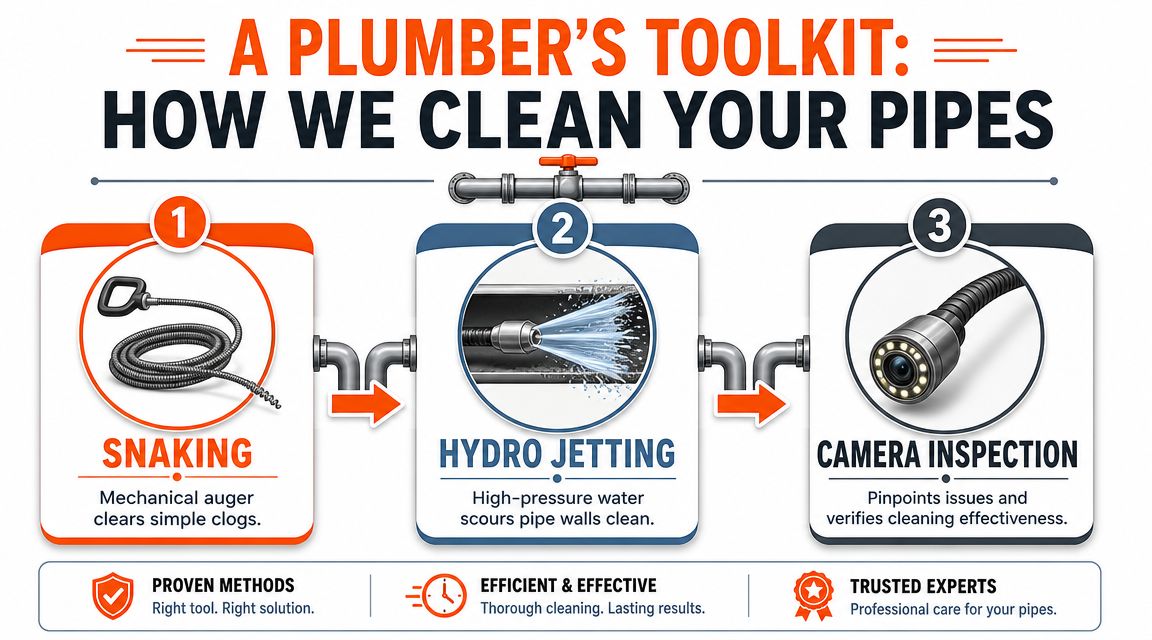
Snaking opens the path
A drain snake or auger is the boring tool, designed for its purpose and effective in use. It's designed to break through or pull apart a blockage so water can move again. For a localized clog, that can be enough.
Think of snaking like drilling a tunnel through packed dirt. It creates a passable route. It doesn't necessarily clean the entire pipe wall.
If you want a better feel for what this tool does and where homeowners tend to get into trouble with it, this guide on how to use an auger is useful background.
Hydro jetting cleans the pipe wall
Hydro jetting is closer to pressure washing the inside of the pipe. Instead of just punching a hole through the obstruction, it uses pressurized water to scour grease, scale, and debris from the inner surface. A Rotor-Rooter descaling guide notes that small-format jetters can deliver about 1,500 psi and that pressurized-water cleaning can be highly effective on stubborn deposits, but may not be appropriate for older or fragile pipes (pipe descaling process guidance).
That last part matters in Tampa Bay. Not every line should be blasted. Older cast iron, brittle joints, and some plastic or composite lines need pressure matched to the material.
For homeowners trying to compare service types before they book, this breakdown of hydro jetting and snaking costs is a helpful reference because it frames the pricing question around the actual method being used.
Camera inspection answers the real question
A camera inspection tells you whether you have buildup, roots, a belly in the line, offset joints, or a structural failure. It keeps everyone from guessing.
Through proper diagnosis, many homeowners save money in the long run. Cleaning a pipe with a hidden collapse can restore flow for a short time, but it won't fix the reason the clog formed. A camera lets the plumber see whether cleaning is the cure or just a temporary patch.
Here's the professional process in plain terms.
How these tools work together
A strong professional workflow is often:
- Inspect the symptoms and access points
- Use a snake to create a pilot opening through the blockage
- Follow with hydro jetting when wall buildup remains
- Confirm results and pipe condition
Drain industry guidance describes a common workflow where plumbers first use a drain snake to create a pilot path through grease or root intrusion, then use a high-pressure water jetter to scour the remaining debris from the pipe wall, reducing recurrence (common drain cleaning workflow).
Heatwave Air Conditioning, Plumbing, & Electric offers plumbing service in this space, but the key point for any homeowner is the process, not the logo on the truck. You want a plumber who can explain why they're choosing snake, jet, camera, or repair.
DIY Fixes vs Professional Plumber Pipe Cleaning
Homeowners should absolutely try simple, low-risk fixes first. The mistake is assuming every clog stays in that category.
A plunger, a hand-cleaned trap, or a basic hair removal tool can solve a minor stoppage near the fixture. Those are reasonable first steps. What usually fails is the jump from “minor” to “I rented a machine and pushed harder.”
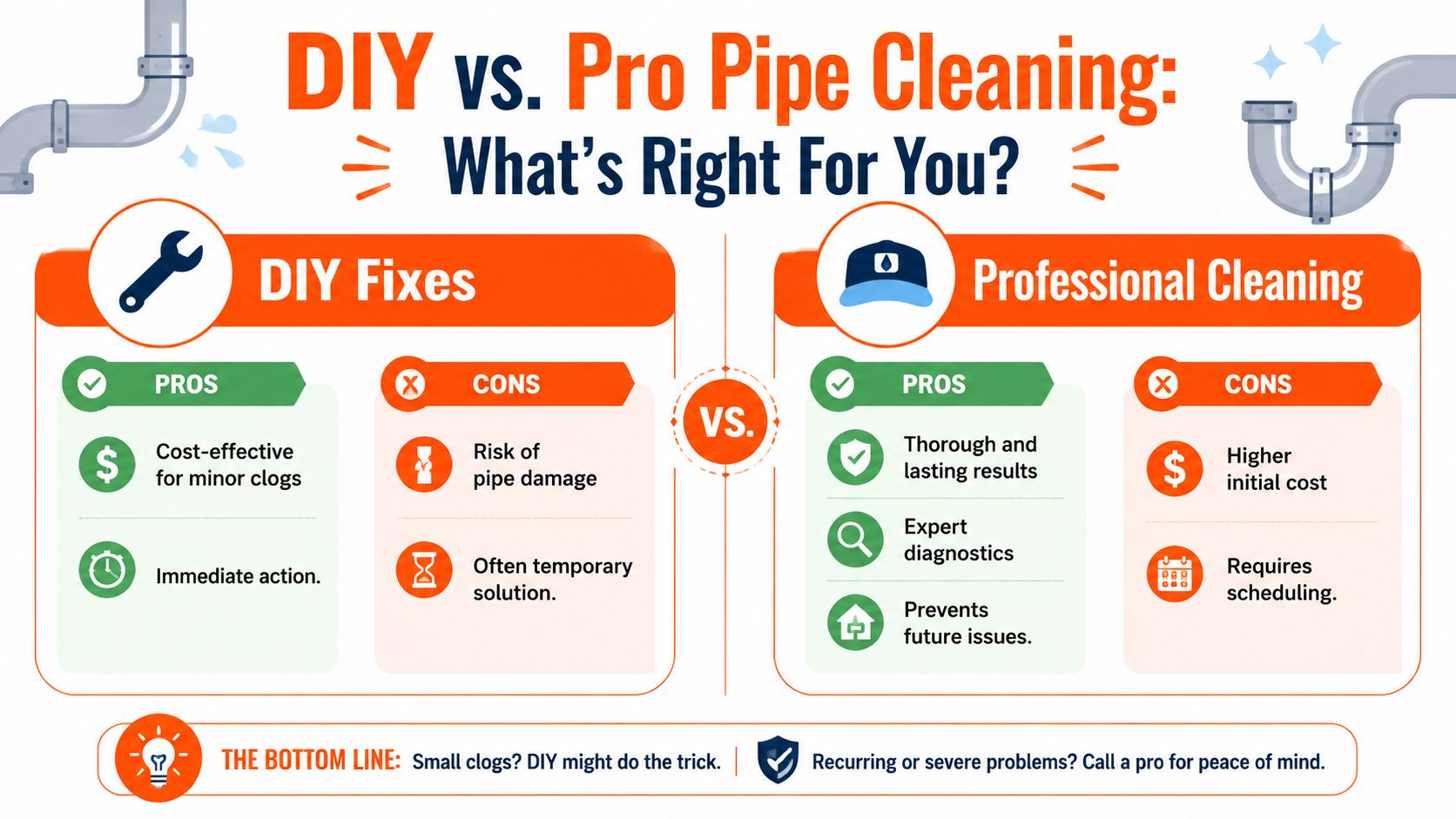
What DIY is good for
DIY works best when the clog is:
- Close to the drain opening: Hair at a tub drain or debris in a sink trap.
- Single-fixture only: One sink is slow, but the rest of the house is fine.
- New and isolated: It just started, and there's no history of repeat backups.
For those situations, gentle methods make sense. Pull the trap if you can do it safely. Use a plunger correctly. Flush with hot water where appropriate for grease-softened residue. Avoid escalating too quickly.
Where DIY starts to get expensive
Rental augers sound practical because the upfront cost feels lower than a service call. The trade-off is risk.
A homeowner video resource on drain machines points out a real problem here: homeowner-grade rentals may lack the power for serious clogs, while professional-grade augers can easily damage older pipes if used incorrectly (drain machine rental risks). That's exactly the kind of gamble that goes wrong in older Tampa Bay homes.
Chemical drain cleaners have their own downside. They may sit in the pipe, create heat, and complicate the next person's work without removing the actual obstruction. They also don't tell you anything about the condition of the line.
If you don't know whether the pipe is blocked, scaled, root-filled, or broken, adding force doesn't equal adding accuracy.
Side-by-side decision guide
| Approach | Best use | Main upside | Main limitation |
|---|---|---|---|
| Plunger | Minor fixture clog | Immediate and low risk | Won't solve deeper buildup |
| Hand trap cleaning | Sink stoppage near fixture | Direct and cheap | Limited to accessible sections |
| Rental auger | Straightforward drain line with low risk pipe condition | More reach than hand tools | Can damage older or fragile pipe |
| Professional snaking | Localized clog deeper in the system | Restores flow quickly | May not fully clean pipe walls |
| Professional jetting | Recurring buildup, grease, scale, root debris | Cleans the full interior surface | Must be matched to pipe condition |
| Camera inspection | Repeat problems or suspected damage | Shows what's actually wrong | Diagnostic step, not cleaning by itself |
A good rule for escalation
Call for professional plumber pipe cleaning when:
- More than one fixture is involved
- The same drain keeps clogging
- You suspect roots or main line trouble
- The home has older piping
- You're considering renting powered equipment because simpler methods failed
At that point, the value isn't brute force. It's using the least invasive method that solves the right problem.
Budgeting for Pipe Cleaning Services in Tampa Bay
Budgeting for pipe cleaning starts with one question: are you paying for a quick opening, a full cleaning, or an investigation into a bigger pipe problem?
That distinction matters in Tampa Bay homes. A simple sink or tub clog may only need a standard cable machine. A line with grease buildup, heavy scale, root intrusion, or repeated backups often needs more time, different equipment, and sometimes a camera to confirm whether cleaning will hold. Homeowners run into trouble when they compare a low quote for "drain clearing" against a higher quote that includes actual diagnosis.

What you are usually paying for
Pipe cleaning prices usually shift based on the method, the location of the clog, and whether the plumber has to prove why the line keeps failing.
A basic snaking job is often the lower-cost entry point because the goal is to restore flow. Jetting usually costs more because it cleans the pipe wall more thoroughly and takes more setup. Camera work adds to the bill, but in older Tampa Bay homes, that money can prevent the wrong fix. If a cast iron line is scaled shut or a sewer line has a belly or crack, repeated cleaning becomes a short-term expense instead of a solution.
That is the main budgeting mistake. Homeowners focus on the service call price and miss the condition of the pipe.
What tends to raise the bill
A quote usually climbs when the job includes:
- A harder blockage: grease-packed kitchen drains, sand and sludge, or root debris in exterior lines
- Difficult access: roof vent entry, long runs, crawlspaces, slab homes, or buried cleanouts
- Heavier cleaning: jetting or multiple passes instead of a single cable run
- Diagnostic work: camera inspection to confirm whether the line is dirty, damaged, or both
- Emergency timing: nights, weekends, and active backups that cannot wait
Florida conditions can play into this. Summer storms can expose weak sewer lines, and mature landscaping around older properties can turn a straightforward cleaning call into a root issue or repair discussion.
A practical way to budget
Set your budget in layers.
Plan for the first step, which is basic clearing if the problem appears isolated. Leave room for diagnostic work if the same line has clogged before. Keep a larger reserve if your home is older, you have recurring backups, or the plumber suspects cast iron deterioration, root entry, or a break in the line.
If you want a clearer baseline for a common service, this guide on how much to snake a drain helps explain what a basic drain-opening visit usually covers.
For broader context beyond drain work alone, this expert guide for plumbing costs can help homeowners understand how service pricing is commonly structured across plumbing jobs.
When cleaning stops being the budget answer
If you are paying for the same drain to be cleared every few months, the low quote is no longer the cheap option. At that point, ask a harder question: is the plumber pricing a cleaning, or are you slowly paying for a repair without getting one?
I tell homeowners to treat repeat service like patching the same roof leak over and over. It may buy time, but it rarely lowers total cost. When a camera shows pipe damage, offset joints, heavy corrosion, or root re-entry, budgeting should shift from cleaning to repair planning.
Choosing Your Tampa Bay Plumber with Confidence
Pipe cleaning is not a handyman side task. It's part of a licensed trade.
The U.S. Bureau of Labor Statistics says most states require plumbers to be licensed, the occupation employed 504,500 workers, the median annual wage was $62,970 in May 2024, and employment is projected to grow 4% from 2024 to 2034, with about 44,000 openings each year on average (BLS plumber occupation profile). For homeowners, that matters because plumber pipe cleaning sits inside a large, regulated service field with training, apprenticeship, and emergency-response expectations.
What to ask before you hire
Don't just ask, “How much to clear a drain?” Ask these instead:
- Are you licensed and insured? That protects you if the job uncovers a bigger problem.
- Do you offer camera inspection when needed? A company that can only snake may treat every problem like a clog.
- How do you decide between snaking, jetting, and repair? The answer should sound specific, not rehearsed.
- Have you worked on homes like mine? Older homes, mature landscaping, and long sewer runs change the job.
- Will I get a clear explanation of what you found? You want findings, not vague language.
Local experience matters
A Tampa Bay plumber should understand the practical differences between a newer subdivision home and an older property with aging lines and established trees. The right local pro won't overpromise. They'll tell you when cleaning should fix the issue and when the pattern points toward a defect.
A good plumber doesn't just clear the blockage. They explain why it formed and what keeps it from coming back.
How to vet the company before they arrive
Before booking, take a few minutes to read through a guide on how to find a good plumber. It helps homeowners separate a real diagnostic service company from a cheap, one-method-only callout.
The best hire is usually the plumber who asks the best questions before they touch the line.
Your Top Pipe Cleaning Questions Answered
How often should home pipes be cleaned
There is no single schedule that fits every Tampa Bay home. A newer house with normal use may go a long time without professional cleaning. An older home with cast iron, heavy kitchen grease, or a history of backups usually needs a more watchful approach.
A good rule is to base the timing on symptoms and history, not the calendar alone. If the kitchen sink slows down every few months, the tub gurgles after laundry, or the same bathroom keeps clogging, stop treating it like a one-off problem. That is usually the point where a professional cleaning and inspection make more sense than another bottle or hand auger.
Is hydro jetting safe for older residential pipes
Sometimes. Sometimes not.
Hydro jetting clears heavy buildup well, especially grease, sludge, and soft root intrusion. But older pipes are not all the same. A solid older line may handle jetting fine. A weakened line with cracks, bad joints, or flaking interior walls may not be a good candidate. In a lot of Tampa Bay homes, especially older properties, the right first step is seeing the inside of the pipe before choosing the cleaning method.
How do I know if I need cleaning or pipe repair
This is the decision that saves money.
If a drain was working fine and then suddenly stopped, cleaning is often the right first move. If the same line keeps giving trouble, or several fixtures are acting up together, the issue may be bigger than a simple blockage. Root intrusion, a separated joint, a belly in the line, or a broken section can all trap waste and keep recreating the clog.
A camera inspection is usually the fastest way to sort that out. AB May explains the role of camera inspection for clog vs repair decisions, and that lines up with what plumbers see in the field. Cleaning removes what is in the way. It does not fix pipe damage.
If the inspection shows an actual break or leak, homeowners often ask about coverage next. This guide to homeowner's insurance for busted pipes is a useful starting point.
If your drains keep slowing down, backing up, or repeating the same problem, get the line diagnosed before paying for the same cleaning again. Heatwave Air Conditioning, Plumbing, & Electric serves Tampa Bay and Southwest Florida with plumbing support that helps homeowners decide whether a line needs cleaning, camera inspection, or repair.