
The call usually comes in when the house has already crossed from uncomfortable to miserable. The thermostat is set low, the vents are pushing warm air, and every room feels sticky. In Florida, people often search “air conditioning repair vehicle” because they're thinking about a car problem. But when your home AC quits in the middle of a hot afternoon, the vehicle that matters most is the one pulling into your driveway with the tools, parts, and testing equipment to get your house livable again.
That service van is the difference between a technician who only confirms the problem and a technician who can solve it on the spot. A good one isn't just transportation. It's a rolling workshop built to diagnose electrical faults, airflow issues, drain problems, failed components, and refrigerant-related issues without wasting a day waiting on another trip.
That Familiar Florida Feeling Your AC Just Died
It usually starts the same way. The house feels a little off, then the temperature keeps climbing, and suddenly everyone notices at once. The kids are restless, the indoor air feels heavy, and you're standing under a vent trying to decide whether the system is running or just pretending to.
A lot of people land on this topic after searching for car AC help. That makes sense. Vehicle AC repair is common and can get expensive. Kelley Blue Book puts car AC repair between $384 and $445 on average, with AC recharge at $239 to $281 and compressor replacement at $1,546 to $1,705 in its car AC repair cost guide. In a car, that's a costly inconvenience. In a Florida home, a dead AC system is a same-day problem.
The real emergency isn't in the driveway
When a home system stops cooling, you're not just losing comfort. You're dealing with bedrooms that won't settle down at night, a kitchen that heats up fast, and indoor humidity that makes the whole house feel worse than the thermostat reading suggests. That's why the important “air conditioning repair vehicle” for a homeowner isn't the family SUV. It's the service van coming to the house.
In practice, the first question isn't always “How old is the unit?” It's often “Is the system completely dead, or is it running and not cooling?” Those are two very different calls, and the answer changes what the technician needs to test first.
A house without cooling in Florida stops feeling normal fast. Comfort becomes urgency in a matter of hours.
What homeowners need right away
Before a technician even opens a panel, homeowners usually want three things:
- A clear answer fast so they know whether it's a small electrical issue or a major mechanical failure.
- A realistic repair path instead of vague guesses.
- A chance at same-visit restoration if the problem is a common part failure.
If your system won't start at all, this guide on why an AC is not turning on gives a useful homeowner-level overview of what may be happening before the truck even arrives.
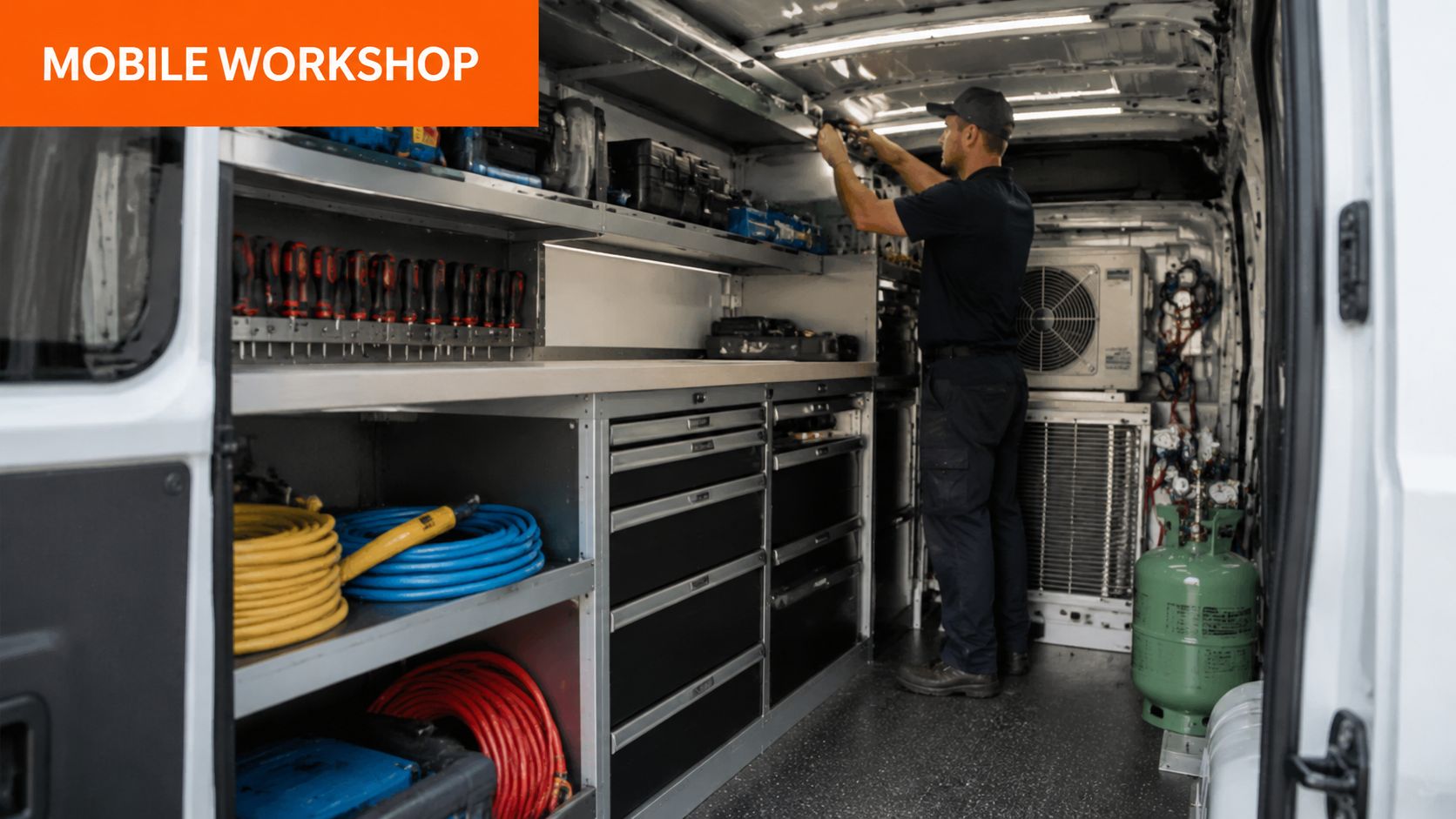
The Modern AC Repair Vehicle A Workshop on Wheels
A professional air conditioning repair vehicle should look less like a general contractor van and more like a compact mechanical shop. Every shelf, bin, and drawer has a job. The layout matters because speed matters. A technician loses time every time they dig for a meter lead, a contactor, or the right capacitor.
Why the van matters as much as the technician
Homeowners tend to judge service by the person at the door, and that's fair. But the vehicle behind that person tells you a lot about the company's standards. A well-set-up van supports better diagnosis, cleaner repairs, and fewer return trips.
That doesn't happen by accident. Outfitting HVAC service vehicles takes planning, training, inventory discipline, and risk management. If you want a practical look at the business side of running properly equipped trucks, the Coverage Axis HVAC insurance guide gives useful context on why professional contractors treat their fleet and equipment as core operating assets.
What a rolling workshop is built to do
Its purpose is simple. The truck has to help the technician diagnose accurately and repair efficiently in one stop whenever the fault falls into a common field-service category.
That usually means carrying what's needed for:
| Function | What it supports in the field |
|---|---|
| Electrical testing | Finding failed capacitors, bad contactors, voltage issues, control faults |
| Airflow diagnosis | Checking supply and return temperatures, blower operation, filter restrictions |
| Refrigerant work | Measuring pressures, locating leaks, recovering and charging properly |
| Mechanical repair | Replacing motors, relays, fittings, drain parts, and common wear items |
A homeowner doesn't need to memorize every component. But it helps to understand the major pieces of a central system, especially when a technician explains a failed part in plain English. This breakdown of central AC system components makes those repair conversations easier to follow.
Practical rule: A diagnosis-only van creates delays. A real service van carries enough inventory to turn answers into action.
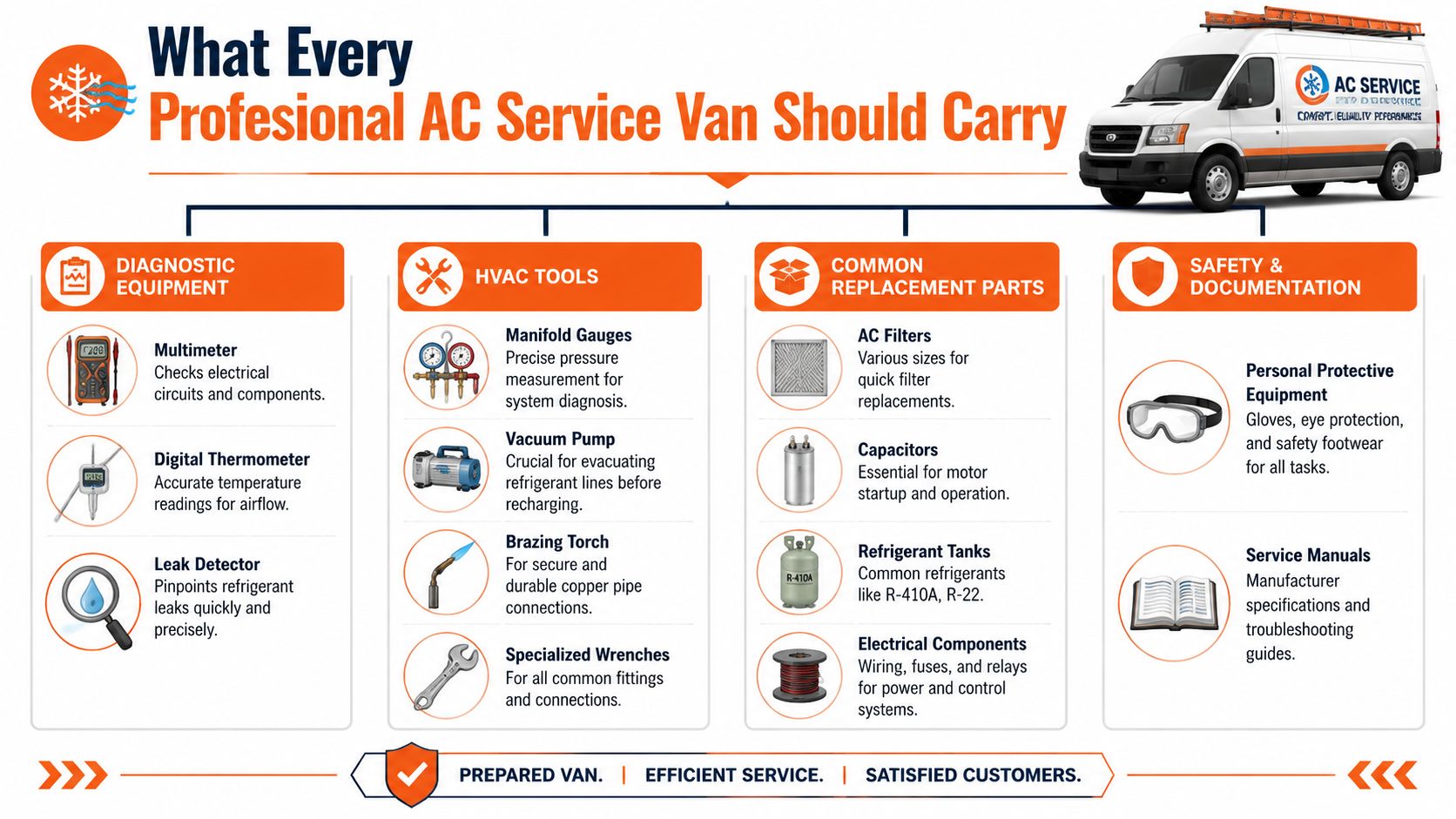
What Every Professional AC Service Van Should Carry
When I look inside a service vehicle, I don't start by asking how new it is. I look for whether it's organized around actual field repairs. Good vans carry tools for diagnosis first, parts second, and paperwork and safety gear close enough that nothing gets skipped.
Diagnostic gear comes first
The fastest way to waste a homeowner's time is to arrive with only hand tools and opinions. A proper air conditioning repair vehicle needs instruments that can prove what's happening inside the system.
That usually includes:
- A multimeter for checking voltage, continuity, amperage, and failed electrical components.
- A clamp meter to verify motor draw and compare it against expected operation.
- Digital thermometers for return and supply air readings.
- Manifold gauges or digital probes for refrigerant pressure testing.
- Leak detection equipment for tracking down refrigerant loss instead of guessing.
- A combustion of basic and specialized hand tools, including nut drivers, service wrenches, insulated screwdrivers, tubing cutters, and core tools.
These aren't optional. They're what separate a real diagnosis from part swapping.
Stock parts decide whether the repair happens today
Most no-cooling calls don't need a warehouse shipment. They need the right common part on the truck. The best vans usually carry a broad mix of high-failure items that fit a wide range of residential systems.
Common examples include:
- Capacitors in multiple ratings
- Contactors and relays
- Fuses and low-voltage electrical supplies
- Condensate drain components
- Universal motors and rescue-style replacements
- Wire, connectors, and terminals
- Filters in common sizes
- Thermostats and control accessories
A van that carries only one or two versions of these parts isn't fully stocked. It's partially prepared.
Refrigerant tools have become more specialized
Refrigerant work has changed. Technicians need equipment matched to the systems they service, and that requirement has become more important as refrigerants and regulations shift. Programs like the California Cool Air Rebate initiative highlight the push to repair leaks in older R-134a vehicle systems instead of topping them off, and the broader lesson applies to field service in general. Technicians must carry specialized equipment for different refrigerants due to regulatory changes.
That matters to homeowners because it affects what a qualified technician has in the truck and how carefully the repair is handled. The old “just add refrigerant” mindset doesn't hold up in professional service.
For a related look at how air conditioning rules affect working vehicles, the Fleet air conditioning compliance overview is a useful read. Different market, same takeaway. Compliance changes what equipment and procedures professionals need.
If you want a homeowner-friendly overview of the field gear involved, this page on air conditioning repair tools is a good reference.
The Real Advantages of On-Site AC Repair
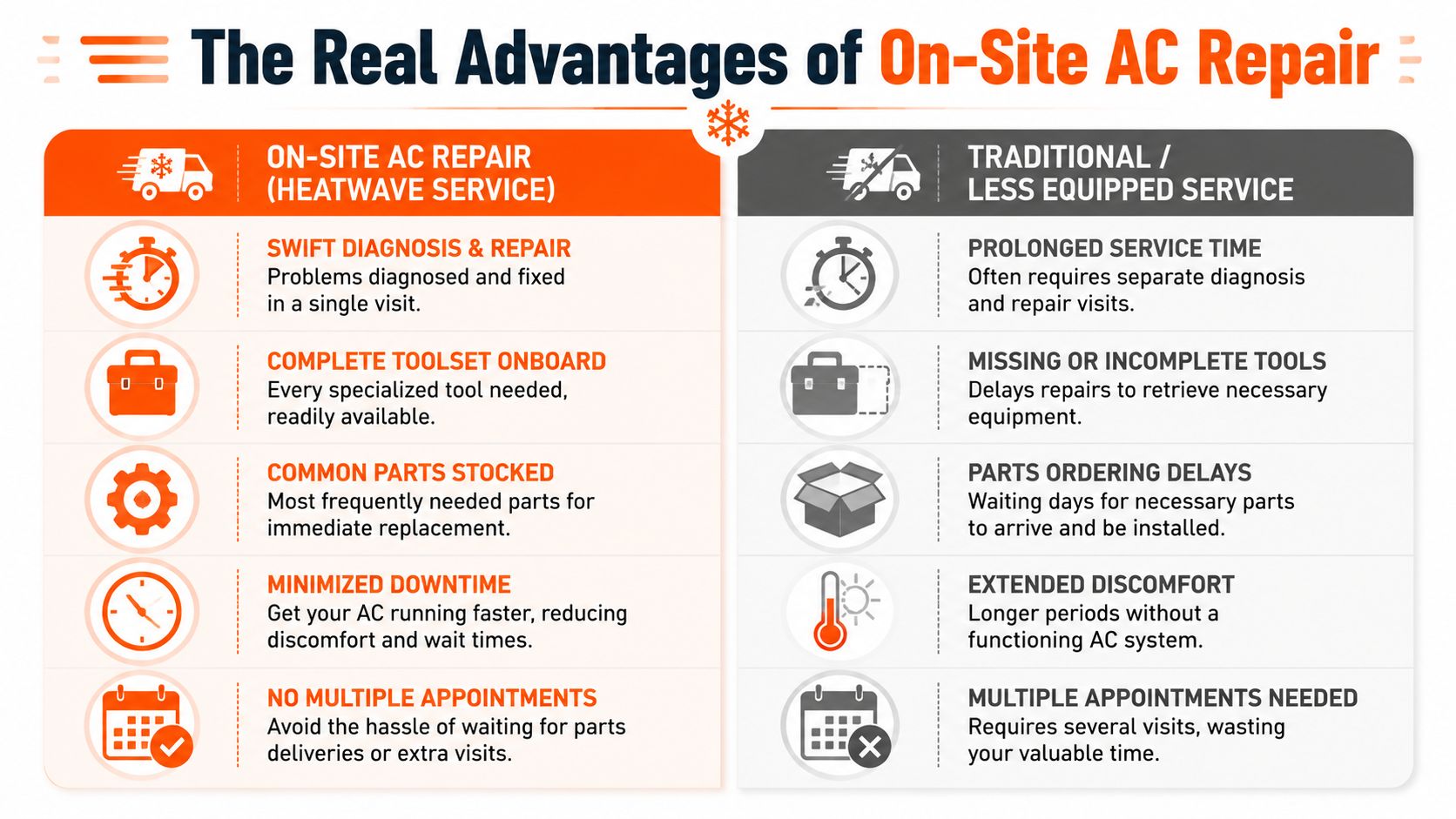
The biggest benefit of a fully stocked service vehicle is simple. It shortens the distance between diagnosis and relief. When the truck already has the meter, the gauges, the drain tools, the capacitor, the contactor, and the thermostat wire, the repair moves forward immediately.
What works better on site
A lot of common residential AC failures are field-fixable if the technician arrives prepared. That includes many electrical faults, drainage issues, airflow-related corrections, and a wide range of straightforward component replacements. The homeowner doesn't care whether the failed part lives in the condenser cabinet, air handler, or thermostat circuit. They care whether the system starts cooling again before bedtime.
Here's the practical difference:
- Prepared service means fewer delays. The truck already has common repair items onboard.
- The diagnosis stays accurate. The technician can test and confirm instead of guessing and leaving.
- Your time is protected. You're less likely to lose another afternoon waiting on a second appointment.
What doesn't work
What frustrates homeowners most isn't always the repair itself. It's the half-visit. That's the appointment where someone confirms the unit isn't cooling, mentions a likely culprit, and then says they need to come back later with parts or tools that should've been there in the first place.
That approach can still happen when a failure is unusual or the part is brand-specific. But it shouldn't be the default on everyday no-cooling calls.
A good truck setup doesn't guarantee every repair will finish in one visit. It does remove a lot of avoidable reasons for a second one.
Why this matters more in Florida
In milder climates, a delay is irritating. In Florida, a delay changes how the house functions. People start moving fans room to room, closing blinds, adjusting sleep plans, and worrying whether the system will hold through the night if it starts limping instead of cooling.
On-site repair helps because it keeps the service call moving. The homeowner gets answers, options, and often a completed repair in the same visit instead of a long pause between each step.
What to Expect During Your AC Service Visit
Homeowners are usually calmer when they know what's about to happen. Good service follows a clear rhythm. The technician arrives, asks what the system has been doing, checks the obvious basics, then starts a structured diagnosis instead of jumping straight to the refrigerant side or replacing parts on instinct.

The visit usually starts with symptoms, not tools
The first few minutes matter. A technician should ask what you noticed, when the problem started, whether the thermostat is responding, whether the outdoor unit is running, and whether there were warning signs such as weak airflow, unusual sounds, water around the system, or intermittent cooling.
After that, the inspection begins with both the indoor and outdoor sides. That's important because a proper diagnosis is thorough. Established trade standards require attention to more than refrigerant level alone. The California Automotive Repair accepted trade standards describe inspection points that include hoses, connections, compressor and clutch condition, electrical connections, leak checking, blower operation, and air control functions. The principle carries over cleanly to home HVAC work. Multiple problems can create the same symptom.
What a real diagnosis looks like
A solid service call usually includes some combination of the following:
- Visual inspection of the condenser, air handler, disconnect, filter, drain line, wiring, and thermostat behavior.
- Electrical testing at major components and controls.
- Airflow checks to see whether the system can move enough air across the coil.
- Temperature readings that show whether cooling is happening and where it may be falling off.
- Refrigerant-side evaluation only after the rest of the system supports doing it correctly.
The key is sequence. If airflow is poor or a blower fault exists, pressure readings alone can mislead the diagnosis.
How the repair decision gets explained
Once the fault is confirmed, the technician should explain it plainly. Not in trade jargon. Not in a rush. A homeowner needs to know what failed, what the repair involves, whether the part is on the truck, and whether there are signs of larger system wear.
A good visit also includes a final check after the work is done. The system should be run, measured, and verified before the job is closed out. If you want to understand the preventive side of that process, this guide on what an air conditioner tune-up is helps show why maintenance often catches the same issues before they become emergency calls.
If a technician only glances at the outdoor unit and says you need refrigerant, that's not a complete diagnostic process.
Pricing Diagnostics and Warranties in Tampa Bay
The number most homeowners want first is the total. That's reasonable. But before you can judge the repair cost, you need to know what the diagnostic process includes and whether the company stands behind the result.
For major failures, the harder question isn't just price. It's whether the repair still makes sense.
What to ask before approving work
When you're comparing HVAC service in Tampa Bay or Southwest Florida, ask these questions up front:
- What does the diagnostic fee include and does it cover a full system evaluation or only a basic visit?
- Will I get a clear repair price before work starts so there are no surprise add-ons?
- Is there a warranty on parts, labor, or both?
- If this repair uncovers deeper wear, how will that be explained?
Those questions protect you better than chasing the lowest advertised number.
Repair versus replacement is the real money decision
Expert field judgment is essential. Sometimes the right move is an immediate repair. Sometimes the system is sending a different message. Maybe one failure is obvious, but several smaller issues are sitting behind it. Maybe the cooling problem is only the latest symptom in a pattern of electrical, airflow, drainage, and performance trouble.
That's why the most useful service visit is the one that helps you decide whether to keep repairing or stop investing in a system that's wearing out. As noted in Thruway Auto Glass's discussion of repair decisions, the key question becomes repair versus replacement, especially when multiple smaller issues point to deeper system wear.
A different industry offers a good comparison point. This AC repair guide for Haltom City drivers shows how vehicle owners weigh a straightforward fix against a more expensive system problem. Home HVAC decisions follow the same logic. The cheapest immediate option isn't always the best long-term one.
Local homeowners need clarity, not guesswork
In this region, you don't want vague language on cost, scope, or warranty. You want a diagnosis you can trust, a repair quote you can understand, and honest advice if replacement would save you from repeated breakdowns.
For homeowners trying to benchmark what different kinds of HVAC work can involve, this page on the average cost of HVAC repair is a useful starting point. The exact number depends on the fault, but the better question is always whether the proposed repair solves the actual problem and makes sense for the condition of the system.
When your home goes hot in the Florida heat, you need more than a technician with a flashlight. You need a real rolling workshop and a team that knows how to use it. Heatwave Air Conditioning, Plumbing, & Electric serves homeowners across Tampa Bay and Southwest Florida with experienced technicians, fully equipped service vehicles, and clear guidance on repairs, diagnostics, and replacement options when a failing system no longer makes financial sense.